×
Request Free Sample ×

Kindly complete the form below to receive a free sample of this Report

* Please use a valid business email

Leading companies partner with us for data-driven Insights

clients tt-cursor
Hero Background

United States Machine Tools Market

ID: MRFR/Equip/19887-HCR
128 Pages
Harshita Gorade
February 2026

United States Machine Tools Market Research Report Information by Type (Metalworking Machines, Parts and Accessories, Installation, Repair, and Maintenance), by End User (Automotive Fabrication and Industrial Machinery Manufacturing, Marine, Aerospace & Defense, Precision Engineering, and Other End Users), – United States Market Forecast Till 2035

Share:
Download PDF ×

We do not share your information with anyone. However, we may send you emails based on your report interest from time to time. You may contact us at any time to opt-out.

US Machine Tools Market Infographic
Purchase Options

United States Machine Tools Market Summary

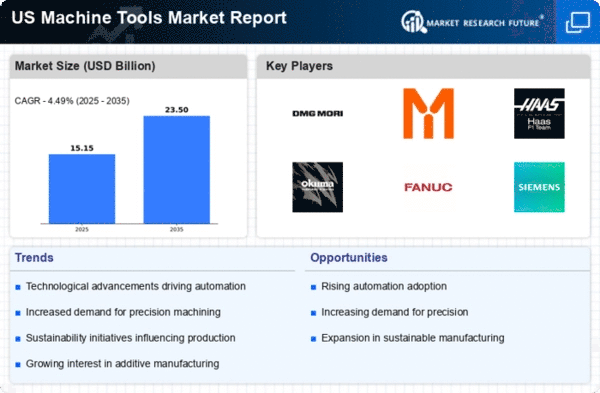
As per Market Research Future analysis, the US Machine Tools Market Size was estimated at 14.5 USD Billion in 2024. The US machine tools market is projected to grow from 15.15 USD Billion in 2025 to 23.5 USD Billion by 2035, exhibiting a compound annual growth rate (CAGR) of 4.4% during the forecast period 2025 - 2035

Key Market Trends & Highlights

The US machine tools market is experiencing a transformative shift driven by automation and sustainability.

  • The market is witnessing a rise in automation, enhancing efficiency and productivity across various sectors.
  • Sustainability initiatives are becoming increasingly prominent, influencing manufacturing practices and material choices.
  • Customization and precision engineering are gaining traction, particularly in the aerospace and automotive segments.
  • Technological advancements in manufacturing and growing demand from the aerospace sector are key drivers propelling market growth.

Market Size & Forecast

2024 Market Size 14.5 (USD Billion)
2035 Market Size 23.5 (USD Billion)
CAGR (2025 - 2035) 4.49%

Major Players

DMG Mori (DE), Mazak (JP), Haas Automation (US), Okuma (JP), Fanuc (JP), Siemens (DE), Emag (DE), Kia (KR), Toshiba Machine (JP)

Our Impact
Enabled $4.3B Revenue Impact for Fortune 500 and Leading Multinationals
Partnering with 2000+ Global Organizations Each Year
30K+ Citations by Top-Tier Firms in the Industry

United States Machine Tools Market Trends

The machine tools market is currently experiencing a dynamic phase. This phase is characterized by technological advancements and evolving consumer demands. Automation and digitalization are at the forefront, as manufacturers increasingly adopt smart technologies to enhance productivity and efficiency. This shift towards Industry 4.0 is reshaping production processes, enabling real-time monitoring and data analytics, which in turn facilitates better decision-making. Furthermore, sustainability is becoming a critical focus, with companies striving to reduce their environmental footprint through energy-efficient machinery and sustainable practices. As a result, the landscape of the machine tools market is transforming, presenting both challenges and opportunities for stakeholders. In addition, the demand for precision and customization is rising, driven by industries such as aerospace, automotive, and medical devices. These sectors require highly specialized tools that can meet stringent quality standards. Consequently, manufacturers are investing in research and development to innovate and create advanced solutions tailored to specific applications. The interplay of these factors suggests that the machine tools market is poised for continued growth, with a strong emphasis on technological integration and sustainability in the coming years.

Rise of Automation

The machine tools market is witnessing a significant shift towards automation. Manufacturers are increasingly integrating automated systems to enhance production efficiency and reduce labor costs. This trend is driven by the need for higher precision and faster turnaround times, which automated solutions can provide. As technology advances, the adoption of robotics and AI in machining processes is likely to expand, further streamlining operations.

Focus on Sustainability

Sustainability is becoming a pivotal concern within the machine tools market. Companies are actively seeking to minimize their environmental impact by investing in energy-efficient machinery and sustainable manufacturing practices. This trend reflects a broader societal shift towards eco-friendly solutions, as stakeholders recognize the importance of reducing waste and conserving resources in production.

Customization and Precision Engineering

The demand for customized solutions is on the rise in the machine tools market. Industries such as aerospace and medical devices require tools that meet specific and stringent quality standards. As a result, manufacturers are focusing on precision engineering and developing specialized tools that cater to unique applications. This trend indicates a growing need for innovation and adaptability in the market.

United States Machine Tools Market Drivers

Rising Focus on Workforce Skill Development

The machine tools market is also being shaped by the rising focus on workforce skill development. As technology evolves, there is an increasing need for skilled labor capable of operating advanced machinery and understanding complex manufacturing processes. In 2025, the demand for skilled workers in the machine tools market is projected to grow by 15%, driven by the need for expertise in operating CNC machines and other sophisticated equipment. Educational institutions and training programs are responding to this demand by offering specialized courses aimed at equipping the workforce with necessary skills. This emphasis on skill development not only enhances productivity but also ensures that manufacturers can effectively leverage new technologies. Consequently, the machine tools market is likely to benefit from a more competent workforce, fostering innovation and efficiency in production.

Shift Towards Smart Manufacturing Solutions

The machine tools market is increasingly influenced by the shift towards smart manufacturing solutions. As industries embrace the Internet of Things (IoT) and Industry 4.0 principles, there is a growing need for machine tools that can integrate seamlessly with digital technologies. This trend is expected to enhance operational efficiency and reduce downtime, as real-time data analytics enable predictive maintenance and process optimization. By 2025, the market for smart machine tools is anticipated to grow by approximately 25%, reflecting the industry's commitment to innovation. Manufacturers are likely to invest in advanced machinery equipped with sensors and connectivity features, which will not only improve productivity but also facilitate better decision-making processes. This shift towards smart manufacturing solutions indicates a transformative phase for the machine tools market.

Technological Advancements in Manufacturing

The machine tools market is experiencing a notable transformation due to rapid technological advancements. Innovations such as computer numerical control (CNC) and additive manufacturing are enhancing precision and efficiency in production processes. In 2025, the market is projected to reach approximately $8 billion, driven by the increasing demand for high-quality and customized products. These advancements not only improve productivity but also reduce waste, aligning with the industry's shift towards lean manufacturing practices. As manufacturers adopt these technologies, the machine tools market is likely to witness a surge in demand for sophisticated machinery that can accommodate complex designs and high-volume production. This trend indicates a robust growth trajectory for the machine tools market, as companies strive to remain competitive in an evolving landscape.

Increased Investment in Infrastructure Development

Infrastructure development in the United States is poised to significantly impact the machine tools market. With the government prioritizing investments in transportation, energy, and public works, the demand for machine tools is expected to rise. In 2025, infrastructure spending is projected to exceed $1 trillion, creating a substantial need for machinery capable of producing components for construction and maintenance projects. This influx of investment is likely to stimulate growth in the machine tools market, as construction companies require reliable and efficient equipment to meet project deadlines. Furthermore, the emphasis on modernizing existing infrastructure will drive the need for advanced machine tools that can handle diverse materials and complex designs, thereby enhancing the overall market potential.

Growing Demand from Aerospace and Automotive Sectors

The aerospace and automotive sectors are significant contributors to the machine tools market, driving demand for advanced machining solutions. In 2025, these industries are expected to account for over 40% of the total market share, reflecting their reliance on precision-engineered components. The aerospace sector, in particular, is witnessing a surge in production rates, necessitating the use of high-performance machine tools to meet stringent quality standards. Similarly, the automotive industry is increasingly adopting automation and advanced machining techniques to enhance efficiency and reduce production costs. This growing demand from key sectors suggests a favorable outlook for the machine tools market, as manufacturers seek to invest in cutting-edge technologies to fulfill their production needs.


Market Segment Insights

By Product Type: Milling Machines (Largest) vs. Grinding Machines (Fastest-Growing)

In the US machine tools market, the distribution of market share among product types shows that milling machines dominate with the largest portion, followed closely by drilling and turning machines. Grinding machines, while having a smaller share, are gaining traction thanks to technological advancements and increased demand for precision tooling. Electrical discharge machines, although niche, are also carving out their space in specialized applications. Growth trends in this segment are driven by several factors including automation and the rising need for efficiency in manufacturing processes. Milling and turning machines are bolstered by their applications in sectors like automotive and aerospace, while grinding machines are becoming crucial in high-precision manufacturing. The need for enhanced productivity and competitive manufacturing is propelling the development of innovative technologies in these categories.

Milling Machines (Dominant) vs. Grinding Machines (Emerging)

Milling machines are characterized by their versatility and efficiency, making them the dominant force in the market. They are widely used for various materials and have applications ranging from construction to intricate component manufacturing. Their ability to produce high-precision parts gives them a competitive advantage. Conversely, grinding machines are emerging rapidly due to advancements in technology that enhance their precision and efficiency. With a growing focus on high-quality finishes and tight tolerances in manufacturing, the demand for grinding machines is expected to surge, catering to industries that require meticulous workmanship.

By Automation: CNC Machine Tools (Largest) vs. Conventional Machine Tools (Fastest-Growing)

In the US machine tools market, CNC machine tools hold the largest market share, driving significant engagement among manufacturers seeking precision and efficiency. This segment is adopted widely across various industries due to its ability to reduce operational costs and enhance production rates. On the other hand, conventional machine tools have been experiencing a surge in interest, particularly among small to medium-sized enterprises (SMEs) that prioritize affordability and straightforward operation. The growth trajectory for CNC machine tools is largely supported by advancements in technology, which facilitate better control and automation in manufacturing processes. Conversely, conventional machine tools are seeing renewed interest as modernized versions that integrate basic automation features are developed. This trend indicates a hybrid approach to machine tool adoption in the market, appealing to diverse buyer preferences and driving overall market vitality.

CNC Machine Tools (Dominant) vs. Conventional Machine Tools (Emerging)

CNC machine tools are characterized by their advanced programming and automation capabilities, making them the dominant choice for precision manufacturing in high-volume production. Their widespread adoption by various industries, such as automotive, aerospace, and electronics, showcases their ability to meet complex manufacturing demands efficiently. In contrast, conventional machine tools are emerging as a viable alternative, especially within the SME segment, due to their cost-effectiveness and user-friendly nature. These tools are being modernized to include basic automation, making them attractive for businesses that seek simplicity without compromising on quality or performance. This dual focus on automation appealing to both high-tech and traditional manufacturing sectors enriches the competitiveness in the US machine tools market.

By Sales Channel: Dealers and Distributors (Largest) vs. Direct Sales (Fastest-Growing)

In the US machine tools market, the distribution of sales channels reveals that Dealers and Distributors hold the largest share, dominating the segment due to their established networks and customer relationships. Events and Exhibitions, while significant, represent a smaller portion of market activity. This distribution highlights the traditional reliance on interpersonal connections and the critical role of these channels in driving sales and customer engagement. Growth trends indicate that Direct Sales are emerging as the fastest-growing segment, driven by the increasing digitalization of sales processes and direct engagement with end-users through online platforms. Companies are shifting towards a direct sales approach to enhance customer experience and streamline their sales processes, a strategy that has become more prominent, particularly following the pandemic as businesses adapt to new market demands.

Dealers and Distributors (Dominant) vs. Direct Sales (Emerging)

Dealers and Distributors in the US machine tools market are characterized by their vast networks and extensive knowledge of the market, allowing them to provide tailored solutions to a wide range of customers. They play a crucial role in the distribution of machine tools, fostering relationships that promote brand loyalty and repeat business. Despite the rise of digital sales channels, these distributors remain pivotal due to their ability to offer local support and expertise. In contrast, Direct Sales are gaining traction as an emerging channel, appealing to manufacturers seeking to establish direct relationships with customers. This approach allows for better control over pricing and customer engagement, offering personalized solutions and immediate feedback, which are essential in a competitive landscape.

By End-User Industry: Aerospace (Largest) vs. Medical (Fastest-Growing)

In the US machine tools market, the end-user industry segment is dominated by the aerospace sector, holding the largest market share. This is attributed to the continued demand for advanced aircraft manufacturing and maintenance, contributing significantly to the overall industry. Following closely behind are medical and automotive sectors, which also represent substantial portions of the market with their intricate machining requirements and innovative manufacturing processes. The growth trends in the US machine tools market are fueled by technological advancements and increasing automation within end-user industries. The aerospace sector continues to invest in high-precision tools. Meanwhile, the medical industry is experiencing rapid expansion driven by technological innovations in equipment manufacturing. Furthermore, the semiconductor sector is witnessing accelerated growth due to rising demands for electronic devices, showcasing diverse opportunities within the market.

Aerospace: Dominant vs. Medical: Emerging

The aerospace sector stands out as a dominant force in the US machine tools market, driven by its rigorous demands for precision and quality in manufacturing components for aircraft and defense applications. This segment benefits from substantial investment in R&D and the adoption of advanced machining techniques. Conversely, the medical industry represents an emerging market segment characterized by rapid growth fueled by innovation in medical devices and equipment manufacturing. The rise in healthcare demand and continuous advancements in surgical technologies are propelling the need for sophisticated machine tools. Both these segments exhibit distinct characteristics, with aerospace focusing on long-term projects and regulatory compliance, while medical emphasizes agility and adaptability to market shifts.

Get more detailed insights about United States Machine Tools Market

Regional Insights

North America : Leading Innovation and Production

The North American machine tools market is primarily driven by technological advancements and increasing demand for precision manufacturing. The United States holds the largest market share at approximately 70%, followed by Canada at around 15%. Regulatory support for advanced manufacturing technologies and investments in automation are key growth catalysts. The market is also influenced by the resurgence of domestic manufacturing and reshoring initiatives, which are expected to further boost demand. The competitive landscape in North America is characterized by the presence of major players such as Haas Automation and Hurco Companies. These companies are focusing on innovation and expanding their product offerings to meet the evolving needs of various industries, including aerospace, automotive, and medical devices. The market is also witnessing increased collaboration between manufacturers and technology providers to enhance productivity and efficiency.

Europe : Diverse Market with Strong Players

Europe's machine tools market is experiencing steady growth, driven by the demand for high-precision manufacturing and automation solutions. Germany is the largest market, accounting for approximately 40% of the region's share, followed by Italy at around 20%. The European Union's regulations promoting sustainable manufacturing practices and innovation are significant growth drivers. Additionally, investments in Industry 4.0 technologies are reshaping the landscape, enhancing productivity and competitiveness. Leading countries in Europe include Germany, Italy, and France, with a robust presence of key players like DMG Mori and Mazak. The competitive environment is marked by a focus on R&D and technological advancements, enabling manufacturers to offer cutting-edge solutions. The market is also characterized by strategic partnerships and collaborations aimed at enhancing product offerings and expanding market reach. "The European machine tool industry is committed to innovation and sustainability, driving growth in the sector."

Asia-Pacific : Emerging Markets and Growth Potential

The Asia-Pacific machine tools market is witnessing rapid growth, fueled by industrialization and increasing demand for automation. China is the largest market in the region, holding approximately 50% of the market share, followed by Japan at around 25%. Government initiatives promoting advanced manufacturing and investments in infrastructure are significant growth drivers. The region's focus on enhancing production capabilities and efficiency is expected to further accelerate market expansion. Key players in the Asia-Pacific region include Okuma, Fanuc, and Mazak, with a strong emphasis on innovation and technology. The competitive landscape is characterized by a mix of established manufacturers and emerging players, all vying for market share. The region is also seeing increased collaboration between companies and research institutions to foster innovation and meet the growing demands of various industries, including automotive and electronics.

Middle East and Africa : Untapped Potential and Growth

The Middle East and Africa machine tools market is in a nascent stage but shows significant growth potential driven by industrialization and infrastructure development. The United Arab Emirates and South Africa are the leading markets, collectively holding around 30% of the region's share. Government initiatives aimed at diversifying economies and promoting manufacturing are key growth catalysts. The region's focus on enhancing local production capabilities is expected to drive demand for machine tools in the coming years. The competitive landscape is characterized by a mix of local and international players, with companies like Kia Motors and Toshiba Machine establishing a presence. The market is witnessing increased investments in technology and training to enhance workforce skills. As the region continues to develop its manufacturing sector, the demand for advanced machine tools is anticipated to rise significantly, creating opportunities for growth and investment.

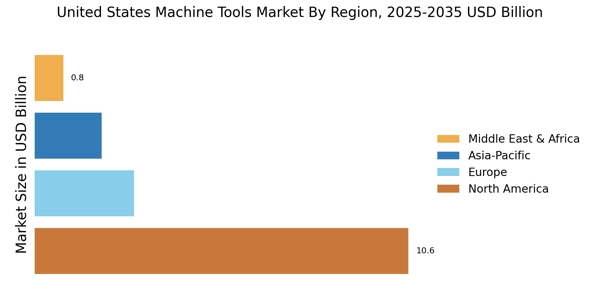
United States Machine Tools Market Regional Image

Key Players and Competitive Insights

The machine tools market is currently characterized by a dynamic competitive landscape, driven by technological advancements and increasing demand for precision manufacturing. Key players such as DMG Mori (Germany), Mazak (Japan), and Haas Automation (US) are at the forefront, each adopting distinct strategies to enhance their market positioning. DMG Mori (Germany) emphasizes innovation through its commitment to Industry 4.0, integrating smart manufacturing solutions into its product offerings. Meanwhile, Mazak (Japan) focuses on expanding its global footprint, particularly in emerging markets, while also investing heavily in R&D to develop advanced machining technologies. Haas Automation (US) leverages its strong domestic presence and competitive pricing strategy to cater to a diverse customer base, thereby shaping the competitive environment through a blend of quality and affordability.
In terms of business tactics, companies are increasingly localizing manufacturing to reduce lead times and enhance supply chain efficiency. The market structure appears moderately fragmented, with a mix of established players and smaller firms vying for market share. This fragmentation allows for a variety of competitive strategies, as companies seek to differentiate themselves through innovation and customer service.
In October 2025, DMG Mori (Germany) announced the launch of a new line of hybrid machines that combine additive and subtractive manufacturing capabilities. This strategic move is significant as it positions the company to meet the growing demand for versatile manufacturing solutions, potentially attracting a broader customer base looking for efficiency and flexibility in production processes.
In September 2025, Mazak (Japan) unveiled its latest multi-tasking machine, which incorporates AI-driven features for enhanced operational efficiency. This development underscores the company's commitment to integrating cutting-edge technology into its offerings, likely providing a competitive edge in an increasingly tech-driven market.
In August 2025, Haas Automation (US) expanded its service network by establishing new support centers across the Midwest. This expansion is crucial as it enhances customer accessibility to technical support and maintenance services, thereby reinforcing the company's reputation for reliability and customer service in a competitive landscape.
As of November 2025, current trends in the machine tools market are heavily influenced by digitalization, sustainability, and the integration of AI technologies. Strategic alliances among key players are becoming increasingly common, facilitating knowledge sharing and resource optimization. Looking ahead, competitive differentiation is expected to evolve, with a pronounced shift from price-based competition to a focus on innovation, technological advancement, and supply chain reliability. Companies that can effectively leverage these trends are likely to secure a more robust market position.

Key Companies in the United States Machine Tools Market include

Industry Developments

July 2022: Peterson Tool Company, Inc. ("PTC"), a prominent provider of machine-specific custom insert tooling solutions, had its assets acquired by Sandvik, as previously announced. Custom carbide form inserts are a component of the product line and are primarily utilized for high-production turning and grooving in the automotive and general engineering industries. The entity under consideration shall be denoted as Walter's GWS Tool division, an operation falling under the purview of Sandvik Manufacturing and Machining Solutions.

Future Outlook

United States Machine Tools Market Future Outlook

The machine tools market is projected to grow at a 4.49% CAGR from 2025 to 2035, driven by technological advancements, increased automation, and rising demand for precision manufacturing.

New opportunities lie in:

  • Investment in AI-driven predictive maintenance solutions.
  • Development of eco-friendly machining processes and materials.
  • Expansion into emerging markets with tailored product offerings.

By 2035, the machine tools market is expected to achieve robust growth and enhanced competitive positioning.

Market Segmentation

US Machine Tools Market Type Outlook

  • Metalworking Machines
  • Parts and Accessories
  • Installation
  • Repair
  • Maintenance

US Machine Tools Market End User Outlook

  • Automotive
  • Fabrication and Industrial Machinery Manufacturing
  • Marine
  • Aerospace & Defense
  • Precision Engineering
  • Other End Users

Report Scope

MARKET SIZE 2024 14.5(USD Billion)
MARKET SIZE 2025 15.15(USD Billion)
MARKET SIZE 2035 23.5(USD Billion)
COMPOUND ANNUAL GROWTH RATE (CAGR) 4.49% (2025 - 2035)
REPORT COVERAGE Revenue Forecast, Competitive Landscape, Growth Factors, and Trends
BASE YEAR 2024
Market Forecast Period 2025 - 2035
Historical Data 2019 - 2024
Market Forecast Units USD Billion
Key Companies Profiled DMG Mori (DE), Mazak (JP), Haas Automation (US), Okuma (JP), Fanuc (JP), Siemens (DE), Emag (DE), Kia (KR), Toshiba Machine (JP)
Segments Covered Product Type, Automation, Sales Channel, End-User Industry
Key Market Opportunities Integration of advanced automation and artificial intelligence in the machine tools market enhances productivity and efficiency.
Key Market Dynamics Technological advancements drive innovation and efficiency in the machine tools market, reshaping competitive dynamics.
Countries Covered US
Leave a Comment

FAQs

What was the overall valuation of the United States Machine Tools Market in 2024?

The overall market valuation was 15.19 USD Billion in 2024.

What is the projected market valuation for the United States Machine Tools Market in 2035?

The projected valuation for 2035 is 23.44 USD Billion.

What is the expected CAGR for the United States Machine Tools Market during the forecast period 2025 - 2035?

The expected CAGR during the forecast period 2025 - 2035 is 4.02%.

Which segments contributed to the market valuation in 2024?

In 2024, segments included Metalworking Machines at 6.5 USD Billion and Parts and Accessories at 3.0 USD Billion.

What are the projected values for the Metalworking Machines segment by 2035?

The Metalworking Machines segment is projected to reach 10.0 USD Billion by 2035.

Which end-user segment had the highest valuation in 2024?

The Fabrication and Industrial Machinery Manufacturing segment had the highest valuation at 4.0 USD Billion in 2024.

What is the projected growth for the Automotive end-user segment by 2035?

The Automotive end-user segment is projected to grow to 5.5 USD Billion by 2035.

Who are the key players in the United States Machine Tools Market?

Key players include Haas Automation, DMG Mori, Mazak, and Fanuc, among others.

What is the projected value for the Maintenance segment by 2035?

The Maintenance segment is projected to reach 3.94 USD Billion by 2035.

How does the projected growth of the Aerospace & Defense segment compare to other segments by 2035?

The Aerospace & Defense segment is projected to grow to 3.0 USD Billion by 2035, indicating robust demand relative to other segments.

What is the market size for Drilling Machines in 2024?

The market for Drilling Machines is valued at 3.0 billion USD in 2024.

What is the projected growth for Turning Machines in the US Machine Tools Market by 2035?

The market value for Turning Machines is expected to grow to 5.7 billion USD by 2035.

How much is the market expected to value for Grinding Machines in 2035?

Grinding Machines are projected to reach a market value of 4.4 billion USD in 2035.

What are the applications driving the growth of the US Machine Tools Market?

The growth is driven by applications in aerospace, automotive, and manufacturing industries.

What is the expected market size for Electrical Discharge Machines in 2024?

The market for Electrical Discharge Machines is valued at 3.58 billion USD in 2024.

Download Free Sample

Kindly complete the form below to receive a free sample of this Report

Compare Licence

×
Features License Type
Single User Multiuser License Enterprise User
Price $4,950 $5,950 $7,250
Maximum User Access Limit 1 User Upto 10 Users Unrestricted Access Throughout the Organization
Free Customization
Direct Access to Analyst
Deliverable Format
Platform Access
Discount on Next Purchase 10% 15% 15%
Printable Versions