×
Request Free Sample ×

Kindly complete the form below to receive a free sample of this Report

* Please use a valid business email

Leading companies partner with us for data-driven Insights

clients tt-cursor
Hero Background

US Linear Motor Market

ID: MRFR/SEM/14758-HCR
100 Pages
Garvit Vyas
February 2026

United States Linear Motor Industry Research Report to 2032

Share:
Download PDF ×

We do not share your information with anyone. However, we may send you emails based on your report interest from time to time. You may contact us at any time to opt-out.

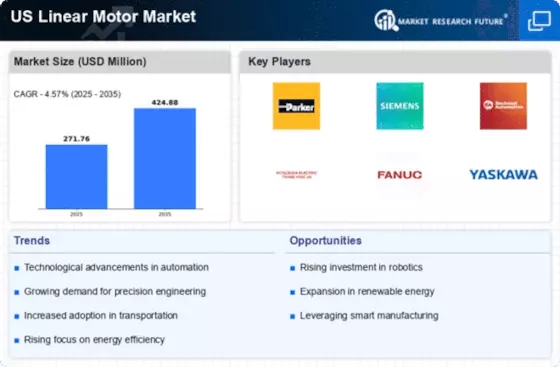
US Linear Motor Market Infographic
Purchase Options

US Linear Motor Market Summary

As per analysis, the US Linear Motor Market is projected to grow from USD 259.88 Million in 2024 to USD 424.88 Million by 2035, exhibiting a compound annual growth rate (CAGR) of 4.57% during the forecast period (2025 - 2035).

Key Market Trends & Highlights

The US Linear Motor Market is poised for substantial growth driven by technological advancements and increasing automation.

  • The Industrial Automation segment remains the largest contributor to the US Linear Motor Market, reflecting a robust demand for efficient manufacturing processes.
  • Robotics is the fastest-growing segment, indicating a shift towards more automated and precise applications in various industries.
  • The Manufacturing sector continues to dominate, while the Aerospace segment is rapidly expanding, showcasing diverse applications of linear motors.
  • Key market drivers include the growing demand for precision engineering and increased investment in automation technologies.

Market Size & Forecast

2024 Market Size 259.88 (USD Million)
2035 Market Size 424.88 (USD Million)
CAGR (2025 - 2035) 4.57%

Major Players

Parker Hannifin (US), Siemens (US), Rockwell Automation (US), Mitsubishi Electric (US), Fanuc (US), Yaskawa Electric (US), Bosch Rexroth (US), Thyssenkrupp (US), Schneider Electric (US)

Our Impact
Enabled $4.3B Revenue Impact for Fortune 500 and Leading Multinationals
Partnering with 2000+ Global Organizations Each Year
30K+ Citations by Top-Tier Firms in the Industry

US Linear Motor Market Trends

The US Linear Motor Market is currently experiencing a notable transformation, driven by advancements in technology and increasing demand for automation across various sectors. Industries such as manufacturing, transportation, and robotics are increasingly adopting linear motors due to their efficiency and precision. This shift appears to be influenced by the need for enhanced performance and reduced operational costs, which linear motors can provide. Furthermore, the growing emphasis on sustainability and energy efficiency is likely to propel the market forward, as these motors typically consume less energy compared to traditional alternatives. In addition, the US Linear Motor Market seems to be benefiting from ongoing research and development efforts aimed at improving motor designs and applications. Innovations in materials and control systems may enhance the capabilities of linear motors, making them more versatile for diverse applications. As industries continue to seek solutions that offer both speed and accuracy, the demand for linear motors is expected to rise. Overall, the market appears poised for growth, with various factors converging to create a favorable environment for linear motor adoption in the United States.

Increased Automation in Manufacturing

The trend towards automation in the manufacturing sector is significantly influencing the US Linear Motor Market. As companies strive to enhance productivity and reduce labor costs, linear motors are being integrated into production lines for their ability to provide precise and rapid movements. This shift not only improves efficiency but also allows for greater flexibility in manufacturing processes.

Advancements in Technology

Technological advancements are playing a crucial role in shaping the US Linear Motor Market. Innovations in materials, such as the development of lightweight and durable components, are enhancing the performance of linear motors. Additionally, improvements in control systems are enabling more sophisticated applications, making these motors suitable for a wider range of industries.

Focus on Energy Efficiency

There is a growing emphasis on energy efficiency within the US Linear Motor Market. As organizations become more environmentally conscious, the demand for linear motors, which typically consume less energy than traditional motors, is likely to increase. This trend aligns with broader sustainability goals and regulatory pressures aimed at reducing energy consumption across various sectors.

US Linear Motor Market Drivers

Expansion of Electric Vehicle Production

The US Linear Motor Market is poised to benefit from the rapid expansion of electric vehicle (EV) production. As automakers increasingly shift towards electric mobility, the demand for efficient and high-performance linear motors is expected to rise. Linear motors are utilized in various applications within EVs, including battery assembly and automated manufacturing processes. The US electric vehicle market is projected to reach a valuation of over 800 billion USD by 2027, indicating a substantial opportunity for linear motor manufacturers. This growth is likely to be fueled by government incentives and consumer demand for sustainable transportation solutions. As a result, the integration of linear motors in the EV sector could significantly enhance the performance and efficiency of production lines, thereby driving the US Linear Motor Market forward.

Growing Demand for Precision Engineering

The US Linear Motor Market is experiencing a notable surge in demand for precision engineering applications. Industries such as aerospace, automotive, and semiconductor manufacturing are increasingly adopting linear motors due to their ability to provide high accuracy and repeatability. According to recent data, the precision engineering sector in the US is projected to grow at a compound annual growth rate (CAGR) of approximately 5.2% over the next five years. This growth is driven by the need for advanced manufacturing processes that require precise motion control. As companies strive to enhance product quality and reduce production costs, the integration of linear motors into their operations appears to be a strategic move. Consequently, this trend is likely to bolster the overall growth of the US Linear Motor Market.

Rising Focus on Renewable Energy Solutions

The US Linear Motor Market is increasingly influenced by the rising focus on renewable energy solutions. As the country transitions towards sustainable energy sources, there is a growing need for efficient systems that can support renewable energy generation and distribution. Linear motors are being utilized in various applications, including wind turbine manufacturing and solar panel production, where precision and reliability are paramount. The renewable energy sector in the US is projected to grow significantly, with investments expected to exceed 200 billion USD by 2025. This growth presents a substantial opportunity for linear motor manufacturers to cater to the evolving needs of the renewable energy market. Consequently, the integration of linear motors into renewable energy applications is likely to drive innovation and growth within the US Linear Motor Market.

Increased Investment in Automation Technologies

The US Linear Motor Market is witnessing increased investment in automation technologies across various sectors. Companies are recognizing the potential of automation to enhance productivity and reduce operational costs. The manufacturing sector, in particular, is investing heavily in automated systems that utilize linear motors for precise motion control. According to industry reports, the automation market in the US is expected to grow by approximately 10% annually, with linear motors playing a crucial role in this transformation. This trend is indicative of a broader shift towards smart manufacturing, where linear motors are integral to achieving higher efficiency and flexibility in production processes. As businesses continue to embrace automation, the demand for linear motors is likely to escalate, further propelling the US Linear Motor Market.

Technological Advancements in Motion Control Systems

The US Linear Motor Market is benefiting from rapid technological advancements in motion control systems. Innovations in control algorithms, sensor technologies, and materials are enhancing the performance and capabilities of linear motors. These advancements enable higher speeds, improved accuracy, and greater energy efficiency, making linear motors more attractive for a variety of applications. The motion control market in the US is projected to grow at a CAGR of around 7% over the next few years, driven by the demand for sophisticated automation solutions. As industries seek to optimize their operations and improve product quality, the adoption of advanced linear motor technologies is likely to increase. This trend suggests a promising outlook for the US Linear Motor Market as it adapts to the evolving technological landscape.


Market Segment Insights

By Application: Industrial Automation (Largest) vs. Robotics (Fastest-Growing)

In the US Linear Motor Market, the application segment is segmented into Industrial Automation, Transportation, Medical Equipment, Robotics, and Consumer Electronics. Industrial Automation holds the largest market share, driven by the increasing demand for efficient and precise manufacturing processes. Robotics ranks as the fastest-growing segment, reflecting the expanding adoption of automation in various industries ranging from manufacturing to healthcare.

Industrial Automation (Dominant) vs. Robotics (Emerging)

Industrial Automation is a dominant application in the US Linear Motor Market, characterized by its crucial role in optimizing production lines and enhancing operational efficiency. Industries leverage linear motors for their precision and repeatability, fostering higher levels of automation. Conversely, Robotics is emerging rapidly, propelled by innovations such as collaborative robots and advancements in AI technology. This segment is gaining traction owing to increased investments in automation across sectors like manufacturing and healthcare, applying linear motors for improved speed, accuracy, and flexibility in robotic applications.

By End Use: Manufacturing (Largest) vs. Aerospace (Fastest-Growing)

In the US Linear Motor Market, the manufacturing segment holds a prominent position as the largest end-use sector. This segment benefits from a robust adoption of linear motors in automation processes, contributing significantly to efficiency and precision in production lines. Following closely, the aerospace sector is emerging as the fastest-growing segment due to increasing investments in advanced technologies, maximizing operational efficiency and reducing weight through the integration of linear motors in aircraft systems. As demand for automation continues to rise, the manufacturing sector is likely to sustain its dominance through continuous innovations and enhanced production techniques. In contrast, the aerospace segment is gaining momentum propelled by advancements in space exploration and defense technology. This segment's growth can be attributed to the need for high-performance, compact solutions that linear motors offer, ensuring competitive edge in manufacturing practices in the aerospace industry.

Manufacturing: Aerospace (Dominant) vs. Healthcare (Emerging)

The manufacturing segment stands as a dominant force in the US Linear Motor Market, owing to its extensive utilization of linear motors for precise and efficient operations in various industrial applications. This segment encompasses a diverse range of processes, including assembly lines and material handling, highlighting its critical role in enhancing production efficiency and reducing downtime. Aerospace, as an emerging segment, is becoming increasingly important with the integration of linear motors for applications such as flight control systems and advanced propulsion technologies. The growing emphasis on lightweight materials and energy efficiency in aerospace design is driving the adoption of linear motors, positioning it as a vital player in the market.

By Type: Synchronous Motor (Largest) vs. Linear Synchronous Motor (Fastest-Growing)

In the US Linear Motor Market, the distribution of market shares reveals that the Synchronous Motor currently stands as the largest segment, commanding a significant portion due to its widespread application in various industries. Following this, the Linear Synchronous Motor is emerging as a prominent player with fast-growing demand, particularly in robotics and automation sectors, reflecting a shift towards advanced technology solutions in linear motion applications. Growth trends in this segment are driven by increasing demand for automation and efficiency in manufacturing processes. Additionally, the push for energy-efficient solutions and advancements in control technologies are bolstering the acceptance of Linear Synchronous Motors. The integration of these motors into new applications shows promising potential, making them attractive for investments and development in the upcoming years.

Synchronous Motor (Dominant) vs. Stepper Motor (Emerging)

The Synchronous Motor maintains its dominant position in the US Linear Motor Market, recognized for its efficiency and precision in motion control. These motors are widely utilized in applications ranging from conveyor systems to industrial machinery, which contributes to their entrenched market presence. On the other hand, the Stepper Motor is labeled as an emerging segment, popular in applications requiring precise incremental movement, such as 3D printing and CNC machinery. The Stepper Motor's ease of control and versatility in operation make it increasingly appealing for new technological developments, allowing it to capture a growing market share amidst the rising tide of automation.

By Technology: Electromagnetic (Largest) vs. Magnetic Levitation (Fastest-Growing)

In the US Linear Motor Market, the technology segment is dominated by electromagnetic systems, which have established themselves as the largest segment due to their widespread application in various industrial and commercial sectors. Magnetic levitation technology, while smaller in market share, is rapidly growing, appealing to industries seeking advanced solutions that reduce friction and enhance efficiency. The piezoelectric and electrostatic technologies, though emerging, are gaining traction as they present innovative advantages for specific applications.

Technology: Electromagnetic (Dominant) vs. Magnetic Levitation (Emerging)

Electromagnetic linear motors are characterized by their mature technology, reliability, and versatility, making them the dominant force in the market. These motors are widely utilized in manufacturing, robotics, and automation due to their high performance and cost-effectiveness. In contrast, magnetic levitation technology stands out for its ability to offer low-friction operation, enabling high speeds and precision in applications like transport systems. As industries increasingly prioritize energy efficiency and performance, magnetic levitation is emerging as a viable alternative, steadily capturing market attention.

By Configuration: Single Axis (Largest) vs. Multi Axis (Fastest-Growing)

In the US Linear Motor Market, the configuration segment is characterized by a clear distribution of market share across its key values. The Single Axis configuration commands a significant share, being the most widely adopted due to its simplicity and effectiveness in various linear motion applications. On the other hand, the Multi Axis configuration is rapidly gaining traction, driven by the increasing need for complex automation solutions that require synchronized movement across multiple axes.

Single Axis (Dominant) vs. Multi Axis (Emerging)

The Single Axis configuration is recognized for its robustness and ease of integration, making it a preferred choice for industries requiring straightforward linear motion applications, such as packaging and assembly. Conversely, the Multi Axis configuration is becoming increasingly popular as it offers superior flexibility and scalability, which are essential for modern manufacturing processes. It allows for simultaneous movement in different directions, catering to advanced applications in robotics and automation. This adaptability positions the Multi Axis as an emerging favorite among manufacturers looking to enhance operational efficiency and reduce cycle times.

Get more detailed insights about US Linear Motor Market

Key Players and Competitive Insights

The Linear Motor Market in the US is characterized by a competitive landscape that is increasingly shaped by technological advancements and strategic collaborations. Key growth drivers include the rising demand for automation in manufacturing processes, the push for energy-efficient solutions, and the integration of smart technologies. Major players such as Parker Hannifin (US), Siemens (US), and Rockwell Automation (US) are strategically positioned to leverage these trends. Parker Hannifin (US) focuses on innovation in motion control technologies, while Siemens (US) emphasizes digital transformation and smart infrastructure. Rockwell Automation (US) is enhancing its operational focus on software solutions that integrate with linear motor technologies, collectively shaping a competitive environment that prioritizes technological leadership and customer-centric solutions.

In terms of business tactics, companies are increasingly localizing manufacturing to reduce lead times and optimize supply chains. The market structure appears moderately fragmented, with several key players exerting influence over various segments. This fragmentation allows for niche players to emerge, yet the collective strength of major companies like Mitsubishi Electric (US) and Fanuc (US) ensures that competition remains robust. These companies are actively pursuing supply chain optimization strategies, which are critical in maintaining their market positions amidst fluctuating demand and supply chain challenges.

In December 2025, Mitsubishi Electric (US) announced a partnership with a leading robotics firm to develop advanced linear motor systems aimed at enhancing precision in automated assembly lines. This strategic move is likely to bolster Mitsubishi's position in the market by integrating cutting-edge robotics with their linear motor technology, thereby addressing the growing demand for high-precision manufacturing solutions. The collaboration underscores the importance of partnerships in driving innovation and meeting customer needs in a rapidly evolving market.

In November 2025, Fanuc (US) unveiled a new line of linear motors designed specifically for high-speed applications in the automotive sector. This launch is significant as it positions Fanuc to capitalize on the increasing automation in automotive manufacturing, where speed and efficiency are paramount. By focusing on high-speed capabilities, Fanuc is likely to attract a broader customer base, enhancing its competitive edge in a market that values performance and reliability.

In October 2025, Rockwell Automation (US) expanded its software offerings to include advanced analytics for linear motor applications. This strategic enhancement is indicative of a broader trend towards digitalization within the industry, as companies seek to leverage data for improved operational efficiency. By integrating analytics into their product offerings, Rockwell is not only enhancing its value proposition but also aligning with the industry's shift towards data-driven decision-making.

As of January 2026, current competitive trends in the Linear Motor Market are heavily influenced by digitalization, sustainability initiatives, and the integration of artificial intelligence (AI). Strategic alliances are increasingly shaping the landscape, enabling companies to pool resources and expertise to drive innovation. The competitive differentiation is likely to evolve from traditional price-based competition to a focus on technological innovation, supply chain reliability, and sustainable practices. Companies that can effectively navigate these trends will likely secure a competitive advantage in the future.

Key Companies in the US Linear Motor Market include

Future Outlook

US Linear Motor Market Future Outlook

The US Linear Motor Market is projected to grow at a 4.57% CAGR from 2025 to 2035, driven by advancements in automation, demand for precision engineering, and increased adoption in transportation.

New opportunities lie in:

  • Integration of linear motors in automated guided vehicles (AGVs) for enhanced efficiency.
  • Development of custom linear motor solutions for specialized industrial applications.
  • Expansion into renewable energy sectors with linear motor-driven systems.

By 2035, the market is expected to solidify its position as a leader in precision motion control.

Market Segmentation

US Linear Motor Market Type Outlook

  • Synchronous Motor
  • Linear Induction Motor
  • Linear Synchronous Motor
  • Stepper Motor

US Linear Motor Market End Use Outlook

  • Manufacturing
  • Aerospace
  • Healthcare
  • Automotive
  • Electronics

US Linear Motor Market Technology Outlook

  • Electromagnetic
  • Magnetic Levitation
  • Piezoelectric
  • Electrostatic

US Linear Motor Market Application Outlook

  • Industrial Automation
  • Transportation
  • Medical Equipment
  • Robotics
  • Consumer Electronics

US Linear Motor Market Configuration Outlook

  • Single Axis
  • Multi Axis
  • Modular
  • Custom

Report Scope

MARKET SIZE 2024259.88(USD Million)
MARKET SIZE 2025272.94(USD Million)
MARKET SIZE 2035424.88(USD Million)
COMPOUND ANNUAL GROWTH RATE (CAGR)4.57% (2024 - 2035)
REPORT COVERAGERevenue Forecast, Competitive Landscape, Growth Factors, and Trends
BASE YEAR2024
Market Forecast Period2025 - 2035
Historical Data2019 - 2024
Market Forecast UnitsUSD Million
Key Companies ProfiledParker Hannifin (US), Siemens (US), Rockwell Automation (US), Mitsubishi Electric (US), Fanuc (US), Yaskawa Electric (US), Bosch Rexroth (US), Thyssenkrupp (US), Schneider Electric (US)
Segments CoveredApplication, End Use, Type, Technology, Configuration
Key Market OpportunitiesGrowing demand for automation in manufacturing drives innovation in the US Linear Motor Market.
Key Market DynamicsTechnological advancements drive demand for linear motors in automation and precision applications across various US industries.
Countries CoveredUS
Leave a Comment

FAQs

What is the projected market valuation of the US Linear Motor Market by 2035?

The projected market valuation of the US Linear Motor Market is 424.88 USD Million by 2035.

What was the market valuation of the US Linear Motor Market in 2024?

The overall market valuation of the US Linear Motor Market was 259.88 USD Million in 2024.

What is the expected CAGR for the US Linear Motor Market during the forecast period 2025 - 2035?

The expected CAGR for the US Linear Motor Market during the forecast period 2025 - 2035 is 4.57%.

Which application segments are driving growth in the US Linear Motor Market?

The application segments driving growth include Industrial Automation, Transportation, and Robotics, with valuations ranging from 40.0 to 170.0 USD Million.

Who are the key players in the US Linear Motor Market?

Key players in the US Linear Motor Market include Parker Hannifin, Siemens, and Rockwell Automation, among others.

What are the leading technologies used in the US Linear Motor Market?

Leading technologies in the US Linear Motor Market include Electromagnetic and Magnetic Levitation, with valuations between 40.0 and 160.0 USD Million.

How does the US Linear Motor Market perform in the healthcare sector?

In the healthcare sector, the US Linear Motor Market was valued between 25.0 and 40.0 USD Million.

What types of linear motors are prevalent in the US market?

Prevalent types of linear motors in the US market include Linear Synchronous Motors and Stepper Motors, with valuations from 60.0 to 124.88 USD Million.

What configurations are available in the US Linear Motor Market?

Available configurations in the US Linear Motor Market include Single Axis and Multi Axis, with valuations ranging from 49.88 to 130.0 USD Million.

What end-use sectors are contributing to the US Linear Motor Market growth?

End-use sectors contributing to growth include Manufacturing and Automotive, with valuations between 50.0 and 165.0 USD Million.

Download Free Sample

Kindly complete the form below to receive a free sample of this Report

Compare Licence

×
Features License Type
Single User Multiuser License Enterprise User
Price $4,950 $5,950 $7,250
Maximum User Access Limit 1 User Upto 10 Users Unrestricted Access Throughout the Organization
Free Customization
Direct Access to Analyst
Deliverable Format
Platform Access
Discount on Next Purchase 10% 15% 15%
Printable Versions