×
Request Free Sample ×

Kindly complete the form below to receive a free sample of this Report

* Please use a valid business email

Leading companies partner with us for data-driven Insights

clients tt-cursor
Hero Background

US Fracture Fixation Products Market

ID: MRFR/HC/18392-HCR
100 Pages
Garvit Vyas
February 2026

US Fracture Fixation Products Market Research Report By Product Type (Internal Fixation Product, External Fixation Product, Small Bone Fracture Management Products, Others), By Application (Metallic Fixators, Bio-absorbable Fixators, Others) and By End User (Hospitals and Clinics, Orthopedic Centers, Ambulatory Surgical Centers, Others) - Growth & Industry Forecast 2025 To 2035

Share:
Download PDF ×

We do not share your information with anyone. However, we may send you emails based on your report interest from time to time. You may contact us at any time to opt-out.

US Fracture Fixation Products Market Infographic
Purchase Options

US Fracture Fixation Products Market Summary

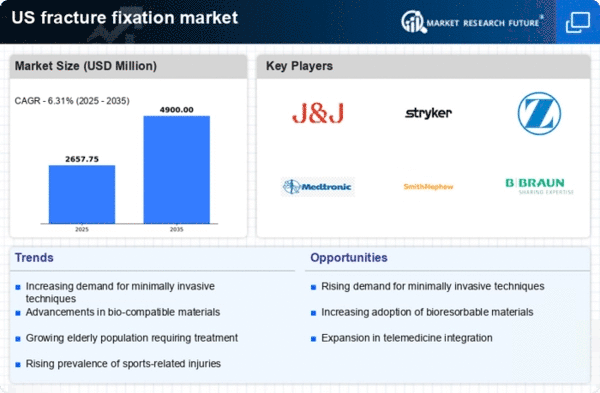
As per Market Research Future analysis, the US fracture fixation-products market size was estimated at 2500.0 USD Million in 2024.. The US fracture fixation-products market is projected to grow from 2657.75 USD Million in 2025 to 4900.0 USD Million by 2035, exhibiting a compound annual growth rate (CAGR) of 6.3% during the forecast period 2025 - 2035

Key Market Trends & Highlights

The US fracture fixation-products market is experiencing robust growth driven by technological advancements and increasing healthcare demands.

  • Technological advancements are enhancing the efficacy and safety of fracture fixation products.
  • The rising incidence of orthopedic injuries is propelling demand across various healthcare settings.
  • The largest segment in the market is the internal fixation devices, while the fastest-growing segment is the external fixation devices.
  • Key market drivers include the increasing geriatric population and advancements in surgical techniques, which are likely to boost market growth.

Market Size & Forecast

2024 Market Size 2500.0 (USD Million)
2035 Market Size 4900.0 (USD Million)
CAGR (2025 - 2035) 6.31%

Major Players

DePuy Synthes (US), Stryker (US), Zimmer Biomet (US), Medtronic (US), Smith & Nephew (GB), B. Braun (DE), Orthofix (US), NuVasive (US), Aesculap (DE)

Our Impact
Enabled $4.3B Revenue Impact for Fortune 500 and Leading Multinationals
Partnering with 2000+ Global Organizations Each Year
30K+ Citations by Top-Tier Firms in the Industry

US Fracture Fixation Products Market Trends

The fracture fixation-products market is currently experiencing notable growth. This growth is driven by advancements in technology and an increasing prevalence of orthopedic injuries. The demand for innovative solutions, such as bioresorbable implants and minimally invasive surgical techniques, appears to be on the rise. This trend is likely influenced by a growing awareness of the benefits associated with these modern approaches, which may lead to improved patient outcomes and reduced recovery times. Furthermore, the aging population in the US is contributing to a higher incidence of fractures, thereby amplifying the need for effective fixation products. In addition, the regulatory landscape surrounding medical devices is evolving, which could impact the fracture fixation-products market. Regulatory bodies are increasingly focusing on ensuring the safety and efficacy of new products, which may lead to a more competitive environment. Manufacturers are likely to invest in research and development to comply with these regulations while also meeting the demands of healthcare providers and patients. Overall, The fracture fixation-products market is poised for continued expansion, driven by innovation and demographic trends.

Technological Advancements

The fracture fixation-products market is witnessing a surge in technological innovations, particularly in the development of smart implants and advanced materials. These innovations may enhance the performance and longevity of fixation devices, potentially leading to better patient outcomes.

Rising Incidence of Orthopedic Injuries

There seems to be an increasing occurrence of orthopedic injuries in the US, driven by factors such as an aging population and active lifestyles. This trend is likely to boost the demand for various fixation products, as healthcare providers seek effective solutions for treatment.

Regulatory Changes

The evolving regulatory framework for medical devices may significantly influence the fracture fixation-products market. Stricter guidelines could lead to increased scrutiny of new products, prompting manufacturers to prioritize compliance and innovation in their offerings.

US Fracture Fixation Products Market Drivers

Rising Healthcare Expenditure

The increasing healthcare expenditure in the US is a significant driver for the fracture fixation-products market. With healthcare spending projected to reach $6 trillion by 2027, there is a growing emphasis on improving patient care and outcomes. This financial commitment enables healthcare facilities to invest in advanced fracture fixation technologies and products. As hospitals and clinics allocate more resources to orthopedic care, the demand for high-quality fixation products is expected to rise. Furthermore, the focus on value-based care encourages the adoption of innovative solutions that enhance recovery and reduce complications. Consequently, the fracture fixation-products market is poised for growth, fueled by the rising healthcare expenditure and the pursuit of improved patient outcomes.

Increased Sports Participation

The surge in sports participation among various age groups is a notable driver for the fracture fixation-products market. As more individuals engage in recreational and competitive sports, the incidence of sports-related injuries, including fractures, is likely to increase. The National Sporting Goods Association reports that over 50% of Americans participate in some form of organized sports. This trend necessitates the availability of effective fracture fixation solutions to address the injuries sustained during athletic activities. As a result, healthcare providers are increasingly seeking advanced fixation products to ensure optimal recovery for athletes. The fracture fixation-products market is expected to benefit from this growing demand, as sports injuries continue to rise alongside increased participation.

Increasing Geriatric Population

The growing geriatric population in the US is a crucial driver for the fracture fixation-products market. As individuals age, they become more susceptible to fractures due to decreased bone density and increased fall risk. According to the US Census Bureau, the population aged 65 and older is projected to reach 80 million by 2040, representing a significant market segment. This demographic shift necessitates advanced fracture fixation solutions to address the unique needs of older patients. The demand for effective and reliable fixation products is likely to rise, as healthcare providers seek to improve patient outcomes and reduce recovery times. Consequently, the fracture fixation-products market is expected to experience substantial growth, driven by the need for innovative solutions tailored to the aging population.

Advancements in Surgical Techniques

Innovations in surgical techniques are significantly influencing the fracture fixation-products market. Minimally invasive procedures, such as arthroscopy and percutaneous fixation, have gained traction due to their benefits, including reduced recovery times and lower complication rates. These advancements necessitate the development of specialized fixation products that cater to these techniques. The market is witnessing an increase in demand for devices that facilitate these modern surgical approaches. For instance, the introduction of bioabsorbable implants and advanced locking plates has transformed the landscape of orthopedic surgery. As surgical techniques continue to evolve, the fracture fixation-products market is likely to expand, driven by the need for products that align with these innovative practices.

Technological Integration in Healthcare

Technology integration in healthcare is transforming the fracture fixation-products market. Innovations such as telemedicine, electronic health records, and advanced imaging techniques are enhancing the diagnosis and treatment of fractures. These technologies facilitate better patient management and improve surgical outcomes. For instance, 3D printing technology is being utilized to create customized fixation devices tailored to individual patient needs. This level of personalization is likely to drive demand for advanced fixation products. As healthcare providers increasingly adopt these technologies, the fracture fixation-products market is expected to expand, reflecting the ongoing trend towards more efficient and effective orthopedic care.


Market Segment Insights

By Type: Internal Fixation Product (Largest) vs. External Fixation Product (Fastest-Growing)

The market share distribution within the US fracture fixation-products market indicates that Internal Fixation Products dominate the landscape, capturing a significant portion due to their broad application in various types of fractures. External Fixation Products, while smaller in overall share, are witnessing increased adoption, driven by advances in technology and improved patient outcomes. Small Bone Fracture Management Products and others fill niche segments but do not match the prominence of the leading categories. Growth trends in this market are positively influenced by an increase in orthopedic procedures and an aging population susceptible to fractures. Technological advancements are propelling External Fixation Products to the forefront, making them the fastest-growing segment. Additionally, the shift towards minimally invasive surgical techniques is enhancing market potential, enabling more patients to benefit from these innovative fixation solutions.

Internal Fixation Product (Dominant) vs. External Fixation Product (Emerging)

Internal Fixation Products, known for their ability to provide strong stabilization through plates and screws, hold the dominant position in the market due to their effectiveness in treating complex fractures. This segment is favored by orthopedic surgeons for their reliability and versatility. On the other hand, External Fixation Products are emerging as a significant player, especially in situations where minimal tissue disruption is required. They are gaining traction in trauma cases and post-operative applications, reflecting a shift in surgical preference towards solutions that facilitate faster recovery and reduced complications. As both segments develop, their synergies enhance overall treatment options available for patients.

By Application: Metallic Fixators (Largest) vs. Bio-absorbable Fixators (Fastest-Growing)

The application segment is composed of diverse categories, including metallic fixators, bio-absorbable fixators, and others. Within this segment, metallic fixators hold the largest market share, driven by their robustness and reliability in various surgical procedures. Bio-absorbable fixators are also gaining traction, capturing a notable share as they offer benefits such as reduced post-operative complications, appealing to both patients and healthcare providers. In terms of growth trends, the market for bio-absorbable fixators is experiencing rapid expansion due to advancements in material technologies that enhance their performance and safety. Increasing awareness about minimizing invasive surgeries and supporting better recovery times are major driving forces for this segment. Consequently, while metallic fixators remain dominant, bio-absorbable options are becoming increasingly popular in clinical settings, reflecting a shift toward innovative, patient-centered solutions in the US fracture fixation-products market.

Metallic Fixators (Dominant) vs. Bio-absorbable Fixators (Emerging)

Metallic fixators are recognized for their widespread use in orthopedic surgeries, providing strong structural support during the healing process. Their durable nature makes them the go-to choice in complex fracture cases, ensuring stability and facilitating proper alignment of fractured bone segments. On the other hand, bio-absorbable fixators are emerging as a compelling alternative, particularly favored in scenarios where reduced irritation and lower infection risks are paramount. These innovative fixators gradually dissolve in the body, eliminating the need for subsequent surgical removal, which resonates well with the trend of less invasive medical solutions. Thus, while metallic fixators dominate the market, bio-absorbable fixators are rapidly carving out their niche, showcasing the evolving landscape of fracture fixation solutions.

By End User: Hospitals (Largest) vs. Orthopedic Centers (Fastest-Growing)

In the US fracture fixation-products market, Hospitals hold the largest market share among the end user segments, primarily due to the high volume of surgical procedures conducted in these facilities. They are equipped with advanced infrastructure and a wide range of medical professionals specialized in orthopedic surgeries, which facilitates the utilization of fracture fixation products. Following closely are Orthopedic Centers, which, while possessing a smaller share, are rapidly gaining ground due to their specialized services and growing patient volume. The growth trends within the end user segment indicate a shift towards more specialized care, with Ambulatory Surgical Centers also rising in relevance by offering less invasive surgical options. The demand for advanced fixation solutions drives innovation and competition among manufacturers, while increased awareness about orthopedic health also plays a significant role in enhancing market growth in this segment.

Hospitals (Dominant) vs. Orthopedic Centers (Emerging)

Hospitals represent the dominant force in the US fracture fixation-products market due to their extensive resources and patient throughput. They provide a holistic approach to fracture treatment, incorporating advanced surgical methods and comprehensive post-operative care. This large-scale operation allows hospitals to negotiate better pricing with suppliers and establish long-term partnership contracts, ensuring a steady supply of fracture fixation products. On the other hand, Orthopedic Centers, although emerging with a focus on specialized orthopedic treatment, are carving out a significant niche. Their tailored services, such as personalized care and innovative fixation techniques, attract patients seeking expert-level treatment, indicating a favorable shift in consumer preference towards specialized facilities.

Get more detailed insights about US Fracture Fixation Products Market

Key Players and Competitive Insights

The fracture fixation-products market is characterized by a dynamic competitive landscape, driven by technological advancements and an increasing demand for innovative solutions in orthopedic care. Key players such as DePuy Synthes (US), Stryker (US), and Zimmer Biomet (US) are at the forefront, each adopting distinct strategies to enhance their market positioning. DePuy Synthes (US) focuses on innovation through the development of advanced fixation devices, while Stryker (US) emphasizes strategic acquisitions to broaden its product portfolio. Zimmer Biomet (US) is actively pursuing regional expansion, particularly in emerging markets, which collectively shapes a competitive environment that is both robust and evolving.In terms of business tactics, companies are increasingly localizing manufacturing to reduce lead times and optimize supply chains. The market structure appears moderately fragmented, with several key players exerting considerable influence. This fragmentation allows for a diverse range of products and solutions, catering to various segments of the healthcare market, while also fostering competition among established and emerging firms.

In October Stryker (US) announced the acquisition of a leading digital health company, aiming to integrate advanced analytics into its fracture fixation products. This strategic move is likely to enhance Stryker's capabilities in providing data-driven solutions, thereby improving patient outcomes and operational efficiencies. The integration of digital health technologies into traditional orthopedic products may redefine the standards of care in the industry.

In September Zimmer Biomet (US) launched a new line of biodegradable fixation devices, which aligns with the growing trend towards sustainability in medical devices. This initiative not only addresses environmental concerns but also positions Zimmer Biomet as a leader in innovative, eco-friendly solutions. The introduction of biodegradable materials could potentially reduce the long-term impact of medical waste, appealing to environmentally conscious healthcare providers.

In November DePuy Synthes (US) unveiled a partnership with a prominent research institution to develop next-generation fixation technologies utilizing artificial intelligence (AI). This collaboration is expected to accelerate the development of smart fixation devices that can adapt to patient-specific needs, thereby enhancing surgical outcomes. The integration of AI into product development signifies a shift towards more personalized and effective orthopedic solutions.

As of November current competitive trends indicate a strong emphasis on digitalization, sustainability, and AI integration within the fracture fixation-products market. Strategic alliances are increasingly shaping the landscape, enabling companies to leverage complementary strengths and accelerate innovation. Looking ahead, competitive differentiation is likely to evolve from traditional price-based competition to a focus on technological advancements, innovative solutions, and reliable supply chains. This shift underscores the importance of adaptability and forward-thinking strategies in maintaining a competitive edge in a rapidly changing market.

Key Companies in the US Fracture Fixation Products Market include

Industry Developments

The US Fracture Fixation Products Market has recently witnessed significant developments, particularly focusing on innovations and acquisitions among key players. In August 2023, Smith and Nephew announced the acquisition of a sports medicine company, aiming to enhance their product offerings in orthopedic solutions.

Parker Hannifin has been expanding its portfolio by investing in advanced materials for fracture fixation. The demand for effective solutions led Medtronic to launch a new line of implants in July 2023, further boosting their market share.

Meanwhile, DePuy Synthes has been actively collaborating with leading surgeons to better understand surgical needs and improve their product range. In terms of financial growth, the market valuation for companies such as Stryker and Zimmer Biomet has seen consistent increases due to the rising prevalence of orthopedic injuries and an aging population in the US.

Additionally, in April 2022, OrthoFix acquired the biologics company to expand its product line in regenerative medicine. The landscape is also influenced by the ongoing advancements in minimally invasive surgical techniques, reflecting a trend towards improved patient outcomes and reduced recovery time.

Future Outlook

US Fracture Fixation Products Market Future Outlook

The Fracture Fixation Products Market is projected to grow at a 6.31% CAGR from 2025 to 2035, driven by technological advancements, increasing orthopedic surgeries, and rising geriatric population.

New opportunities lie in:

  • Development of biodegradable fixation devices for enhanced patient recovery.
  • Expansion of telemedicine platforms for remote monitoring of post-surgery patients.
  • Investment in AI-driven surgical planning tools to improve operational efficiency.

By 2035, the market is expected to achieve substantial growth, reflecting evolving healthcare needs and innovations.

Market Segmentation

US Fracture Fixation Products Market Type Outlook

  • Internal Fixation Product
  • External Fixation Product
  • Small Bone Fracture Management Products
  • Others

US Fracture Fixation Products Market End User Outlook

  • Hospitals and Clinics
  • Orthopedic Centers
  • Ambulatory Surgical Centers
  • Others

US Fracture Fixation Products Market Application Outlook

  • Metallic Fixators
  • Bio-absorbable Fixators
  • Others

Report Scope

MARKET SIZE 2024 2500.0(USD Million)
MARKET SIZE 2025 2657.75(USD Million)
MARKET SIZE 2035 4900.0(USD Million)
COMPOUND ANNUAL GROWTH RATE (CAGR) 6.31% (2025 - 2035)
REPORT COVERAGE Revenue Forecast, Competitive Landscape, Growth Factors, and Trends
BASE YEAR 2024
Market Forecast Period 2025 - 2035
Historical Data 2019 - 2024
Market Forecast Units USD Million
Key Companies Profiled DePuy Synthes (US), Stryker (US), Zimmer Biomet (US), Medtronic (US), Smith & Nephew (GB), B. Braun (DE), Orthofix (US), NuVasive (US), Aesculap (DE)
Segments Covered Type, Application, End User
Key Market Opportunities Advancements in bioresorbable materials enhance patient outcomes in the fracture fixation-products market.
Key Market Dynamics Technological advancements and regulatory changes drive innovation in the fracture fixation-products market.
Countries Covered US
Leave a Comment

FAQs

What is the expected market size of the US Fracture Fixation Products Market in 2024?

The US Fracture Fixation Products Market is expected to be valued at 2.5 billion USD in 2024.

What is the projected market size for the US Fracture Fixation Products Market by 2035?

By 2035, the US Fracture Fixation Products Market is projected to reach a value of 5.2 billion USD.

What is the expected CAGR for the US Fracture Fixation Products Market from 2025 to 2035?

The market is expected to grow at a compound annual growth rate (CAGR) of 6.885% from 2025 to 2035.

Which segment of the US Fracture Fixation Products Market is estimated to have the largest share in 2024?

The Internal Fixation Product segment is estimated to have the largest share, valued at 1.2 billion USD in 2024.

What will be the value of the External Fixation Product segment in 2035?

The External Fixation Product segment is expected to reach a value of 1.6 billion USD by 2035.

Who are the key players in the US Fracture Fixation Products Market?

Key players in the market include Smith and Nephew, Medtronic, DePuy Synthes, and Stryker among others.

What is the estimated value of the Small Bone Fracture Management Products segment in 2024?

The Small Bone Fracture Management Products segment is estimated to be valued at 0.5 billion USD in 2024.

What growth opportunities exist in the US Fracture Fixation Products Market?

There are growth opportunities arising from the increasing number of orthopedic surgeries and advancements in product technologies.

What are the challenges facing the US Fracture Fixation Products Market?

Challenges include regulatory hurdles and the high cost of advanced fracture fixation devices.

What impact does the current global scenario have on the US Fracture Fixation Products Market?

The current global scenario may affect supply chains and demand for fracture fixation products.

Download Free Sample

Kindly complete the form below to receive a free sample of this Report

Compare Licence

×
Features License Type
Single User Multiuser License Enterprise User
Price $4,950 $5,950 $7,250
Maximum User Access Limit 1 User Upto 10 Users Unrestricted Access Throughout the Organization
Free Customization
Direct Access to Analyst
Deliverable Format
Platform Access
Discount on Next Purchase 10% 15% 15%
Printable Versions