×
Request Free Sample ×

Kindly complete the form below to receive a free sample of this Report

* Please use a valid business email

Leading companies partner with us for data-driven Insights

clients tt-cursor
Hero Background

US Enterprise IoT Market

ID: MRFR/SEM/14446-HCR
100 Pages
Garvit Vyas
February 2026

United States Enterprise Iot Industry Research Report to 2032

Share:
Download PDF ×

We do not share your information with anyone. However, we may send you emails based on your report interest from time to time. You may contact us at any time to opt-out.

US Enterprise IoT Market Infographic
Purchase Options

US Enterprise IoT Market Summary

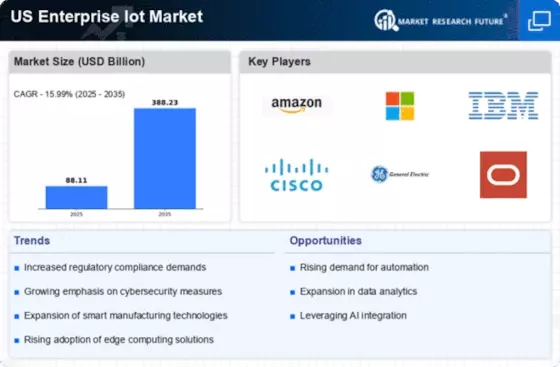
As per analysis, the US Enterprise Iot Market is projected to grow from USD 75.96 Billion in 2024 to USD 388.23 Billion by 2035, exhibiting a compound annual growth rate (CAGR) of 15.99% during the forecast period (2025 - 2035).

Key Market Trends & Highlights

The US Enterprise IoT Market is poised for substantial growth driven by technological advancements and increasing demand for automation.

  • The Asset Tracking segment remains the largest contributor to the US Enterprise IoT Market, reflecting a strong emphasis on operational efficiency.
  • Predictive Maintenance is emerging as the fastest-growing segment, driven by the need for enhanced reliability and reduced downtime.
  • Manufacturing continues to dominate the market, while Healthcare is rapidly gaining traction as a key area for IoT applications.
  • The growing demand for automation and increased investment in smart manufacturing are pivotal drivers of market expansion.

Market Size & Forecast

2024 Market Size 75.96 (USD Billion)
2035 Market Size 388.23 (USD Billion)
CAGR (2025 - 2035) 15.99%

Major Players

Amazon (US), Microsoft (US), IBM (US), Cisco (US), GE (US), Oracle (US), Intel (US), Siemens (US), Honeywell (US)

Our Impact
Enabled $4.3B Revenue Impact for Fortune 500 and Leading Multinationals
Partnering with 2000+ Global Organizations Each Year
30K+ Citations by Top-Tier Firms in the Industry

US Enterprise IoT Market Trends

The US Enterprise IoT Market is currently experiencing a transformative phase, characterized by the integration of advanced technologies and innovative solutions. Organizations across various sectors are increasingly adopting IoT devices to enhance operational efficiency, improve decision-making, and drive cost savings. This trend is propelled by the growing need for real-time data analytics and automation, which are essential for maintaining competitiveness in a rapidly evolving business landscape. Furthermore, the emphasis on sustainability and energy efficiency is prompting enterprises to leverage IoT solutions that facilitate smarter resource management and reduce environmental impact. In addition, the regulatory environment in the United States is evolving to support the expansion of IoT technologies. Government initiatives aimed at fostering innovation and ensuring cybersecurity are likely to shape the future of the US Enterprise IoT Market. As businesses continue to navigate the complexities of digital transformation, the demand for secure, scalable, and interoperable IoT solutions is expected to rise. This dynamic landscape presents both challenges and opportunities for stakeholders, as they seek to harness the potential of IoT to drive growth and enhance customer experiences.

Increased Focus on Cybersecurity

As the US Enterprise IoT Market expands, the emphasis on cybersecurity becomes paramount. Organizations are recognizing the vulnerabilities associated with interconnected devices and are investing in robust security measures to protect sensitive data. This trend indicates a shift towards prioritizing security protocols and compliance with regulations, ensuring that IoT deployments are resilient against potential threats.

Integration of Artificial Intelligence

The integration of artificial intelligence within IoT systems is gaining traction in the US Enterprise IoT Market. Businesses are leveraging AI to analyze vast amounts of data generated by IoT devices, enabling predictive analytics and automated decision-making. This trend suggests a move towards smarter, more autonomous systems that can optimize operations and enhance overall efficiency.

Adoption of Edge Computing

Edge computing is emerging as a critical component in the US Enterprise IoT Market. By processing data closer to the source, organizations can reduce latency and improve response times. This trend highlights the need for real-time data processing capabilities, allowing enterprises to make informed decisions swiftly and effectively.

US Enterprise IoT Market Drivers

Growing Demand for Automation

The US Enterprise IoT Market is experiencing a notable surge in demand for automation across various sectors. Businesses are increasingly adopting IoT solutions to streamline operations, enhance productivity, and reduce operational costs. According to recent data, the automation market is projected to grow at a compound annual growth rate (CAGR) of approximately 10% over the next five years. This trend is particularly evident in manufacturing and logistics, where IoT devices facilitate real-time monitoring and control of processes. As organizations seek to optimize their supply chains and improve efficiency, the integration of IoT technologies becomes paramount. Consequently, the growing demand for automation is driving investments in IoT infrastructure, thereby propelling the growth of the US Enterprise IoT Market.

Rising Focus on Data Analytics

The increasing emphasis on data analytics within the US Enterprise IoT Market is driving the adoption of IoT solutions. Organizations are recognizing the value of data generated by IoT devices and are leveraging advanced analytics to derive actionable insights. This trend is particularly pronounced in sectors such as healthcare and retail, where data-driven decision-making can lead to improved outcomes and customer experiences. According to market forecasts, the data analytics market is projected to grow at a CAGR of 12% through 2026. As businesses seek to harness the power of data, the demand for IoT technologies that facilitate data collection and analysis is likely to rise, further fueling the growth of the US Enterprise IoT Market.

Expansion of Smart Infrastructure

The expansion of smart infrastructure in the United States is a significant driver of the US Enterprise IoT Market. Cities and municipalities are increasingly investing in IoT-enabled solutions to enhance urban living and improve public services. For example, smart traffic management systems utilize IoT sensors to optimize traffic flow, reduce congestion, and enhance safety. According to industry reports, investments in smart city initiatives are expected to reach over $100 billion by 2025. This trend not only fosters economic growth but also creates a conducive environment for IoT adoption across various sectors, including transportation, energy, and public safety. The ongoing development of smart infrastructure is likely to propel the US Enterprise IoT Market forward, as it necessitates the integration of advanced IoT technologies.

Increased Investment in Smart Manufacturing

The US Enterprise IoT Market is witnessing a significant increase in investment in smart manufacturing technologies. Companies are adopting IoT solutions to enhance production efficiency, reduce downtime, and improve product quality. The smart manufacturing market is projected to reach $400 billion by 2025, driven by the need for real-time monitoring and predictive maintenance. IoT devices enable manufacturers to collect and analyze data from machinery, leading to informed decision-making and optimized operations. This trend is indicative of a broader shift towards Industry 4.0, where interconnected systems and automation play a crucial role. As manufacturers continue to invest in IoT technologies, the US Enterprise IoT Market is poised for substantial growth.

Regulatory Support and Standards Development

The US Enterprise IoT Market benefits from increasing regulatory support and the development of standards that promote the safe and effective deployment of IoT technologies. Government initiatives aimed at fostering innovation and ensuring cybersecurity are crucial in shaping the market landscape. For instance, the National Institute of Standards and Technology (NIST) has been actively working on frameworks that guide IoT implementation across various sectors. This regulatory environment not only enhances consumer trust but also encourages businesses to invest in IoT solutions. As a result, the establishment of clear guidelines and standards is likely to facilitate the growth of the US Enterprise IoT Market, making it more attractive for both new entrants and established players.


Market Segment Insights

By Application: Asset Tracking (Largest) vs. Predictive Maintenance (Fastest-Growing)

In the US Enterprise IoT Market, the application segment is dominated by Asset Tracking, which holds the largest market share. This segment benefits from the growing need for operational efficiency and real-time visibility in supply chain processes. Following closely, Predictive Maintenance is emerging as a crucial application, leveraging IoT capabilities to enhance machinery reliability and reduce downtime. Together, these two applications significantly shape the landscape of the market. The growth trends indicate a shift towards more integrated IoT solutions, particularly in predictive maintenance technologies. This is driven by the desire for enhanced operational efficiencies and reduced operational costs. Additionally, the rapid advancements in machine learning and analytics are enabling organizations to implement predictive models that anticipate equipment failures, thus driving the adoption of this application in various industries.

Asset Tracking (Dominant) vs. Remote Monitoring (Emerging)

Asset Tracking is positioned as the dominant application within the US Enterprise IoT Market, characterized by its ability to enhance visibility and control over physical assets in real time. This technology captures location data and monitors asset conditions, ultimately contributing to better inventory management and loss prevention. In contrast, Remote Monitoring is an emerging segment, utilizing IoT sensors to track performance and operational metrics from afar. This application is gaining traction due to the increased demand for remote system management, especially in industries like healthcare and utilities, where continuous monitoring can lead to significant operational savings and improved service delivery.

By End Use: Manufacturing (Largest) vs. Healthcare (Fastest-Growing)

In the US Enterprise IoT Market, the manufacturing sector holds the largest share, driven by the need for automation and efficiency. This sector is increasingly adopting IoT solutions to enhance production processes, monitor equipment health, and streamline supply chains. Additionally, manufacturing accounts for a significant portion of IoT deployments, reflecting its pivotal role in the broader industry landscape. On the other hand, the healthcare sector is emerging as the fastest-growing segment. The adoption of wearables, telehealth solutions, and smart medical devices is propelling growth in this area. Innovations such as remote patient monitoring and data analytics are becoming crucial in enhancing patient care and operational efficiencies within healthcare facilities, making it an appealing target for IoT investments.

Healthcare (Dominant) vs. Transportation (Emerging)

In the US Enterprise IoT Market, healthcare is dominating the landscape through the integration of IoT technologies that improve patient outcomes and operational efficiencies. This sector is focused on leveraging data analytics, artificial intelligence, and connected devices to streamline processes, enhance patient monitoring, and reduce operational costs. Meanwhile, transportation is viewed as an emerging segment with vast potential for IoT applications. The rise in connected vehicles and smart logistics solutions is transforming this sector, promoting better fleet management, real-time tracking, and improved safety measures. As urban mobility trends evolve and sustainability becomes a priority, both sectors are poised for continued expansion and innovation.

By Connectivity Technology: Cellular (Largest) vs. LPWAN (Fastest-Growing)

In the US Enterprise IoT market, connectivity technologies are crucial for seamless integration and operation. Among these, Cellular stands out as the largest segment, capturing a significant portion of the market share, driven by the widespread adoption of mobile networks for IoT applications. Wi-Fi and Bluetooth also hold substantial shares but are often overshadowed by the robust capabilities of Cellular networks in providing reliable and extensive coverage for various enterprise applications. LPWAN, while smaller in overall share, is swiftly gaining traction as organizations seek cost-effective solutions for low-data-rate IoT devices in rural and remote areas.

Cellular: Dominant vs. LPWAN: Emerging

Cellular technology is predominant in the US Enterprise IoT market, valued for its reliability, speed, and wide geographic coverage. It supports a vast range of applications from smart cities to remote monitoring. Meanwhile, LPWAN is emerging as a significant player, tailored for low-power devices requiring minimal bandwidth and extensive battery life. Its appeal lies in enabling long-range communication with lower operational costs, making it ideal for deployments in agriculture, logistics, and utilities. As enterprises continuously explore innovative IoT solutions, both technologies are expected to coexist, catering to diverse use cases.

By Deployment Model: Cloud-Based (Largest) vs. Hybrid (Fastest-Growing)

In the US Enterprise IoT Market, the deployment model segment reflects a diverse landscape with distinct technologies leading the way. Cloud-Based deployment has emerged as the largest segment, benefitting from the convenience of remote access, scalability, and reduced infrastructure costs. In contrast, Hybrid deployment has carved a niche for itself, combining the benefits of both on-premises and cloud solutions, catering to organizations seeking flexibility without compromising security.

Cloud-Based (Dominant) vs. Hybrid (Emerging)

The Cloud-Based deployment model is characterized by its ability to provide extensive data storage options and seamless integration capabilities, making it a preferred choice for enterprises looking to modernize their operations. It offers organizations the ability to manage IoT devices and applications effectively while eliminating the need for significant capital investment in hardware. On the other hand, the Hybrid model is gaining momentum, as it allows businesses to maintain control over sensitive data while leveraging the cloud for less critical processes. This hybrid approach addresses the growing concern for data security and regulatory compliance, which is vital in the US market, thus making it an attractive option for enterprises.

By Device Type: Sensors (Largest) vs. Actuators (Fastest-Growing)

In the US Enterprise IoT market, the device type segment is prominently led by sensors, which capture critical data across various environments and applications. These devices represent the largest share within the market due to their extensive adoption in smart manufacturing, smart cities, and healthcare. Meanwhile, actuators are emerging as the fastest-growing segment, driven by the increasing demand for automation and control in industrial processes and home automation systems.

Sensors (Dominant) vs. Actuators (Emerging)

Sensors are the dominant force in the device type segment, known for their ability to monitor a wide range of environmental factors and operational parameters. Their versatility allows them to be integral to various industries, from manufacturing to agriculture. On the other hand, actuators are categorized as emerging devices, gaining significant traction due to advancements in automation technology. They serve as critical components in systems requiring precise control and movement, thereby complementing sensors by transforming digital signals into physical actions, enhancing overall operational efficiency.

Get more detailed insights about US Enterprise IoT Market

Key Players and Competitive Insights

The Enterprise IoT Market is currently characterized by a dynamic competitive landscape, driven by rapid technological advancements and increasing demand for automation across various sectors. Key players such as Amazon (US), Microsoft (US), and IBM (US) are strategically positioned to leverage their extensive cloud infrastructures and AI capabilities. Amazon (US) focuses on enhancing its IoT services through its AWS platform, while Microsoft (US) emphasizes integrating IoT solutions with its Azure cloud services. IBM (US) is concentrating on industry-specific IoT applications, particularly in manufacturing and healthcare, which collectively shape a competitive environment that is increasingly reliant on innovation and strategic partnerships.
In terms of business tactics, companies are localizing manufacturing and optimizing supply chains to enhance operational efficiency. The market structure appears moderately fragmented, with a mix of established players and emerging startups. The collective influence of these key players fosters a competitive atmosphere where collaboration and technological integration are paramount.
In December 2025, Amazon (US) announced the launch of a new IoT service aimed at smart home integration, which is expected to enhance user experience and drive customer engagement. This strategic move underscores Amazon's commitment to expanding its IoT ecosystem and solidifying its market leadership. The introduction of this service may also stimulate competition among other players, compelling them to innovate further.
In November 2025, Microsoft (US) unveiled a partnership with a leading automotive manufacturer to develop IoT solutions for connected vehicles. This collaboration is significant as it not only broadens Microsoft's IoT application scope but also positions it at the forefront of the automotive industry's digital transformation. Such partnerships are likely to enhance Microsoft's competitive edge by integrating advanced analytics and AI into vehicle systems.
In October 2025, IBM (US) launched a new suite of IoT solutions tailored for the healthcare sector, focusing on remote patient monitoring and data analytics. This initiative reflects IBM's strategic pivot towards addressing critical industry needs, potentially leading to improved patient outcomes and operational efficiencies. The emphasis on healthcare IoT solutions may also attract new clients and partnerships, further solidifying IBM's market presence.
As of January 2026, current trends in the Enterprise IoT Market include a pronounced focus on digitalization, sustainability, and AI integration. Strategic alliances are increasingly shaping the competitive landscape, enabling companies to pool resources and expertise. Looking ahead, competitive differentiation is likely to evolve from traditional price-based competition to a focus on innovation, technology, and supply chain reliability. This shift may redefine market dynamics, compelling companies to invest in cutting-edge technologies and sustainable practices to maintain their competitive advantage.

Key Companies in the US Enterprise IoT Market include

Future Outlook

US Enterprise IoT Market Future Outlook

The US Enterprise IoT Market is projected to grow at a 15.99% CAGR from 2025 to 2035, driven by advancements in connectivity, data analytics, and automation technologies.

New opportunities lie in:

  • Development of AI-driven predictive maintenance solutions Integration of IoT with blockchain for enhanced security Expansion of smart supply chain management platforms

By 2035, the market is expected to be robust, driven by innovative solutions and strategic partnerships.

Market Segmentation

US Enterprise IoT Market End Use Outlook

  • Manufacturing
  • Transportation
  • Healthcare
  • Energy
  • Retail

US Enterprise IoT Market Application Outlook

  • Asset Tracking
  • Predictive Maintenance
  • Smart Metering
  • Supply Chain Management
  • Remote Monitoring

US Enterprise IoT Market Device Type Outlook

  • Sensors
  • Actuators
  • Gateways
  • Controllers

US Enterprise IoT Market Deployment Model Outlook

  • On-Premises
  • Cloud-Based
  • Hybrid

US Enterprise IoT Market Connectivity Technology Outlook

  • Cellular
  • Wi-Fi
  • Bluetooth
  • LPWAN
  • Satellite

Report Scope

MARKET SIZE 2024 75.96(USD Billion)
MARKET SIZE 2025 89.42(USD Billion)
MARKET SIZE 2035 388.23(USD Billion)
COMPOUND ANNUAL GROWTH RATE (CAGR) 15.99% (2024 - 2035)
REPORT COVERAGE Revenue Forecast, Competitive Landscape, Growth Factors, and Trends
BASE YEAR 2024
Market Forecast Period 2025 - 2035
Historical Data 2019 - 2024
Market Forecast Units USD Billion
Key Companies Profiled Amazon (US), Microsoft (US), IBM (US), Cisco (US), GE (US), Oracle (US), Intel (US), Siemens (US), Honeywell (US)
Segments Covered Application, End Use, Connectivity Technology, Deployment Model, Device Type
Key Market Opportunities Integration of advanced analytics and artificial intelligence in US Enterprise IoT solutions enhances operational efficiency.
Key Market Dynamics Rising demand for smart manufacturing solutions drives innovation and competition in the US Enterprise IoT Market.
Countries Covered US
Leave a Comment

FAQs

What is the current valuation of the US Enterprise IoT Market?

As of 2024, the US Enterprise IoT Market was valued at 75.96 USD Billion.

What is the projected market size for the US Enterprise IoT Market by 2035?

The market is projected to reach 388.23 USD Billion by 2035.

What is the expected CAGR for the US Enterprise IoT Market during the forecast period?

The expected CAGR for the US Enterprise IoT Market from 2025 to 2035 is 15.99%.

Which application segments are driving growth in the US Enterprise IoT Market?

Key application segments include Predictive Maintenance, which is projected to grow from 20.0 to 100.0 USD Billion.

How does the manufacturing sector contribute to the US Enterprise IoT Market?

The manufacturing sector is expected to grow from 15.0 to 75.0 USD Billion, indicating substantial investment.

What role do connectivity technologies play in the US Enterprise IoT Market?

Connectivity technologies like Wi-Fi are projected to expand from 20.0 to 100.0 USD Billion, highlighting their importance.

What are the leading deployment models in the US Enterprise IoT Market?

Cloud-Based deployment is anticipated to grow from 30.0 to 150.0 USD Billion, reflecting a shift towards cloud solutions.

Which device types are most prevalent in the US Enterprise IoT Market?

Gateways are projected to grow from 20.0 to 100.0 USD Billion, indicating their critical role in IoT infrastructure.

Who are the key players in the US Enterprise IoT Market?

Prominent players include Amazon, Microsoft, IBM, and Cisco, all of which are actively shaping the market landscape.

What is the significance of remote monitoring in the US Enterprise IoT Market?

Remote Monitoring is expected to grow from 10.96 to 63.23 USD Billion, underscoring its relevance in operational efficiency.

Download Free Sample

Kindly complete the form below to receive a free sample of this Report

Compare Licence

×
Features License Type
Single User Multiuser License Enterprise User
Price $4,950 $5,950 $7,250
Maximum User Access Limit 1 User Upto 10 Users Unrestricted Access Throughout the Organization
Free Customization
Direct Access to Analyst
Deliverable Format
Platform Access
Discount on Next Purchase 10% 15% 15%
Printable Versions