×
Request Free Sample ×

Kindly complete the form below to receive a free sample of this Report

* Please use a valid business email

Leading companies partner with us for data-driven Insights

clients tt-cursor
Hero Background

US Dry Construction Market

ID: MRFR/PCM/18946-HCR
100 Pages
Garvit Vyas
February 2026

US Dry Construction Market Research Report By Type (Wall Systems, Floor Systems, Ceiling Systems, Roof Systems), By End Use (Residential, Commercial, Industrial, Institutional), By Material (Gypsum Board, Lightweight Steel Frame, Fiber Cement Board, Wood Products), and By Construction Method (Prefabricated, Modular, Traditional) – Forecast to 2035

Share:
Download PDF ×

We do not share your information with anyone. However, we may send you emails based on your report interest from time to time. You may contact us at any time to opt-out.

US Dry Construction Market Infographic
Purchase Options

US Dry Construction Market Summary

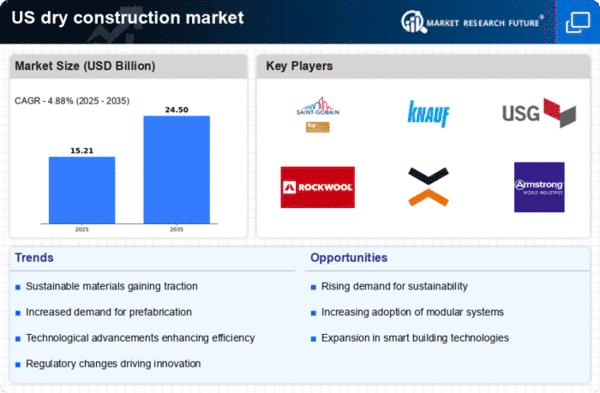
As per Market Research Future analysis, the US dry construction market Size was estimated at 14.5 USD Billion in 2024. The US dry construction market is projected to grow from 15.21 USD Billion in 2025 to 24.5 USD Billion by 2035, exhibiting a compound annual growth rate (CAGR) of 4.8% during the forecast period 2025 - 2035

Key Market Trends & Highlights

The US dry construction market is experiencing a transformative shift towards sustainability and technological advancements.

  • The market is increasingly driven by a focus on sustainability, with eco-friendly materials gaining traction.
  • Technological integration is reshaping construction processes, enhancing efficiency and reducing waste.
  • Prefabrication is emerging as a prominent trend, streamlining construction timelines and costs.
  • Key market drivers include rising labor costs and regulatory support for energy efficiency initiatives.

Market Size & Forecast

2024 Market Size 14.5 (USD Billion)
2035 Market Size 24.5 (USD Billion)
CAGR (2025 - 2035) 4.88%

Major Players

Saint-Gobain (FR), Knauf (DE), USG Corporation (US), Rockwool International (DK), Etex Group (BE), Armstrong World Industries (US), Boral Limited (AU), Siniat (FR), Gyptec (PT)

Our Impact
Enabled $4.3B Revenue Impact for Fortune 500 and Leading Multinationals
Partnering with 2000+ Global Organizations Each Year
30K+ Citations by Top-Tier Firms in the Industry

US Dry Construction Market Trends

The dry construction market is currently experiencing a notable transformation, driven by advancements in technology and evolving consumer preferences. The shift towards sustainable building practices is becoming increasingly prominent, as stakeholders seek to minimize environmental impact while enhancing energy efficiency. This trend is reflected in the growing adoption of eco-friendly materials and innovative construction techniques that reduce waste and improve overall performance. Furthermore, the integration of smart technologies into construction processes is reshaping how projects are designed and executed, leading to improved project management and cost efficiency. In addition, the demand for prefabricated and modular construction solutions is on the rise, as these methods offer significant advantages in terms of speed and flexibility. The dry construction market appears to be aligning with the broader trends of urbanization and population growth, necessitating efficient building solutions that can meet the needs of modern society. As the market continues to evolve, it is likely that stakeholders will increasingly prioritize sustainability, efficiency, and technological integration in their projects, shaping the future landscape of construction in the United States.

Sustainability Focus

There is a growing emphasis on sustainable practices within the dry construction market. Stakeholders are increasingly adopting eco-friendly materials and methods that reduce environmental impact. This trend reflects a broader societal shift towards sustainability, as consumers and businesses alike prioritize green building solutions.

Technological Integration

The integration of advanced technologies is transforming the dry construction market. Innovations such as Building Information Modeling (BIM) and smart construction tools are enhancing project efficiency and accuracy. These technologies facilitate better planning and execution, ultimately leading to cost savings and improved outcomes.

Rise of Prefabrication

Prefabrication is gaining traction in the dry construction market, offering benefits such as reduced construction time and enhanced quality control. This method allows for components to be manufactured off-site and assembled on-site, streamlining the building process and addressing labor shortages.

US Dry Construction Market Drivers

Rising Labor Costs

The escalating labor costs in the construction sector are likely to drive the adoption of dry construction methods in the United States. As skilled labor becomes increasingly scarce and expensive, construction companies are exploring alternative methods that require less labor input. The dry construction market offers solutions that can mitigate these labor challenges, as many dry construction techniques are designed for quicker assembly and reduced workforce requirements. Recent statistics indicate that labor costs in the construction industry have risen by approximately 15% over the past five years. This trend suggests that builders may increasingly turn to dry construction methods to maintain profitability while meeting project deadlines.

Increased Urbanization

The ongoing trend of urbanization in the United States appears to be a significant driver for the dry construction market. As more individuals migrate to urban areas, the demand for housing and commercial spaces intensifies. This urban influx necessitates efficient construction methods, which dry construction techniques can provide. The dry construction market is likely to benefit from this trend, as it offers faster build times and reduced labor costs. According to recent data, urban areas are projected to house approximately 85% of the US population by 2030, further amplifying the need for innovative construction solutions. Consequently, the dry construction market is positioned to meet the increasing demand for sustainable and efficient building practices in densely populated regions.

Advancements in Material Technology

Innovations in material technology are poised to significantly impact the dry construction market. The development of new, lightweight, and durable materials enhances the efficiency and effectiveness of dry construction methods. These advancements allow for quicker installation and improved performance characteristics, such as better insulation and fire resistance. The dry construction market is likely to benefit from these technological improvements, as they align with the growing demand for high-performance building solutions. For instance, the introduction of advanced gypsum boards and insulation materials has revolutionized the way structures are built, making dry construction an increasingly attractive option for builders and developers.

Consumer Preference for Customization

The evolving consumer preference for customized living and working spaces is emerging as a key driver for the dry construction market. As clients seek unique designs and personalized features, the flexibility offered by dry construction methods becomes increasingly appealing. The dry construction market can cater to these demands through modular and prefabricated solutions that allow for greater design freedom. Recent surveys indicate that over 60% of homebuyers express a desire for customizable features in their new homes. This trend suggests that builders who adopt dry construction techniques may gain a competitive edge by offering tailored solutions that meet the specific needs of their clients.

Regulatory Support for Energy Efficiency

Regulatory frameworks in the United States increasingly emphasize energy efficiency and sustainability, which may bolster the dry construction market. Government initiatives and incentives aimed at reducing energy consumption in buildings are becoming more prevalent. The dry construction market stands to gain from these regulations, as many dry construction materials and methods are inherently energy-efficient. For instance, the implementation of the Energy Policy Act has led to a surge in demand for energy-efficient building materials, which aligns with the principles of dry construction. This regulatory support not only encourages the adoption of dry construction techniques but also enhances the market's growth potential, as builders seek to comply with stringent energy standards.

Market Segment Insights

By Type: Wall Systems (Largest) vs. Floor Systems (Fastest-Growing)

In the US dry construction market, Wall Systems hold the largest market share, driven by their essential role in building infrastructure and interiors. Following closely, Floor Systems are witnessing rapid growth as construction projects increasingly focus on efficiency and speed of installation, thus bolstering their presence in the market. The growth trends for these segments reflect the ongoing advancements in materials technology and construction methodologies. Rising demand for energy-efficient and sustainable building solutions further propels the expansion of Floor Systems. Additionally, the increasing number of residential and commercial construction projects boosts the requirement for Wall Systems, solidifying their position in the market.

Wall Systems (Dominant) vs. Floor Systems (Emerging)

Wall Systems are a dominant force in the US dry construction market, known for their critical function in structural integrity and space delineation. They are preferred for their versatility and ease of installation, making them a staple across various construction projects. On the other hand, Floor Systems are emerging rapidly, favored for innovative designs and improved acoustic performance. Factors such as the shift towards modular building techniques and a growing emphasis on design aesthetics are driving the adoption of Floor Systems. The competitive landscape indicates that while Wall Systems remain a key player, Floor Systems are poised for significant growth due to changing consumer preferences and market demands.

By Material: Gypsum Board (Largest) vs. Lightweight Steel Frame (Fastest-Growing)

In the US dry construction market, the material segment is characterized by a diverse range of products, with gypsum board holding the largest market share due to its widespread use in residential and commercial construction. Lightweight steel frame is gaining traction, emerging as a popular alternative for many builders looking for reduced weight and improved durability in their projects. Fiber cement board and wood products also contribute significantly to the segment, each catering to different architectural and aesthetic requirements. The growth trends in this segment reveal an increasing demand for lightweight and sustainable construction materials. Innovations in manufacturing processes and an uptick in green building initiatives are driving the adoption of eco-friendly products like fiber cement board. Additionally, the shift towards modular construction techniques is amplifying the appeal of gypsum board and lightweight steel frames, as they meet the industry's evolving needs for efficiency and scalability.

Gypsum Board (Dominant) vs. Wood Products (Emerging)

Gypsum board has established itself as a dominant material in the US dry construction market owing to its versatility, ease of installation, and superior fire resistance. It is widely favored for interior wall and ceiling applications in various construction projects. In contrast, wood products are emerging as a prominent alternative, particularly in environmentally conscious projects where sustainability is a significant consideration. These materials offer a natural aesthetic and are increasingly being sourced from sustainable forests, aligning with growing consumer preferences for eco-friendly construction options. While gypsum board remains the go-to choice for many, the rise of wood products showcases a notable trend toward incorporating natural materials into modern design, creating a dynamic balance in the market.

By End Use: Residential (Largest) vs. Commercial (Fastest-Growing)

In the US dry construction market, the distribution of market share among end-use segments reveals that the residential sector holds the largest portion, significantly influencing the overall market dynamics. The commercial sector, while smaller in comparison, has shown a robust performance indicating its growing significance in construction activities. This distribution illustrates the diverse nature of demand across different sectors, with residential needs driving the majority of construction projects. Looking ahead, growth trends are notably shaped by increasing urbanization and demographic shifts, particularly in residential construction. The commercial segment is experiencing rapid expansion, fueled by rising demand for office spaces and retail establishments, alongside significant investments in infrastructure projects. These drivers underline the dynamic nature of the US dry construction market, suggesting a potential shift in focus towards more commercial initiatives in the coming years.

Residential (Dominant) vs. Industrial (Emerging)

The residential segment stands as the dominant force within the US dry construction market, characterized by a consistent influx of new housing projects and renovations. This segment benefits from favorable governmental policies and a growing population, ensuring a steady demand for residential construction. In contrast, the industrial segment is emerging as a critical player in the market, driven by the increasing need for warehouses, manufacturing facilities, and logistics centers. As e-commerce continues to thrive, the industrial sector is adapting to meet the needs of modern supply chains. Both segments reflect different aspects of market demand, highlighting the balance of established and evolving construction needs in the landscape.

By Construction Method: Prefabricated (Largest) vs. Modular (Fastest-Growing)

The US dry construction market displays a notable distribution among the construction method segments, with prefabricated methods holding the largest market share. This segment has gained traction due to its efficiency and cost-effectiveness. Modular construction follows closely, capturing significant attention as an innovative approach, while traditional methods maintain a foothold but are gradually being overshadowed by newer technologies. Growth trends in this segment are propelled by the increasing demand for sustainable and time-efficient construction solutions. Prefabricated construction's dominance is driven by its ability to reduce waste and improve quality control, while the rapid adoption of modular methods reflects shifting consumer preferences towards faster project delivery and flexibility. Traditional construction methods are evolving, yet they face challenges in competing with the pace of innovation in prefabricated and modular alternatives.

Prefabricated (Dominant) vs. Modular (Emerging)

Prefabricated construction is characterized by its assembly-line approach, allowing for the production of building components off-site, which can then be transported and assembled on-site, thus minimizing delays. This method not only reduces construction time but also enhances quality assurance through controlled manufacturing environments. Its sustainability aspect adds to its appeal, making it a dominant force in the industry. In contrast, modular construction is emerging due to its innovative design and faster execution. It incorporates flexible design options and adaptability, catering to diverse project needs, and is often associated with modern architectural styles. Both methods are reshaping the landscape of the US dry construction market.

Get more detailed insights about US Dry Construction Market

Key Players and Competitive Insights

The dry construction market in the US is characterized by a competitive landscape that is increasingly shaped by innovation, sustainability, and strategic partnerships. Key players such as USG Corporation (US), Saint-Gobain (FR), and Armstrong World Industries (US) are actively pursuing strategies that emphasize technological advancements and eco-friendly solutions. USG Corporation (US) has positioned itself as a leader in sustainable building materials, focusing on reducing carbon footprints through innovative product lines. Meanwhile, Saint-Gobain (FR) is leveraging its extensive research capabilities to enhance product performance and energy efficiency, thereby reinforcing its market presence. Armstrong World Industries (US) is also making strides in digital transformation, utilizing data analytics to optimize operations and improve customer engagement, which collectively shapes a dynamic competitive environment.The business tactics employed by these companies reflect a concerted effort to localize manufacturing and optimize supply chains, which are crucial in a moderately fragmented market. This competitive structure allows for a diverse range of offerings, yet the influence of major players remains significant. The collective strategies of these companies not only enhance their operational efficiencies but also contribute to a more resilient market structure, capable of adapting to changing consumer demands and regulatory pressures.

In October USG Corporation (US) announced a partnership with a leading technology firm to develop AI-driven solutions for construction project management. This strategic move is expected to streamline operations and reduce project timelines, thereby enhancing overall productivity. The integration of AI into their processes signifies a forward-thinking approach that could set new industry standards and improve competitive positioning.

In September Saint-Gobain (FR) launched a new line of eco-friendly insulation products designed to meet the growing demand for sustainable building materials. This initiative not only aligns with global sustainability goals but also positions the company as a frontrunner in the green building movement. The introduction of these products is likely to attract environmentally conscious consumers and strengthen Saint-Gobain's market share.

In August Armstrong World Industries (US) expanded its manufacturing capabilities by investing in a new facility focused on advanced ceiling solutions. This expansion is anticipated to enhance production efficiency and meet the increasing demand for innovative ceiling systems. By investing in state-of-the-art technology, Armstrong aims to solidify its competitive edge and respond effectively to market trends.

As of November the competitive trends in the dry construction market are increasingly defined by digitalization, sustainability, and the integration of advanced technologies such as AI. Strategic alliances are becoming pivotal in shaping the landscape, allowing companies to pool resources and expertise. The shift from price-based competition to a focus on innovation, technology, and supply chain reliability is evident, suggesting that future competitive differentiation will hinge on the ability to adapt to these evolving trends.

Key Companies in the US Dry Construction Market include

Future Outlook

US Dry Construction Market Future Outlook

The dry construction market is projected to grow at a 4.88% CAGR from 2025 to 2035, driven by technological advancements, sustainability trends, and increasing demand for efficient building solutions.

New opportunities lie in:

  • Development of modular construction techniques for faster project delivery.
  • Integration of smart building technologies to enhance energy efficiency.
  • Expansion of eco-friendly material offerings to meet sustainability regulations.

By 2035, the dry construction market is expected to achieve robust growth, driven by innovation and sustainability.

Market Segmentation

US Dry Construction Market Type Outlook

  • Wall Systems
  • Floor Systems
  • Ceiling Systems
  • Roof Systems

US Dry Construction Market End Use Outlook

  • Residential
  • Commercial
  • Industrial
  • Institutional

US Dry Construction Market Material Outlook

  • Gypsum Board
  • Lightweight Steel Frame
  • Fiber Cement Board
  • Wood Products

US Dry Construction Market Construction Method Outlook

  • Prefabricated
  • Modular
  • Traditional

Report Scope

MARKET SIZE 2024 14.5(USD Billion)
MARKET SIZE 2025 15.21(USD Billion)
MARKET SIZE 2035 24.5(USD Billion)
COMPOUND ANNUAL GROWTH RATE (CAGR) 4.88% (2025 - 2035)
REPORT COVERAGE Revenue Forecast, Competitive Landscape, Growth Factors, and Trends
BASE YEAR 2024
Market Forecast Period 2025 - 2035
Historical Data 2019 - 2024
Market Forecast Units USD Billion
Key Companies Profiled Saint-Gobain (FR), Knauf (DE), USG Corporation (US), Rockwool International (DK), Etex Group (BE), Armstrong World Industries (US), Boral Limited (AU), Siniat (FR), Gyptec (PT)
Segments Covered Type, Material, End Use, Construction Method
Key Market Opportunities Integration of sustainable materials and technologies enhances efficiency in the dry construction market.
Key Market Dynamics Technological advancements drive efficiency and sustainability in the dry construction market, reshaping competitive dynamics.
Countries Covered US
Leave a Comment
Download Free Sample

Kindly complete the form below to receive a free sample of this Report

Compare Licence

×
Features License Type
Single User Multiuser License Enterprise User
Price $4,950 $5,950 $7,250
Maximum User Access Limit 1 User Upto 10 Users Unrestricted Access Throughout the Organization
Free Customization
Direct Access to Analyst
Deliverable Format
Platform Access
Discount on Next Purchase 10% 15% 15%
Printable Versions