×
Request Free Sample ×

Kindly complete the form below to receive a free sample of this Report

* Please use a valid business email

Leading companies partner with us for data-driven Insights

clients tt-cursor
Hero Background

US Catalyst Fertilizer Market

ID: MRFR/Agri/19208-HCR
128 Pages
Garvit Vyas
February 2026

US Catalyst Fertilizer Market Size, Share, Industry Trend & Analysis Research Report: By Application (Nitrogenous Fertilizers, Phosphatic Fertilizers, Potassic Fertilizers, Complex Fertilizers), By Form (Solid, Liquid, Granular), By Production Method (Haber-Bosch Process, Contact Process, Others) andBy End Use (Agriculture, Horticulture, Forestry)- Forecast to 2035

Share:
Download PDF ×

We do not share your information with anyone. However, we may send you emails based on your report interest from time to time. You may contact us at any time to opt-out.

US Catalyst Fertilizer Market Infographic
Purchase Options

US Catalyst Fertilizer Market Summary

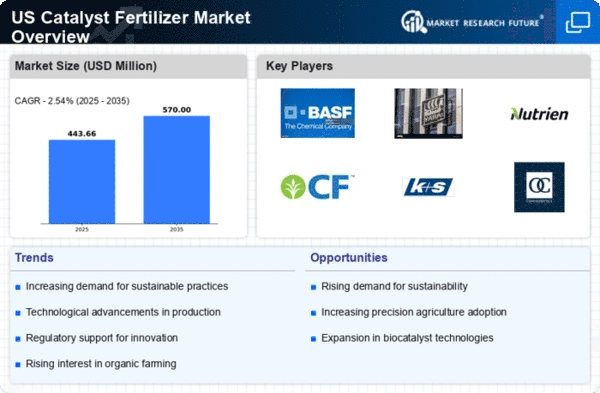
As per Market Research Future analysis, the US Catalyst Fertilizer Market Size was estimated at 432.67 USD Million in 2024. The US catalyst fertilizer market is projected to grow from 443.66 USD Million in 2025 to 570.0 USD Million by 2035, exhibiting a compound annual growth rate (CAGR) of 2.5% during the forecast period 2025 - 2035

Key Market Trends & Highlights

The US The catalyst fertilizer market is experiencing a shift towards sustainable practices. Additionally, technological advancements are playing a significant role.

  • Sustainable practices adoption is becoming increasingly prevalent among farmers, reflecting a broader trend towards environmental responsibility.
  • Technological innovations in fertilizer production are enhancing efficiency and effectiveness, driving market growth.
  • Precision agriculture integration is gaining traction, allowing for more targeted and efficient use of fertilizers.
  • Rising demand for food production and government initiatives are key drivers propelling the catalyst fertilizer market forward.

Market Size & Forecast

2024 Market Size 432.67 (USD Million)
2035 Market Size 570.0 (USD Million)
CAGR (2025 - 2035) 2.54%

Major Players

BASF SE (DE), Yara International ASA (NO), Nutrien Ltd (CA), CF Industries Holdings Inc (US), K+S AG (DE), OCI N.V. (NL), Mosaic Company (US), SABIC (SA)

Our Impact
Enabled $4.3B Revenue Impact for Fortune 500 and Leading Multinationals
Partnering with 2000+ Global Organizations Each Year
30K+ Citations by Top-Tier Firms in the Industry

US Catalyst Fertilizer Market Trends

The catalyst fertilizer market is currently experiencing a dynamic phase. This phase is characterized by evolving agricultural practices and an increasing demand for sustainable farming solutions. As environmental concerns gain prominence, there is a noticeable shift towards fertilizers that enhance crop yield while minimizing ecological impact. This trend is driven by both regulatory frameworks and consumer preferences, which increasingly favor products that align with sustainable agriculture principles. Furthermore, advancements in technology are facilitating the development of innovative catalyst fertilizers that optimize nutrient delivery and improve soil health. In addition, the catalyst fertilizer market is witnessing a rise in research and development activities aimed at creating more efficient formulations. These efforts are likely to enhance the effectiveness of fertilizers, thereby supporting farmers in achieving higher productivity levels. The integration of precision agriculture techniques is also becoming more prevalent, allowing for targeted application of fertilizers based on specific crop needs. This approach not only maximizes resource utilization but also contributes to reducing waste and environmental degradation. Overall, the catalyst fertilizer market appears poised for growth as it adapts to the changing landscape of agricultural demands and sustainability goals.

Sustainable Practices Adoption

There is a growing emphasis on sustainable agricultural practices within the catalyst fertilizer market. Farmers are increasingly seeking fertilizers that not only boost crop yields but also adhere to environmental standards. This trend is influenced by consumer demand for eco-friendly products and regulatory pressures aimed at reducing chemical runoff and soil degradation.

Technological Innovations

Technological advancements are playing a crucial role in shaping the catalyst fertilizer market. Innovations in formulation and application methods are enhancing the efficiency of fertilizers. These developments enable better nutrient absorption by plants, which can lead to improved crop performance and reduced environmental impact.

Precision Agriculture Integration

The integration of precision agriculture techniques is transforming the catalyst fertilizer market. By utilizing data-driven approaches, farmers can apply fertilizers more accurately based on specific crop requirements. This not only optimizes resource use but also minimizes waste, aligning with sustainability objectives.

US Catalyst Fertilizer Market Drivers

Growing Awareness of Soil Health

The catalyst fertilizer market is benefiting from a growing awareness of soil health. This awareness is shared among farmers and agricultural stakeholders. As the understanding of soil microbiomes and their role in crop productivity expands, there is an increasing emphasis on using fertilizers that enhance soil quality. In the US, educational programs and workshops are promoting the importance of soil health, leading to a shift in fertilizer usage towards products that support sustainable practices. This trend is likely to drive demand for catalyst fertilizers, which are formulated to improve soil structure and nutrient availability. The market could experience a growth rate of approximately 4% as more farmers recognize the long-term benefits of investing in soil health through the use of advanced fertilizers.

Rising Demand for Food Production

The catalyst fertilizer market is experiencing a surge in demand driven by the increasing need for food production. As the global population continues to grow, projected to reach approximately 9.7 billion by 2050, the agricultural sector faces immense pressure to enhance crop yields. In the US, the agricultural output must rise significantly to meet this demand, leading to a greater reliance on catalyst fertilizers. These fertilizers improve nutrient efficiency and promote sustainable farming practices, which are essential for maximizing productivity. The market is expected to witness a compound annual growth rate (CAGR) of around 5% over the next few years, indicating a robust growth trajectory fueled by the necessity for increased food supply.

Government Initiatives and Subsidies

Government initiatives play a crucial role in shaping the catalyst fertilizer market. In the US, various federal and state programs provide financial incentives and subsidies to farmers adopting advanced fertilizer technologies. These initiatives aim to promote sustainable agricultural practices and enhance food security. For instance, the USDA has implemented programs that encourage the use of environmentally friendly fertilizers, which can lead to improved soil health and crop productivity. As a result, the catalyst fertilizer market is likely to benefit from increased adoption rates among farmers, potentially leading to a market growth of approximately 4% annually. Such support from government entities is pivotal in driving innovation and ensuring the long-term viability of the agricultural sector.

Environmental Regulations and Compliance

The catalyst fertilizer market is significantly influenced by stringent environmental regulations. These regulations aim to reduce agricultural runoff and promote sustainable practices. In the US, regulatory bodies such as the Environmental Protection Agency (EPA) enforce guidelines that require farmers to adopt fertilizers that minimize environmental impact. Compliance with these regulations often necessitates the use of catalyst fertilizers, which are designed to enhance nutrient uptake and reduce waste. This regulatory landscape is expected to propel the market forward, as farmers seek solutions that align with environmental standards. The catalyst fertilizer market could see an increase in demand of around 6% as farmers adapt to these regulations, ensuring both compliance and improved agricultural efficiency.

Technological Advancements in Fertilizer Production

Technological advancements are reshaping the catalyst fertilizer market, leading to more efficient production processes and enhanced product formulations. Innovations in chemical engineering and materials science have resulted in the development of new catalyst fertilizers that offer improved nutrient release profiles and better crop absorption rates. In the US, research institutions and private companies are investing heavily in R&D to create fertilizers that not only boost yields but also minimize environmental impact. This focus on innovation is likely to drive market growth, with projections indicating a potential increase of 5% in market size over the next few years. The integration of cutting-edge technologies is essential for meeting the evolving needs of the agricultural sector.


Market Segment Insights

By Application: Nitrogenous Fertilizers (Largest) vs. Complex Fertilizers (Fastest-Growing)

In the US catalyst fertilizer market, the distribution of market share among different application segments reveals that nitrogenous fertilizers hold the largest share, significantly dominating the overall landscape. Following them, phosphatic and potassic fertilizers capture notable portions, while complex fertilizers are emerging as key contributors to market dynamics. These segments collectively cater to diverse agricultural needs, with varying nutrient requirements driving their distinct positions within the market. The growth trends within the application segment indicate a shift towards complex fertilizers, which are becoming increasingly popular due to their balanced nutrient composition. Factors propelling this growth include the rising demand for sustainable agricultural practices and enhanced crop yields. Additionally, technological advancements in fertilizer production are enabling the introduction of innovative complex formulations, further enticing farmers and agricultural businesses in the US catalyst fertilizer market.

Nitrogenous Fertilizers (Dominant) vs. Complex Fertilizers (Emerging)

Nitrogenous fertilizers serve as the dominant segment in the US catalyst fertilizer market, primarily due to their essential role in boosting crop production through nitrogen supply, which is crucial for plant growth. This segment includes various products, such as urea and ammonium nitrate, valued for their effectiveness and efficiency. Their prevalence in agricultural practices stems from their ability to significantly enhance soil fertility and crop performance. In contrast, complex fertilizers are emerging as a popular alternative, as they offer a well-rounded approach to nutrition by combining multiple nutrients into a single product. This characteristic appeals to modern farming practices, where efficiency and tailored nutrition plans are critical for maximizing yields. As agricultural practices evolve, both segments are expected to play pivotal roles in shaping the market.

By Form: Solid (Largest) vs. Liquid (Fastest-Growing)

In the US catalyst fertilizer market, the form segment showcases a diverse distribution among solid, liquid, and granular fertilizers. Solid fertilizers hold the largest market share, benefiting from their established application methods and cost-effectiveness. In contrast, liquid fertilizers are gaining traction due to their ease of application and quicker absorption rates, appealing to modern agricultural practices that prioritize efficiency and yield enhancement. Granular fertilizers maintain a steady presence, offering specialized options for various crops, yet they lag behind in overall preference compared to solids and liquids. Growth trends within the form segment are notably driven by the increasing demand for efficient and effective crop nutrient management. Solid fertilizers, although dominant, face challenges from the rapidly expanding liquid segment, which is favored for its versatility in various farming techniques. Innovations in formulation and application technology are propelling liquid fertilizers as the fastest-growing option, while granular fertilizers are seeking to carve out niche markets with specialized formulations tailored for high-value crops. The increasing focus on sustainable agriculture practices is also influencing the shift towards liquid and specialty fertilizers as growers seek optimized solutions for nutrient delivery.

Solid (Dominant) vs. Liquid (Emerging)

Solid fertilizers are characterized by their long shelf life and cost advantages, making them the dominant choice in the US catalyst fertilizer market. They often come in simple forms, allowing easy application and storage, catering to large-scale agriculture where efficiency is key. However, the liquid fertilizer segment is emerging rapidly, driven by advancements in formulation technology and the increasing demand for quicker nutrient uptake by crops. Liquid fertilizers provide flexibility in application methods and often deliver nutrients more efficiently, which is appealing in precision farming practices. As growers continue to strive for higher yields and more efficient use of resources, liquid fertilizers are gaining a foothold, complemented by ongoing innovations that enhance their market position.

By Production Method: Haber-Bosch Process (Largest) vs. Contact Process (Fastest-Growing)

The distribution of market share within the production methods reveals a clear dominance of the Haber-Bosch Process, holding the largest share due to its established efficiency and scalability in producing nitrogen-based fertilizers. The Contact Process, while smaller in share, has been gaining traction among manufacturers looking for innovative methods to create phosphorous fertilizers, showcasing a competitive landscape among the production techniques in use. In terms of growth trends, the segment is witnessing an increasing shift towards more sustainable practices. The Haber-Bosch Process, though traditional, is being optimized for improved energy efficiency, while the Contact Process is evolving rapidly with technology advancements making it more appealing. Additionally, environmental regulations are driving demand for both processes, compelling manufacturers to optimize their operations and invest in new technologies.

Haber-Bosch Process (Dominant) vs. Contact Process (Emerging)

The Haber-Bosch Process remains the dominant method in the production landscape, characterized by its high efficiency in synthesizing ammonia from nitrogen and hydrogen, thus serving as the backbone of nitrogen fertilizer production. Its widespread adoption is attributed to its cost-effectiveness and scalability in meeting large agricultural demands. Conversely, the Contact Process is emerging as a competitive alternative, particularly for phosphorous fertilizers, benefiting from technological advancements that enhance its efficiency and reduce environmental impact. This method is gaining attention as agricultural practices shift towards sustainability, offering a promising growth trajectory amid rising interest in eco-friendly production methodologies.

By End-Use: Agriculture (Largest) vs. Horticulture (Fastest-Growing)

In the US catalyst fertilizer market, the Agriculture segment holds the largest share, representing a significant portion of the overall market. The Agriculture segment is driven by the increasing demands of food production and the necessity for enhanced crop yields, leading to substantial investments in catalyst fertilizers. Conversely, the Horticulture segment is witnessing rapid growth, fueled by the rise in ornamental plant cultivation and urban gardening practices, making it a key area of focus for market players. Growth trends in the US catalyst fertilizer market indicate a robust expansion across both Agriculture and Horticulture segments. Factors such as the growing population, the push for sustainable farming practices, and technological advancements in fertilizer formulations are propelling this growth. The diversification of crop types and the rising interest in eco-friendly products are key drivers, reinforcing the significance of catalyst fertilizers in optimizing access to essential nutrients for various end-use applications.

Agriculture: Dominant vs. Horticulture: Emerging

The Agriculture segment stands as the dominant force within the US catalyst fertilizer market, essential for maximizing crop productivity and minimizing environmental impact. This segment encompasses a wide variety of crops, from grains to fruits, necessitating specific fertilizer formulations tailored to improve nutrient absorption and soil health. In contrast, the Horticulture segment is emerging rapidly, characterized by a growing interest in landscaping, ornamental plants, and sustainable urban gardening solutions. Horticulturists are increasingly seeking advanced fertilizers that not only cater to aesthetic preferences but also promote plant health through innovative, eco-friendly compositions. As these segments evolve, the demand for sophisticated catalyst fertilizers is expected to rise, highlighting the need for continued innovation and adaptation in product offerings.

Get more detailed insights about US Catalyst Fertilizer Market

Key Players and Competitive Insights

The catalyst fertilizer market is currently characterized by a dynamic competitive landscape, driven by increasing agricultural demands and the need for sustainable farming practices. Key players such as BASF SE (DE), Yara International ASA (NO), and CF Industries Holdings Inc (US) are actively shaping the market through strategic initiatives focused on innovation and sustainability. BASF SE (DE) emphasizes its commitment to developing advanced catalyst technologies that enhance fertilizer efficiency, while Yara International ASA (NO) is investing in digital farming solutions to optimize crop yields. CF Industries Holdings Inc (US) is also focusing on expanding its production capabilities to meet the growing demand for nitrogen-based fertilizers, thereby reinforcing its market position.In terms of business tactics, companies are increasingly localizing manufacturing and optimizing supply chains to enhance operational efficiency. The market appears moderately fragmented, with several key players exerting considerable influence. This competitive structure allows for a diverse range of products and services, catering to various agricultural needs. The collective strategies of these companies indicate a trend towards collaboration and innovation, which is likely to reshape the market dynamics in the coming years.

In October Yara International ASA (NO) announced a partnership with a leading tech firm to develop AI-driven solutions for precision agriculture. This strategic move is expected to enhance the efficiency of fertilizer application, thereby reducing waste and improving crop yields. The integration of AI technology into their operations signifies a shift towards more data-driven decision-making processes, which could set a new standard in the industry.

In September CF Industries Holdings Inc (US) unveiled plans to invest $500 million in expanding its production facilities in the Midwest. This expansion aims to increase the company’s output of nitrogen fertilizers, addressing the rising demand from farmers. Such a significant investment not only strengthens CF Industries' market presence but also reflects a broader trend of companies scaling up operations to meet the needs of a growing agricultural sector.

In August BASF SE (DE) launched a new line of eco-friendly catalyst fertilizers designed to minimize environmental impact. This initiative aligns with global sustainability goals and positions BASF as a leader in environmentally responsible practices within the fertilizer sector. The introduction of these products is likely to attract environmentally conscious consumers and enhance the company's competitive edge.

As of November the catalyst fertilizer market is witnessing trends such as digitalization, sustainability, and the integration of advanced technologies like AI. Strategic alliances among key players are becoming increasingly common, fostering innovation and enhancing competitive positioning. Looking ahead, the competitive differentiation in this market is expected to evolve, with a notable shift from price-based competition to a focus on innovation, technology, and supply chain reliability. Companies that successfully leverage these trends will likely secure a stronger foothold in the market.

Key Companies in the US Catalyst Fertilizer Market include

Industry Developments

The US Catalyst Fertilizer Market has recently seen significant activities, particularly with companies such as Livent Corporation, CF Industries, and The Mosaic Company. In September 2023, Livent Corporation announced a strategic partnership to enhance lithium supply chains, an important factor as lithium is critical in sustainable agriculture practices. In August 2023, CF Industries' acquisition of a state-of-the-art ammonia production facility further solidified its footprint in the market, increasing capacity and streamlining operations in response to surge in agricultural demands. The Mosaic Company in July 2023 reported substantial growth in earnings following increased prices of phosphate and potash fertilizers.

This growth is echoed by other key players like Nutrien and Yara North America, who have been adapting production strategies in line with recent agricultural trends. Furthermore, major developments in environmental regulations by the US government have spurred these companies to innovate and adopt more sustainable practices. Over the last two years, occurrences like ChemChina's ongoing expansion into the North American market and BASF's investments in Research and Development have also marked significant advancements in the US Catalyst Fertilizer Market, impacting overall market valuation positively.

Future Outlook

US Catalyst Fertilizer Market Future Outlook

The Catalyst Fertilizer Market is projected to grow at 2.54% CAGR from 2025 to 2035, driven by technological advancements, increasing agricultural demand, and sustainability initiatives.

New opportunities lie in:

  • Development of precision agriculture technologies for optimized fertilizer application.
  • Expansion into organic catalyst fertilizers to meet rising consumer demand.
  • Investment in R&D for innovative catalyst formulations enhancing crop yield.

By 2035, the catalyst fertilizer market is expected to achieve robust growth and increased market share.

Market Segmentation

US Catalyst Fertilizer Market Form Outlook

  • Solid
  • Liquid
  • Granular

US Catalyst Fertilizer Market End-Use Outlook

  • Agriculture
  • Horticulture
  • Forestry

US Catalyst Fertilizer Market Application Outlook

  • Nitrogenous Fertilizers
  • Phosphatic Fertilizers
  • Potassic Fertilizers
  • Complex Fertilizers

US Catalyst Fertilizer Market Production Method Outlook

  • Haber-Bosch Process
  • Contact Process
  • Others

Report Scope

MARKET SIZE 2024 432.67(USD Million)
MARKET SIZE 2025 443.66(USD Million)
MARKET SIZE 2035 570.0(USD Million)
COMPOUND ANNUAL GROWTH RATE (CAGR) 2.54% (2025 - 2035)
REPORT COVERAGE Revenue Forecast, Competitive Landscape, Growth Factors, and Trends
BASE YEAR 2024
Market Forecast Period 2025 - 2035
Historical Data 2019 - 2024
Market Forecast Units USD Million
Key Companies Profiled BASF SE (DE), Yara International ASA (NO), Nutrien Ltd (CA), CF Industries Holdings Inc (US), K+S AG (DE), OCI N.V. (NL), Mosaic Company (US), SABIC (SA)
Segments Covered Application, Form, Production Method, End-Use
Key Market Opportunities Adoption of precision agriculture technologies enhances efficiency in the catalyst fertilizer market.
Key Market Dynamics Rising demand for sustainable agriculture drives innovation in catalyst fertilizer technologies and regulatory compliance.
Countries Covered US
Leave a Comment

FAQs

What is the expected market size of the US Catalyst Fertilizer Market in 2024?

The US Catalyst Fertilizer Market is expected to be valued at 3.5 billion USD in 2024.

What is the projected market size for the US Catalyst Fertilizer Market in 2035?

The market is expected to reach a value of 5.0 billion USD by 2035.

What is the expected compound annual growth rate (CAGR) for the US Catalyst Fertilizer Market from 2025 to 2035?

The expected CAGR for the US Catalyst Fertilizer Market is 3.296% from 2025 to 2035.

Which segment of the US Catalyst Fertilizer Market is projected to have the largest market share in 2024?

The Nitrogenous Fertilizers segment is projected to have the largest market share, valued at 1.5 billion USD in 2024.

What is the market value of Phosphatic Fertilizers in the US Catalyst Fertilizer Market for 2024?

Phosphatic Fertilizers are valued at 1.0 billion USD in the US Catalyst Fertilizer Market for 2024.

Who are the major players in the US Catalyst Fertilizer Market?

Major players include Livent Corporation, ChemChina, BASF, and The Mosaic Company, among others.

What is the projected market value for Potassic Fertilizers in 2035?

The Potassic Fertilizers segment is projected to reach a market value of 1.0 billion USD in 2035.

What is the expected market size of Complex Fertilizers in the US Catalyst Fertilizer Market for 2024?

Complex Fertilizers are expected to be valued at 0.3 billion USD in 2024.

How is the growth rate for the Nitrogenous Fertilizers segment expected to trend from 2025 to 2035?

The Nitrogenous Fertilizers segment is expected to witness significant growth during the forecast period of 2025 to 2035.

What challenges might affect the growth of the US Catalyst Fertilizer Market?

Challenges such as fluctuating raw material prices and environmental regulations may impact market growth.

Download Free Sample

Kindly complete the form below to receive a free sample of this Report

Compare Licence

×
Features License Type
Single User Multiuser License Enterprise User
Price $4,950 $5,950 $7,250
Maximum User Access Limit 1 User Upto 10 Users Unrestricted Access Throughout the Organization
Free Customization
Direct Access to Analyst
Deliverable Format
Platform Access
Discount on Next Purchase 10% 15% 15%
Printable Versions