×
Request Free Sample ×

Kindly complete the form below to receive a free sample of this Report

* Please use a valid business email

Leading companies partner with us for data-driven Insights

clients tt-cursor
Hero Background

US Attack Helicopter Market

ID: MRFR/AD/19360-HCR
100 Pages
Garvit Vyas
February 2026

US Attack Helicopter Market Size, Share, Industry Trend & Analysis Research Report: By MTOW (Below 8 metric ton (16,000 lbs), Above 8 metric ton (16,000 lbs)) andBy Platform (Army, Navy, Air Force)- Forecast to 2035

Share:
Download PDF ×

We do not share your information with anyone. However, we may send you emails based on your report interest from time to time. You may contact us at any time to opt-out.

US Attack Helicopter Market Infographic
Purchase Options

US Attack Helicopter Market Summary

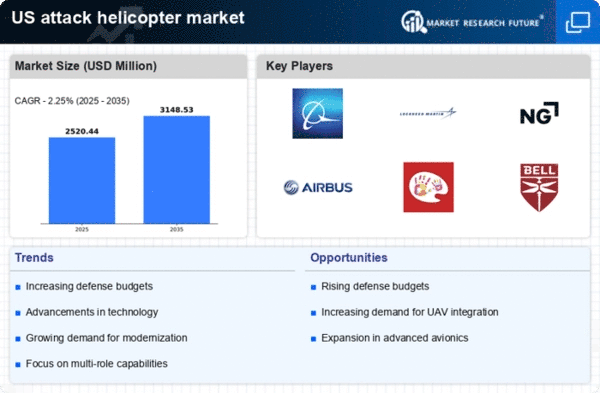
As per Market Research Future analysis, the US attack helicopter market Size was estimated at 2464.98 USD Million in 2024. The US attack helicopter market is projected to grow from 2520.44 USD Million in 2025 to 3148.53 USD Million by 2035, exhibiting a compound annual growth rate (CAGR) of 2.2% during the forecast period 2025 - 2035

Key Market Trends & Highlights

The US attack helicopter market is experiencing robust growth driven by technological advancements and rising defense budgets.

  • Technological advancements are enhancing the capabilities of attack helicopters, making them more versatile and effective.
  • The largest segment in the US attack helicopter market is the modernization of existing fleets, which is crucial for maintaining operational readiness.
  • The fastest-growing segment is the focus on multi-role capabilities, reflecting the evolving nature of military operations.
  • Rising geopolitical tensions and advancements in weaponry are key drivers propelling the market forward.

Market Size & Forecast

2024 Market Size 2464.98 (USD Million)
2035 Market Size 3148.53 (USD Million)
CAGR (2025 - 2035) 2.25%

Major Players

Boeing (US), Lockheed Martin (US), Northrop Grumman (US), Airbus (DE), Leonardo (IT), Bell Helicopter (US), Russian Helicopters (RU), Korea Aerospace Industries (KR), Hindustan Aeronautics Limited (IN)

Our Impact
Enabled $4.3B Revenue Impact for Fortune 500 and Leading Multinationals
Partnering with 2000+ Global Organizations Each Year
30K+ Citations by Top-Tier Firms in the Industry

US Attack Helicopter Market Trends

The attack helicopter market is currently experiencing a dynamic evolution, driven by advancements in technology and changing defense strategies. The increasing emphasis on modern warfare capabilities has led to a surge in demand for advanced rotorcraft that can perform a variety of missions, including close air support, reconnaissance, and anti-armor operations. As military forces seek to enhance their operational effectiveness, the integration of cutting-edge systems such as advanced avionics, weaponry, and stealth features appears to be a priority. This trend is likely to shape procurement strategies and influence the development of next-generation platforms. Moreover, the geopolitical landscape continues to impact the attack helicopter market, as nations reassess their defense postures in response to emerging threats. The focus on interoperability among allied forces suggests a potential increase in joint exercises and collaborative programs, which may further drive the demand for versatile and adaptable helicopter systems. Additionally, the ongoing modernization of existing fleets indicates a commitment to maintaining operational readiness and technological superiority. As a result, the attack helicopter market is poised for growth, with opportunities for innovation and strategic partnerships in the coming years.

Technological Advancements

The attack helicopter market is witnessing rapid technological advancements, particularly in avionics and weapon systems. Enhanced targeting systems, improved sensors, and advanced communication technologies are becoming standard features. These innovations are likely to improve mission effectiveness and situational awareness, making helicopters more versatile in various combat scenarios.

Increased Defense Budgets

Rising defense budgets across various branches of the military are contributing to a robust demand for new attack helicopters. This trend indicates a commitment to upgrading and expanding aerial capabilities, which may lead to increased procurement of advanced rotorcraft to meet evolving operational requirements.

Focus on Multi-Role Capabilities

There is a growing emphasis on multi-role capabilities within the attack helicopter market. Military forces are increasingly seeking platforms that can perform diverse missions, including reconnaissance, close air support, and anti-tank operations. This trend suggests a shift towards more adaptable and flexible helicopter designs that can meet a range of operational needs.

US Attack Helicopter Market Drivers

Advancements in Weaponry

Innovations in weaponry are significantly influencing the attack helicopter market. The integration of precision-guided munitions and advanced targeting systems enhances the operational effectiveness of these aircraft. The US military has invested heavily in developing next-generation weapon systems, which are expected to be deployed on new attack helicopter models. This focus on advanced armaments not only improves combat capabilities but also increases the attractiveness of attack helicopters for defense contracts. As the demand for sophisticated weaponry continues to rise, the attack helicopter market is poised for growth, with manufacturers adapting to meet these evolving requirements.

Rising Geopolitical Tensions

The attack helicopter market is experiencing growth due to rising geopolitical tensions, particularly in regions where military presence is crucial. Nations are increasingly investing in advanced military capabilities to deter potential threats. The US defense budget has seen allocations exceeding $700 billion, with a notable portion directed towards enhancing aerial combat capabilities. This trend indicates a robust demand for attack helicopters, as they play a pivotal role in modern warfare. The need for rapid response and precision strikes in conflict zones further propels the market. As countries prioritize military readiness, the attack helicopter market is likely to benefit from increased procurement and modernization efforts.

Emerging Defense Partnerships

Emerging defense partnerships are shaping the landscape of the attack helicopter market. The US has been actively engaging in collaborative defense initiatives with allied nations, leading to joint procurement programs and technology sharing. These partnerships often result in increased orders for attack helicopters, as countries seek to enhance their military capabilities through cooperative efforts. The potential for shared development projects may also drive innovation within the market. As alliances strengthen, the attack helicopter market is likely to see a boost in demand, reflecting the strategic importance of aerial combat capabilities in modern defense strategies.

Modernization of Existing Fleets

The modernization of existing helicopter fleets is a key driver for the attack helicopter market. Many military forces, including the US, are opting to upgrade their current aircraft rather than procure entirely new models. This approach allows for enhanced capabilities without the substantial costs associated with new acquisitions. Upgrades often include improved avionics, enhanced weapon systems, and better survivability features. As defense budgets remain constrained, this trend towards modernization is likely to sustain demand within the attack helicopter market. The focus on extending the life cycle of existing platforms indicates a strategic shift that could benefit manufacturers specializing in upgrades.

Increased Focus on Counterinsurgency Operations

The attack helicopter market is being driven by an increased focus on counterinsurgency operations. The US military has recognized the importance of versatile aerial platforms in asymmetric warfare scenarios. Attack helicopters provide critical support in urban environments, where traditional ground forces may face challenges. The demand for helicopters capable of conducting close air support and reconnaissance missions is on the rise. This shift in military strategy suggests a sustained need for attack helicopters, as they are essential for effective engagement in complex operational theaters. Consequently, manufacturers are likely to see increased orders and contracts in this segment.


Market Segment Insights

By Application: Combat (Largest) vs. Reconnaissance (Fastest-Growing)

In the US attack helicopter market, the application segment is characterized by diverse roles that these helicopters fulfill. Currently, the Combat application represents the largest share, significantly driven by increasing defense budgets and modernization efforts. Following this, the Reconnaissance segment is experiencing robust growth, capitalizing on advancements in surveillance technologies and the rising importance of intelligence, surveillance, and reconnaissance (ISR) capabilities in military operations. Growth trends indicate that while Combat remains dominant, the Reconnaissance application is emerging as a vital area of focus, driven by the need for enhanced situational awareness and efficiency in operations. The increasing incidence of asymmetric warfare and the evolving threats also amplify the demand for helicopters tailored for reconnaissance missions. This evolution shows a paradigm shift where traditional roles are supplemented by new, agile solutions tailored to specific operational needs.

Combat (Dominant) vs. Reconnaissance (Emerging)

Combat applications dominate the US attack helicopter market, as they are central to offensive operations and ground support roles in modern warfare. These helicopters are equipped with advanced weaponry and armor, designed to withstand battlefield conditions and to engage with enemy forces directly. As military strategies evolve, the demand for combat helicopters that can adapt to various scenarios is crucial. On the other hand, the Reconnaissance application is rapidly emerging, with helicopters dedicated to surveillance and intelligence gathering playing a pivotal role in contemporary military tactics. These platforms are integrated with sophisticated sensors and communication systems, allowing for real-time data collection and enhanced situational awareness, highlighting the increasing reliance on information superiority in combat scenarios.

By Payload Capacity: Medium (Largest) vs. Light-weight (Fastest-Growing)

In the US attack helicopter market, payload capacity is primarily segmented into lightweight, medium, and heavyweight classifications. The medium segment holds the largest share, catering to the majority of operational requirements of military forces. The lightweight category, while smaller in market share, is rapidly gaining traction due to its increasing relevance in modern warfare and specialized missions. The shift towards advanced technology and the need for enhanced maneuverability are driving growth in the lightweight segment, positioning it as the fastest-growing category. In contrast, the medium segment remains dominant, providing a balanced mix of capacity and performance that aligns with the operational needs of various military applications. The heavyweight class, while critical for specific missions, operates within a niche that limits its broader market appeal.

Medium (Dominant) vs. Lightweight (Emerging)

The medium payload capacity segment is recognized as the dominant force in the US attack helicopter market, featuring helicopters that deliver a robust combination of offensive and defensive capabilities. These helicopters can carry a substantial array of weapons and equipment while maintaining agility and speed. In comparison, the lightweight category is emerging rapidly due to an increased focus on versatility and lower operational costs. Helicopters within this segment are designed for quick redeployment and specialized missions, appealing to military strategies that prioritize speed and adaptability. This duality in market position between medium and lightweight helicopters showcases a evolving landscape, driven by diverse military tactical requirements.

By Engine Type: Turbo-shaft (Largest) vs. Hybrid (Fastest-Growing)

The US attack helicopter market is primarily dominated by the turbo-shaft engine type, which commands a significant market share due to its superior power-to-weight ratio and efficiency in demanding missions. The internal combustion engine also plays a role but is less favored in the latest models as defense forces gravitate towards more advanced technologies. Hybrid engines, although presently a smaller segment, are gaining traction due to their potential for enhanced performance and reduced emissions. Growth trends indicate a shift towards hybrid technologies, spurred by increasing environmental regulations and the need for versatile performance in modern warfare scenarios. Investments in research and development for turbo-shaft engines remain robust, ensuring their dominance, even as hybrid solutions attract interest from defense contractors aiming to innovate. The demand for more efficient, powerful, and eco-friendly methods of propulsion is driving this evolution in the US attack helicopter market.

Turbo-shaft (Dominant) vs. Hybrid (Emerging)

Turbo-shaft engines are the backbone of many existing attack helicopters, offering robust power, reliability, and efficiency, making them the go-to choice for military applications. Their design allows for a compact yet powerful engine that translates into superior maneuverability and performance under high-stress conditions. In contrast, hybrid engines represent an emerging trend in the market, combining traditional engine technologies with electric propulsion systems. This dual approach not only presents lower fuel consumption but also aligns with global initiatives for greener military operations. As defense budgets increasingly factor in sustainability, hybrid systems are expected to gain a foothold, particularly in next-generation attack helicopters, thus reshaping operational capabilities.

By End-use: Military (Largest) vs. Civilian (Fastest-Growing)

The US attack helicopter market is dominated by the military segment, which accounts for a significant market share due to ongoing defense spending and modernization efforts. The paramilitary segment also holds a considerable share, driven by governmental security operations. In contrast, the civilian segment, while smaller, is emerging as a key player as private sector interests in security and aerial support services grow. Growth trends indicate a strong surge in demand from the civilian segment, fueled by advancements in technology and increased focus on law enforcement and disaster response capabilities. The military segment continues to lead in terms of expenditure, while the paramilitary segment is expected to maintain steady growth as geopolitical tensions shape defense priorities. Strategic partnerships and innovative upgrades are likely to enhance the competitive landscape further.

Military (Dominant) vs. Civilian (Emerging)

The military segment is characterized by robust investments in advanced technologies, integration of cutting-edge systems, and a focus on operational readiness. These helicopters are equipped with state-of-the-art avionics, weaponry, and battlefield support capabilities, solidifying their dominant position in the market. On the other hand, the civilian segment is emerging, supported by increasing private and governmental emphasis on aerial surveillance, firefighting, and medical evacuation services. This segment's growth is propelled by enhanced versatility and efficiency of attack helicopters, catering to a diverse range of operational requirements beyond traditional military applications.

Get more detailed insights about US Attack Helicopter Market

Key Players and Competitive Insights

The attack helicopter market is characterized by a dynamic competitive landscape, driven by technological advancements and evolving defense needs. Key players such as Boeing (US), Lockheed Martin (US), and Bell Helicopter (US) are at the forefront, each adopting distinct strategies to enhance their market positioning. Boeing (US) focuses on innovation and modernization of its Apache helicopters, while Lockheed Martin (US) emphasizes partnerships and integration of advanced technologies into its platforms. Bell Helicopter (US) is actively pursuing regional expansion and local manufacturing to cater to specific market demands, thereby shaping a competitive environment that is increasingly reliant on technological prowess and strategic collaborations.In terms of business tactics, companies are localizing manufacturing and optimizing supply chains to enhance operational efficiency. The market appears moderately fragmented, with several players vying for dominance. However, the collective influence of major companies like Northrop Grumman (US) and Airbus (DE) contributes to a competitive structure that is both robust and evolving, as these firms leverage their technological capabilities to gain market share.

In October Boeing (US) announced a significant upgrade program for its AH-64 Apache helicopters, aimed at enhancing their combat capabilities through advanced avionics and weapon systems. This strategic move underscores Boeing's commitment to maintaining its competitive edge by ensuring that its platforms remain relevant in modern warfare scenarios. The upgrade is expected to attract interest from both domestic and international clients, potentially increasing Boeing's market share in the attack helicopter segment.

In September Lockheed Martin (US) entered into a partnership with a leading AI technology firm to integrate artificial intelligence into its helicopter systems. This collaboration is poised to revolutionize operational efficiency and decision-making processes in combat situations. By harnessing AI, Lockheed Martin (US) aims to enhance the capabilities of its helicopters, making them more adaptable to the rapidly changing battlefield environment, thus reinforcing its strategic positioning in the market.

In August Bell Helicopter (US) launched a new initiative to establish a manufacturing facility in Texas, aimed at localizing production and reducing lead times for its attack helicopters. This move not only aligns with the growing trend of supply chain optimization but also positions Bell Helicopter (US) to better serve its clients in the region. The facility is expected to enhance production efficiency and foster closer relationships with local defense contractors, thereby strengthening Bell's competitive stance.

As of November the attack helicopter market is witnessing trends such as digitalization, sustainability, and AI integration, which are redefining competitive dynamics. Strategic alliances are increasingly shaping the landscape, as companies recognize the need for collaboration to drive innovation. Moving forward, competitive differentiation is likely to evolve from traditional price-based competition to a focus on technological innovation, reliability in supply chains, and the ability to adapt to emerging threats. This shift indicates a future where companies that prioritize R&D and strategic partnerships will likely lead the market.

Key Companies in the US Attack Helicopter Market include

Industry Developments

Recent developments in the US Attack Helicopter Market indicate a growing emphasis on advanced technologies and modernization. Companies like Bell Helicopter and Sikorsky continue to innovate with the introduction of upgraded models featuring enhanced avionics, weapon systems, and stealth capabilities. In September 2023, Boeing secured a significant contract from the U.S. Army for the production of Apache helicopters, reflecting the military's commitment to maintaining a robust aerial combat capability. Additionally, Raytheon Technologies recently expanded its partnerships with defense agencies to integrate artificial intelligence in helicopter operations, aiming to increase operational efficiency.

Notably, General Dynamics released a comprehensive report on its successful testing of a new targeting system, garnering attention in November 2023. In mergers and acquisitions, Lockheed Martin's acquisition of a smaller technology firm involved in drone technology in August 2023 aims to enhance its capabilities in both unmanned and manned systems. The market valuation of companies within this sector is witnessing considerable growth, driven by an increased defense budget and the imperative for modernization. Overall, these developments underscore a pivotal shift towards advanced technology integration in the U.S. Attack Helicopter Market.

Future Outlook

US Attack Helicopter Market Future Outlook

The Attack Helicopter Market is projected to grow at a 2.25% CAGR from 2025 to 2035, driven by technological advancements and increasing defense budgets.

New opportunities lie in:

  • Development of advanced avionics systems for enhanced targeting accuracy.
  • Integration of AI-driven maintenance solutions to reduce operational costs.
  • Expansion into emerging markets through strategic partnerships and joint ventures.

By 2035, the market is expected to solidify its position with sustained growth and innovation.

Market Segmentation

US Attack Helicopter Market End-use Outlook

  • Military
  • Paramilitary
  • Civilian

US Attack Helicopter Market Application Outlook

  • Combat
  • Reconnaissance
  • Search and Rescue
  • Transport

US Attack Helicopter Market Engine Type Outlook

  • Turbo-shaft
  • Internal Combustion Engine
  • Hybrid

US Attack Helicopter Market Payload Capacity Outlook

  • Lightweight
  • Medium
  • Heavyweight

Report Scope

MARKET SIZE 2024 2464.98(USD Million)
MARKET SIZE 2025 2520.44(USD Million)
MARKET SIZE 2035 3148.53(USD Million)
COMPOUND ANNUAL GROWTH RATE (CAGR) 2.25% (2025 - 2035)
REPORT COVERAGE Revenue Forecast, Competitive Landscape, Growth Factors, and Trends
BASE YEAR 2024
Market Forecast Period 2025 - 2035
Historical Data 2019 - 2024
Market Forecast Units USD Million
Key Companies Profiled Boeing (US), Lockheed Martin (US), Northrop Grumman (US), Airbus (DE), Leonardo (IT), Bell Helicopter (US), Russian Helicopters (RU), Korea Aerospace Industries (KR), Hindustan Aeronautics Limited (IN)
Segments Covered Application, Payload Capacity, Engine Type, End-use
Key Market Opportunities Integration of advanced avionics and weapon systems enhances operational capabilities in the attack helicopter market.
Key Market Dynamics Technological advancements drive competition and innovation in the attack helicopter market, influencing procurement strategies and operational capabilities.
Countries Covered US
Leave a Comment

FAQs

What is the expected market size of the US Attack Helicopter Market in 2024?

The US Attack Helicopter Market is expected to be valued at 2.11 USD Billion in 2024.

What will be the projected market value of the US Attack Helicopter Market by 2035?

By 2035, the US Attack Helicopter Market is projected to be valued at 4.2 USD Billion.

What is the expected compound annual growth rate (CAGR) for the US Attack Helicopter Market from 2025 to 2035?

The expected CAGR for the US Attack Helicopter Market from 2025 to 2035 is 6.458%.

Which segment of the US Attack Helicopter Market has a higher value in 2024?

In 2024, the Below 8 metric ton segment of the US Attack Helicopter Market is valued at 1.01 USD Billion, slightly lower than the Above 8 metric ton segment, which is valued at 1.1 USD Billion.

What is the estimated market value for the Below 8 metric ton segment by 2035?

The Below 8 metric ton segment is estimated to reach a value of 2.05 USD Billion by 2035.

Which major players dominate the US Attack Helicopter Market?

Major players in the US Attack Helicopter Market include Bell Helicopter, Raytheon Technologies, Airbus, Boeing, and Lockheed Martin.

What market value is projected for the Above 8 metric ton segment in 2035?

The Above 8 metric ton segment of the US Attack Helicopter Market is projected to reach a value of 2.15 USD Billion by 2035.

What are the key growth drivers for the US Attack Helicopter Market?

Key growth drivers for the US Attack Helicopter Market include increasing defense budgets and advancements in helicopter technology.

How is the US Attack Helicopter Market expected to be influenced by current global conflicts?

Current global conflicts may drive higher demand for attack helicopters, leading to increased market growth.

What opportunities exist in the US Attack Helicopter Market for the next decade?

Opportunities in the US Attack Helicopter Market include modernization programs and the integration of advanced technologies into existing helicopters.

Download Free Sample

Kindly complete the form below to receive a free sample of this Report

Compare Licence

×
Features License Type
Single User Multiuser License Enterprise User
Price $4,950 $5,950 $7,250
Maximum User Access Limit 1 User Upto 10 Users Unrestricted Access Throughout the Organization
Free Customization
Direct Access to Analyst
Deliverable Format
Platform Access
Discount on Next Purchase 10% 15% 15%
Printable Versions