×
Request Free Sample ×

Kindly complete the form below to receive a free sample of this Report

* Please use a valid business email

Leading companies partner with us for data-driven Insights

clients tt-cursor
Hero Background

US Applied AI in Cybersecurity Market

ID: MRFR/ICT/57388-HCR
200 Pages
Aarti Dhapte
February 2026

US Applied AI in Cybersecurity Market Research Report By Organization Size (SMEs, Large Enterprise) and By Security Type (Network Security, Endpoint Security, Application Security, Cloud Security, ICS Security, IoT Security, Identity and Access Management, Risk and Compliance Management, Data Loss Prevention, Unified Threat Management, Security and Vulnerability Management, Antivirus/Antimalware, Fraud Detection, Intrusion Detection/Prevention System, Threat Intelligence, Others) - Forecast to 2035

Share:
Download PDF ×

We do not share your information with anyone. However, we may send you emails based on your report interest from time to time. You may contact us at any time to opt-out.

US Applied AI in Cybersecurity Market Infographic
Purchase Options

US Applied AI in Cybersecurity Market Summary

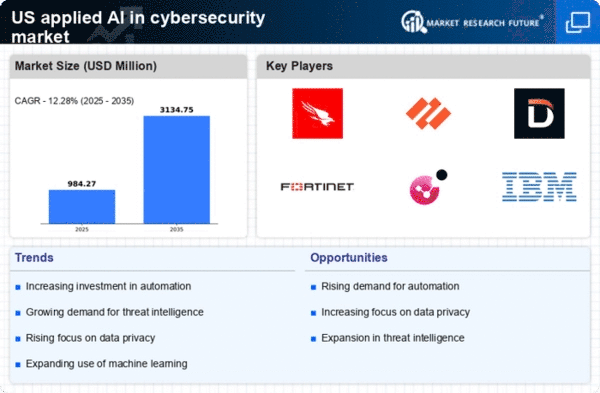
As per Market Research Future analysis, the US Applied AI in Cybersecurity Market size was estimated at 876.62 USD Million in 2024. The Applied Ai-in-cybersecurity market is projected to grow from 984.27 USD Million in 2025 to 3134.75 USD Million by 2035, exhibiting a compound annual growth rate (CAGR) of 12.2% during the forecast period 2025 - 2035

Key Market Trends & Highlights

The US applied AI-in-cybersecurity market is experiencing robust growth driven by technological advancements and increasing security demands.

  • Investment in AI technologies is surging as organizations seek to enhance their cybersecurity measures.
  • Enhanced threat detection capabilities are becoming a focal point for businesses aiming to mitigate risks effectively.
  • The largest segment in this market is the enterprise security solutions, while the fastest-growing segment is the cloud security solutions.
  • The rising cyber threat landscape and growing regulatory pressures are key drivers propelling market expansion.

Market Size & Forecast

2024 Market Size 876.62 (USD Million)
2035 Market Size 3134.75 (USD Million)
CAGR (2025 - 2035) 12.28%

Major Players

CrowdStrike (US), Palo Alto Networks (US), Darktrace (GB), Fortinet (US), Check Point Software Technologies (IL), IBM (US), McAfee (US), Cisco Systems (US), FireEye (US)

Our Impact
Enabled $4.3B Revenue Impact for Fortune 500 and Leading Multinationals
Partnering with 2000+ Global Organizations Each Year
30K+ Citations by Top-Tier Firms in the Industry

US Applied AI in Cybersecurity Market Trends

the US Applied AI in Cybersecurity Market is currently experiencing a transformative phase., driven by the increasing sophistication of cyber threats and the growing reliance on digital infrastructure. Organizations are increasingly adopting artificial intelligence technologies to enhance their security measures, as traditional methods often fall short in addressing complex cyber challenges. This shift is evident in various sectors, including finance, healthcare, and government, where the need for robust cybersecurity solutions is paramount. The integration of machine learning algorithms and automated threat detection systems is becoming commonplace, allowing for real-time responses to potential breaches. As a result, the applied AI in cybersecurity market is poised for substantial growth., with stakeholders recognizing the necessity of proactive measures to safeguard sensitive information. Moreover, the regulatory landscape is evolving, with government agencies emphasizing the importance of cybersecurity frameworks that incorporate advanced technologies. This regulatory push is likely to further stimulate investment in the applied ai-in-cybersecurity market, as organizations seek to comply with stringent guidelines while enhancing their security posture. The collaboration between public and private sectors is also fostering innovation, leading to the development of cutting-edge solutions tailored to combat emerging threats. As the market continues to mature, it appears that the focus will remain on leveraging artificial intelligence to create resilient cybersecurity infrastructures that can adapt to the ever-changing threat landscape.

Increased Investment in AI Technologies

Organizations are channeling resources into advanced AI technologies to bolster their cybersecurity frameworks. This trend reflects a growing recognition of the limitations of traditional security measures, prompting a shift towards more dynamic and responsive solutions.

Enhanced Threat Detection Capabilities

The application of machine learning algorithms is significantly improving threat detection capabilities. By analyzing vast amounts of data, these systems can identify anomalies and potential threats more effectively, allowing for timely interventions.

Regulatory Compliance and Framework Development

As regulatory bodies emphasize cybersecurity, organizations are increasingly adopting AI-driven solutions to meet compliance requirements. This trend indicates a proactive approach to not only adhere to regulations but also to enhance overall security measures.

US Applied AI in Cybersecurity Market Drivers

Growing Regulatory Pressures

Regulatory pressures are intensifying, compelling organizations to adopt more robust cybersecurity measures. the applied AI in cybersecurity market is experiencing growth. as companies seek to comply with various regulations, such as the CCPA and GDPR. These regulations often mandate the implementation of advanced security technologies to protect sensitive data. As non-compliance can result in hefty fines, businesses are increasingly turning to AI-driven solutions to ensure they meet regulatory requirements. This trend is likely to bolster the applied ai-in-cybersecurity market, as organizations prioritize compliance alongside security.

Rising Cyber Threat Landscape

The increasing complexity and frequency of cyber threats are driving the applied ai-in-cybersecurity market. Organizations are facing sophisticated attacks, including ransomware and phishing, which have surged by over 50% in recent years. This evolving threat landscape necessitates advanced security measures, prompting businesses to invest in AI-driven solutions. the applied AI in cybersecurity market is projected to grow. as companies seek to enhance their defenses against these persistent threats. As a result, the demand for AI technologies that can analyze vast amounts of data and identify anomalies in real-time is likely to rise, indicating a robust growth trajectory for the industry.

Increased Focus on Data Privacy

The heightened focus on data privacy is significantly influencing the applied ai-in-cybersecurity market. With consumers becoming more aware of their data rights, organizations are compelled to enhance their data protection strategies. AI technologies are being leveraged to monitor and secure sensitive information, ensuring compliance with privacy regulations. The market is witnessing a surge in demand for AI solutions that can provide real-time insights into data usage and potential breaches. This emphasis on data privacy not only drives investment in AI technologies but also shapes the future landscape of the applied ai-in-cybersecurity market.

Demand for Automation in Security Operations

The need for automation in security operations is becoming increasingly apparent, as organizations strive to improve efficiency and reduce response times. The applied ai-in-cybersecurity market is benefiting from this trend, as AI technologies can automate routine tasks, allowing security teams to focus on more complex issues. Reports suggest that automation can reduce incident response times by up to 70%, which is crucial in mitigating potential damages from cyber incidents. Consequently, businesses are investing in AI solutions that streamline security processes, thereby driving growth in the applied ai-in-cybersecurity market.

Integration of AI with Existing Security Frameworks

The integration of AI technologies with existing security frameworks is a key driver for the applied ai-in-cybersecurity market. Organizations are increasingly recognizing the value of enhancing their traditional security measures with AI capabilities. This integration allows for improved threat detection and response, as AI can analyze patterns and predict potential vulnerabilities. As companies invest in hybrid security solutions, the applied ai-in-cybersecurity market is expected to expand. The synergy between AI and existing systems not only enhances security posture but also optimizes resource allocation, making it a compelling proposition for businesses.


Market Segment Insights

By Organization Size: Large Enterprise (Largest) vs. SMEs (Fastest-Growing)

In the US applied ai-in-cybersecurity market, Large Enterprises command a significant share due to their extensive resources and critical infrastructure needs. These organizations are increasingly adopting advanced AI-driven security solutions to safeguard their vast networks against complex cyber threats. Conversely, SMEs are rapidly increasing their market presence, demonstrating a growing need for affordable and effective cybersecurity solutions tailored to smaller operational scales. The growth trends show that while Large Enterprises remain the dominant players, SMEs are emerging as the fastest-growing segment. Factors driving this growth include the rising awareness of cyber threats among smaller companies, the proliferation of cost-effective AI solutions, and increasing regulatory requirements for cybersecurity compliance. This shift indicates a maturing market with diverse needs and applications among different organization sizes.

Large Enterprise: Dominant vs. SMEs: Emerging

Large Enterprises in the US applied ai-in-cybersecurity market are characterized by robust investments in security frameworks and cutting-edge AI technologies. Their vast infrastructure demands sophisticated cybersecurity measures, allowing them to leverage advanced analytics and real-time threat detection capabilities. On the other hand, SMEs are quickly becoming an emerging force, driven by the need for accessible cybersecurity solutions. These organizations often focus on budget-friendly AI applications that provide essential protection without compromising quality. As cyber threats continue to evolve, both segments are crucial to the market, with Large Enterprises defining standards and SMEs pushing innovation and agility in cybersecurity practices.

By Deployment Type: Cloud (Largest) vs. On Premises (Fastest-Growing)

The US applied ai-in-cybersecurity market is primarily dominated by the Cloud deployment type, which accounts for a significant share of the total market. Cloud solutions offer flexibility and scalability, making them appealing to a wide range of organizations looking to enhance their cybersecurity posture. In contrast, On Premises solutions, while smaller in market share, are gaining traction due to specific regulatory and security needs that some enterprises prioritize. The growth trends within the deployment types are noteworthy. Cloud deployment continues to thrive due to its ease of access and integration with existing infrastructures. Conversely, On Premises is emerging as the fastest-growing segment, driven by increasing concerns over data privacy and the need for greater control over cybersecurity measures. This juxtaposition reflects the evolving landscape of cybersecurity needs across various industries.

Cloud (Dominant) vs. On Premises (Emerging)

Cloud deployment in the US applied ai-in-cybersecurity market is characterized by its extensive adoption across various sectors, providing robust solutions that cater to diverse organizational needs. Its dominance can be attributed to features such as cost-effective scalability, remote accessibility, and continuous updates which reduce the burden on internal IT teams. On the other hand, On Premises solutions are positioned as an emerging option for companies that prioritize stringent data control and compliance with regulatory standards. While they may require greater initial investment and maintenance, the growing demand for customized security environments is propelling their adoption, particularly among industries with sensitive data handling requirements.

By Security Type: Network Security (Largest) vs. Endpoint Security (Fastest-Growing)

The security type segment within the US applied ai-in-cybersecurity market is characterized by diverse offerings, with network security commanding the largest market share. This segment encompasses various solutions designed to protect networks from unauthorized access, ensure data integrity, and safeguard sensitive information. Endpoint security follows closely, emerging rapidly due to the increasing number of remote work arrangements and the rise in cyber threats targeting endpoints. Together, these segments hold a significant share in the overall market landscape, reflecting the evolving priorities of organizations in cybersecurity. Growth trends in the security type segment are driven by the rising sophistication of cyber threats and the need for comprehensive protection. Network security remains pivotal as organizations accelerate their digital transformation initiatives. Conversely, endpoint security is witnessing rapid growth as businesses adapt to new working environments, with a focus on securing individual devices connected to the network. This growth is fueled by advancements in AI and machine learning technologies, enabling faster detection and response to threats, and the increasing acceptance of cloud-based solutions that enhance flexibility and responsiveness.

Network Security (Dominant) vs. Endpoint Security (Emerging)

Network security, as the dominant force in the US applied ai-in-cybersecurity market, focuses on protecting an organization's networks from various threats, utilizing technologies that ensure data integrity and confidentiality. Its robust solutions encompass firewalls, intrusion detection systems, and virtual private networks (VPNs), making it essential for safeguarding digital infrastructure. On the other hand, endpoint security is identified as an emerging segment, rapidly gaining attention due to the proliferation of remote work and mobile devices. This segment addresses vulnerabilities at the endpoint level, deploying solutions that include anti-virus software, endpoint detection and response (EDR), and threat intelligence. The convergence of these two segments highlights the necessity of a multi-layered security strategy in today's interconnected world.

By Application: Identity and Access Management (Largest) vs. Threat Intelligence (Fastest-Growing)

In the US applied ai-in-cybersecurity market, Identity and Access Management holds the largest market share among application segments, reflecting the increasing need for robust security measures to manage user identities and access rights effectively. Other segments such as Security and Vulnerability Management and Data Loss Prevention also contribute significantly but remain behind in overall market share. Meanwhile, Threat Intelligence is emerging as a critical component, showcasing rapid growth due to its proactive approach to cyber threat detection and mitigation. The growth trends in this segment are primarily driven by the rising sophistication of cyber threats and the corresponding demand for innovative security solutions. Organizations are investing in AI-driven technologies to enhance their cybersecurity frameworks. Emerging segments like Fraud Detection/Anti-Fraud and Unified Threat Management are experiencing heightened interest, further indicating a shift towards integrated and adaptive security strategies. This trend reflects a broader industry movement towards automation and improved intelligence capabilities, highlighting the importance of agility in threat response.

Identity and Access Management (Dominant) vs. Threat Intelligence (Emerging)

Identity and Access Management (IAM) serves as the backbone of cybersecurity in the US applied ai-in-cybersecurity market, ensuring that the right individuals access the right resources at the right times for the right reasons. IAM solutions are characterized by features such as single sign-on, multi-factor authentication, and user management, positioning them as dominant players that cater to both compliance and operational efficiency. In contrast, Threat Intelligence focuses on collecting and analyzing information regarding current and potential attacks, making it an emerging segment that supports proactive defense measures. As organizations increasingly rely on data-driven insights for cybersecurity decisions, Threat Intelligence is witnessing rapid adoption, underscoring its significance as threats continue to evolve.

By End User: BFSI (Largest) vs. Healthcare (Fastest-Growing)

In the US applied ai-in-cybersecurity market, the BFSI sector holds the largest market share, reflecting its substantial investment in advanced technology solutions to counteract rising cyber threats. The retail sector follows closely, leveraging AI for fraud prevention and customer data protection. Other sectors, including Healthcare and Government & Defense, also contribute significantly to market dynamics, with each striving for enhanced cybersecurity measures to secure sensitive information. Currently, the healthcare sector is on a rapid growth trajectory as the demand for secure patient data management and protection against cyber-attacks escalates. Regulatory compliance and increased digitalization are driving factors, pushing healthcare organizations to integrate advanced cybersecurity measures. Similarly, the manufacturing and utilities sectors are increasingly adopting AI solutions, recognizing the need to fortify critical infrastructure against potential cyber threats.

BFSI: Dominant vs. Healthcare: Emerging

BFSI stands as the dominant sector in the US applied ai-in-cybersecurity market, benefiting from extensive regulatory requirements and a high level of financial transactions that necessitate robust cybersecurity solutions. Financial institutions are increasingly adopting AI technologies to enhance threat detection and risk mitigation. In contrast, healthcare is emerging as a significant player, driven by heightened cyber threats and the urgent need for secure electronic health records. As healthcare providers enhance their digital infrastructures, they are prioritizing cybersecurity investments, recognizing AI's potential to safeguard sensitive data and maintain compliance with regulatory standards. The contrasting characteristics of these sectors highlight the evolving landscape of cybersecurity needs and investments across industries.

Get more detailed insights about US Applied AI in Cybersecurity Market

Key Players and Competitive Insights

The applied ai-in-cybersecurity market is currently characterized by intense competition and rapid technological advancements. Key growth drivers include the increasing sophistication of cyber threats, the rising demand for automated security solutions, and the integration of AI technologies into cybersecurity frameworks. Major players such as CrowdStrike (US), Palo Alto Networks (US), and IBM (US) are strategically positioned to leverage these trends. CrowdStrike (US) focuses on cloud-native solutions and threat intelligence, while Palo Alto Networks (US) emphasizes its AI-driven security platform to enhance threat detection and response capabilities. IBM (US) is investing heavily in AI and machine learning to bolster its security offerings, indicating a collective shift towards innovation and advanced technology in the competitive landscape.The market structure appears moderately fragmented, with a mix of established players and emerging startups. Key business tactics include localizing services to meet regional compliance requirements and optimizing supply chains to enhance service delivery. The influence of major players is significant, as they set benchmarks for technological advancements and customer expectations, thereby shaping the overall market dynamics.

In October CrowdStrike (US) announced a strategic partnership with a leading cloud service provider to enhance its threat detection capabilities through integrated AI solutions. This collaboration is likely to bolster CrowdStrike's market position by expanding its service offerings and improving its response times to emerging threats. Such partnerships are indicative of a broader trend where companies are seeking synergies to enhance their technological capabilities and market reach.

In September Palo Alto Networks (US) launched a new AI-driven security platform aimed at small to medium-sized enterprises (SMEs). This initiative reflects a strategic move to capture a growing segment of the market that requires robust cybersecurity solutions but lacks the resources for extensive IT infrastructure. By targeting SMEs, Palo Alto Networks (US) not only diversifies its customer base but also positions itself as a leader in accessible cybersecurity solutions.

In August IBM (US) unveiled its latest AI-enhanced security software, which incorporates advanced machine learning algorithms to predict and mitigate potential cyber threats. This development underscores IBM's commitment to innovation and its strategy to maintain a competitive edge in the rapidly evolving cybersecurity landscape. The introduction of such cutting-edge technology is likely to attract new clients and reinforce existing relationships, thereby enhancing IBM's market share.

As of November current competitive trends in the applied ai-in-cybersecurity market include a strong emphasis on digital transformation, sustainability, and the integration of AI technologies. Strategic alliances are increasingly shaping the landscape, as companies recognize the value of collaboration in enhancing their technological capabilities. Looking ahead, competitive differentiation is expected to evolve, with a shift from price-based competition towards innovation, technology, and supply chain reliability. This transition may redefine how companies position themselves in the market, emphasizing the importance of advanced solutions and strategic partnerships.

Key Companies in the US Applied AI in Cybersecurity Market include

Industry Developments

In July 2023, Proofpoint announced its AI-powered email security enhancements, aimed at combating the ever-growing threat of phishing attacks, reflecting a trend towards intelligent threat-hunting capabilities across the industry.

Meanwhile, in August 2023, Microsoft reported substantial growth in its cybersecurity offerings, emphasizing AI integration for improved security response times, which has become essential given the rising cyber threats. Notably, in September 2023, Cisco Systems made headlines by acquiring a small AI startup to expand its cybersecurity capabilities, further indicating a consolidation trend among key players in the market. The valuation of market leaders like Check Point Software Technologies and Fortinet has increased, driven by heightened demand for advanced cybersecurity solutions amidst numerous high-profile data breaches.

Over the past two years, the market has expanded significantly due to increasing cyberattack frequency and the growing need for sophisticated AI technologies to address these challenges effectively. This ongoing evolution highlights an urgent need for robust, responsive, and innovative security measures in the US.

Future Outlook

US Applied AI in Cybersecurity Market Future Outlook

The Applied AI in Cybersecurity Market is projected to grow at a 12.28% CAGR from 2025 to 2035, driven by increasing cyber threats and demand for advanced security solutions.

New opportunities lie in:

  • Development of AI-driven threat detection platforms for real-time response.
  • Integration of AI in compliance automation tools for regulatory adherence.
  • Creation of AI-based predictive analytics for risk management strategies.

By 2035, the market is expected to be robust, driven by innovation and strategic investments.

Market Segmentation

US Applied AI in Cybersecurity Market End User Outlook

  • BFSI
  • Retail
  • Government & Defense
  • Manufacturing
  • Utilities
  • Oil & Gas
  • Healthcare
  • Automotive & Transportation
  • Other

US Applied AI in Cybersecurity Market Application Outlook

  • Identity and Access Management
  • Risk and Compliance Management
  • Data Loss Prevention
  • Unified Threat Management
  • Security and Vulnerability Management
  • Antivirus/Antimalware
  • Fraud Detection/Anti-Fraud
  • Intrusion Detection/Prevention System
  • Threat Intelligence
  • Others

US Applied AI in Cybersecurity Market Security Type Outlook

  • Network Security
  • Endpoint Security
  • Application Security
  • Cloud Security
  • ICS Security
  • IoT Security
  • Others

US Applied AI in Cybersecurity Market Deployment Type Outlook

  • On Premises
  • Cloud

US Applied AI in Cybersecurity Market Organization Size Outlook

  • SMEs
  • Large Enterprise

Report Scope

MARKET SIZE 2024 876.62(USD Million)
MARKET SIZE 2025 984.27(USD Million)
MARKET SIZE 2035 3134.75(USD Million)
COMPOUND ANNUAL GROWTH RATE (CAGR) 12.28% (2025 - 2035)
REPORT COVERAGE Revenue Forecast, Competitive Landscape, Growth Factors, and Trends
BASE YEAR 2024
Market Forecast Period 2025 - 2035
Historical Data 2019 - 2024
Market Forecast Units USD Million
Key Companies Profiled CrowdStrike (US), Palo Alto Networks (US), Darktrace (GB), Fortinet (US), Check Point Software Technologies (IL), IBM (US), McAfee (US), Cisco Systems (US), FireEye (US)
Segments Covered Organization Size, Deployment Type, Security Type, Application, End User
Key Market Opportunities Integration of advanced machine learning algorithms enhances threat detection and response capabilities in the applied ai-in-cybersecurity market.
Key Market Dynamics Rising demand for advanced threat detection drives innovation in applied AI technologies for cybersecurity solutions.
Countries Covered US
Leave a Comment

FAQs

What was the expected market size of the US Applied AI in Cybersecurity Market in 2024?

The US Applied AI in Cybersecurity Market was valued at 818.12 million USD in 2024.

What will be the projected market value of the US Applied AI in Cybersecurity Market by 2035?

By 2035, the market is projected to reach a value of 10,045.0 million USD.

What is the expected CAGR for the US Applied AI in Cybersecurity Market from 2025 to 2035?

The expected CAGR for the market from 2025 to 2035 is 25.606%.

Which organization size segment will contribute significantly to the US Applied AI in Cybersecurity Market in 2035?

For the year 2035, large enterprises are forecasted to contribute significantly with a market value of 6,915.0 million USD.

What market value is expected for SMEs in the US Applied AI in Cybersecurity Market by 2035?

The SMEs segment is expected to reach a market value of 3,130.0 million USD by 2035.

Who are the key players in the US Applied AI in Cybersecurity Market?

Major players in the market include Proofpoint, Microsoft, Check Point Software Technologies, Fortinet, and Splunk, among others.

What is the projected market growth rate for large enterprises in the US Applied AI in Cybersecurity Market?

The market for large enterprises is projected to grow significantly, reaching 6,915.0 million USD by 2035.

What are the key applications driving the growth of the US Applied AI in Cybersecurity Market?

Key applications driving growth include threat detection, incident response, and vulnerability management.

What emerging trends are shaping the US Applied AI in Cybersecurity Market?

Emerging trends include increasing automation in cybersecurity processes and the integration of advanced machine learning techniques.

How does the current global scenario affect the US Applied AI in Cybersecurity Market?

The current global scenario is driving demand for enhanced cybersecurity measures, boosting market growth across various sectors.

Download Free Sample

Kindly complete the form below to receive a free sample of this Report

Compare Licence

×
Features License Type
Single User Multiuser License Enterprise User
Price $4,950 $5,950 $7,250
Maximum User Access Limit 1 User Upto 10 Users Unrestricted Access Throughout the Organization
Free Customization
Direct Access to Analyst
Deliverable Format
Platform Access
Discount on Next Purchase 10% 15% 15%
Printable Versions