×
Request Free Sample ×

Kindly complete the form below to receive a free sample of this Report

* Please use a valid business email

Leading companies partner with us for data-driven Insights

clients tt-cursor
Hero Background

South Korea Applied AI in Cybersecurity Market

ID: MRFR/ICT/57129-HCR
200 Pages
Aarti Dhapte
February 2026

South Korea Applied AI in Cybersecurity Market Size, Share and Trends Analysis Report By Organization Size (SMEs, Large Enterprise) and By Security Type (Network Security, Endpoint Security, Application Security, Cloud Security, ICS Security, IoT Security, Identity and Access Management, Risk and Compliance Management, Data Loss Prevention, Unified Threat Management, Security and Vulnerability Management, Antivirus/Antimalware, Fraud Detection, Intrusion Detection/Prevention System, Threat Intelligence, Others)- Forecast to 2035

Share:
Download PDF ×

We do not share your information with anyone. However, we may send you emails based on your report interest from time to time. You may contact us at any time to opt-out.

South Korea Applied AI in Cybersecurity Market Infographic
Purchase Options

South Korea Applied AI in Cybersecurity Market Summary

As per Market Research Future analysis, the South Korea Applied AI in Cybersecurity Market size was estimated at 68.49 USD Million in 2024. The South Korea applied ai-in-cybersecurity market is projected to grow from 86.7 USD Million in 2025 to 916.25 USD Million by 2035, exhibiting a compound annual growth rate (CAGR) of 26.5% during the forecast period 2025 - 2035

Key Market Trends & Highlights

The South Korea applied AI-in-cybersecurity market is poised for substantial growth driven by technological advancements and increasing cyber threats.

  • The integration of AI technologies is transforming cybersecurity practices across various sectors.
  • Workforce development initiatives are gaining traction to address the skills gap in cybersecurity.
  • Public-private collaboration is enhancing the effectiveness of cybersecurity measures in South Korea.
  • The rising cyber threat landscape and increased investment in cybersecurity solutions are key drivers of market growth.

Market Size & Forecast

2024 Market Size 68.49 (USD Million)
2035 Market Size 916.25 (USD Million)
CAGR (2025 - 2035) 26.59%

Major Players

CrowdStrike (US), Palo Alto Networks (US), Darktrace (GB), Fortinet (US), Check Point Software Technologies (IL), IBM (US), McAfee (US), Cisco Systems (US)

Our Impact
Enabled $4.3B Revenue Impact for Fortune 500 and Leading Multinationals
Partnering with 2000+ Global Organizations Each Year
30K+ Citations by Top-Tier Firms in the Industry

South Korea Applied AI in Cybersecurity Market Trends

The South Korea Applied AI in Cybersecurity Market is experiencing notable growth, driven by increasing cyber threats and the need for advanced security solutions. In South Korea, the government has prioritized cybersecurity, leading to substantial investments in technology and infrastructure. This focus on enhancing digital security is evident in various sectors, including finance, healthcare, and public services. As organizations seek to protect sensitive data, the integration of artificial intelligence into cybersecurity strategies appears to be a key trend. AI technologies are being utilized to detect anomalies, automate responses, and predict potential threats, thereby improving overall security posture. Moreover, the demand for skilled professionals in the applied ai-in-cybersecurity market is rising. Educational institutions and training programs are adapting to meet this need, fostering a workforce equipped with the necessary skills to navigate complex cyber environments. Collaboration between the public and private sectors is also becoming increasingly important, as organizations share information and resources to combat cyber threats more effectively. This collaborative approach may enhance the resilience of South Korea's cybersecurity landscape, positioning it as a leader in the region. Overall, the applied ai-in-cybersecurity market is poised for continued expansion, driven by innovation and a proactive stance against cyber risks.

Integration of AI Technologies

The incorporation of artificial intelligence into cybersecurity frameworks is becoming prevalent. Organizations are leveraging AI to enhance threat detection and response capabilities. This trend indicates a shift towards more automated and intelligent security measures, which may lead to improved efficiency and effectiveness in combating cyber threats.

Focus on Workforce Development

There is a growing emphasis on developing a skilled workforce in the applied ai-in-cybersecurity market. Educational institutions are increasingly offering specialized programs to equip individuals with the necessary skills. This trend suggests a recognition of the importance of human expertise in conjunction with technological advancements.

Public-Private Collaboration

Collaboration between government entities and private organizations is gaining traction. This trend highlights the importance of sharing information and resources to enhance cybersecurity efforts. Such partnerships may lead to more robust defenses against cyber threats, fostering a more secure digital environment.

South Korea Applied AI in Cybersecurity Market Drivers

Rising Cyber Threat Landscape

The increasing frequency and sophistication of cyber threats in South Korea is a primary driver for the applied ai-in-cybersecurity market. As organizations face a growing array of cyberattacks, including ransomware and phishing, the demand for advanced security solutions is escalating. In 2025, it is estimated that cybercrime could cost the South Korean economy over $30 billion annually. This alarming trend compels businesses to adopt AI-driven cybersecurity measures to enhance their defenses. Thus, the applied AI in cybersecurity market is positioned to grow as companies seek to leverage machine learning and predictive analytics to identify and mitigate threats proactively. The urgency to protect sensitive data and maintain operational integrity is likely to drive investments in AI technologies. This makes it a critical factor in the market's expansion.

Technological Advancements in AI

Technological advancements in AI are significantly influencing the applied ai-in-cybersecurity market in South Korea. Innovations in machine learning, natural language processing, and data analytics are enabling the development of sophisticated cybersecurity tools that can adapt to evolving threats. In 2025, the market is expected to benefit from breakthroughs in AI algorithms that enhance threat detection and response capabilities. These advancements allow organizations to analyze vast amounts of data in real-time, identifying anomalies and potential threats more effectively. As AI technologies continue to evolve, they are likely to play a pivotal role in shaping the future of cybersecurity. The applied ai-in-cybersecurity market stands to gain from these technological improvements, as businesses seek to leverage cutting-edge solutions to stay ahead of cyber adversaries.

Government Initiatives and Regulations

The South Korean government is actively promoting the adoption of AI technologies in cybersecurity through various initiatives and regulatory frameworks. In 2025, the government has allocated approximately $200 million to enhance national cybersecurity infrastructure, which includes funding for AI research and development. This financial support is expected to stimulate growth in the applied ai-in-cybersecurity market as companies align their strategies with government mandates. Furthermore, regulations aimed at improving data protection and privacy are compelling organizations to invest in AI solutions that ensure compliance. The government's commitment to fostering a secure digital environment is likely to create a conducive atmosphere for the applied ai-in-cybersecurity market, encouraging innovation and collaboration among stakeholders.

Growing Awareness of Cybersecurity Risks

There is a notable increase in awareness regarding cybersecurity risks among businesses and consumers in South Korea. As high-profile data breaches and cyber incidents make headlines, organizations are becoming more cognizant of the potential repercussions of inadequate cybersecurity measures. This heightened awareness is driving demand for advanced solutions in the applied ai-in-cybersecurity market. Companies are now more inclined to invest in AI technologies that offer real-time threat detection and automated response capabilities. The shift in mindset towards proactive cybersecurity measures is likely to foster growth in the market, as organizations seek to protect their reputations and maintain customer trust. The emphasis on cybersecurity education and training further supports this trend, creating a more informed landscape for AI-driven solutions.

Increased Investment in Cybersecurity Solutions

Investment in cybersecurity solutions is witnessing a significant uptick in South Korea, driven by the need for robust defenses against cyber threats. In 2025, the cybersecurity market is projected to reach $10 billion, with a substantial portion allocated to AI-driven solutions. This trend indicates a growing recognition of the importance of integrating AI technologies into cybersecurity strategies. Organizations are increasingly prioritizing investments in applied ai-in-cybersecurity market solutions to enhance threat detection, response times, and overall security posture. The influx of capital into this sector is likely to spur innovation and the development of advanced AI tools, further propelling the market's growth. As businesses strive to safeguard their digital assets, the demand for AI-enhanced cybersecurity solutions is expected to remain strong.

Market Segment Insights

By Organization Size: Large Enterprise (Largest) vs. SMEs (Fastest-Growing)

In the South Korea applied ai-in-cybersecurity market, the market share distribution indicates that large enterprises currently hold the majority share due to their substantial investments and expansive cybersecurity infrastructure. These organizations possess the resources to implement advanced AI-driven solutions, making them dominant players in the market. On the other hand, SMEs are quickly gaining traction, capturing an increasing portion of the market as they adopt AI technologies to enhance their cybersecurity measures. Growth trends reveal that while large enterprises continue to expand their capabilities, SMEs are emerging as the fastest-growing segment, driven by the rising awareness of cyber threats and the need for affordable, scalable security solutions. The proliferation of cloud-based AI tools has lowered entry barriers for SMEs, empowering them to leverage sophisticated cybersecurity measures that were previously accessible only to larger organizations. This trend is expected to fuel ongoing growth in the sector.

Large Enterprise: Dominant vs. SMEs: Emerging

Large enterprises are characterized by their extensive resources, allowing them to invest significantly in comprehensive cybersecurity strategies powered by AI. This segment benefits from established infrastructure and experience, leading to a strong competitive advantage in the market. They typically prioritize robust, integrated solutions tailored to protect vast networks and sensitive data. Conversely, SMEs, though smaller in scale, are quickly becoming an essential part of the cybersecurity landscape. They are innovating rapidly, often adopting cloud-based AI solutions that are both cost-effective and scalable. The agility of SMEs enables them to respond swiftly to emerging threats, making them a crucial focus for innovations in cybersecurity technology.

By Deployment Type: Cloud (Largest) vs. On Premises (Fastest-Growing)

In the South Korea applied ai-in-cybersecurity market, Cloud deployment is the largest segment, dominating the overall market landscape with significant adoption across various sectors. Organizations opting for Cloud solutions benefit from scalability, cost efficiency, and reduced maintenance burdens. On the other hand, the On Premises segment, while trailing in market share, is witnessing a resurgence due to increasing concerns regarding data privacy and compliance, driving enterprises to implement localized solutions. Growth trends in this segment are heavily influenced by the rapid advancement of AI technologies and evolving cyber threats that necessitate robust security measures. The demand for Cloud solutions is propelled by their compatibility with remote working environments and the convenience of access. Conversely, the On Premises segment is expected to grow fastest as organizations prioritize enhanced control over their systems, investing in infrastructure that allows for tailored security protocols to meet specific organizational needs.

Deployment Type: Cloud (Dominant) vs. On Premises (Emerging)

The Cloud deployment type in the South Korea applied ai-in-cybersecurity market stands out as the dominant choice for organizations, primarily due to its flexibility and ease of scalability. This segment allows businesses to swiftly adopt the latest AI-driven cybersecurity solutions without the need for substantial upfront investments in hardware or software. The infrastructure provided by Cloud services enables continuous updates and adaptive security measures. In contrast, the On Premises segment is emerging as a viable option for enterprises prioritizing data sovereignty and stringent compliance regulations. Companies are increasingly recognizing the importance of having dedicated control over their cybersecurity infrastructure. Although it may involve higher initial costs and maintenance efforts, this deployment is gaining traction among businesses seeking to tailor their security frameworks to specific operational demands.

By Security Type: Network Security (Largest) vs. Cloud Security (Fastest-Growing)

The South Korea applied ai-in-cybersecurity market exhibits a diverse distribution of security type segments, where Network Security holds the largest market share due to its foundational role in safeguarding data and systems. Endpoint Security and Application Security follow, reflecting the increasing focus on securing user devices and applications against sophisticated threats. Emerging segments like Cloud Security and IoT Security are gaining traction, driven by the shift towards digital transformation and remote work environments. Growth trends indicate heightened investments in Cloud Security, which is currently the fastest-growing segment as organizations increasingly migrate to cloud solutions. The rise in cyber threats targeting IoT devices further propels IoT Security growth. However, Network Security remains dominant, with ongoing advancements in threat detection and response capabilities shaping the competitive landscape.

Network Security (Dominant) vs. Cloud Security (Emerging)

Network Security stands out as the dominant force in the South Korea applied ai-in-cybersecurity market, characterized by its comprehensive range of solutions designed to protect networks from unauthorized access and cyber threats. This segment prioritizes threat management and incident response, focusing on maintaining the integrity, confidentiality, and availability of data. On the other hand, Cloud Security is an emerging segment, driven by the rapid adoption of cloud services. It emphasizes the need for robust data protection protocols, regulatory compliance, and identity management, addressing the unique challenges posed by cloud environments. As more businesses transition to cloud solutions, the integration of AI in Cloud Security is poised to enhance real-time threat detection and response capabilities.

By Application: Identity and Access Management (Largest) vs. Fraud Detection/Anti-Fraud (Fastest-Growing)

In the South Korea applied ai-in-cybersecurity market, Identity and Access Management holds the largest share of market value, reflecting its critical role in securing user identities and managing access rights across organizations. Following closely are segments like Threat Intelligence and Security and Vulnerability Management, which also show steady demand from businesses looking to strengthen their cybersecurity frameworks. Overall, the distribution highlights a balanced growth across various applications, with a particular emphasis on those addressing compliance requirements and automated threat prevention. The growth trends in this segment are driven by the increasing complexities of cyber threats and the necessity for organizations to adopt integrated solutions. Risk and Compliance Management is gaining traction as regulations tighten, while technologies in Intrusion Detection and Prevention are evolving to keep pace with sophisticated attack vectors. Rapid digitalization within enterprises further accelerates the adoption of AI-driven solutions across the board, making Threat Intelligence and Fraud Detection essential components of comprehensive cybersecurity strategies.

Identity and Access Management (Dominant) vs. Fraud Detection/Anti-Fraud (Emerging)

Identity and Access Management is the dominant segment within South Korea's applied ai-in-cybersecurity market, providing robust authentication processes and user access controls that are vital for operational security. Organizations prioritize this area to mitigate risks associated with unauthorized access and data breaches. On the other hand, Fraud Detection/Anti-Fraud represents an emerging segment, progressively gaining traction as AI technologies enhance their ability to analyze patterns and detect fraudulent activities in real-time. This rapid evolution is particularly relevant in industries such as finance and e-commerce, where the stakes of cyber fraud are notably high. The synergy between these two segments exemplifies an integrated approach to cybersecurity, enhancing overall security posture.

By End User: BFSI (Largest) vs. Healthcare (Fastest-Growing)

The End User segment in the South Korea applied ai-in-cybersecurity market displays a diverse distribution among various sectors. The BFSI sector holds the largest share, capitalizing on the increasing demand for enhanced security measures to protect sensitive financial data. Other significant players include Retail and Government & Defense, which also contribute notably to the overall market dynamics through their reliance on advanced cybersecurity solutions. Emerging trends indicate that the Healthcare segment is rapidly becoming the fastest-growing area. This growth is driven by the increasing cyber threats to patient data and medical records, which necessitate advanced ai-driven cybersecurity solutions. Moreover, the rise in connected medical devices and a greater emphasis on regulatory compliance are further fueling this upward trend in the segment.

BFSI (Dominant) vs. Healthcare (Emerging)

The BFSI sector is a dominant player in the South Korea applied ai-in-cybersecurity market, characterized by its extensive investment in robust security frameworks to safeguard customer data and transaction integrity. Financial institutions are increasingly leveraging ai technologies to detect fraud, manage risks, and enhance overall security posture. Conversely, the Healthcare sector presents an emerging opportunity, driven by the urgent need for enhanced cybersecurity measures to protect patient information from rising cyber threats. This sector's focus on ensuring data privacy and integrating ai solutions to secure medical devices and electronic records illustrates its growing importance in the cybersecurity landscape, positioning it alongside BFSI as a key segment.

Get more detailed insights about South Korea Applied AI in Cybersecurity Market

Key Players and Competitive Insights

The applied ai-in-cybersecurity market is currently characterized by a dynamic competitive landscape, driven by the increasing sophistication of cyber threats and the growing demand for advanced security solutions. Major players such as CrowdStrike (US), Palo Alto Networks (US), and Darktrace (GB) are at the forefront, leveraging innovative technologies and strategic partnerships to enhance their market positions. CrowdStrike (US) focuses on cloud-native solutions, emphasizing real-time threat intelligence and incident response capabilities, while Palo Alto Networks (US) is enhancing its offerings through continuous innovation in AI-driven security platforms. Darktrace (GB) distinguishes itself with its self-learning AI technology, which autonomously detects and responds to threats, thereby shaping a competitive environment that prioritizes advanced technological integration.
The market structure appears moderately fragmented, with a mix of established players and emerging startups. Key business tactics include localizing operations to better serve regional markets and optimizing supply chains to enhance efficiency. The collective influence of these major players fosters a competitive atmosphere where innovation and technological advancement are paramount, as companies strive to differentiate themselves in a crowded marketplace.
In October 2025, CrowdStrike (US) announced a strategic partnership with a leading telecommunications provider to enhance its threat detection capabilities through integrated AI solutions. This collaboration is expected to bolster CrowdStrike's market presence by expanding its reach into new customer segments, particularly in the telecommunications sector, which is increasingly targeted by cyber threats. The partnership underscores the importance of collaboration in addressing complex cybersecurity challenges.
In September 2025, Palo Alto Networks (US) launched a new AI-driven security platform designed to automate threat detection and response processes. This initiative reflects the company's commitment to innovation and positions it to capture a larger share of the market by offering solutions that reduce response times and improve overall security posture. The introduction of this platform is likely to enhance customer loyalty and attract new clients seeking cutting-edge cybersecurity solutions.
In August 2025, Darktrace (GB) secured a significant investment to further develop its self-learning AI technology. This funding is anticipated to accelerate the company's research and development efforts, enabling it to refine its algorithms and expand its product offerings. The investment not only strengthens Darktrace's financial position but also highlights the growing investor confidence in AI-driven cybersecurity solutions, which are increasingly viewed as essential in combating evolving cyber threats.
As of November 2025, current trends in the applied ai-in-cybersecurity market indicate a strong emphasis on digital transformation, sustainability, and the integration of AI technologies. Strategic alliances are becoming increasingly vital, as companies recognize the need to collaborate in order to enhance their capabilities and address the multifaceted nature of cyber threats. Looking ahead, competitive differentiation is likely to evolve from traditional price-based competition to a focus on innovation, technological advancement, and supply chain reliability, as organizations seek to establish themselves as leaders in a rapidly changing landscape.

Key Companies in the South Korea Applied AI in Cybersecurity Market include

Industry Developments

The South Korea Applied AI in Cybersecurity Market is witnessing significant developments, particularly through advancements from key players such as SK Infosec, Darktrace, and Samsung SDS. AhnLab has reported growth in market adoption, leveraging AI technologies to enhance threat detection capabilities. Relevant activities in the sector include a notable focus on machine learning and big data analytics to counteract increasing cyber threats in governmental and corporate environments.

In March 2023, Penta Security Systems announced a strategic partnership aimed at fortifying cybersecurity frameworks within enterprises. Recent financial reports, such as those from Fortinet and LG CNS, indicate an upward trend in market valuations as businesses integrate AI-centric security solutions to mitigate risks. Current affairs also highlight ongoing initiatives in cybersecurity policy enhancement spearheaded by Korea Internet and Security Agency (KISA) to support infrastructure resilience.

The last couple of years have seen growth spurts in the market, with notable regulations introduced in December 2021 aimed at fostering innovation and security compliance. Moreover, recent investments from firms like NCSOFT in developing AI-based defensive systems underscore an aggressive push towards safeguarding digital assets in the face of evolving cyber threats.


Future Outlook

South Korea Applied AI in Cybersecurity Market Future Outlook

The applied AI in cybersecurity market is projected to grow at a CAGR of 26.59% from 2025 to 2035, driven by increasing cyber threats and demand for advanced security solutions.

New opportunities lie in:

  • Development of AI-driven threat detection platforms for real-time response.
  • Integration of AI in compliance automation tools for regulatory adherence.
  • Creation of customized AI solutions for small and medium enterprises' cybersecurity needs.

By 2035, the market is expected to be robust, driven by innovation and increasing investment.

Market Segmentation

South Korea Applied AI in Cybersecurity Market End User Outlook

  • BFSI
  • Retail
  • Government & Defense
  • Manufacturing
  • Utilities
  • Oil & Gas
  • Healthcare
  • Automotive & Transportation
  • Other

South Korea Applied AI in Cybersecurity Market Application Outlook

  • Identity and Access Management
  • Risk and Compliance Management
  • Data Loss Prevention
  • Unified Threat Management
  • Security and Vulnerability Management
  • Antivirus/Antimalware
  • Fraud Detection/Anti-Fraud
  • Intrusion Detection/Prevention System
  • Threat Intelligence
  • Others

South Korea Applied AI in Cybersecurity Market Security Type Outlook

  • Network Security
  • Endpoint Security
  • Application Security
  • Cloud Security
  • ICS Security
  • IoT Security
  • Others

South Korea Applied AI in Cybersecurity Market Deployment Type Outlook

  • On Premises
  • Cloud

South Korea Applied AI in Cybersecurity Market Organization Size Outlook

  • SMEs
  • Large Enterprise

Report Scope

MARKET SIZE 2024 68.49(USD Million)
MARKET SIZE 2025 86.7(USD Million)
MARKET SIZE 2035 916.25(USD Million)
COMPOUND ANNUAL GROWTH RATE (CAGR) 26.59% (2025 - 2035)
REPORT COVERAGE Revenue Forecast, Competitive Landscape, Growth Factors, and Trends
BASE YEAR 2024
Market Forecast Period 2025 - 2035
Historical Data 2019 - 2024
Market Forecast Units USD Million
Key Companies Profiled CrowdStrike (US), Palo Alto Networks (US), Darktrace (GB), Fortinet (US), Check Point Software Technologies (IL), IBM (US), McAfee (US), Cisco Systems (US)
Segments Covered Organization Size, Deployment Type, Security Type, Application, End User
Key Market Opportunities Integration of advanced machine learning algorithms enhances threat detection in the applied ai-in-cybersecurity market.
Key Market Dynamics Rising demand for advanced threat detection drives innovation in applied AI technologies within South Korea's cybersecurity landscape.
Countries Covered South Korea
Leave a Comment

FAQs

What is the expected market size of the South Korea Applied AI in Cybersecurity Market in 2024?

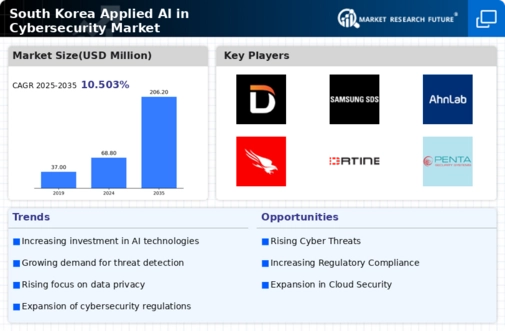
The South Korea Applied AI in Cybersecurity Market is expected to be valued at 68.75 USD Million in 2024.

What is the projected market value for the South Korea Applied AI in Cybersecurity Market by 2035?

By 2035, the market is projected to reach a value of 206.25 USD Million.

What is the expected compound annual growth rate (CAGR) for the South Korea Applied AI in Cybersecurity Market from 2025 to 2035?

The expected CAGR for the market during this period is 10.503 %.

What will be the market size for SMEs within the South Korea Applied AI in Cybersecurity Market in 2035?

The market size for SMEs is expected to grow to 81.25 USD Million by 2035.

What will be the market size for large enterprises in the South Korea Applied AI in Cybersecurity Market in 2035?

For large enterprises, the market size is anticipated to reach 125.0 USD Million by 2035.

Who are the key players in the South Korea Applied AI in Cybersecurity Market?

Major players in the market include SK Infosec, Darktrace, Samsung SDS, AhnLab, and Crowdstrike.

What are some key applications driving growth in the South Korea Applied AI in Cybersecurity Market?

Key applications include threat detection, incident response, and vulnerability management.

How is the market for Applied AI in Cybersecurity expected to grow in South Korea?

The market is expected to exhibit strong growth due to rising cyber threats and the need for advanced protection mechanisms.

What challenges might the South Korea Applied AI in Cybersecurity Market face?

Challenges include the evolving nature of cyber threats and regulatory compliance requirements.

How are global conflicts impacting the South Korea Applied AI in Cybersecurity Market?

Global conflicts are increasing awareness and investment in cybersecurity measures, thus driving market growth.

Download Free Sample

Kindly complete the form below to receive a free sample of this Report

Compare Licence

×
Features License Type
Single User Multiuser License Enterprise User
Price $4,950 $5,950 $7,250
Maximum User Access Limit 1 User Upto 10 Users Unrestricted Access Throughout the Organization
Free Customization
Direct Access to Analyst
Deliverable Format
Platform Access
Discount on Next Purchase 10% 15% 15%
Printable Versions