×
Request Free Sample ×

Kindly complete the form below to receive a free sample of this Report

* Please use a valid business email

Leading companies partner with us for data-driven Insights

clients tt-cursor
Hero Background

US Airport Surveillance Radar Market

ID: MRFR/AD/16172-HCR
100 Pages
Sejal Akre
February 2026

US Airport Surveillance Radar Market Size, Share, Industry Trend & Analysis Research Report: By Type (Primary Radars, Secondary Radars) andBy Application (Civil & Commercial Airports, Military Airbases & Airfields)- Forecast to 2035

Share:
Download PDF ×

We do not share your information with anyone. However, we may send you emails based on your report interest from time to time. You may contact us at any time to opt-out.

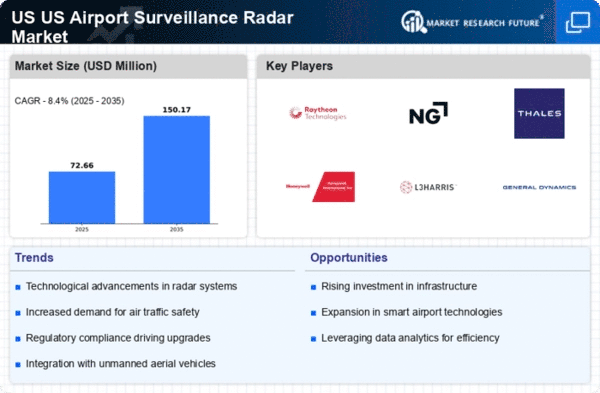
US Airport Surveillance Radar Market Infographic
Purchase Options

US Airport Surveillance Radar Market Summary

As per analysis, the US Airport Surveillance Radar Market is projected to grow from USD 67.03 Million in 2024 to USD 150.17 Million by 2035, exhibiting a compound annual growth rate (CAGR) of 7.61% during the forecast period (2025 - 2035).

Key Market Trends & Highlights

The US Airport Surveillance Radar Market is poised for growth driven by technological advancements and increasing air traffic demands.

  • Technological advancements in radar systems are enhancing the efficiency of air traffic control operations.
  • The air traffic control segment remains the largest, while the ADS-B segment is experiencing the fastest growth.
  • Regulatory changes are prompting modernization efforts across airport infrastructure.
  • Increased air traffic demand and government investments in aviation security are key drivers of market expansion.

Market Size & Forecast

2024 Market Size 67.03 (USD Million)
2035 Market Size 150.17 (USD Million)
CAGR (2025 - 2035) 7.61%

Major Players

Raytheon Technologies (US), Northrop Grumman (US), Thales Group (US), Harris Corporation (US), Lockheed Martin (US), General Dynamics (US), L3Harris Technologies (US), Boeing (US), Honeywell International (US)

Our Impact
Enabled $4.3B Revenue Impact for Fortune 500 and Leading Multinationals
Partnering with 2000+ Global Organizations Each Year
30K+ Citations by Top-Tier Firms in the Industry

US Airport Surveillance Radar Market Trends

The US Airport Surveillance Radar Market is currently experiencing a transformative phase, driven by advancements in technology and increasing demands for air traffic safety. The integration of modern radar systems enhances the ability to monitor aircraft movements with greater precision, thereby improving overall operational efficiency. Furthermore, the emphasis on upgrading existing infrastructure to accommodate next-generation radar systems appears to be a priority for many airports across the United States. This shift not only addresses safety concerns but also aligns with the broader goals of enhancing the passenger experience and optimizing air traffic management. In addition, the regulatory environment surrounding aviation safety is evolving, which may influence the adoption of new radar technologies. The Federal Aviation Administration (FAA) continues to advocate for the implementation of advanced surveillance systems that can provide real-time data to air traffic controllers. This focus on modernization suggests a potential increase in investments within the US Airport Surveillance Radar Market, as stakeholders recognize the necessity of maintaining high safety standards while accommodating growing air traffic demands. As the market progresses, it is likely that innovations will emerge, further shaping the landscape of airport surveillance in the United States.

Technological Advancements

The US Airport Surveillance Radar Market is witnessing a surge in technological innovations, particularly in radar systems that enhance detection capabilities. These advancements facilitate improved tracking of aircraft, thereby contributing to heightened safety and efficiency in air traffic management.

Regulatory Changes

Recent regulatory shifts by the Federal Aviation Administration are prompting airports to adopt more sophisticated radar technologies. These changes aim to bolster safety protocols and ensure compliance with evolving aviation standards, thereby influencing market dynamics.

Infrastructure Modernization

There is a growing trend towards the modernization of airport infrastructure, with many facilities investing in next-generation radar systems. This trend reflects a commitment to enhancing operational efficiency and improving the overall passenger experience.

US Airport Surveillance Radar Market Drivers

Increased Air Traffic Demand

The US Airport Surveillance Radar Market is experiencing a surge in demand due to the increasing volume of air traffic. According to the Federal Aviation Administration (FAA), air traffic in the United States is projected to grow by approximately 4.1 percent annually over the next decade. This growth necessitates enhanced surveillance capabilities to ensure safety and efficiency in airspace management. As airports expand their operations to accommodate more flights, the need for advanced radar systems becomes paramount. Enhanced radar technology not only improves tracking accuracy but also aids in managing congested airspace, thereby reducing delays and enhancing passenger experience. Consequently, the rising air traffic demand is a significant driver for the US Airport Surveillance Radar Market, prompting investments in modern radar systems to meet future requirements.

Regulatory Compliance and Safety Standards

The US Airport Surveillance Radar Market is significantly shaped by stringent regulatory compliance and safety standards imposed by aviation authorities. The FAA mandates that airports adhere to specific safety protocols, which include the implementation of advanced radar systems for effective air traffic management. Compliance with these regulations is not only essential for operational safety but also for securing funding and support from federal agencies. As regulations evolve to address emerging challenges in aviation, airports are compelled to upgrade their surveillance systems to meet these standards. This regulatory landscape creates a continuous demand for advanced radar technologies, driving growth in the US Airport Surveillance Radar Market. The emphasis on safety and compliance ensures that airports invest in reliable and efficient radar solutions to maintain operational integrity.

Technological Innovations in Radar Systems

The US Airport Surveillance Radar Market is propelled by ongoing technological innovations in radar systems. Advancements such as the integration of artificial intelligence and machine learning into radar technology enhance the ability to process vast amounts of data in real-time. These innovations improve target detection, tracking accuracy, and overall situational awareness for air traffic controllers. The National Oceanic and Atmospheric Administration (NOAA) has reported that modern radar systems can now provide more precise weather data, which is essential for flight safety. As airports seek to adopt cutting-edge technologies to improve operational efficiency, the demand for innovative radar solutions is expected to rise. This trend indicates a shift towards more intelligent and adaptive radar systems, which are essential for managing the complexities of modern air traffic.

Government Investments in Aviation Security

The US Airport Surveillance Radar Market is significantly influenced by government investments aimed at enhancing aviation security. The Department of Homeland Security (DHS) and the FAA have allocated substantial budgets to upgrade airport surveillance systems, ensuring compliance with evolving security standards. For instance, the FAA's budget for fiscal year 2026 includes provisions for advanced radar systems that bolster situational awareness and threat detection capabilities. These investments are crucial in addressing potential security threats and ensuring the safety of passengers and cargo. As the government prioritizes aviation security, the demand for sophisticated radar technologies is likely to increase, driving growth in the US Airport Surveillance Radar Market. This trend underscores the importance of robust surveillance systems in maintaining national security and public confidence in air travel.

Infrastructure Development and Expansion Projects

The US Airport Surveillance Radar Market is positively impacted by ongoing infrastructure development and expansion projects at airports across the country. Many airports are undergoing significant upgrades to accommodate increasing passenger volumes and enhance operational efficiency. The FAA has initiated several programs aimed at modernizing airport infrastructure, which includes the installation of state-of-the-art radar systems. For example, the modernization of the New York City area airports is expected to incorporate advanced radar technologies to improve air traffic flow and safety. These infrastructure projects not only enhance the overall airport experience but also create a robust demand for advanced surveillance radar systems. As airports invest in their infrastructure, the US Airport Surveillance Radar Market is likely to witness substantial growth, driven by the need for effective airspace management.


Market Segment Insights

By Application: Air Traffic Control (Largest) vs. Ground Control (Fastest-Growing)

In the US Airport Surveillance Radar Market, the Air Traffic Control application dominates with the largest share, facilitating the management of aircraft movement both on the ground and in-flight. Ground Control is recognized as the fastest-growing segment, driven by increasing air traffic and the need for enhanced ground operations at airports. Approach Control and Enroute Control, while significant, hold a smaller market share compared to these leading applications, highlighting the focus on optimizing air traffic management and ground operations. Growth trends within the application segment are fueled by advancements in radar technology and increased investment in air traffic management systems. The expansion of airports and the rise in passenger numbers lead to higher demand for robust surveillance systems to ensure safety and efficiency. Furthermore, the implementation of smart technologies and automation in air traffic operations is likely to boost the Ground Control sector, making it a focal point for future investments and innovation in the market.

Air Traffic Control (Dominant) vs. Ground Control (Emerging)

Air Traffic Control stands out as the dominant application in the US Airport Surveillance Radar Market, primarily responsible for the safe and efficient management of aircraft during takeoff, landing, and in-flight. This segment benefits from established technologies and a crucial role in airport operations, ensuring compliance with safety regulations. On the other hand, Ground Control is emerging rapidly due to the rising need for improved airport efficiency and the management of increasingly complex ground traffic. The growing adoption of innovative radar technologies in this segment presents unique opportunities for enhancement in safety and operational efficiency, positioning Ground Control as a critical area for future development in airport surveillance.

By Technology: Primary Radar (Largest) vs. ADS-B (Fastest-Growing)

In the US Airport Surveillance Radar Market, the distribution of market share is predominantly led by the Primary Radar segment, which commands significant attention due to its long-range capabilities and reliable detection of aircrafts. Following it, Secondary Radar and Multilateration hold substantial shares, catering to various operational needs in the aviation sector. The ADS-B market, while smaller currently, shows promising growth potential as airports modernize surveillance systems to enhance situational awareness.

Technology: Primary Radar (Dominant) vs. ADS-B (Emerging)

Primary Radar, known for its accuracy and extensive range, is the dominant technology in the US Airport Surveillance Radar Market. Its ability to detect aircraft in all weather conditions makes it indispensable for airport operations. On the other hand, ADS-B is emerging as a transformative technology, leveraging satellite communication for real-time data sharing. This makes ADS-B not only cost-effective but also essential for upcoming automated air traffic management systems. As airports seek to modernize their surveillance capabilities, the integration of ADS-B with existing systems is expected to accelerate its adoption.

By End Use: Commercial Airports (Largest) vs. Military Airports (Fastest-Growing)

In the US Airport Surveillance Radar Market, the distribution of market share is heavily influenced by the demand at different airports. Commercial airports dominate this market due to higher traffic volumes, necessitating advanced radar systems for effective surveillance and safety management. On the other hand, military airports, though smaller in current market share, are experiencing rapid growth due to increasing defense budgets and modernization initiatives containing advanced surveillance technology. This dynamic highlights a shift in focus towards enhancing military capabilities alongside the robust demand in the commercial sector.

Surveillance Technology: Commercial Airports (Dominant) vs. Military Airports (Emerging)

Commercial airports represent the dominant sector within the US Airport Surveillance Radar Market, driven by the increasing need for traffic management and security in high-traffic areas. These facilities are integrating state-of-the-art radar technologies to enhance operational efficiency and manage air traffic inflow effectively. Meanwhile, military airports are emerging as a critical segment, fueled by government initiatives to upgrade defense infrastructure and improve airspace security. Investments in advanced surveillance systems are on the rise in military sectors, allowing for improved tracking of aerial threats and compliance with modern warfare tactics, positioning them as a rapidly growing area in the market.

Get more detailed insights about US Airport Surveillance Radar Market

Key Players and Competitive Insights

The Airport Surveillance Radar Market is characterized by a competitive landscape that is increasingly shaped by technological advancements and strategic collaborations. Key players such as Raytheon Technologies (US), Northrop Grumman (US), and L3Harris Technologies (US) are at the forefront, focusing on innovation and digital transformation to enhance their operational capabilities. These companies are not only investing in research and development but are also pursuing strategic partnerships to bolster their market positions. The collective strategies of these firms indicate a trend towards a more integrated and technologically advanced market environment, where the emphasis is on delivering sophisticated radar solutions that meet the evolving demands of air traffic management.

In terms of business tactics, companies are localizing manufacturing and optimizing supply chains to enhance efficiency and responsiveness to market needs. The competitive structure of the market appears moderately fragmented, with several key players exerting influence over various segments. This fragmentation allows for a diverse range of offerings, yet the presence of major players like Lockheed Martin (US) and Boeing (US) suggests a significant concentration of market power among a few dominant firms, which could shape pricing and innovation trajectories.

In December 2025, Raytheon Technologies (US) announced a partnership with a leading technology firm to develop next-generation radar systems that leverage artificial intelligence for enhanced target detection. This strategic move is likely to position Raytheon at the cutting edge of radar technology, potentially redefining operational standards in air traffic control and surveillance. The integration of AI into their systems may not only improve accuracy but also streamline operations, thereby enhancing overall safety in air travel.

In November 2025, Northrop Grumman (US) secured a contract with the Federal Aviation Administration (FAA) to upgrade existing radar systems across several major airports. This contract underscores Northrop Grumman's commitment to maintaining its leadership position in the market while addressing the critical need for modernization in air traffic management. The upgrade is expected to enhance the reliability and efficiency of radar operations, which is crucial for accommodating increasing air traffic volumes.

In October 2025, L3Harris Technologies (US) launched a new radar system designed specifically for small and medium-sized airports, aiming to expand its market reach. This initiative reflects a strategic focus on catering to underserved segments of the market, potentially increasing L3Harris's customer base and revenue streams. By addressing the unique needs of smaller airports, the company may enhance its competitive edge and foster long-term growth.

As of January 2026, current trends in the Airport Surveillance Radar Market are heavily influenced by digitalization, sustainability, and the integration of AI technologies. Strategic alliances among key players are shaping the competitive landscape, fostering innovation and collaboration. The shift from price-based competition to a focus on technological advancement and supply chain reliability is evident. Companies that prioritize innovation and adaptability are likely to thrive, as the market evolves towards more sophisticated and efficient radar solutions.

Key Companies in the US Airport Surveillance Radar Market include

Industry Developments

The US Airport Surveillance Radar Market has recently seen notable developments, including advancements from major players like Raytheon Technologies, L3Harris Technologies, and Northrop Grumman, which focus on the integration of Artificial Intelligence and Machine Learning to enhance situational awareness for air traffic control. In September 2023, Raytheon Technologies announced a new radar technology that significantly increases detection range and accuracy, positioning them ahead in competitive capabilities. Additionally, Leonardo's acquisition of a small tech firm specializing in radar signal processing earlier this year highlighted strategic moves within the sector to bolster their technological edge.

The market is also witnessing a growing need for modernization and upgrades of legacy radar systems to meet safety and operational efficiency, driven by the Federal Aviation Administration's initiatives aimed at enhancing airport infrastructure. Furthermore, the market valuation is predicted to grow significantly, fueled by increased federal funding and investment in airport technology projects, generating heightened demand for advanced surveillance radar systems. Overall, these trends signify a dynamic landscape in the US Airport Surveillance Radar Market, driven by innovation and regulatory support.

Future Outlook

US Airport Surveillance Radar Market Future Outlook

The US Airport Surveillance Radar Market is projected to grow at a 7.61% CAGR from 2025 to 2035, driven by technological advancements and increasing air traffic management needs.

New opportunities lie in:

  • Integration of AI-driven analytics for enhanced radar performance
  • Development of compact, cost-effective radar systems for smaller airports
  • Partnerships with drone manufacturers for integrated surveillance solutions

By 2035, the market is expected to be robust, driven by innovation and strategic partnerships.

Market Segmentation

US Airport Surveillance Radar Market End Use Outlook

  • Commercial Airports
  • Military Airports
  • Private Airports

US Airport Surveillance Radar Market Technology Outlook

  • Primary Radar
  • Secondary Radar
  • Multilateration
  • ADS-B

US Airport Surveillance Radar Market Application Outlook

  • Air Traffic Control
  • Ground Control
  • Approach Control
  • Enroute Control

Report Scope

MARKET SIZE 202467.03(USD Million)
MARKET SIZE 202572.67(USD Million)
MARKET SIZE 2035150.17(USD Million)
COMPOUND ANNUAL GROWTH RATE (CAGR)7.61% (2024 - 2035)
REPORT COVERAGERevenue Forecast, Competitive Landscape, Growth Factors, and Trends
BASE YEAR2024
Market Forecast Period2025 - 2035
Historical Data2019 - 2024
Market Forecast UnitsUSD Million
Key Companies ProfiledRaytheon Technologies (US), Northrop Grumman (US), Thales Group (US), Harris Corporation (US), Lockheed Martin (US), General Dynamics (US), L3Harris Technologies (US), Boeing (US), Honeywell International (US)
Segments CoveredApplication, Technology, End Use
Key Market OpportunitiesIntegration of advanced artificial intelligence in US Airport Surveillance Radar systems enhances operational efficiency and safety.
Key Market DynamicsTechnological advancements and regulatory changes drive growth in the US Airport Surveillance Radar Market.
Countries CoveredUS
Leave a Comment

FAQs

What is the projected market valuation of the US Airport Surveillance Radar Market by 2035?

The projected market valuation for the US Airport Surveillance Radar Market is expected to reach 150.17 USD Million by 2035.

What was the market valuation of the US Airport Surveillance Radar Market in 2024?

The overall market valuation of the US Airport Surveillance Radar Market was 67.03 USD Million in 2024.

What is the expected CAGR for the US Airport Surveillance Radar Market during the forecast period 2025 - 2035?

The expected CAGR for the US Airport Surveillance Radar Market during the forecast period 2025 - 2035 is 7.61%.

Which companies are considered key players in the US Airport Surveillance Radar Market?

Key players in the US Airport Surveillance Radar Market include Raytheon Technologies, Northrop Grumman, Thales Group, and Lockheed Martin.

What are the primary applications of airport surveillance radar?

The primary applications of airport surveillance radar include Air Traffic Control, Ground Control, Approach Control, and Enroute Control.

What is the valuation range for the Air Traffic Control segment in the US Airport Surveillance Radar Market?

The valuation range for the Air Traffic Control segment in the US Airport Surveillance Radar Market is between 20.0 and 45.0 USD Million.

How does the valuation of Secondary Radar compare to other technologies in the market?

The valuation for Secondary Radar ranges from 25.0 to 50.0 USD Million, indicating its prominence among other technologies.

What is the expected valuation for Commercial Airports in the US Airport Surveillance Radar Market?

The expected valuation for Commercial Airports in the US Airport Surveillance Radar Market ranges from 30.0 to 70.0 USD Million.

What segment is projected to have the highest valuation in the US Airport Surveillance Radar Market?

The segment projected to have the highest valuation is Secondary Radar, with a range of 25.0 to 50.0 USD Million.

What is the valuation range for the Multilateration technology in the market?

The valuation range for the Multilateration technology in the US Airport Surveillance Radar Market is between 12.0 and 30.0 USD Million.

Download Free Sample

Kindly complete the form below to receive a free sample of this Report

Compare Licence

×
Features License Type
Single User Multiuser License Enterprise User
Price $4,950 $5,950 $7,250
Maximum User Access Limit 1 User Upto 10 Users Unrestricted Access Throughout the Organization
Free Customization
Direct Access to Analyst
Deliverable Format
Platform Access
Discount on Next Purchase 10% 15% 15%
Printable Versions