×
Request Free Sample ×

Kindly complete the form below to receive a free sample of this Report

* Please use a valid business email

Leading companies partner with us for data-driven Insights

clients tt-cursor
Hero Background

US Airport Management Market

ID: MRFR/AD/13766-HCR
100 Pages
Garvit Vyas
February 2026

US Airport Management Market

Share:
Download PDF ×

We do not share your information with anyone. However, we may send you emails based on your report interest from time to time. You may contact us at any time to opt-out.

US Airport Management Market Infographic
Purchase Options

US Airport Management Market Summary

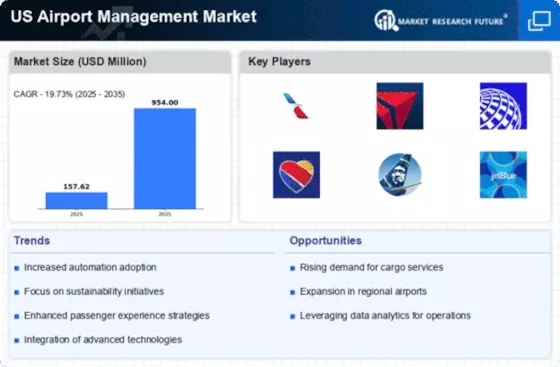
As per analysis, the US Airport Management Market is projected to grow from USD 131.65 Million in 2024 to USD 954.0 Million by 2035, exhibiting a compound annual growth rate (CAGR) of 19.73% during the forecast period (2025 - 2035).

Key Market Trends & Highlights

The US Airport Management Market is poised for growth driven by technological advancements and a focus on sustainability.

  • The integration of smart technologies is transforming airport operations, enhancing efficiency and safety.
  • Sustainability initiatives are increasingly prioritized, reflecting a commitment to environmental responsibility within the industry.
  • Air Traffic Control remains the largest segment, while Screening Technologies is recognized as the fastest-growing segment in the market.
  • Regulatory compliance and growing air travel demand are key drivers propelling the market forward.

Market Size & Forecast

2024 Market Size 131.65 (USD Million)
2035 Market Size 954.0 (USD Million)
CAGR (2025 - 2035) 19.73%

Major Players

American Airlines (US), Delta Air Lines (US), United Airlines (US), Southwest Airlines (US), Alaska Airlines (US), JetBlue Airways (US), SkyWest Airlines (US), Allegiant Air (US)

Our Impact
Enabled $4.3B Revenue Impact for Fortune 500 and Leading Multinationals
Partnering with 2000+ Global Organizations Each Year
30K+ Citations by Top-Tier Firms in the Industry

US Airport Management Market Trends

The US Airport Management Market is currently experiencing a transformative phase, driven by advancements in technology and evolving passenger expectations. Airports are increasingly adopting innovative solutions to enhance operational efficiency and improve the overall travel experience. This shift is characterized by the integration of smart technologies, such as automated check-in systems and real-time data analytics, which streamline processes and reduce wait times. Furthermore, the emphasis on sustainability is becoming more pronounced, as airports seek to minimize their environmental impact through energy-efficient practices and eco-friendly infrastructure. In addition to technological advancements, the US Airport Management Market is witnessing a growing focus on passenger-centric services. Airports are investing in amenities that cater to the needs of travelers, including enhanced retail options, improved dining experiences, and comfortable waiting areas. This trend reflects a broader understanding that passenger satisfaction is crucial for the long-term success of airport operations. As the market continues to evolve, stakeholders must remain adaptable to changing demands and explore new strategies to maintain competitiveness in this dynamic environment.

Integration of Smart Technologies

The US Airport Management Market is increasingly embracing smart technologies to enhance operational efficiency. Innovations such as automated check-in kiosks, biometric screening, and real-time flight information systems are being implemented to streamline passenger flow and reduce congestion. This trend not only improves the travel experience but also allows airports to optimize resource allocation and manage operations more effectively.

Focus on Sustainability

Sustainability is becoming a central theme within the US Airport Management Market. Airports are actively pursuing initiatives aimed at reducing their carbon footprint and promoting eco-friendly practices. This includes investments in renewable energy sources, waste reduction programs, and sustainable building designs. Such efforts not only align with regulatory requirements but also resonate with environmentally conscious travelers.

Enhanced Passenger Experience

The emphasis on passenger experience is reshaping the US Airport Management Market. Airports are prioritizing the development of amenities that cater to traveler comfort and convenience. This includes improved dining options, expanded retail spaces, and enhanced lounge facilities. By focusing on the overall experience, airports aim to foster customer loyalty and encourage repeat business.

US Airport Management Market Drivers

Growing Air Travel Demand

The US Airport Management Market is experiencing a surge in air travel demand, driven by factors such as economic growth and increased disposable income among consumers. The Bureau of Transportation Statistics indicates that passenger enplanements have consistently risen, with projections suggesting a continued upward trend. This growing demand necessitates the expansion and modernization of airport facilities to accommodate larger volumes of travelers. Airports are investing in infrastructure improvements, including terminal expansions and enhanced boarding processes, to meet this demand. Consequently, airports that effectively manage this growth are likely to enhance their operational capabilities and improve overall passenger satisfaction, thereby solidifying their market position.

Public-Private Partnerships (PPPs)

Public-Private Partnerships (PPPs) are becoming increasingly prevalent in the US Airport Management Market, facilitating the development and management of airport infrastructure. These collaborations allow for shared investment and risk, enabling airports to undertake large-scale projects that may be financially unfeasible independently. For instance, several airports have engaged in PPPs to fund terminal renovations and technology upgrades. This model not only accelerates project timelines but also enhances service delivery through innovative solutions brought by private entities. As airports continue to seek funding avenues, the trend towards PPPs is likely to grow, fostering a more dynamic and responsive airport management landscape.

Focus on Environmental Sustainability

The US Airport Management Market is witnessing a pronounced focus on environmental sustainability, driven by both regulatory pressures and public demand. Airports are increasingly adopting green initiatives, such as renewable energy sources and sustainable construction practices, to minimize their environmental footprint. The Federal Aviation Administration has introduced programs that incentivize airports to implement eco-friendly technologies. For example, airports that invest in solar energy systems can significantly reduce operational costs while enhancing their sustainability profile. This shift towards sustainability not only aligns with broader environmental goals but also appeals to environmentally conscious travelers, potentially increasing passenger loyalty and airport patronage.

Regulatory Compliance and Safety Standards

The US Airport Management Market is heavily influenced by stringent regulatory compliance and safety standards. The Federal Aviation Administration (FAA) mandates various safety protocols that airports must adhere to, ensuring the safety of passengers and staff. Compliance with these regulations often necessitates investment in advanced management systems and technologies. For instance, airports are required to implement security measures that align with Transportation Security Administration (TSA) guidelines. This regulatory landscape not only drives operational efficiency but also enhances the overall safety of airport operations. As a result, airports that prioritize compliance are likely to experience improved reputations and increased passenger trust, which can lead to higher traffic volumes and revenue generation.

Technological Advancements in Airport Operations

The integration of cutting-edge technologies is a pivotal driver in the US Airport Management Market. Innovations such as biometric screening, automated baggage handling, and real-time data analytics are transforming airport operations. For example, the adoption of Internet of Things (IoT) devices allows for enhanced monitoring of airport facilities, leading to improved maintenance and operational efficiency. According to industry reports, airports that have embraced these technologies have seen a reduction in operational costs by up to 20%. Furthermore, the implementation of advanced management software facilitates better resource allocation and enhances the passenger experience, ultimately contributing to increased airport competitiveness in a rapidly evolving market.


Market Segment Insights

By Airport Operations Management: Air Traffic Control (Largest) vs. Ground Handling Services (Fastest-Growing)

In the US Airport Management Market, the segment of Air Traffic Control dominates the market share, accounting for a significant portion of the operations implemented at airports. This segment plays a crucial role in ensuring safe and orderly air traffic flow, with a reliance on advanced technology and skilled personnel to manage aircraft movements. On the other hand, Ground Handling Services are rapidly gaining traction, driven by the increasing demand for efficient airport operations and passenger convenience. This segment encompasses a variety of functions, including ramp services and aircraft servicing, which are essential to facilitate timely departures and arrivals. The growth trends within these segments are influenced by several key factors. The Air Traffic Control segment sees continuous investment in advanced systems and automation technology, enhancing safety and efficiency. Additionally, the rise in air travel post-pandemic indicates a steady demand for both Air Traffic Control and Ground Handling Services. As airlines expand fleets and airport infrastructures improve, Ground Handling Services are evolving to meet the challenges of higher passenger volumes and cargo handling needs, positioning themselves as a critical focus area for airports seeking operational optimization.

Air Traffic Control (Dominant) vs. Baggage Management (Emerging)

Air Traffic Control is recognized as the dominant segment in airport operations, primarily due to its importance in maintaining safety and efficiency in air travel. This segment is geared towards coordinating aircraft movements, managing airspace, and providing critical communication to pilots. In contrast, Baggage Management stands out as an emerging segment, as it adapts to modern challenges such as increasing passenger loads and the demand for speedy, reliable baggage handling processes. Effective baggage management systems utilize advanced tracking technologies and data analytics to minimize lost luggage incidents and enhance passenger satisfaction. As airports ramp up efforts to enhance operational efficiency, both segments are being recognized for their essential contributions to overall airport functionality.

By Airport Security Management: Access Control Systems (Largest) vs. Screening Technologies (Fastest-Growing)

In the US Airport Management Market, access control systems hold the largest share among the various airport security management segment values, followed closely by surveillance systems and screening technologies. Surveillance systems are also notable, providing an essential layer of security and operational efficiency. Meanwhile, incident management, while critical for maintaining safety, occupies a smaller share of the market compared to the other segment values. This distribution highlights the diverse security needs within airport management, catering to both access control and monitoring requirements.

Surveillance Systems: Dominant vs. Incident Management: Emerging

Access control systems are vital for ensuring authorized entry and minimizing security risks at airports, making them the dominant value in the segment. These systems are comprehensive, utilizing biometric data and smart technology to streamline the security process. In contrast, incident management serves an emerging role, focusing on rapid response to security breaches and incidents. Although currently smaller in market share, the increasing importance of security awareness and regulatory compliance drives its growth. As airports upgrade their security protocols, the need for dynamic incident management systems will likely expand, helping to aid in the prevention and mitigation of breaches.

By Airport Infrastructure Management: Runway Management (Largest) vs. Terminal Management (Fastest-Growing)

In the US Airport Management Market, the distribution among segments reveals that Runway Management holds the largest share. This segment is critical for the safe and efficient takeoff and landing of aircraft, making it a priority in airport management. Terminal Management, while not as large in share, is rapidly gaining traction and has emerged as the fastest-growing segment due to increasing passenger traffic and heightened service expectations.

Runway Management (Dominant) vs. Terminal Management (Emerging)

Runway Management plays a dominant role in the overall efficiency and safety of airport operations. It encompasses aspects such as runway repairs, lighting, and scheduling aircraft movements, ensuring minimal delays and maximizing capacity. On the other hand, Terminal Management has emerged as a crucial focus for many airports in response to growing passenger numbers and expectations for enhanced customer experience. This segment involves managing ticketing, baggage handling, and traveler amenities, reflecting a shift towards prioritizing passenger convenience and operational efficiency.

By Airport Financial Management: Revenue Management (Largest) vs. Cost Control (Fastest-Growing)

In the US Airport Management Market, the Airport Financial Management segment has shown significant differentiation among its values. Revenue Management leads the segment, commanding the largest share with its essential role in maximizing airport revenue through strategic pricing and effective inventory management. On the other hand, Cost Control has emerged as a key player, drawing attention as it expands rapidly, reflecting airports' increasing focus on operational efficiency and sustainability in financial practices. Growth trends in this segment are propelled by technological advancements and the evolving regulatory landscape. As airports seek to optimize their financial performance, the adoption of sophisticated financial management tools and analytics has become critical. This supports not only revenue maximization but also enhances budgeting and financial reporting, thus driving overall operational success in the competitive airport environment.

Revenue Management (Dominant) vs. Budgeting (Emerging)

Revenue Management stands as the dominant force within the Airport Financial Management segment, characterized by its crucial role in driving profitability through comprehensive pricing strategies and revenue optimization techniques. Airports are increasingly leveraging data analytics to refine their revenue management approaches, ensuring that they are responsive to market dynamics and passenger demand. In contrast, Budgeting is an emerging value that, while vital for operational planning, is gaining traction as airports embrace more collaborative and flexible budgeting processes. This shift is influenced by the need for transparency and adaptability in financial planning, which complements the more established revenue management practices. As both segments evolve, their interplay will define the future of airport financial strategies in an increasingly complex market.

Get more detailed insights about US Airport Management Market

Key Players and Competitive Insights

The Airport Management Market in the US is characterized by a competitive landscape that is increasingly shaped by innovation, digital transformation, and strategic partnerships. Key players such as American Airlines (US), Delta Air Lines (US), and Southwest Airlines (US) are actively pursuing strategies that enhance operational efficiency and customer experience. For instance, American Airlines (US) has focused on expanding its digital services, which appears to be a response to the growing demand for seamless travel experiences. Delta Air Lines (US), on the other hand, has been investing in sustainability initiatives, indicating a shift towards environmentally responsible operations. Meanwhile, Southwest Airlines (US) has been enhancing its regional connectivity, which suggests a strategy aimed at capturing a broader market share in underserved areas.

The business tactics employed by these companies reflect a moderately fragmented market structure, where localizing operations and optimizing supply chains are critical for maintaining competitiveness. The collective influence of these key players is significant, as they not only drive innovation but also set industry standards that smaller competitors may strive to emulate. This dynamic fosters a competitive environment where agility and responsiveness to market changes are paramount.

In November 2025, Delta Air Lines (US) announced a partnership with a leading technology firm to develop AI-driven solutions for airport operations. This strategic move is likely to enhance operational efficiency and improve customer service by streamlining processes such as baggage handling and check-in procedures. The integration of AI technologies could position Delta as a frontrunner in operational excellence within the market.

In December 2025, American Airlines (US) unveiled a new initiative aimed at reducing its carbon footprint by 50% by 2030. This ambitious goal underscores the airline's commitment to sustainability and reflects a broader industry trend towards environmentally conscious practices. Such initiatives may not only enhance brand reputation but also attract environmentally aware consumers, thereby influencing market dynamics.

In January 2026, Southwest Airlines (US) launched a new route network that connects several regional airports, thereby expanding its operational footprint. This strategic expansion is indicative of the airline's focus on capturing market share in less competitive regions, which could lead to increased revenue streams. By enhancing regional connectivity, Southwest may also improve customer loyalty and brand recognition in these areas.

As of January 2026, the competitive trends in the Airport Management Market are increasingly defined by digitalization, sustainability, and the integration of advanced technologies such as AI. Strategic alliances are becoming more prevalent, as companies recognize the value of collaboration in enhancing operational capabilities. Looking ahead, it appears that competitive differentiation will evolve from traditional price-based competition to a focus on innovation, technological advancements, and supply chain reliability. This shift may redefine how companies position themselves in the market, emphasizing the importance of adaptability and forward-thinking strategies.

Key Companies in the US Airport Management Market include

Future Outlook

US Airport Management Market Future Outlook

The US Airport Management Market is poised for growth at a 19.73% CAGR from 2025 to 2035, driven by technological advancements, increasing passenger traffic, and enhanced operational efficiency.

New opportunities lie in:

  • Implementation of AI-driven predictive maintenance systems
  • Expansion of integrated passenger flow management solutions
  • Development of sustainable airport infrastructure initiatives

By 2035, the market is expected to achieve robust growth, positioning itself as a leader in airport management solutions.

Market Segmentation

US Airport Management Market Airport Security Management Outlook

  • Access Control Systems
  • Surveillance Systems
  • Screening Technologies
  • Incident Management

US Airport Management Market Airport Financial Management Outlook

  • Revenue Management
  • Cost Control
  • Budgeting
  • Financial Reporting

US Airport Management Market Airport Operations Management Outlook

  • Air Traffic Control
  • Ground Handling Services
  • Passenger Services
  • Baggage Management

US Airport Management Market Airport Infrastructure Management Outlook

  • Runway Management
  • Terminal Management
  • Parking Management
  • Facility Maintenance

Report Scope

MARKET SIZE 2024131.65(USD Million)
MARKET SIZE 2025160.48(USD Million)
MARKET SIZE 2035954.0(USD Million)
COMPOUND ANNUAL GROWTH RATE (CAGR)19.73% (2024 - 2035)
REPORT COVERAGERevenue Forecast, Competitive Landscape, Growth Factors, and Trends
BASE YEAR2024
Market Forecast Period2025 - 2035
Historical Data2019 - 2024
Market Forecast UnitsUSD Million
Key Companies ProfiledAmerican Airlines (US), Delta Air Lines (US), United Airlines (US), Southwest Airlines (US), Alaska Airlines (US), JetBlue Airways (US), SkyWest Airlines (US), Allegiant Air (US)
Segments CoveredAirport Operations Management, Airport Security Management, Airport Infrastructure Management, Airport Financial Management
Key Market OpportunitiesIntegration of advanced technologies for enhanced operational efficiency in the US Airport Management Market.
Key Market DynamicsTechnological advancements and regulatory changes drive efficiency and sustainability in the US Airport Management Market.
Countries CoveredUS
Leave a Comment

FAQs

What is the current valuation of the US Airport Management Market?

The US Airport Management Market was valued at 131.65 USD Million in 2024.

What is the projected market valuation for the US Airport Management Market by 2035?

The market is projected to reach 954.0 USD Million by 2035.

What is the expected CAGR for the US Airport Management Market during the forecast period?

The expected CAGR for the US Airport Management Market from 2025 to 2035 is 19.73%.

Which companies are considered key players in the US Airport Management Market?

Key players include American Airlines, Delta Air Lines, United Airlines, Southwest Airlines, Alaska Airlines, JetBlue Airways, SkyWest Airlines, and Allegiant Air.

What are the main segments of the US Airport Management Market?

The main segments include Airport Operations Management, Airport Security Management, Airport Infrastructure Management, and Airport Financial Management.

How much was the valuation for Airport Operations Management in 2024?

The valuation for Airport Operations Management was approximately 131.65 USD Million in 2024.

What is the projected valuation for Airport Security Management by 2035?

The projected valuation for Airport Security Management is expected to be substantial, reflecting the overall market growth.

What are the key components of Airport Infrastructure Management?

Key components include Runway Management, Terminal Management, Parking Management, and Facility Maintenance.

How does the revenue management segment perform in the US Airport Management Market?

The revenue management segment is projected to show strong performance, with a valuation of 314.0 USD Million by 2035.

What trends are influencing the growth of the US Airport Management Market?

Trends such as advancements in technology and increasing passenger traffic are likely influencing the market's growth.

Download Free Sample

Kindly complete the form below to receive a free sample of this Report

Compare Licence

×
Features License Type
Single User Multiuser License Enterprise User
Price $4,950 $5,950 $7,250
Maximum User Access Limit 1 User Upto 10 Users Unrestricted Access Throughout the Organization
Free Customization
Direct Access to Analyst
Deliverable Format
Platform Access
Discount on Next Purchase 10% 15% 15%
Printable Versions