×
Request Free Sample ×

Kindly complete the form below to receive a free sample of this Report

* Please use a valid business email

Leading companies partner with us for data-driven Insights

clients tt-cursor
Hero Background

US Agriculture Robots Market

ID: MRFR/SEM/11907-HCR
100 Pages
Garvit Vyas
February 2026

United States Agriculture Robots Industry Research Report to 2032

Share:
Download PDF ×

We do not share your information with anyone. However, we may send you emails based on your report interest from time to time. You may contact us at any time to opt-out.

US Agriculture Robots Market Infographic
Purchase Options

US Agriculture Robots Market Summary

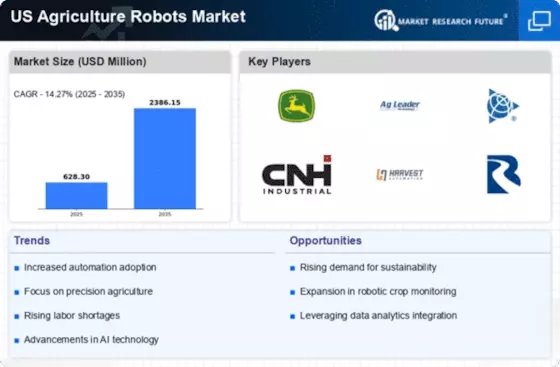
As per analysis, the US Agriculture Robots Market is projected to grow from USD 549.84 Million in 2024 to USD 636.78 Million in 2025, ultimately reaching USD 2386.15 Million by 2035, exhibiting a compound annual growth rate (CAGR) of 14.27% during the forecast period (2025 - 2035).

Key Market Trends & Highlights

The US Agriculture Robots Market is experiencing robust growth driven by technological advancements and increasing demand for efficiency.

  • The market witnesses increased adoption of autonomous systems, particularly in crop monitoring, which remains the largest segment.
  • Integration of AI and data analytics is transforming operational efficiencies, especially in the harvesting segment, which is the fastest-growing.
  • Sustainable practices are gaining traction as farmers seek to align with environmental sustainability initiatives.
  • Rising labor costs and government support are significant drivers propelling the market forward.

Market Size & Forecast

2024 Market Size 549.84 (USD Million)
2035 Market Size 2386.15 (USD Million)
CAGR (2025 - 2035) 14.27%

Major Players

John Deere (US), AG Leader Technology (US), Trimble Inc. (US), CNH Industrial (US), Harvest Automation (US), Blue River Technology (US), Raven Industries (US), Drones for Agriculture (US), Octinion (US)

Our Impact
Enabled $4.3B Revenue Impact for Fortune 500 and Leading Multinationals
Partnering with 2000+ Global Organizations Each Year
30K+ Citations by Top-Tier Firms in the Industry

US Agriculture Robots Market Trends

The US Agriculture Robots Market is currently experiencing a transformative phase, driven by advancements in technology and the increasing need for efficiency in agricultural practices. As farmers face challenges such as labor shortages and the demand for higher productivity, the adoption of robotic solutions appears to be a viable response. These innovations encompass a range of applications, from planting and harvesting to monitoring crop health and managing livestock. The integration of artificial intelligence and machine learning into these systems suggests a future where precision agriculture becomes the norm, potentially leading to enhanced yields and reduced resource consumption. Moreover, the regulatory environment in the United States is evolving to accommodate the rise of automation in agriculture. Government initiatives aimed at promoting sustainable farming practices and supporting technological innovation may further bolster the US Agriculture Robots Market. As stakeholders, including farmers, technology developers, and policymakers, collaborate to address the challenges of modern agriculture, the market is likely to witness significant growth. This synergy between technology and agriculture not only enhances operational efficiency but also contributes to the overall sustainability of food production in the country.

Increased Adoption of Autonomous Systems

The trend towards autonomous agricultural systems is gaining momentum in the US Agriculture Robots Market. Farmers are increasingly utilizing robots for tasks such as planting, weeding, and harvesting, which allows for greater efficiency and reduced labor costs. This shift is driven by the need to optimize productivity while addressing labor shortages in the agricultural sector.

Integration of AI and Data Analytics

The incorporation of artificial intelligence and data analytics into agricultural robotics is becoming more prevalent. These technologies enable farmers to make informed decisions based on real-time data, enhancing crop management and resource allocation. This trend indicates a move towards precision agriculture, where data-driven insights lead to improved yields and sustainability.

Focus on Sustainable Practices

Sustainability is emerging as a key focus within the US Agriculture Robots Market. As environmental concerns grow, there is a push for robotic solutions that minimize chemical usage and reduce waste. This trend reflects a broader commitment to sustainable farming practices, aligning with consumer demand for environmentally friendly food production.

US Agriculture Robots Market Drivers

Rising Labor Costs

The US Agriculture Robots Market is experiencing a notable shift due to escalating labor costs. As wages for agricultural workers continue to rise, farmers are increasingly seeking automation solutions to maintain profitability. The Bureau of Labor Statistics indicates that agricultural labor costs have surged by approximately 20% over the past five years. This trend compels farmers to invest in robotics technology, which can perform tasks such as planting, harvesting, and monitoring crops with greater efficiency. Consequently, the demand for agricultural robots is likely to increase, as these machines can alleviate the burden of labor shortages and reduce operational costs in the long run.

Technological Advancements

Technological advancements play a pivotal role in shaping the US Agriculture Robots Market. Innovations in robotics, artificial intelligence, and machine learning are enhancing the capabilities of agricultural robots. For instance, the development of precision agriculture technologies allows for more accurate planting and harvesting, leading to increased yields. According to the USDA, the adoption of such technologies has the potential to boost crop productivity by up to 30%. As these advancements continue to evolve, they are expected to drive further investment in agricultural robotics, making them an integral part of modern farming practices.

Growing Demand for Food Security

The growing demand for food security is a significant driver of the US Agriculture Robots Market. With the population projected to reach over 400 million by 2050, the pressure on agricultural systems to produce sufficient food is intensifying. Agricultural robots can play a vital role in addressing this challenge by increasing efficiency and reducing waste. The USDA reports that automation can help achieve a 25% increase in food production without expanding arable land. This potential to enhance food security is likely to propel the adoption of robotics in agriculture, as farmers seek innovative solutions to meet rising demands.

Government Support and Incentives

Government support and incentives are crucial drivers for the US Agriculture Robots Market. Various federal and state programs aim to promote the adoption of advanced agricultural technologies. For example, the USDA has introduced grants and funding opportunities for farmers who invest in automation and robotics. These initiatives not only alleviate the financial burden on farmers but also encourage the integration of innovative solutions into traditional farming practices. As a result, the market for agricultural robots is likely to expand, as more farmers take advantage of these incentives to enhance productivity and sustainability.

Environmental Sustainability Initiatives

Environmental sustainability initiatives are increasingly influencing the US Agriculture Robots Market. As concerns about climate change and resource depletion grow, farmers are seeking ways to minimize their environmental impact. Agricultural robots can contribute to sustainable practices by optimizing resource use, such as water and fertilizers. For instance, precision irrigation systems can reduce water consumption by up to 50%. The USDA supports these initiatives through research and funding, encouraging farmers to adopt technologies that promote sustainability. This alignment with environmental goals is expected to drive the growth of the agricultural robotics market, as more farmers recognize the benefits of sustainable practices.


Market Segment Insights

By Application: Crop Monitoring (Largest) vs. Harvesting (Fastest-Growing)

In the US Agriculture Robots Market, the application segment is diverse, with Crop Monitoring accounting for the largest market share among the various applications. Following closely, Harvesting stands out as the fastest-growing segment, driven by the increasing demand for efficiency and precision in agricultural practices. Soil Analysis, Planting, and Weed Control also contribute significantly to the market, showcasing their importance as precision agriculture becomes more prevalent. The segmentation illustrates a keen interest in adopting technology that enhances crop management and productivity.

Crop Monitoring (Dominant) vs. Harvesting (Emerging)

Crop Monitoring has established itself as the dominant application within the US Agriculture Robots Market, driven by advancements in drone technology and continuous monitoring solutions that empower farmers to make informed decisions. This segment enables real-time insights into crop health, leading to improved yield and resource management. Conversely, Harvesting is emerging rapidly, capturing market attention due to its ability to significantly reduce labor costs and improve harvesting efficiency. The ongoing innovation in robotic solutions, combined with labor shortages in agriculture, is propelling the adoption of harvesting robots, indicating a robust growth trajectory in the coming years.

By Type: Drones (Largest) vs. Autonomous Tractors (Fastest-Growing)

In the US Agriculture Robots Market, drones currently hold the largest market share among various types of robots utilized in agriculture. These aerial devices are widely adopted for purposes such as crop monitoring, spraying, and data collection, showcasing their versatility and efficiency. Autonomous tractors, though not as dominant in market share, are quickly gaining traction due to their advanced technology and the growing need for labor-saving solutions in farming operations.

Drones (Dominant) vs. Autonomous Tractors (Emerging)

Drones have emerged as the dominant force within the US Agriculture Robots Market, providing farmers with advanced tools for aerial surveillance and precision agriculture. They offer significant advantages, including enhanced crop health monitoring and efficient pesticide application, leading to improved yields and reduced operational costs. On the other hand, autonomous tractors are rapidly becoming an essential part of modern farming by automating crucial tasks such as tilling, planting, and harvesting. These machines are equipped with cutting-edge technology for navigation and operation, making them a valuable investment for farms striving for productivity and efficiency in increasingly competitive agricultural landscapes.

By End Use: Farms (Largest) vs. Greenhouses (Fastest-Growing)

The distribution of market share in the US Agriculture Robots Market is primarily dominated by farms, which represent the largest segment. Farms utilize agricultural robots for various tasks, including planting, harvesting, and maintenance, resulting in significant efficiency gains. Greenhouses follow as a rapidly growing segment as they adopt innovative technologies to optimize production. Research institutions, agricultural cooperatives, and government agencies also contribute to the market but hold smaller shares comparatively, reflecting their specialized needs and different operational dynamics.

Farms (Dominant) vs. Greenhouses (Emerging)

Farms are the dominant segment in the US Agriculture Robots Market, characterized by a wide range of robotic applications that enhance productivity and reduce labor costs. These robots are integral to various farming operations, such as precision agriculture and automated harvesting. In contrast, greenhouses are an emerging segment, rapidly adopting robotic technologies to improve operational efficiency and resource management. The growing demand for sustainable agricultural practices and the need for year-round crop production drive the adoption of robotics in greenhouses. As they enhance yield and manage climate-controlled environments, greenhouses are increasingly turning to automation solutions, indicating a significant shift in agricultural methodologies.

By Technology: Artificial Intelligence (Largest) vs. Machine Learning (Fastest-Growing)

In the US Agriculture Robots Market, the distribution of market share among technology segments is notably varied. Artificial Intelligence stands out as the dominant force, leveraging its capabilities to optimize farming processes and enhance productivity. Following closely is Machine Learning, which, while currently smaller in terms of market share, is gaining significant traction as farmers seek more automated and intelligent solutions. Other technologies like Computer Vision, GPS Technology, and Remote Sensing also contribute to the landscape, yet their shares remain less pronounced.

AI (Dominant) vs. Machine Learning (Emerging)

Artificial Intelligence is establishing itself as the dominant technology in the US Agriculture Robots Market, driven by its ability to analyze vast amounts of data and provide actionable insights to farmers. Its applications range from precision farming to robotic harvesting, making it invaluable in boosting crop yields and reducing waste. In contrast, Machine Learning, recognized as an emerging technology, is finding its footing by enhancing automation and predictive analytics capabilities. As more agricultural stakeholders invest in intelligent systems, Machine Learning is rapidly evolving. This growth is propelled by the need for improved decision-making based on historical data and real-time analytics, fostering a more efficient and responsive agricultural ecosystem.

By Farm Size: Large Scale (Largest) vs. Family Owned (Fastest-Growing)

The US Agriculture Robots Market exhibits a diverse distribution across different farm sizes. Among these segments, Large Scale farms hold the largest share, benefitting from investments in advanced technologies and automation to enhance productivity and efficiency. Family Owned farms, while smaller in size, are rapidly adopting agricultural robotics to remain competitive and manage labor shortages, reflecting a significant shift towards modernization in this sector.

Farm Size: Large Scale (Dominant) vs. Family Owned (Emerging)

Large Scale farms dominate the US Agriculture Robotics Market due to their substantial operational capacity and ability to invest in cutting-edge technologies. These farms leverage robotics for various applications, including planting, harvesting, and monitoring crops, leading to increased efficiencies and lower overhead costs. On the other hand, Family Owned farms are a rapidly emerging segment as they adapt to changing market dynamics and labor challenges. By integrating affordable robotic solutions, they enhance their productivity and competitive edge, thus contributing to the evolving landscape of the agricultural robotics industry.

Get more detailed insights about US Agriculture Robots Market

Key Players and Competitive Insights

The Agriculture Robots Market is currently characterized by a dynamic competitive landscape, driven by technological advancements and increasing demand for efficiency in farming practices. Key players such as John Deere (US), AG Leader Technology (US), and Trimble Inc. (US) are at the forefront, each adopting distinct strategies to enhance their market positioning. John Deere (US) emphasizes innovation through the integration of AI and machine learning into its robotic solutions, aiming to optimize crop management and yield. Meanwhile, AG Leader Technology (US) focuses on precision agriculture technologies, enhancing data analytics capabilities to support farmers in making informed decisions. Trimble Inc. (US) is actively pursuing partnerships to expand its digital agriculture offerings, thereby enhancing its competitive edge in the market.

The business tactics employed by these companies reflect a trend towards localizing manufacturing and optimizing supply chains to meet the growing demand for agricultural automation. The market structure appears moderately fragmented, with several players vying for market share. However, the collective influence of major companies is significant, as they drive innovation and set industry standards, thereby shaping the competitive environment.

In December 2025, John Deere (US) announced a strategic partnership with a leading AI firm to develop advanced robotic systems capable of autonomous field operations. This collaboration is expected to enhance the efficiency of farming practices, allowing for real-time data analysis and decision-making, which could significantly reduce operational costs for farmers. The strategic importance of this partnership lies in its potential to position John Deere (US) as a leader in the autonomous agriculture segment.

In November 2025, AG Leader Technology (US) launched a new suite of precision farming tools that integrate seamlessly with existing farm management software. This launch is indicative of the company's commitment to enhancing user experience and providing farmers with comprehensive solutions that improve productivity. The strategic significance of this development is that it not only strengthens AG Leader Technology's (US) product portfolio but also reinforces its position in the competitive landscape by addressing the evolving needs of modern farmers.

In October 2025, Trimble Inc. (US) expanded its digital agriculture platform through the acquisition of a data analytics startup specializing in crop health monitoring. This acquisition is likely to enhance Trimble's (US) capabilities in providing actionable insights to farmers, thereby improving crop yields and sustainability. The strategic importance of this move lies in its alignment with the growing trend towards data-driven agriculture, positioning Trimble (US) as a key player in the integration of technology and farming practices.

As of January 2026, the Agriculture Robots Market is witnessing trends such as digitalization, sustainability, and AI integration, which are redefining competitive dynamics. Strategic alliances among key players are increasingly shaping the landscape, fostering innovation and collaboration. The shift from price-based competition to a focus on technological advancement and supply chain reliability is evident, suggesting that future competitive differentiation will hinge on the ability to innovate and adapt to changing market demands.

Key Companies in the US Agriculture Robots Market include

Future Outlook

US Agriculture Robots Market Future Outlook

The US Agriculture Robots Market is projected to grow at a 14.27% CAGR from 2025 to 2035, driven by technological advancements, labor shortages, and increasing demand for sustainable farming practices.

New opportunities lie in:

  • Development of autonomous weeding robots for precision agriculture.
  • Integration of AI-driven analytics for crop monitoring and yield prediction.
  • Expansion of robotic solutions for livestock management and health monitoring.

By 2035, the market is expected to be robust, driven by innovation and increased adoption of automation.

Market Segmentation

US Agriculture Robots Market Type Outlook

  • Autonomous Tractors
  • Drones
  • Robotic Harvesters
  • Weeding Robots
  • Seeding Robots

US Agriculture Robots Market End Use Outlook

  • Farms
  • Greenhouses
  • Research Institutions
  • Agricultural Cooperatives
  • Government Agencies

US Agriculture Robots Market Farm Size Outlook

  • Small Scale
  • Medium Scale
  • Large Scale
  • Commercial
  • Family Owned

US Agriculture Robots Market Technology Outlook

  • Artificial Intelligence
  • Machine Learning
  • Computer Vision
  • GPS Technology
  • Remote Sensing

US Agriculture Robots Market Application Outlook

  • Crop Monitoring
  • Soil Analysis
  • Harvesting
  • Planting
  • Weed Control

Report Scope

MARKET SIZE 2024549.84(USD Million)
MARKET SIZE 2025636.78(USD Million)
MARKET SIZE 20352386.15(USD Million)
COMPOUND ANNUAL GROWTH RATE (CAGR)14.27% (2024 - 2035)
REPORT COVERAGERevenue Forecast, Competitive Landscape, Growth Factors, and Trends
BASE YEAR2024
Market Forecast Period2025 - 2035
Historical Data2019 - 2024
Market Forecast UnitsUSD Million
Key Companies ProfiledJohn Deere (US), AG Leader Technology (US), Trimble Inc. (US), CNH Industrial (US), Harvest Automation (US), Blue River Technology (US), Raven Industries (US), Drones for Agriculture (US), Octinion (US)
Segments CoveredApplication, Type, End Use, Technology, Farm Size
Key Market OpportunitiesIntegration of artificial intelligence in precision agriculture enhances efficiency and productivity in the US Agriculture Robots Market.
Key Market DynamicsRising demand for precision agriculture drives innovation and competition in the US Agriculture Robots Market.
Countries CoveredUS
Leave a Comment

FAQs

What is the current valuation of the US Agriculture Robots Market?

As of 2024, the US Agriculture Robots Market was valued at 549.84 USD Million.

What is the projected market valuation for the US Agriculture Robots Market in 2035?

The market is projected to reach a valuation of 2386.15 USD Million by 2035.

What is the expected CAGR for the US Agriculture Robots Market during the forecast period?

The expected CAGR for the US Agriculture Robots Market from 2025 to 2035 is 14.27%.

Which companies are considered key players in the US Agriculture Robots Market?

Key players in the market include John Deere, AG Leader Technology, Trimble Inc., and CNH Industrial.

What are the main applications of agriculture robots in the US market?

Main applications include Crop Monitoring, Soil Analysis, Harvesting, Planting, and Weed Control, with Harvesting valued at 703.12 USD Million in 2026.

How does the market segment by type of agriculture robots?

The market segments by type include Autonomous Tractors, Drones, Robotic Harvesters, Weeding Robots, and Seeding Robots, with Robotic Harvesters projected at 500.0 USD Million in 2026.

What are the end-use segments for agriculture robots in the US?

End-use segments include Farms, Greenhouses, Research Institutions, Agricultural Cooperatives, and Government Agencies, with Farms expected to reach 703.0 USD Million in 2026.

What technologies are driving the US Agriculture Robots Market?

Key technologies include Artificial Intelligence, Machine Learning, Computer Vision, GPS Technology, and Remote Sensing, with Remote Sensing projected at 892.15 USD Million in 2026.

How is the US Agriculture Robots Market segmented by farm size?

The market is segmented by farm size into Small Scale, Medium Scale, Large Scale, Commercial, and Family Owned, with Large Scale expected to reach 715.83 USD Million in 2026.

What trends are influencing the growth of the US Agriculture Robots Market?

Trends influencing growth include advancements in technology, increasing demand for efficiency in farming, and the rising adoption of automation, contributing to the projected market expansion.

Download Free Sample

Kindly complete the form below to receive a free sample of this Report

Compare Licence

×
Features License Type
Single User Multiuser License Enterprise User
Price $4,950 $5,950 $7,250
Maximum User Access Limit 1 User Upto 10 Users Unrestricted Access Throughout the Organization
Free Customization
Direct Access to Analyst
Deliverable Format
Platform Access
Discount on Next Purchase 10% 15% 15%
Printable Versions