×
Request Free Sample ×

Kindly complete the form below to receive a free sample of this Report

* Please use a valid business email

Leading companies partner with us for data-driven Insights

clients tt-cursor
Hero Background

US Advanced Air Mobility Market

ID: MRFR/AD/19305-HCR
100 Pages
Garvit Vyas
February 2026

US Advanced Air Mobility Market Size, Share, Industry Trend & Analysis Research Report: By Application (Passenger Transport, Cargo Transport, Emergency Medical Services, Urban Air Mobility, Defense Operations), By Vehicle Type (Electric Vertical Take-Off and Landing, Hybrid Vertical Take-Off and Landing, Fixed-Wing Aircraft, Multi-Rotor Drones), By Technology (Electric Propulsion, Hybrid Propulsion, Autonomous Systems, Artificial Intelligence, Advanced Navigation Systems) andBy End Use (Commercial, Government, Military, Personal)- Forecast to 2035

Share:
Download PDF ×

We do not share your information with anyone. However, we may send you emails based on your report interest from time to time. You may contact us at any time to opt-out.

US Advanced Air Mobility Market Infographic
Purchase Options

US Advanced Air Mobility Market Summary

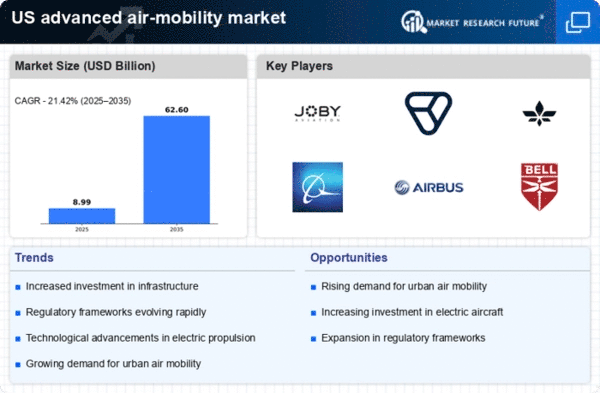
As per Market Research Future analysis, the US advanced air-mobility market size was estimated at 7.4 USD Billion in 2024. The US advanced air-mobility market is projected to grow from 8.99 USD Billion in 2025 to 62.6 USD Billion by 2035, exhibiting a compound annual growth rate (CAGR) of 21.4% during the forecast period 2025 - 2035

Key Market Trends & Highlights

The US advanced air-mobility market is poised for substantial growth driven by technological innovations and evolving regulatory frameworks.

  • Technological advancements in eVTOL aircraft are enhancing operational efficiency and safety, positioning this segment as the largest in the market.
  • Regulatory evolution and infrastructure development are critical for facilitating the integration of advanced air-mobility solutions into urban environments.
  • Sustainability and environmental considerations are increasingly influencing consumer preferences and shaping market dynamics.
  • Growing urbanization and congestion, along with government initiatives and support, are key drivers propelling the demand for advanced air-mobility solutions.

Market Size & Forecast

2024 Market Size 7.4 (USD Billion)
2035 Market Size 62.6 (USD Billion)
CAGR (2025 - 2035) 21.42%

Major Players

Joby Aviation (US), Volocopter (DE), Lilium (DE), Boeing (US), Airbus (FR), Bell Textron (US), Hyundai Urban Air Mobility (KR), EHang (CN), Pipistrel (SI)

Our Impact
Enabled $4.3B Revenue Impact for Fortune 500 and Leading Multinationals
Partnering with 2000+ Global Organizations Each Year
30K+ Citations by Top-Tier Firms in the Industry

US Advanced Air Mobility Market Trends

The advanced air-mobility market is currently experiencing a transformative phase, driven by technological advancements and increasing interest from various stakeholders. Innovations in electric vertical takeoff and landing (eVTOL) aircraft are at the forefront, promising to revolutionize urban transportation. Regulatory frameworks are evolving to accommodate these new technologies, which may facilitate their integration into existing air traffic systems. Furthermore, public-private partnerships are emerging, fostering collaboration between government entities and private companies to develop infrastructure and operational standards. This collaborative approach appears to be essential for addressing safety, efficiency, and environmental concerns associated with advanced air mobility. In addition, the demand for sustainable transportation solutions is influencing the advanced air-mobility market. As urban areas continue to grow, the need for efficient and eco-friendly transport options becomes increasingly pressing. The potential for reduced congestion and lower emissions is appealing to both consumers and policymakers. Moreover, advancements in battery technology and renewable energy sources may further enhance the viability of these air vehicles. Overall, the advanced air-mobility market seems poised for significant growth, with various factors converging to create a favorable environment for innovation and investment.

Technological Advancements in eVTOL Aircraft

The development of electric vertical takeoff and landing (eVTOL) aircraft is a key trend within the advanced air-mobility market. These vehicles are designed to operate in urban environments, offering the potential for rapid transit and reduced congestion. Innovations in battery technology and aerodynamics are enhancing their performance and efficiency, making them more appealing to both consumers and operators.

Regulatory Evolution and Infrastructure Development

As the advanced air-mobility market expands, regulatory frameworks are adapting to accommodate new technologies. Government agencies are working to establish guidelines that ensure safety and efficiency in air traffic management. Additionally, infrastructure development, such as vertiports and charging stations, is becoming increasingly important to support the operation of eVTOL aircraft.

Sustainability and Environmental Considerations

The push for sustainable transportation solutions is significantly influencing the advanced air-mobility market. With growing concerns about urban air quality and climate change, there is a strong emphasis on developing eco-friendly air vehicles. The integration of renewable energy sources and advancements in battery technology are likely to play a crucial role in reducing the environmental impact of air mobility.

US Advanced Air Mobility Market Drivers

Government Initiatives and Support

Government initiatives and support play a crucial role in shaping the advanced air-mobility market. Federal and state governments are actively promoting policies that encourage the development and integration of aerial mobility solutions. In 2025, several states have launched pilot programs to test eVTOL operations, with funding exceeding $500 million allocated for infrastructure development. These initiatives aim to create a regulatory framework that facilitates the safe operation of advanced air-mobility vehicles. Additionally, government support for public-private partnerships is likely to enhance collaboration between stakeholders, fostering innovation and accelerating market growth. The proactive stance of government entities indicates a commitment to integrating advanced air-mobility solutions into the broader transportation ecosystem, making it a vital driver for the market.

Growing Urbanization and Congestion

The increasing urbanization in the US is driving the demand for advanced air-mobility market solutions. As cities expand, traffic congestion becomes a pressing issue, leading to longer commute times and reduced productivity. The advanced air-mobility market offers a potential solution by providing aerial transportation options that can bypass ground traffic. According to recent studies, urban areas are projected to house over 80% of the US population by 2050, intensifying the need for innovative transportation solutions. This trend suggests that urban planners and policymakers are likely to invest in advanced air-mobility infrastructure to alleviate congestion, thereby fostering growth in the market. The integration of aerial vehicles into urban transport systems could significantly enhance mobility, making it a crucial driver for the advanced air-mobility market.

Investment in Research and Development

Investment in research and development (R&D) is a critical driver for the advanced air-mobility market. The US government, alongside private sector players, is allocating substantial funds to develop new technologies and improve existing ones. In 2025, federal funding for aerospace R&D is expected to exceed $1 billion, reflecting a strong commitment to advancing air-mobility solutions. This financial backing is likely to accelerate innovation in electric vertical takeoff and landing (eVTOL) aircraft, autonomous systems, and air traffic management technologies. As advancements are made, the market is expected to expand, attracting more stakeholders and fostering competition. The emphasis on R&D not only enhances the capabilities of aerial vehicles but also addresses safety and regulatory challenges, making it a pivotal factor in the growth of the advanced air-mobility market.

Technological Integration with Smart Cities

The integration of advanced air-mobility solutions with smart city initiatives is becoming a pivotal driver for the market. As cities in the US adopt smart technologies to enhance urban living, the potential for aerial mobility solutions to complement these systems is increasingly recognized. The advanced air-mobility market stands to benefit from the synergy between aerial vehicles and smart infrastructure, such as traffic management systems and energy-efficient grids. By 2025, it is anticipated that over 50 US cities will implement smart city technologies, creating opportunities for advanced air-mobility solutions to integrate seamlessly into urban transport networks. This alignment not only enhances operational efficiency but also promotes sustainability, making it a compelling factor for growth in the advanced air-mobility market.

Public Acceptance and Demand for New Mobility Solutions

Public acceptance of new mobility solutions is emerging as a significant driver for the advanced air-mobility market. As consumers become more aware of the benefits of aerial transportation, including reduced travel times and environmental sustainability, demand is likely to increase. Surveys indicate that approximately 60% of urban residents in the US express interest in using air taxis for short-distance travel. This growing enthusiasm suggests a shift in consumer behavior, which could lead to increased investment and development in the advanced air-mobility market. Furthermore, as companies begin to demonstrate the safety and reliability of their aerial vehicles, public confidence is expected to rise, further propelling market growth. The interplay between consumer demand and technological advancements may create a robust ecosystem for the advanced air-mobility market.


Market Segment Insights

By Application: Passenger Transport (Largest) vs. Emergency Medical Services (Fastest-Growing)

In the current landscape of the US advanced air-mobility market, Passenger Transport holds the largest share, significantly overshadowing other applications with its widespread adoption. This segment's robust position is supported by increasing consumer interest in air travel alternatives and the evolving infrastructure to support it. Conversely, segments like Cargo Transport and Defense Operations are also growing but do not match the scale of Passenger Transport. The growth trends within the US advanced air-mobility market are primarily driven by technological advancements, regulatory support, and rising urbanization. Emergency Medical Services have emerged as the fastest-growing segment due to the increasing demand for rapid medical response and better access to healthcare facilities. As cities expand and instantiate air mobility networks, the potential for significant growth across all applications becomes evident.

Passenger Transport (Dominant) vs. Cargo Transport (Emerging)

Passenger Transport is characterized by its established infrastructure and consumer base, making it the dominant segment in the US advanced air-mobility market. The segment benefits from high demand for efficient urban transport solutions and a push for sustainable travel options. On the other hand, Cargo Transport, though currently smaller, represents an emerging opportunity fueled by the e-commerce boom and supply chain innovations. This segment aims to leverage advanced air mobility to enhance logistics and delivery services, especially in hard-to-reach areas. As technology matures, both segments are expected to evolve, but Passenger Transport will likely maintain its lead due to its foundational role in urban air travel.

By Vehicle Type: Electric Vertical Take-Off and Landing (Largest) vs. Multi-Rotor Drones (Fastest-Growing)

The market for vehicle types in the US advanced air-mobility market is diverse, with Electric Vertical Take-Off and Landing (eVTOL) aircraft holding the largest share, driven by their efficiency and urban transportation capabilities. Hybrid Vertical Take-Off and Landing (hVTOL) and Fixed-Wing Aircraft are also significant contributors, but they lag behind in market penetration. Multi-Rotor Drones, while currently a smaller segment, are gaining traction due to their versatility and lower operational costs, appealing to both commercial and recreational users. Growth trends within this segment are influenced by technological advancements and increasing investments in urban air mobility solutions. Electric Vertical Take-Off and Landing vehicles are experiencing high demand due to sustainability goals and regulatory support for electric aircraft. Meanwhile, Multi-Rotor Drones are emerging rapidly, with innovations improving flight time and safety features, making them attractive for various applications, including logistics and emergency response.

Electric Vertical Take-Off and Landing (Dominant) vs. Multi-Rotor Drones (Emerging)

Electric Vertical Take-Off and Landing (eVTOL) vehicles dominate the vehicle type segment with their promise of efficient aerial transport solutions tailored for urban areas. These aircraft leverage electric propulsion systems, significantly reducing noise and emissions compared to traditional aviation. Their ability to operate in congested environments positions them as a key player in addressing urban mobility challenges. Conversely, Multi-Rotor Drones are rapidly becoming an emerging option in the market, renowned for their agility and ease of use. They are particularly favored for delivery services and aerial photography, benefiting from lower costs and simpler operating requirements. The growth potential for Multi-Rotor Drones in logistics and various commercial applications is substantial, making them a vital segment to watch in the upcoming years.

By Technology: Electric Propulsion (Largest) vs. Autonomous Systems (Fastest-Growing)

In the segment values of the US advanced air-mobility market, Electric Propulsion holds the largest market share, underpinned by a strong consumer preference for sustainable and eco-friendly travel solutions. This segment is rapidly evolving, catering to the increasing demand for energy-efficient transportation modes. Meanwhile, Autonomous Systems represent the fastest-growing area within this market due to technological advancements and a surge in investment aimed at enhancing safety and efficiency. As consumer preference shifts toward automated flight solutions, the Autonomous Systems segment is thriving, propelled by innovative developments in AI and machine learning. The integration of advanced navigation and safety systems is key to driving these trends forward. Additionally, increased regulatory support and advancements in sensor technology will likely further boost the adoption of these systems, positioning them as a central focus in future air mobility solutions.

Technology: Electric Propulsion (Dominant) vs. Autonomous Systems (Emerging)

Electric Propulsion is currently the dominant technology in the US advanced air-mobility market, characterized by its emphasis on sustainability and reduced emissions. This segment is leading the charge as consumers and manufacturers alike prioritize ecological considerations in their transportation choices. On the other hand, Autonomous Systems are seen as an emerging technology set to reshape the market landscape, capitalizing on breakthroughs in AI and machine learning. This segment boasts significant potential for growth as enhancements in automation technologies drive their adoption, especially among urban air mobility solutions. The synergy between these technologies indicates a promising future, where electric-powered and autonomous aircraft may redefine the transportation paradigm.

By End-use: Commercial (Largest) vs. Personal (Fastest-Growing)

In the analysis of the end-use segment within the US advanced air-mobility market, the commercial sector emerges as the largest component, capturing a significant portion of the market share. Government and military applications also hold substantial shares, driven by various regulatory initiatives and funding for urban air mobility projects. Personal airmobility, although currently smaller in market share, is rapidly gaining traction among tech-savvy consumers looking for innovative transportation solutions. Growth trends indicate that the commercial segment will continue to thrive due to increased demand for logistics and distribution services. Meanwhile, personal air travel is positioned as the fastest-growing segment, propelled by advancements in technology and rising urban congestion. Government and military sectors are expanding their investments in research and development, ensuring robust competition and innovation across all segments.

Commercial (Dominant) vs. Personal (Emerging)

The commercial segment stands as the dominant force within the US advanced air-mobility market, driven by a surge in demand for delivery services and aerial taxis. This segment benefits from established infrastructure and partnerships with logistics companies, making it a cornerstone of future transportation solutions. On the other hand, the personal segment represents an emerging opportunity for manufacturers and service providers. With a focus on individual user experience and convenience, this segment is characterized by user-friendly applications and cost-effective solutions. As urban areas become congested, personal air transport options are designed to alleviate traffic woes, appealing to a growing demographic interested in innovative, faster commuting methods.

Get more detailed insights about US Advanced Air Mobility Market

Key Players and Competitive Insights

The advanced air-mobility market is currently characterized by a dynamic competitive landscape, driven by technological innovation, regulatory advancements, and increasing investment in urban air transportation solutions. Major players such as Joby Aviation (US), Boeing (US), and Volocopter (DE) are strategically positioning themselves to capitalize on these growth drivers. Joby Aviation (US) focuses on developing electric vertical takeoff and landing (eVTOL) aircraft, emphasizing sustainability and efficiency in urban environments. Boeing (US), leveraging its extensive aerospace experience, is investing in partnerships and research to enhance its capabilities in air mobility. Meanwhile, Volocopter (DE) is actively pursuing regulatory approvals and public acceptance, aiming to establish a robust operational framework for its air taxi services. Collectively, these strategies contribute to a competitive environment that is increasingly oriented towards innovation and collaboration.Key business tactics within the advanced air-mobility market include localizing manufacturing and optimizing supply chains to enhance operational efficiency. The market structure appears moderately fragmented, with several players vying for dominance while also collaborating on various initiatives. This collective influence of key players fosters a competitive atmosphere where innovation and strategic partnerships are paramount for success.

In October Joby Aviation (US) announced a significant partnership with a major urban transportation network to integrate its eVTOL services into existing transit systems. This strategic move is likely to enhance Joby’s market penetration and facilitate a seamless transition for consumers to adopt air mobility solutions. By aligning with established transportation networks, Joby positions itself as a key player in the future of urban mobility, potentially increasing its user base and operational efficiency.

In September Boeing (US) unveiled its latest prototype for an autonomous air taxi, showcasing advanced AI capabilities for navigation and safety. This development underscores Boeing's commitment to integrating cutting-edge technology into its air mobility solutions. The introduction of AI-driven features may not only enhance operational safety but also attract investment and partnerships, further solidifying Boeing's position in the market.

In August Volocopter (DE) successfully completed a series of test flights in a major metropolitan area, marking a critical step towards regulatory approval for commercial operations. This achievement is indicative of Volocopter's proactive approach to demonstrating the viability of its air taxi services. By engaging with local authorities and the public, Volocopter aims to build trust and acceptance, which are essential for the successful launch of its services.

As of November current competitive trends in the advanced air-mobility market are heavily influenced by digitalization, sustainability initiatives, and the integration of AI technologies. Strategic alliances are increasingly shaping the landscape, as companies recognize the value of collaboration in overcoming regulatory and technological challenges. Looking ahead, competitive differentiation is expected to evolve, with a shift from price-based competition to a focus on innovation, technological advancements, and supply chain reliability. This transition may redefine how companies position themselves in the market, emphasizing the importance of sustainable practices and cutting-edge solutions.

Key Companies in the US Advanced Air Mobility Market include

Industry Developments

The US Advanced Air Mobility Market has recently witnessed significant developments, with notable progress in the regulatory and operational landscape. Companies such as Joby Aviation, Archer Aviation, and Wisk Aero are actively conducting flight testing of their electric vertical takeoff and landing (eVTOL) aircraft, pushing towards certification and commercial deployment. In October 2023, Joby Aviation announced their partnership with United Airlines for aerial taxi services, enhancing their market presence. Additionally, Volocopter has made strides in securing partnerships for urban air mobility operations, showcasing the increasing interest and investment in this sector.

The market valuation for firms in this space has seen commendable growth, with increased funding driving innovation and competition. In a notable acquisition, Lilium announced a merger with a special purpose acquisition company in July 2023, aiming to capitalize on the burgeoning demand for air travel solutions. Moreover, regulatory support from the Federal Aviation Administration is proving crucial, exemplified by ongoing initiatives aimed at streamlining the certification process for eVTOL aircraft. These advancements signal a vibrant and rapidly evolving landscape as stakeholders strive to establish the future of transportation in the United States.

Future Outlook

US Advanced Air Mobility Market Future Outlook

The Advanced Air Mobility Market is projected to grow at a 21.42% CAGR from 2025 to 2035, driven by technological advancements, regulatory support, and urbanization.

New opportunities lie in:

  • Development of vertiports for urban air mobility operations.
  • Integration of AI for optimized air traffic management solutions.
  • Partnerships with logistics firms for last-mile delivery services.

By 2035, the advanced air-mobility market is expected to be a pivotal component of urban transportation.

Market Segmentation

US Advanced Air Mobility Market End-use Outlook

  • Commercial
  • Government
  • Military
  • Personal

US Advanced Air Mobility Market Technology Outlook

  • Electric Propulsion
  • Hybrid Propulsion
  • Autonomous Systems
  • Artificial Intelligence
  • Advanced Navigation Systems

US Advanced Air Mobility Market Application Outlook

  • Passenger Transport
  • Cargo Transport
  • Emergency Medical Services
  • Urban Air Mobility
  • Defense Operations

US Advanced Air Mobility Market Vehicle Type Outlook

  • Electric Vertical Take-Off and Landing
  • Hybrid Vertical Take-Off and Landing
  • Fixed-Wing Aircraft
  • Multi-Rotor Drones

Report Scope

MARKET SIZE 2024 7.4(USD Billion)
MARKET SIZE 2025 8.99(USD Billion)
MARKET SIZE 2035 62.6(USD Billion)
COMPOUND ANNUAL GROWTH RATE (CAGR) 21.42% (2025 - 2035)
REPORT COVERAGE Revenue Forecast, Competitive Landscape, Growth Factors, and Trends
BASE YEAR 2024
Market Forecast Period 2025 - 2035
Historical Data 2019 - 2024
Market Forecast Units USD Billion
Key Companies Profiled Joby Aviation (US), Volocopter (DE), Lilium (DE), Boeing (US), Airbus (FR), Bell Textron (US), Hyundai Urban Air Mobility (KR), EHang (CN), Pipistrel (SI)
Segments Covered Application, Vehicle Type, Technology, End-use
Key Market Opportunities Integration of autonomous systems enhances operational efficiency in the advanced air-mobility market.

Key Market Dynamics Regulatory advancements and technological innovations drive competitive dynamics in the advanced air-mobility market.

Countries Covered US
Leave a Comment

FAQs

What is the expected market size of the US Advanced Air Mobility Market by 2035?

The US Advanced Air Mobility Market is expected to be valued at 4.32 billion USD by the year 2035.

What was the market valuation for the US Advanced Air Mobility Market in 2024?

The market valuation for the US Advanced Air Mobility Market in 2024 is projected to be 1.23 billion USD.

What is the expected compound annual growth rate (CAGR) for the US Advanced Air Mobility Market from 2025 to 2035?

The expected CAGR for the US Advanced Air Mobility Market from 2025 to 2035 is 12.135%.

Which application is projected to have the largest market share in the US Advanced Air Mobility Market by 2035?

Passenger transport is projected to have the largest market share, valued at 1.43 billion USD by 2035.

What is the expected growth value for the Cargo Transport segment by 2035?

The Cargo Transport segment is expected to grow to 1.06 billion USD by 2035.

How much is the Emergency Medical Services application expected to be valued in 2035?

The Emergency Medical Services application is expected to be valued at 0.85 billion USD in 2035.

Which are some of the key players in the US Advanced Air Mobility Market?

Key players in the US Advanced Air Mobility Market include Boeing, Airbus, Volocopter, and Wisk Aero.

What is the projected market size for Urban Air Mobility in 2035?

Urban Air Mobility is projected to reach 0.54 billion USD by the year 2035.

What is the expected market value for Defense Operations application in 2035?

The Defense Operations application is expected to be valued at 0.44 billion USD in 2035.

What is the growth potential for the US Advanced Air Mobility Market?

The growth potential for the market is significant, driven by emerging technologies and increasing demand across various applications.

Download Free Sample

Kindly complete the form below to receive a free sample of this Report

Compare Licence

×
Features License Type
Single User Multiuser License Enterprise User
Price $4,950 $5,950 $7,250
Maximum User Access Limit 1 User Upto 10 Users Unrestricted Access Throughout the Organization
Free Customization
Direct Access to Analyst
Deliverable Format
Platform Access
Discount on Next Purchase 10% 15% 15%
Printable Versions