×
Request Free Sample ×

Kindly complete the form below to receive a free sample of this Report

* Please use a valid business email

Leading companies partner with us for data-driven Insights

clients tt-cursor
Hero Background

UK Teledermatology Market

ID: MRFR/HC/49982-HCR
200 Pages
Rahul Gotadki
February 2026

UK Teledermatology Market Research Report: Size, Share, Trend Analysis By Technology (Store and Forward, Real-Time Consultation, Remote Patient Monitoring), By End Use (Hospitals, Diagnostic Laboratories, Home Healthcare), By Applications (Skin Cancer Diagnosis, Psoriasis Treatment, Dermatological Consultation) and By Service Model (Cloud-Based Services, Web-Based Services, Software as a Service) - Growth Outlook & Industry Forecast 2025 To 2035

Share:
Download PDF ×

We do not share your information with anyone. However, we may send you emails based on your report interest from time to time. You may contact us at any time to opt-out.

UK Teledermatology Market Infographic
Purchase Options

UK Teledermatology Market Summary

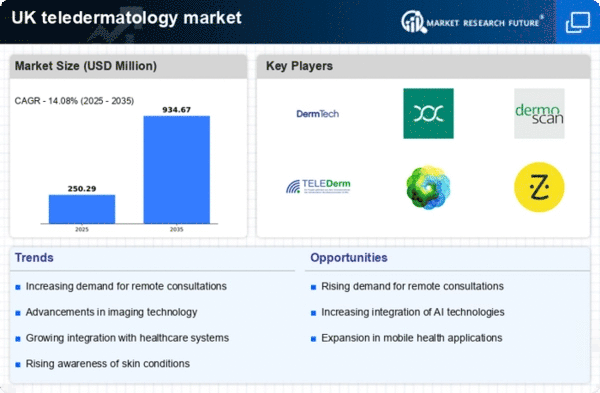
As per Market Research Future analysis, the UK teledermatology market Size was estimated at 219.4 USD Million in 2024. The UK teledermatology market is projected to grow from 250.29 USD Million in 2025 to 934.67 USD Million by 2035, exhibiting a compound annual growth rate (CAGR) of 14.0% during the forecast period 2025 - 2035

Key Market Trends & Highlights

The UK teledermatology market is experiencing robust growth driven by technological advancements and increasing demand for accessible healthcare.

  • The largest segment in the UK teledermatology market is the remote consultation services, while the fastest-growing segment is the mobile health applications.
  • There is a notable increase in the adoption of digital platforms, enhancing patient access to dermatological care.
  • Regulatory support for telehealth services is fostering a conducive environment for market expansion.
  • Key market drivers include technological advancements in dermatology and the rising incidence of skin disorders.

Market Size & Forecast

2024 Market Size 219.4 (USD Million)
2035 Market Size 934.67 (USD Million)
CAGR (2025 - 2035) 14.08%

Major Players

DermTech (US), Maven Clinic (US), DermoScan (DE), TeleDerm (US), SkinVision (NL), Zocdoc (US), MDLIVE (US), Doxy.me (US)

Our Impact
Enabled $4.3B Revenue Impact for Fortune 500 and Leading Multinationals
Partnering with 2000+ Global Organizations Each Year
30K+ Citations by Top-Tier Firms in the Industry

UK Teledermatology Market Trends

The teledermatology market is currently experiencing notable growth, driven by advancements in technology and increasing demand for accessible healthcare solutions. The integration of digital platforms allows patients to consult dermatologists remotely, thereby reducing wait times and enhancing convenience. This shift towards virtual consultations appears to be reshaping the landscape of dermatological care, as more individuals seek timely advice for skin conditions without the need for in-person visits. Furthermore, the rising prevalence of skin disorders and heightened awareness of dermatological health contribute to the expanding market. In addition, the regulatory environment in the UK is evolving to accommodate teledermatology services, which may further facilitate market expansion. Initiatives aimed at improving digital health infrastructure and promoting telehealth services are likely to enhance the overall patient experience. As healthcare providers increasingly adopt teledermatology solutions, the market is poised for continued growth, reflecting a broader trend towards digital transformation in healthcare delivery. This evolution suggests a promising future for teledermatology, as it aligns with the needs of both patients and providers in an increasingly digital world.

Increased Adoption of Digital Platforms

The teledermatology market is witnessing a surge in the adoption of digital platforms for remote consultations. This trend is driven by the convenience and efficiency that such platforms offer, allowing patients to receive expert advice without the need for physical appointments. As technology continues to advance, the integration of artificial intelligence and machine learning into these platforms may enhance diagnostic accuracy and patient outcomes.

Regulatory Support for Telehealth Services

Regulatory bodies in the UK are increasingly recognizing the importance of telehealth services, including teledermatology. This support is likely to lead to the establishment of clearer guidelines and standards, which could foster greater trust among patients and healthcare providers. As regulations evolve, they may facilitate the growth of teledermatology by ensuring that services meet safety and quality benchmarks.

Rising Demand for Accessible Healthcare

There is a growing demand for accessible healthcare solutions, particularly in dermatology. The teledermatology market is responding to this need by providing patients with easier access to specialists, especially in underserved areas. This trend reflects a broader societal shift towards prioritizing health equity and ensuring that all individuals have the opportunity to receive timely and effective care.

UK Teledermatology Market Drivers

Rising Incidence of Skin Disorders

The teledermatology market is significantly influenced by the increasing incidence of skin disorders in the UK. Conditions such as eczema, psoriasis, and skin cancer are becoming more prevalent, prompting a greater need for dermatological services. According to recent health statistics, approximately 1 in 5 individuals in the UK will experience a skin condition at some point in their lives. This rising demand for dermatological care is pushing healthcare providers to adopt teledermatology solutions, which offer timely access to specialists. The convenience of remote consultations is particularly appealing in rural areas, where access to dermatologists may be limited. As the incidence of skin disorders continues to rise, the teledermatology market is expected to expand, providing essential services to a growing patient population.

Cost-Effectiveness of Teledermatology

The teledermatology market is increasingly recognized for its cost-effectiveness, which is a crucial driver for its adoption in the UK. Teledermatology services can reduce the need for in-person consultations, thereby lowering overall healthcare costs for both patients and providers. Studies indicate that teledermatology can save up to £100 per consultation compared to traditional methods, making it an attractive option for budget-conscious patients. Additionally, healthcare systems benefit from reduced hospital visits and shorter waiting times, which can enhance patient satisfaction. As the UK healthcare system seeks to optimize resources, the cost-effectiveness of teledermatology is likely to play a pivotal role in its growth, encouraging more healthcare providers to integrate these services into their offerings.

Increased Focus on Preventive Healthcare

The teledermatology market is benefiting from a growing emphasis on preventive healthcare. As awareness of skin conditions rises, patients are increasingly seeking early diagnosis and treatment options. This trend is particularly evident in the UK, where the National Health Service (NHS) promotes regular skin checks to prevent serious conditions such as melanoma. The convenience of teledermatology services allows patients to consult dermatologists without the need for in-person visits, thus encouraging more individuals to seek care. It is estimated that around 30% of patients in the UK prefer teledermatology for its accessibility and efficiency. This shift towards preventive care is likely to drive the growth of the teledermatology market, as more patients recognize the benefits of early intervention.

Technological Advancements in Dermatology

The teledermatology market is experiencing a surge due to rapid technological advancements. Innovations in imaging technology, such as high-resolution cameras and artificial intelligence algorithms, enhance diagnostic accuracy and patient engagement. The integration of mobile applications allows patients to easily upload images of skin conditions, facilitating remote consultations. In the UK, the market is projected to grow at a CAGR of approximately 15% over the next five years, driven by these technological improvements. Furthermore, the development of secure data transmission methods ensures patient confidentiality, which is crucial for the acceptance of teledermatology services. As technology continues to evolve, it is likely that the teledermatology market will expand, offering more sophisticated solutions for both patients and healthcare providers.

Growing Acceptance of Telehealth Solutions

The teledermatology market is witnessing a growing acceptance of telehealth solutions among both patients and healthcare providers. This shift is largely attributed to the increasing familiarity with digital health technologies and the convenience they offer. In the UK, surveys indicate that over 70% of patients are open to using telehealth services for dermatological consultations. This acceptance is further bolstered by the positive experiences of patients who have utilized teledermatology, reporting high levels of satisfaction with the quality of care received. As more healthcare professionals recognize the benefits of teledermatology, including improved patient access and reduced workload, the market is likely to see continued growth. The increasing acceptance of telehealth solutions is a key driver for the expansion of the teledermatology market.


Market Segment Insights

By Technology: Store and Forward (Largest) vs. Real-Time Consultation (Fastest-Growing)

In the UK teledermatology market, the market share distribution reveals that the Store and Forward technology currently holds the largest segment. This method allows for the effective storage and subsequent forwarding of patient data for remote assessment, contributing significantly to the overall efficiency of teledermatology services. On the other hand, Real-Time Consultation is emerging rapidly, gaining traction among practitioners and patients alike due to its interactive nature, enhancing patient engagement and care delivery. As technological advancements continue to shape healthcare, growth trends indicate a robust increase in both Store and Forward and Real-Time Consultation technologies. The rise in patient awareness and the demand for convenient healthcare options are key drivers, as healthcare providers seek to enhance service delivery. The integration of advanced imaging techniques and mobile applications is further solidifying the position of Real-Time Consultation as the fastest-growing segment, catering to a more tech-savvy patient demographic.

Technology: Store and Forward (Dominant) vs. Real-Time Consultation (Emerging)

Store and Forward technology serves as a dominant force in the UK teledermatology market, enabling healthcare providers to efficiently manage patient data and workflows. It facilitates asynchronous communication, allowing dermatologists to review and diagnose skin conditions at their convenience without requiring immediate patient presence. In contrast, Real-Time Consultation is seen as an emerging technology that focuses on synchronous interactions, providing immediate feedback and advice to patients. This segment is gaining popularity among younger patients who prefer on-demand services. Both segments serve vital roles in teledermatology, but their differing approaches to patient interaction highlight the diverse needs within the market, ensuring that both dominant and emerging trends can coexist effectively.

By End Use: Hospitals (Largest) vs. Home Healthcare (Fastest-Growing)

In the UK teledermatology market, the distribution of market share among end-use segments reveals that hospitals hold the largest share, thanks to established infrastructure and a high patient volume. Diagnostic laboratories follow, playing a critical role in supporting hospitals with advanced analysis, while home healthcare is gaining traction as an emerging segment, catering to the rising demand for remote care solutions. Growth trends in this market segment are significantly influenced by technological advancements and an increasing emphasis on patient-centered care. The shift towards home healthcare is driven by patients' preference for convenient, accessible services and the growing investment in telecommunication technologies. Hospitals are also expanding their teledermatology services, focusing on integrating telehealth solutions into their existing practices, which is expected to further boost the market.

Hospitals (Dominant) vs. Home Healthcare (Emerging)

Hospitals represent the dominant force in the UK teledermatology market, characterized by their capacity to harness comprehensive resources and cutting-edge technologies. These facilities typically have established protocols for teledermatology, allowing them to provide effective and timely patient care. Conversely, home healthcare is emerging as a vital segment, marked by its flexibility and alignment with modern patient needs. It leverages digital tools to enable remote consultations and follow-ups, capturing the growing market of patients who prefer receiving care in the comfort of their homes. The rise of this segment highlights a shift in healthcare delivery models, emphasizing accessibility and convenience.

By Application: Skin Cancer Diagnosis (Largest) vs. Dermatological Consultation (Fastest-Growing)

In the UK teledermatology market, Skin Cancer Diagnosis holds the largest market share, reflecting its critical importance in patient care. This segment has maintained a strong foothold as awareness around skin cancer has grown, leading to increased demand for remote diagnosis solutions. Dermatological Consultation, while currently smaller in size, has been rapidly gaining traction due to the convenience and speed of teleconsultation, appealing especially to younger demographics and those seeking quick advice. The growth trends indicate that the teledermatology market is evolving towards more accessible services. Skin Cancer Diagnosis remains central to the market, but the fast momentum of Dermatological Consultation underscores a significant shift in consumer preferences. Factors driving this growth include advancements in technology, enhanced digital literacy, and an increasing societal shift toward remote healthcare solutions, positioning teledermatology as a key player in modern healthcare.

Skin Cancer Diagnosis (Dominant) vs. Dermatological Consultation (Emerging)

Skin Cancer Diagnosis is the dominant force within the UK teledermatology market, predominantly due to rising incidences of skin cancer and heightened public awareness regarding early detection. This segment is characterized by sophisticated diagnostic tools and a strong integration of telecommunication technologies. Dermatological Consultation, on the other hand, is emerging rapidly as patients seek more immediate access to dermatological expertise. The convenience of consultations over digital platforms, coupled with the ongoing shift towards holistic healthcare solutions, positions this segment as a crucial growth driver. As technology continues to advance, both segments are expected to thrive, catering to an increasing demand for telehealth services.

By Service Model: Cloud-Based Services (Largest) vs. Software as a Service (Fastest-Growing)

In the UK teledermatology market, the service model segment shows a clear market share distribution. Cloud-Based Services emerge as the largest segment, driven by their ability to offer secure, scalable, and efficient solutions for dermatology practices. Web-Based Services follow closely behind, providing immediate access to dermatological consultations. Meanwhile, Software as a Service models are rapidly gaining traction, catering to the increasing demand for flexible and on-demand software solutions. Recent growth trends indicate a strong shift towards Cloud-Based Services, fueled by the ongoing digital transformation in the healthcare sector. The demand for remote consultations and efficient patient management systems is driving the adoption of these services. Furthermore, the Software as a Service segment is identified as the fastest-growing due to its scalable nature, appealing to both small clinics and large hospital networks looking for adaptable solutions that enhance patient care.

Cloud-Based Services (Dominant) vs. Software as a Service (Emerging)

Cloud-Based Services in the UK teledermatology market position themselves as the dominant solution, appealing to a wide range of dermatology practices with their robust infrastructure and comprehensive features. These services allow for secure data storage, easy access to patient information, and seamless collaboration among healthcare providers. In contrast, Software as a Service is considered an emerging player, rapidly adapting to market needs by offering flexible subscription models and on-demand capabilities. This segment is characterized by its lower upfront costs and the ability to update software without disrupting services, making it particularly attractive for new entrants and smaller practices looking to modernize their operations.

Get more detailed insights about UK Teledermatology Market

Key Players and Competitive Insights

The teledermatology market exhibits a dynamic competitive landscape characterized by rapid technological advancements and an increasing demand for remote healthcare solutions. Key growth drivers include the rising prevalence of skin disorders, the need for accessible healthcare, and the integration of artificial intelligence (AI) in diagnostic processes. Major players such as DermTech (US), SkinVision (NL), and MDLIVE (US) are strategically positioned to leverage these trends. DermTech (US) focuses on innovation through its proprietary genomic testing technology, while SkinVision (NL) emphasizes user-friendly mobile applications for skin cancer detection. MDLIVE (US) is enhancing its service offerings through partnerships with healthcare providers, thereby expanding its reach and operational capabilities.The business tactics employed by these companies reflect a moderately fragmented market structure, where localized strategies and supply chain optimization play crucial roles. Companies are increasingly localizing their services to cater to regional healthcare regulations and consumer preferences. This localized approach, combined with strategic partnerships, allows for a more tailored service delivery, enhancing customer satisfaction and loyalty. The collective influence of these key players shapes a competitive environment that is both innovative and responsive to market demands.

In October DermTech (US) announced a collaboration with a leading health insurance provider to integrate its genomic testing services into the insurer's telehealth platform. This strategic move is likely to enhance patient access to advanced diagnostic tools, potentially increasing the adoption of teledermatology services. By aligning with insurance providers, DermTech (US) not only broadens its market reach but also reinforces its commitment to improving patient outcomes through innovative solutions.

In September SkinVision (NL) launched an upgraded version of its mobile application, incorporating AI-driven features for enhanced skin lesion analysis. This development signifies a critical step in the company's strategy to maintain a competitive edge in the teledermatology space. By leveraging AI technology, SkinVision (NL) aims to improve diagnostic accuracy and user engagement, thereby solidifying its position as a leader in the market.

In August MDLIVE (US) expanded its teledermatology services by partnering with a prominent dermatology clinic network. This partnership is expected to streamline patient referrals and enhance service delivery, reflecting MDLIVE's strategy to integrate with established healthcare systems. Such collaborations are pivotal in creating a seamless patient experience, which is increasingly becoming a differentiating factor in the telehealth sector.

As of November current competitive trends in the teledermatology market are heavily influenced by digitalization, AI integration, and a growing emphasis on sustainability. Strategic alliances are becoming more prevalent, as companies recognize the value of collaborative efforts in enhancing service offerings and operational efficiencies. Looking ahead, competitive differentiation is likely to evolve from traditional price-based competition to a focus on innovation, technological advancements, and supply chain reliability. This shift underscores the importance of adaptability and forward-thinking strategies in navigating the complexities of the teledermatology landscape.

Key Companies in the UK Teledermatology Market include

Industry Developments

In recent months, the UK Teledermatology Market has seen several notable developments. Companies like Babylon Health and Healthily have expanded their digital health services, focusing on user-friendly platforms to improve accessibility for patients needing dermatological consultations. In September 2023, SkinVision announced a partnership with major dermatology clinics to enhance early skin cancer detection through its mobile app, signifying a commitment to preventative healthcare.

Additionally, VivaSight launched an innovative AI-driven teledermatology tool, capturing significant attention from healthcare providers seeking efficient patient diagnostics. Moreover, in August 2023, a significant merger was announced between Lemonaid Health and Dermatica, aiming to create a comprehensive telehealth platform that combines general medical offerings with specialized dermatological expertise. This merger is expected to enhance service reach and improve patient outcomes in skin health management. Over the past two years, UK authorities have actively promoted telehealth initiatives, resulting in increased market growth and valuation for providers, especially among companies like iDerm and HighQ.

The emphasis on digital solutions reflects ongoing trends of integrating technology into primary healthcare.

Future Outlook

UK Teledermatology Market Future Outlook

The Teledermatology Market is projected to grow at a 14.08% CAGR from 2025 to 2035, driven by technological advancements, increased demand for remote consultations, and rising skin disease prevalence.

New opportunities lie in:

  • Development of AI-driven diagnostic tools for enhanced accuracy in teledermatology.
  • Expansion of subscription-based teledermatology services for continuous patient engagement.
  • Partnerships with pharmacies for integrated teledermatology and medication delivery solutions.

By 2035, the teledermatology market is expected to achieve substantial growth and innovation.

Market Segmentation

UK Teledermatology Market End Use Outlook

  • Hospitals
  • Diagnostic Laboratories
  • Home Healthcare

UK Teledermatology Market Technology Outlook

  • Store and Forward
  • Real-Time Consultation
  • Remote Patient Monitoring

UK Teledermatology Market Application Outlook

  • Skin Cancer Diagnosis
  • Psoriasis Treatment
  • Dermatological Consultation

UK Teledermatology Market Service Model Outlook

  • Cloud-Based Services
  • Web-Based Services
  • Software as a Service

Report Scope

MARKET SIZE 2024 219.4(USD Million)
MARKET SIZE 2025 250.29(USD Million)
MARKET SIZE 2035 934.67(USD Million)
COMPOUND ANNUAL GROWTH RATE (CAGR) 14.08% (2025 - 2035)
REPORT COVERAGE Revenue Forecast, Competitive Landscape, Growth Factors, and Trends
BASE YEAR 2024
Market Forecast Period 2025 - 2035
Historical Data 2019 - 2024
Market Forecast Units USD Million
Key Companies Profiled DermTech (US), Maven Clinic (US), DermoScan (DE), TeleDerm (US), SkinVision (NL), Zocdoc (US), MDLIVE (US), Doxy.me (US)
Segments Covered Technology, End Use, Application, Service Model
Key Market Opportunities Integration of artificial intelligence in diagnostic processes enhances efficiency in the teledermatology market.

Key Market Dynamics Rising demand for remote skin consultations drives innovation and competition in the teledermatology market.
Countries Covered UK
Leave a Comment

FAQs

What is the projected market size of the UK Teledermatology Market in 2024?

The UK Teledermatology Market is projected to be valued at 219.0 million USD in 2024.

What is the expected market size by 2035 for the UK Teledermatology Market?

By 2035, the UK Teledermatology Market is expected to reach a valuation of 1039.0 million USD.

What is the expected CAGR for the UK Teledermatology Market from 2025 to 2035?

The UK Teledermatology Market is expected to experience a CAGR of 15.205% during the period from 2025 to 2035.

Which technology segment will have the highest market value in 2035 within the UK Teledermatology Market?

The Real-Time Consultation segment is expected to have the highest market value, reaching 360.0 million USD in 2035.

What is the expected market size for the Store and Forward technology in 2024?

The Store and Forward technology segment is expected to be valued at 65.0 million USD in 2024.

Who are the major players in the UK Teledermatology Market?

Key players in the market include Babylon Health, VivaSight, Dermatica, and SkinVision among others.

What is the projected market size for Remote Patient Monitoring technology in 2035?

The Remote Patient Monitoring technology segment is projected to reach a market size of 369.0 million USD by 2035.

What is the valuation of the Real-Time Consultation technology in the UK Teledermatology Market in 2024?

The Real-Time Consultation technology segment is valued at 75.0 million USD in 2024.

How does the Remote Patient Monitoring segment grow from 2024 to 2035?

The Remote Patient Monitoring segment is expected to grow significantly, from 79.0 million USD in 2024 to 369.0 million USD in 2035.

What are the emerging trends driving growth in the UK Teledermatology Market?

Key trends include increased adoption of digital health technologies and rising demand for remote consultations and monitoring.

Download Free Sample

Kindly complete the form below to receive a free sample of this Report

Compare Licence

×
Features License Type
Single User Multiuser License Enterprise User
Price $4,950 $5,950 $7,250
Maximum User Access Limit 1 User Upto 10 Users Unrestricted Access Throughout the Organization
Free Customization
Direct Access to Analyst
Deliverable Format
Platform Access
Discount on Next Purchase 10% 15% 15%
Printable Versions