×
Request Free Sample ×

Kindly complete the form below to receive a free sample of this Report

* Please use a valid business email

Leading companies partner with us for data-driven Insights

clients tt-cursor
Hero Background

UK Solar Panel Recycling Market

ID: MRFR/EnP/52953-HCR
200 Pages
Snehal Singh
February 2026

UK Solar Panel Recycling Market Research Report By Type (Monocrystalline, Polycrystalline, Thin Film), By Process (Thermal, Mechanical, Laser) and By Application (Solar Panel Manufacturing, Construction, Metal Industry, Electronics and Semiconductor industry)- Forecast to 2035

Share:
Download PDF ×

We do not share your information with anyone. However, we may send you emails based on your report interest from time to time. You may contact us at any time to opt-out.

UK Solar Panel Recycling Market Infographic
Purchase Options

UK Solar Panel Recycling Market Summary

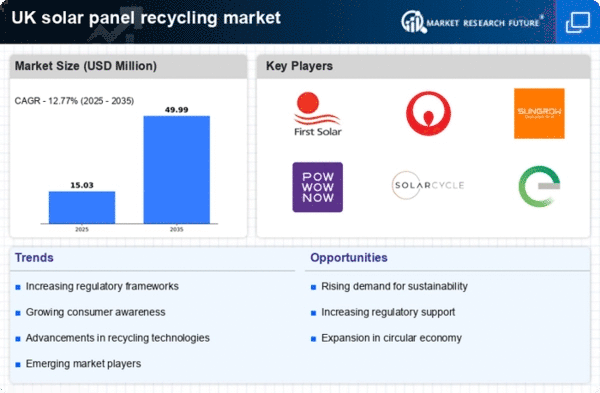
As per Market Research Future analysis, the UK solar panel recycling market size was estimated at 13.33 $ Million in 2024. The UK solar panel-recycling market is projected to grow from 15.03 $ Million in 2025 to 49.99 $ Million by 2035, exhibiting a compound annual growth rate (CAGR) of 12.7% during the forecast period 2025 - 2035

Key Market Trends & Highlights

The UK The UK solar panel recycling market is poised for growth, driven by regulatory changes and technological advancements.

  • Regulatory developments are shaping the landscape of the UK solar panel-recycling market, fostering compliance and innovation.
  • Technological innovations in recycling processes are enhancing efficiency and reducing costs, making recycling more viable.
  • Market awareness and education initiatives are increasing public engagement and participation in recycling programs.
  • The rising demand for renewable energy and increasing environmental regulations are key drivers propelling market growth.

Market Size & Forecast

2024 Market Size 13.33 (USD Million)
2035 Market Size 49.99 (USD Million)
CAGR (2025 - 2035) 12.77%

Major Players

First Solar (US), Veolia (FR), Sungrow (CN), Recycling Technologies (GB), SolarCycle (US), Enel Green Power (IT), Canadian Solar (CA), Ecolomondo (CA)

Our Impact
Enabled $4.3B Revenue Impact for Fortune 500 and Leading Multinationals
Partnering with 2000+ Global Organizations Each Year
30K+ Citations by Top-Tier Firms in the Industry

UK Solar Panel Recycling Market Trends

The solar panel recycling market is currently undergoing a notable transformation. This change is driven by increasing awareness of environmental sustainability and the need for responsible waste management. As the adoption of solar energy continues to rise, the volume of end-of-life solar panels is expected to grow significantly. This situation presents both challenges and opportunities for the recycling sector. Stakeholders are increasingly recognizing the importance of developing efficient recycling processes to recover valuable materials, such as silicon, silver, and other metals, which can be reused in new solar panels or other applications. Furthermore, regulatory frameworks are evolving to support recycling initiatives, encouraging manufacturers to take responsibility for the lifecycle of their products. In addition, advancements in recycling technologies are likely to enhance the efficiency and effectiveness of material recovery. Innovative methods are being explored to improve the separation and processing of components from solar panels, which could lead to higher recovery rates and lower costs. The collaboration between industry players, government bodies, and research institutions appears to be crucial in fostering a robust recycling ecosystem. As the solar panel-recycling market matures, it may play a vital role in promoting a circular economy, reducing waste, and minimizing the environmental impact of solar energy systems. This shift not only aligns with sustainability goals but also supports the transition towards a greener economy.

Regulatory Developments

Recent changes in regulations are shaping the landscape of the solar panel-recycling market. The UK government is implementing stricter guidelines to ensure that manufacturers are accountable for the disposal and recycling of solar panels. This regulatory push is likely to encourage investment in recycling facilities and technologies, fostering a more sustainable approach to waste management.

Technological Innovations

The emergence of new technologies is enhancing the efficiency of recycling processes within the solar panel-recycling market. Innovations in material recovery techniques are being developed, which may lead to improved separation and extraction of valuable materials. These advancements could significantly reduce costs and increase the overall effectiveness of recycling operations.

Market Awareness and Education

There is a growing emphasis on raising awareness about the importance of recycling solar panels. Educational initiatives aimed at consumers and industry stakeholders are becoming more prevalent. This trend suggests that as knowledge about the benefits of recycling increases, participation in recycling programs may also rise, contributing to a more sustainable future.

UK Solar Panel Recycling Market Drivers

Rising Demand for Renewable Energy

The solar panel recycling market is supported by the increasing demand for renewable energy sources in the UK. As the country transitions towards cleaner energy, the installation of solar panels has increased significantly, leading to a corresponding rise in the need for recycling solutions. In 2025, the UK is projected to have over 1 million solar installations, generating approximately 13 GW of solar power. This growth in solar energy production creates a pressing need for effective recycling methods to manage end-of-life panels. The recycling of solar panels not only mitigates environmental impact but also recovers valuable materials such as silicon, silver, and glass. The potential to reclaim these resources is likely to attract investments in the solar panel-recycling market, fostering innovation and efficiency in recycling processes.

Increasing Environmental Regulations

The solar panel recycling market is experiencing a surge in demand due to rising environmental regulations in the UK. The government has implemented stringent policies aimed at reducing waste and promoting sustainability. As a result, manufacturers are compelled to adopt recycling practices to comply with these regulations. The UK aims to achieve net-zero emissions by 2050, which necessitates the effective management of solar panel waste. This regulatory landscape encourages investment in recycling technologies and infrastructure, thereby driving growth in the solar panel-recycling market. Furthermore, the UK government has allocated £1.5 billion towards green initiatives, which includes funding for recycling programs. This financial support is likely to enhance the capacity and efficiency of recycling operations, ultimately benefiting the solar panel-recycling market.

Growing Public Awareness of Sustainability

Public awareness of sustainability issues is increasingly influencing the solar panel-recycling market. As consumers become more environmentally conscious, there is a growing expectation for manufacturers to adopt responsible recycling practices. Surveys indicate that over 70% of UK residents prioritize sustainability when making purchasing decisions, which is prompting companies to enhance their recycling efforts. This shift in consumer behavior is likely to drive demand for recycled materials, thereby supporting the solar panel-recycling market. Additionally, educational campaigns and community initiatives are raising awareness about the importance of recycling solar panels, further encouraging responsible disposal practices. The emphasis on sustainability is expected to create a more favorable environment for the growth of the solar panel-recycling market.

Economic Incentives for Recycling Initiatives

Economic incentives are emerging as a crucial driver for the solar panel-recycling market. The UK government has introduced various financial mechanisms to encourage recycling initiatives, including grants and subsidies for recycling facilities. These incentives aim to lower the operational costs associated with recycling processes, making them more attractive to businesses. Furthermore, the potential for job creation in the recycling sector is likely to garner additional support from local governments. In 2025, the solar panel-recycling market is projected to generate approximately £200 million in revenue, driven by these economic incentives. The financial viability of recycling operations is expected to attract investments, thereby fostering growth in the solar panel-recycling market.

Technological Advancements in Recycling Processes

Technological advancements are playing a pivotal role in shaping the solar panel-recycling market. Innovations in recycling processes, such as improved separation techniques and automated systems, are enhancing the efficiency and effectiveness of recycling operations. For instance, new methods can recover up to 95% of materials from solar panels, significantly reducing waste. The integration of artificial intelligence and machine learning in recycling facilities is also streamlining operations, leading to cost reductions and increased throughput. As these technologies become more accessible, they are likely to drive the growth of the solar panel-recycling market. The UK government is actively supporting research and development in this area, with funding initiatives aimed at fostering technological innovation in recycling practices.


Market Segment Insights

By Type: Monocrystalline (Largest) vs. Polycrystalline (Fastest-Growing)

Monocrystalline solar panels dominate the UK solar panel-recycling market, capturing a significant portion of overall market share due to their high efficiency and long lifespan. In contrast, polycrystalline panels, while slightly less efficient than their monocrystalline counterparts, are gaining traction in the recycling space due to their lower production costs and increasing consumer preference for budget-friendly options. The thin film segment, although smaller, serves niche applications that cater to discrete market needs. Growth trends indicate that polycrystalline solar panels are set to experience the fastest growth, driven by rapid technological advancements and a push for more affordable solar solutions. The ongoing efforts to enhance recycling technologies further support the sustainable lifecycle of these panels. Policy incentives for green technologies are also bolstering demand, helping to position polycrystalline as a strong contender in the market.

Solar Panels: Monocrystalline (Dominant) vs. Polycrystalline (Emerging)

Monocrystalline solar panels are regarded as the dominant player in the recycling sector due to their superior efficiency and longevity, making them a preferred choice for many consumers and businesses alike. Their ability to generate more power per square meter allows for a better return on investment when recycled. Meanwhile, polycrystalline panels are emerging as a strong alternative, benefiting from lower costs and increased production capacity. This growing segment is attracting more interest as manufacturers innovate to improve efficiency and reduce waste. The thin film category, while smaller, continues to find its niche in specialized applications, serving as a complementary technology but with slower growth compared to the more dominant types.

By Process: Thermal (Largest) vs. Mechanical (Fastest-Growing)

The UK solar panel-recycling market is witnessing a notable distribution of market share among the different processes employed. Among these, Thermal processing holds the largest share, attributed to its ability to effectively recover valuable materials from solar panels. Mechanical processes, while currently smaller in share, are rapidly gaining traction due to innovations that enhance their efficiency and cost-effectiveness. This dynamic landscape illustrates a competitive environment where both technologies play crucial roles. Looking ahead, growth trends within this segment are encouraging, driven by regulatory pressures and an increasing focus on sustainability. Mechanical recycling technologies are emerging as the fastest-growing solution, appealing to companies aiming to reduce waste in an eco-friendly manner. Additionally, advancements in Thermal recycling methods are helping to improve recovery rates and reduce energy consumption, further solidifying its dominant position in the market.

Process: Thermal (Dominant) vs. Mechanical (Emerging)

Thermal processing is a dominant force in the UK solar panel-recycling market, known for its effectiveness in recovering silicon and metals through high-temperature treatment. This method is highly efficient, allowing recyclers to reclaim significant quantities of materials, thus reducing the strain on virgin resource extraction. Meanwhile, Mechanical processing is rapidly emerging as a viable alternative, leveraging advancements in technology to enhance material recovery rates without the energy intensity of thermal methods. Mechanical processes often involve shredding and sorting, making them appealing in terms of cost and environmental impact. As sustainability becomes a priority, the shift towards more eco-friendly recycling methods positions Mechanical processing as a strong contender for future market relevance.

By Application: Solar Panel Manufacturing (Largest) vs. Electronics & Semiconductor industry (Fastest-Growing)

In the UK solar panel-recycling market, the application segment is diverse, with Solar Panel Manufacturing holding the largest market share due to the continuous growth in solar energy adoption. The Construction industry also holds a significant share, benefiting from sustainable practices that incorporate recycled solar materials. Additionally, the Metal Industry contributes to the market by reinforcing efforts to recycle materials from old panels, while the Electronics & Semiconductor industry shows increasing relevance as electronic waste management becomes more critical. Growth trends in this segment are driven by the rising demand for eco-friendly practices and regulatory support for recycling initiatives. Solar Panel Manufacturing remains a dominant force, while the Electronics & Semiconductor industry is emerging rapidly as a critical player due to technological advancements. Investments in recycling technologies and increasing consumer awareness about sustainability further propel the growth of these applications within the market.

Solar Panel Manufacturing (Dominant) vs. Electronics & Semiconductor industry (Emerging)

Solar Panel Manufacturing is the dominant application in the UK solar panel-recycling market, characterized by a well-established framework for the recycling process of photovoltaic materials. This segment benefits from a mature supply chain and partnerships with various stakeholders, including manufacturers and regulators, fostering an environment conducive to innovation and efficiency. In contrast, the Electronics & Semiconductor industry emerges as a significant player as it addresses the increasing volume of electronic waste. This sector is characterized by rapid technological advancements and a growing focus on the recycling of critical materials, prompting investments and collaborations aimed at enhancing recycling processes and minimizing environmental impact.

Get more detailed insights about UK Solar Panel Recycling Market

Key Players and Competitive Insights

The solar panel recycling market is characterized by a dynamic competitive landscape. This landscape is driven by increasing regulatory pressures and a growing emphasis on sustainability. Key players are actively positioning themselves through innovative strategies, partnerships, and technological advancements. For instance, First Solar (US) has focused on enhancing its recycling capabilities, aiming to recover up to 90% of materials from decommissioned panels. Meanwhile, Veolia (FR) has been expanding its operational footprint in the UK, leveraging its expertise in waste management to optimize recycling processes. These strategic moves collectively shape a competitive environment that is increasingly focused on sustainability and resource efficiency.
In terms of business tactics, companies are localizing manufacturing and optimizing supply chains to enhance operational efficiency. The market appears moderately fragmented, with several players vying for market share. However, the influence of key players like Sungrow (CN) and Recycling Technologies (GB) is notable, as they implement strategies that emphasize technological innovation and regional partnerships, thereby enhancing their competitive positioning.
In October 2025, Sungrow (CN) announced a partnership with a UK-based firm to develop advanced recycling technologies aimed at improving the recovery rates of critical materials from solar panels. This collaboration is strategically significant as it not only enhances Sungrow's technological capabilities but also aligns with the growing demand for sustainable practices in the UK market. Such partnerships are likely to bolster the company's market presence and drive innovation in recycling processes.
In September 2025, Recycling Technologies (GB) launched a new facility dedicated to the recycling of solar panels, which is expected to increase its processing capacity by 50%. This expansion is crucial as it positions the company to meet the rising demand for recycling services, particularly in light of the increasing volume of decommissioned panels. The facility's advanced technology is anticipated to set a new standard in the industry, further solidifying Recycling Technologies' competitive edge.
In August 2025, SolarCycle (US) secured a significant investment to enhance its recycling operations, focusing on the development of proprietary technologies that improve the efficiency of material recovery. This investment underscores the company's commitment to innovation and positions it favorably in a market that is increasingly prioritizing technological advancements. The ability to recover valuable materials efficiently could provide SolarCycle with a competitive advantage as the market evolves.
As of November 2025, current trends in the solar panel-recycling market indicate a strong shift towards digitalization, sustainability, and the integration of AI technologies. Strategic alliances are becoming increasingly important, as companies recognize the value of collaboration in driving innovation and enhancing operational efficiencies. Looking ahead, competitive differentiation is likely to evolve from traditional price-based competition to a focus on technological innovation, supply chain reliability, and sustainable practices. This shift suggests that companies that prioritize these aspects will be better positioned to thrive in the future.

Key Companies in the UK Solar Panel Recycling Market include

Industry Developments

In recent months, the UK Solar Panel Recycling Market has experienced significant developments, with increasing focus on sustainability and environmental regulations. Notably, companies like Avalon Renewables, UK Solar Recycling, EcoSun Recycling, Solera, and others are enhancing their operational capabilities to align with the UK government's recycling initiatives. The market is witnessing growth, driven by rising awareness of the ecological impacts of solar panel waste. In August 2023, EcoSun Recycling announced a strategic partnership with Sustainable Energy Solutions to improve recycling technology efficiency, a move expected to bolster market valuation.

Additionally, Solar Panel Recycling Ltd and Green Circle are advancing their recycling processes to ensure compliance with the UK's extended producer responsibility regulations set to be fully implemented by 2025. Furthermore, The Solar Trade Association has initiated industry dialogues focusing on enhancing recycling frameworks. There have been no recent mergers or acquisitions involving the mentioned companies that meet the criteria of trustworthiness and reporting. Over the last couple of years, the market has seen increased investment in recycling infrastructure, reflecting the UK's commitment to a circular economy in the renewable energy sector.

Future Outlook

UK Solar Panel Recycling Market Future Outlook

The Solar Panel Recycling Market is projected to grow at a 12.77% CAGR from 2025 to 2035, driven by regulatory support, technological advancements, and increasing waste management needs.

New opportunities lie in:

  • Development of automated recycling facilities for efficient material recovery.
  • Partnerships with solar manufacturers for end-of-life panel take-back programs.
  • Investment in R&D for innovative recycling technologies to enhance profitability.

By 2035, the market is expected to be robust, driven by sustainable practices and increased recycling capabilities.

Market Segmentation

UK Solar Panel Recycling Market Type Outlook

  • Monocrystalline
  • Polycrystalline
  • Thin Film

UK Solar Panel Recycling Market Process Outlook

  • Thermal
  • Mechanical
  • Laser

UK Solar Panel Recycling Market Application Outlook

  • Solar Panel Manufacturing
  • Construction
  • Metal Industry
  • Electronics & Semiconductor industry

Report Scope

MARKET SIZE 2024 13.33(USD Million)
MARKET SIZE 2025 15.03(USD Million)
MARKET SIZE 2035 49.99(USD Million)
COMPOUND ANNUAL GROWTH RATE (CAGR) 12.77% (2025 - 2035)
REPORT COVERAGE Revenue Forecast, Competitive Landscape, Growth Factors, and Trends
BASE YEAR 2024
Market Forecast Period 2025 - 2035
Historical Data 2019 - 2024
Market Forecast Units USD Million
Key Companies Profiled First Solar (US), Veolia (FR), Sungrow (CN), Recycling Technologies (GB), SolarCycle (US), Enel Green Power (IT), Canadian Solar (CA), Ecolomondo (CA)
Segments Covered Type, Process, Application
Key Market Opportunities Emerging technologies enhance efficiency in the solar panel-recycling market, addressing environmental concerns and regulatory demands.
Key Market Dynamics Regulatory changes drive innovation and competition in the solar panel-recycling market, enhancing sustainability efforts.
Countries Covered UK
Leave a Comment

FAQs

What is the expected market size of the UK Solar Panel Recycling Market in 2024?

The UK Solar Panel Recycling Market is expected to be valued at 13.24 million USD in 2024.

What is the projected market size for the UK Solar Panel Recycling Market by 2035?

By 2035, the overall market is expected to reach a valuation of 81.72 million USD.

What is the expected compound annual growth rate (CAGR) for the UK Solar Panel Recycling Market from 2025 to 2035?

The expected CAGR for the UK Solar Panel Recycling Market is 17.997% from 2025 to 2035.

Which segment of the market is projected to have the largest value in 2035?

The Monocrystalline segment is projected to be valued at 30.0 million USD in 2035.

What are the significant players in the UK Solar Panel Recycling Market?

Major players in the market include Avalon Renewables, UK Solar Recycling, EcoSun Recycling, and Reclaim PV Recycling among others.

What will the value of the Polycrystalline segment be in 2024?

The Polycrystalline segment is expected to be valued at 4.0 million USD in 2024.

How much is the Thin Film segment expected to be worth by 2035?

The Thin Film segment is projected to reach a value of 26.72 million USD by 2035.

What is driving growth in the UK Solar Panel Recycling Market?

Increased emphasis on sustainability and regulatory pressures are key growth drivers for this market.

What challenges does the UK Solar Panel Recycling Market currently face?

Challenges include high operational costs and the complexity of recycling processes.

How does regionality impact the UK Solar Panel Recycling Market?

Regional policies and local demand for recycled materials significantly influence market dynamics.

Download Free Sample

Kindly complete the form below to receive a free sample of this Report

Compare Licence

×
Features License Type
Single User Multiuser License Enterprise User
Price $4,950 $5,950 $7,250
Maximum User Access Limit 1 User Upto 10 Users Unrestricted Access Throughout the Organization
Free Customization
Direct Access to Analyst
Deliverable Format
Platform Access
Discount on Next Purchase 10% 15% 15%
Printable Versions