×
Request Free Sample ×

Kindly complete the form below to receive a free sample of this Report

* Please use a valid business email

Leading companies partner with us for data-driven Insights

clients tt-cursor
Hero Background

UK Optical Transport Network Market

ID: MRFR/ICT/54105-HCR
200 Pages
Aarti Dhapte
February 2026

UK Optical Transport Network Market Size, Share and Trends Analysis Report By Technology (Wavelength Division Multiplexer, Dense Wavelength Division Multiplexer, Others), By Service (Network Design, Network Support, Others), By Component (Optical Switch, Optical Packet Platform, Others) and By End-user (IT/Telecom, Healthcare, Retail, Government, Others)- Forecast to 2035

Share:
Download PDF ×

We do not share your information with anyone. However, we may send you emails based on your report interest from time to time. You may contact us at any time to opt-out.

UK Optical Transport Network Market Infographic
Purchase Options

UK Optical Transport Network Market Summary

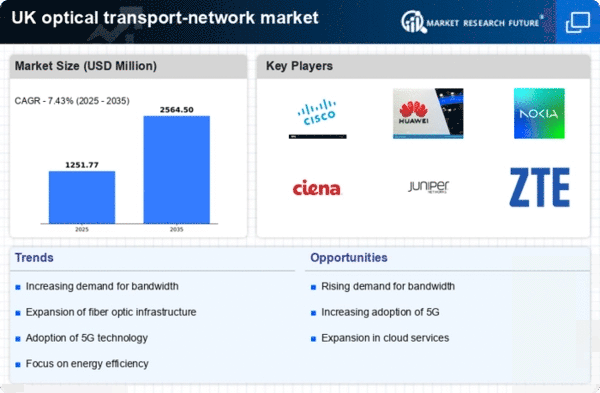
As per Market Research Future analysis, the UK optical transport-network market Size was estimated at 1165.2 USD Million in 2024. The UK optical transport-network market is projected to grow from 1251.77 USD Million in 2025 to 2564.5 USD Million by 2035, exhibiting a compound annual growth rate (CAGR) of 7.4% during the forecast period 2025 - 2035

Key Market Trends & Highlights

The UK optical transport-network market is poised for substantial growth driven by technological advancements and increasing demand for bandwidth.

  • The largest segment in the UK optical transport-network market is the cloud services segment, which is experiencing rapid growth.
  • The fastest-growing segment is the advanced technologies segment, reflecting a shift towards more sophisticated networking solutions.
  • Regulatory support for infrastructure development is fostering a conducive environment for market expansion.
  • Rising data traffic and government initiatives are key drivers propelling the growth of the optical transport-network market.

Market Size & Forecast

2024 Market Size 1165.2 (USD Million)
2035 Market Size 2564.5 (USD Million)
CAGR (2025 - 2035) 7.43%

Major Players

Cisco Systems (US), Huawei Technologies (CN), Nokia (FI), Ciena Corporation (US), Juniper Networks (US), ZTE Corporation (CN), ADVA Optical Networking (DE), Infinera Corporation (US), Mitsubishi Electric (JP)

Our Impact
Enabled $4.3B Revenue Impact for Fortune 500 and Leading Multinationals
Partnering with 2000+ Global Organizations Each Year
30K+ Citations by Top-Tier Firms in the Industry

UK Optical Transport Network Market Trends

The optical transport network market is currently experiencing a transformative phase, driven by the increasing demand for high-speed data transmission and the proliferation of cloud-based services. As organizations across various sectors seek to enhance their connectivity and bandwidth capabilities, investments in optical transport technologies are becoming more pronounced. This shift is largely influenced by the need for efficient data handling, which is essential for supporting the growing number of internet-connected devices and applications. Furthermore, advancements in optical networking technologies, such as wavelength division multiplexing and optical switching, are facilitating the deployment of more robust and scalable networks. In addition, the regulatory environment in the UK is evolving to support the expansion of optical transport networks. Government initiatives aimed at improving digital infrastructure are likely to bolster market growth. The emphasis on sustainability and energy efficiency is also shaping the development of optical transport solutions, as companies strive to reduce their carbon footprint while maintaining high performance. Overall, the optical transport-network market appears poised for continued growth, driven by technological advancements and supportive policies that encourage innovation and investment.

Increased Demand for Bandwidth

The optical transport-network market is witnessing a surge in demand for bandwidth, primarily due to the rise of data-intensive applications. As businesses and consumers increasingly rely on high-speed internet for various activities, the need for enhanced data transmission capabilities becomes critical. This trend is likely to drive investments in optical transport technologies that can accommodate higher data rates.

Adoption of Advanced Technologies

The market is experiencing a notable shift towards the adoption of advanced technologies such as wavelength division multiplexing and optical switching. These innovations enable more efficient use of existing infrastructure, allowing for greater data capacity without the need for extensive physical upgrades. This trend suggests a focus on maximizing current resources while preparing for future demands.

Regulatory Support for Infrastructure Development

Government policies in the UK are increasingly supportive of infrastructure development in the optical transport-network market. Initiatives aimed at enhancing digital connectivity and promoting competition among service providers are likely to create a more favorable environment for investment. This regulatory support may facilitate the expansion of optical networks, ultimately benefiting consumers and businesses alike.

UK Optical Transport Network Market Drivers

Rising Data Traffic

The optical transport-network market is experiencing a surge in data traffic, driven by the increasing reliance on digital services and applications. As businesses and consumers demand higher bandwidth for activities such as streaming, cloud computing, and online gaming, the need for robust optical transport networks becomes paramount. In the UK, data traffic is projected to grow at a compound annual growth rate (CAGR) of approximately 25% over the next five years. This growth necessitates the expansion and enhancement of optical transport networks to accommodate the escalating data requirements. Consequently, service providers are investing heavily in optical infrastructure to ensure they can meet the demands of their customers, thereby propelling the optical transport-network market forward.

Increased Competition

The optical transport-network market is witnessing heightened competition among service providers, which is driving innovation and investment in network infrastructure. As new entrants and established players vie for market share, there is a growing emphasis on offering superior services and competitive pricing. This competitive landscape is prompting operators to upgrade their optical transport networks to deliver faster and more reliable services. In the UK, the entry of alternative network providers is challenging traditional telecom operators, leading to a more dynamic market environment. This competition is likely to result in improved service offerings for consumers and businesses, ultimately benefiting the optical transport-network market as operators strive to differentiate themselves through enhanced network capabilities.

Government Initiatives

Government initiatives aimed at improving digital infrastructure are significantly impacting the optical transport-network market. In the UK, various policies and funding programs are being implemented to enhance broadband connectivity and support the deployment of optical networks. The UK government has committed to investing £5 billion in improving digital infrastructure, which includes expanding fiber-optic networks across rural and urban areas. This investment is expected to stimulate growth in the optical transport-network market, as it encourages private sector participation and innovation. By fostering a conducive environment for network expansion, government initiatives are likely to enhance the overall capacity and reliability of optical transport networks, thereby meeting the increasing demand for high-speed connectivity.

Growing Cloud Services

The proliferation of cloud services is a key driver of growth in the optical transport-network market. As businesses increasingly migrate their operations to the cloud, the demand for high-capacity, low-latency optical networks is intensifying. In the UK, the cloud computing market is expected to reach £40 billion by 2026, which will further fuel the need for robust optical transport networks to support data transfer and storage. This trend is prompting service providers to invest in optical infrastructure that can handle the increased data loads associated with cloud services. The optical transport-network market is likely to benefit from this shift, as operators enhance their networks to accommodate the growing reliance on cloud-based solutions.

Technological Advancements

Technological innovations play a crucial role in shaping the optical transport-network market. The introduction of advanced technologies such as wavelength division multiplexing (WDM) and optical switching is enhancing the capacity and efficiency of optical networks. These advancements allow for the transmission of multiple data streams over a single optical fiber, significantly increasing bandwidth without the need for additional physical infrastructure. In the UK, the adoption of these technologies is expected to drive market growth, as operators seek to optimize their networks and reduce operational costs. The optical transport-network market is likely to benefit from ongoing research and development efforts aimed at improving optical technologies, which could lead to more efficient and cost-effective solutions for network operators.


Market Segment Insights

By Technology: Wavelength Division Multiplexer (Largest) vs. Dense Wavelength Division Multiplexer (Fastest-Growing)

In the UK optical transport-network market, Wavelength Division Multiplexer (WDM) holds the largest share, significantly influencing network performance due to its capacity to transmit multiple data streams simultaneously over a single optical fiber. Dense Wavelength Division Multiplexer (DWDM) follows closely, emerging as a robust technology that enhances data traffic handling capabilities, marking a notable shift in market dynamics as operators seek more efficient transmission methods. The growth trends in this segment are largely driven by the increasing demand for high-speed internet and cloud services, prompting network operators to upgrade their infrastructure. The shift towards 5G networks and the rising adoption of IoT devices further accelerate the adoption of DWDM technology. As companies strive for higher data rates and bandwidth, the technology segment is poised for continued advancements leading to enhanced network capabilities.

Technology: Wavelength Division Multiplexer (Dominant) vs. Dense Wavelength Division Multiplexer (Emerging)

Wavelength Division Multiplexer (WDM) technology remains dominant in the optical transport network landscape due to its proven reliability and extensive applications. It is widely utilized in long-haul transmission networks to maximize efficiency and reduce operational costs. In contrast, Dense Wavelength Division Multiplexer (DWDM) is an emerging technology, designed to support the growing data demands by enabling higher capacity through closely spaced wavelengths. This technology is particularly attractive for metropolitan networks and data centers seeking to optimize bandwidth usage. Both technologies are integral to modern networks, with WDM established as the backbone while DWDM rapidly garners attention for its potential to service future connectivity needs.

By Service: Network Design (Largest) vs. Network Support (Fastest-Growing)

In the UK optical transport-network market, Network Design dominates the service segment, accounting for a significant share of overall revenues. Its importance is driven by the increasing demand for robust and scalable network solutions that facilitate high-speed data transmission. Meanwhile, Network Support, while smaller in market share, is swiftly gaining traction as organizations recognize the necessity of dedicated maintenance and technical assistance for complex network infrastructures. The growth trends in the service segment are primarily influenced by advancements in technology and the escalating need for efficient network optimization. With organizations transitioning to digital and cloud-based systems, the demand for Network Support services is projected to increase rapidly. Additionally, the ongoing expansion of high-speed internet and data services will likely push Network Design to continuously evolve and enhance its offerings to meet future demands.

Network Design: Dominant vs. Network Support: Emerging

Network Design represents a dominant force within the service segment, characterized by comprehensive planning and architecture tailored to maximize performance and reliability of data transmission systems. Companies specializing in this area utilize advanced technologies to create bespoke solutions that cater to various industry needs, thus solidifying their position in the market. Conversely, Network Support is emerging as a critical service category, focusing on providing essential assistance, maintenance, and troubleshooting for existing networks. This segment appeals to enterprises seeking professional expertise to ensure continuous operations and minimize downtime, driven by increasing network complexities and the adoption of new technologies. As both segments continue to develop, their diverging focuses create a dynamic landscape within the market.

By Component: Optical Packet Platform (Largest) vs. Optical Switch (Fastest-Growing)

In the UK optical transport-network market, the component segment is characterized by a competitive distribution among optical switches, optical packet platforms, and other components. Currently, the optical packet platform holds a significant share as the largest component, driven by the increasing demand for high-capacity data transmission and improved network efficiency. Meanwhile, optical switches are emerging as crucial elements for enhancing network agility and responsiveness, contributing to their rapid expansion in market share. The growth trends within this segment are influenced by several key drivers. Firstly, advancements in optical networking technologies are facilitating faster data rates and more reliable connections, prompting an uptake in optical packet platforms. Additionally, the rise in cloud computing and the need for robust data handling capabilities are pushing businesses to invest in optical switches, which are recognized for their capacity to manage larger network loads effectively. Together, these components are shaping the landscape of the optical transport network.

Optical Packet Platform (Dominant) vs. Optical Switch (Emerging)

The optical packet platform has established itself as a dominant force in the component segment, primarily due to its ability to efficiently handle extensive data traffic with minimal latency. This technology is particularly well-suited for telecommunications providers looking to enhance service delivery. On the other hand, optical switches are emerging as vital components that facilitate greater network flexibility and real-time data processing. Their increasing adoption can be attributed to the growing demand for scalable and efficient optical networking solutions. While the optical packet platform leads in market share, the optical switch's role in ensuring seamless connectivity and enhanced network performance positions it as a key player in the evolving optical transport landscape.

By End-user: IT/Telecom (Largest) vs. Healthcare (Fastest-Growing)

The market shares within the end-user segment of the UK optical transport-network market reveal that IT and Telecom players dominate substantially, reflecting their significant investments in infrastructure and technology to enhance connectivity and data management. Following closely, the healthcare sector showcases a growing demand for sophisticated optical transport solutions in telemedicine and digital health services, which is progressively reshaping the market dynamics. In terms of growth trends, the healthcare segment is witnessing rapid expansion, fueled by the increasing adoption of technology in patient care and the need for reliable data transmission for medical applications. Meanwhile, IT and Telecom continue to thrive as the backbone of digital communication, with ongoing upgrades and expansions to meet the surge in data traffic driven by cloud computing and IoT advancements, thereby bolstering their market position.

IT/Telecom (Dominant) vs. Healthcare (Emerging)

The IT/Telecom sector holds a paramount position in the UK optical transport-network market, being driven by the relentless pursuit for greater bandwidth and faster connectivity solutions. Companies in this sector are leveraging advanced optical technologies to support the ever-growing demand for high-speed internet and data services. On the other hand, the healthcare segment is emerging as a vital player, as its need for robust communication frameworks becomes increasingly crucial for telehealth solutions and medical data management. This evolution is pushed by the digitization of healthcare processes that demand reliable and swift data transfer capabilities. Both sectors are essential, with IT/Telecom as the bedrock of communications and Healthcare rapidly adopting optical solutions to innovate and improve service delivery.

Get more detailed insights about UK Optical Transport Network Market

Key Players and Competitive Insights

The optical transport-network market is currently characterized by a dynamic competitive landscape, driven by the increasing demand for high-capacity data transmission and the proliferation of cloud services. Major players such as Cisco Systems (US), Huawei Technologies (CN), and Nokia (FI) are strategically positioned to leverage their technological advancements and extensive portfolios. Cisco Systems (US) focuses on innovation through its software-defined networking solutions, while Huawei Technologies (CN) emphasizes regional expansion and partnerships to enhance its market presence. Nokia (FI) is actively pursuing digital transformation initiatives, which collectively shape a competitive environment that is increasingly reliant on technological differentiation and strategic collaborations.
Key business tactics within this market include localizing manufacturing and optimizing supply chains to enhance operational efficiency. The competitive structure appears moderately fragmented, with several key players exerting influence over market dynamics. This fragmentation allows for a diverse range of offerings, yet the collective impact of these major companies fosters a competitive atmosphere where innovation and strategic partnerships are paramount.
In October 2025, Ciena Corporation (US) announced a significant partnership with a leading telecommunications provider to enhance its optical transport solutions. This collaboration aims to integrate advanced optical technologies, thereby improving network performance and reliability. The strategic importance of this partnership lies in Ciena's ability to leverage its expertise in optical networking to meet the growing demands for bandwidth and low-latency services.
In September 2025, ADVA Optical Networking (DE) unveiled a new line of optical transport products designed to support 5G networks. This launch reflects ADVA's commitment to innovation and its strategic focus on addressing the evolving needs of telecommunications operators. The introduction of these products is likely to strengthen ADVA's competitive position by providing cutting-edge solutions that cater to the increasing demand for high-speed connectivity.
In August 2025, Infinera Corporation (US) expanded its global footprint by establishing a new research and development center in the UK. This move is indicative of Infinera's strategy to enhance its technological capabilities and foster innovation in optical transport solutions. The establishment of this center is expected to facilitate collaboration with local partners and contribute to the development of next-generation optical technologies.
As of November 2025, current competitive trends in the optical transport-network market are heavily influenced by digitalization, sustainability, and the integration of artificial intelligence (AI). Strategic alliances are increasingly shaping the landscape, as companies recognize the need for collaboration to drive innovation and address market challenges. Looking ahead, competitive differentiation is likely to evolve from traditional price-based competition to a focus on technological innovation, supply chain reliability, and the ability to deliver sustainable solutions.

Key Companies in the UK Optical Transport Network Market include

Industry Developments

Recent developments in the UK Optical Transport Network Market have highlighted significant advancements and evolving dynamics among leading companies. In September 2023, Vodafone Group announced the expansion of its optical transport network across the UK to enhance its service offerings, indicating the ongoing investment in next-generation infrastructure. Meanwhile, in August 2023, ADVA Optical Networking revealed a new solution aimed at maximizing bandwidth efficiency, reaffirming its commitment to innovation within the sector. Additionally, there were discussions regarding potential collaborations to address increasing data traffic demands, with ZTE Corporation and BT Group exploring synergies to enhance service delivery. 

Although no notable mergers or acquisitions occurred recently among the highlighted companies like Ciena, Nokia, and Cisco Systems, their continued focus on Research and Development signifies a competitive landscape. The growing market valuation of companies in this sector, driven by the rising need for reliable and high-capacity networks, is shaping the future of the UK telecommunications industry. Over the past two to three years, the UK Optical Transport Network Market has witnessed a push for modernization, with investments in fiber-optic capabilities becoming a priority for various telecommunications providers.


Future Outlook

UK Optical Transport Network Market Future Outlook

The optical transport-network market in the UK is poised for growth at 7.43% CAGR from 2025 to 2035, driven by increasing data demand and technological advancements.

New opportunities lie in:

  • Expansion of 5G infrastructure to enhance network capacity.
  • Development of AI-driven network management solutions.
  • Investment in green technologies for sustainable optical networks.

By 2035, the market is expected to achieve robust growth, driven by innovation and strategic investments.

Market Segmentation

UK Optical Transport Network Market Service Outlook

  • Network Design
  • Network Support
  • Others

UK Optical Transport Network Market End-user Outlook

  • IT/Telecom
  • Healthcare
  • Retail
  • Government
  • Others

UK Optical Transport Network Market Component Outlook

  • Optical Switch
  • Optical Packet Platform
  • Others

UK Optical Transport Network Market Technology Outlook

  • Wavelength Division Multiplexer (WDM)
  • Dense Wavelength Division Multiplexer (DWDM)
  • Others

Report Scope

MARKET SIZE 2024 1165.2(USD Million)
MARKET SIZE 2025 1251.77(USD Million)
MARKET SIZE 2035 2564.5(USD Million)
COMPOUND ANNUAL GROWTH RATE (CAGR) 7.43% (2025 - 2035)
REPORT COVERAGE Revenue Forecast, Competitive Landscape, Growth Factors, and Trends
BASE YEAR 2024
Market Forecast Period 2025 - 2035
Historical Data 2019 - 2024
Market Forecast Units USD Million
Key Companies Profiled Cisco Systems (US), Huawei Technologies (CN), Nokia (FI), Ciena Corporation (US), Juniper Networks (US), ZTE Corporation (CN), ADVA Optical Networking (DE), Infinera Corporation (US), Mitsubishi Electric (JP)
Segments Covered Technology, Service, Component, End-user
Key Market Opportunities Adoption of advanced optical technologies enhances bandwidth capacity and network efficiency in the optical transport-network market.
Key Market Dynamics Technological advancements drive competition in the optical transport-network market, enhancing capacity and efficiency in the UK.
Countries Covered UK
Leave a Comment

FAQs

What is the expected market size of the UK Optical Transport Network Market in 2024?

The expected market size of the UK Optical Transport Network Market in 2024 is valued at 873.9 million USD.

What will be the market size of the UK Optical Transport Network Market by 2035?

By 2035, the UK Optical Transport Network Market is expected to be valued at 1155.0 million USD.

What is the projected CAGR for the UK Optical Transport Network Market from 2025 to 2035?

The projected compound annual growth rate for the UK Optical Transport Network Market from 2025 to 2035 is 2.568%.

Which technologies are key sub-segments in the UK Optical Transport Network Market?

The key sub-segments in the UK Optical Transport Network Market include Wavelength Division Multiplexer, Dense Wavelength Division Multiplexer, and Others.

What is the market value for Wavelength Division Multiplexer technology in 2024?

The market value for Wavelength Division Multiplexer technology in 2024 is 381.4 million USD.

How much will the Dense Wavelength Division Multiplexer technology be valued at by 2035?

The Dense Wavelength Division Multiplexer technology is expected to be valued at 431.3 million USD by 2035.

Which companies are major players in the UK Optical Transport Network Market?

Major players in the UK Optical Transport Network Market include Nokia, Ciena, Mellanox Technologies, and BT Group among others.

What is the expected market size for 'Others' technology in the UK Optical Transport Network Market by 2035?

The expected market size for 'Others' technology in the UK Optical Transport Network Market by 2035 is approximately 222.5 million USD.

What are some growth drivers for the UK Optical Transport Network Market?

Some growth drivers for the UK Optical Transport Network Market include increased data transmission capabilities and the rising demand for high-speed internet.

What is the impact of the current global scenario on the UK Optical Transport Network Market?

The current global scenario may impact supply chains and investment trends within the UK Optical Transport Network Market.

Download Free Sample

Kindly complete the form below to receive a free sample of this Report

Compare Licence

×
Features License Type
Single User Multiuser License Enterprise User
Price $4,950 $5,950 $7,250
Maximum User Access Limit 1 User Upto 10 Users Unrestricted Access Throughout the Organization
Free Customization
Direct Access to Analyst
Deliverable Format
Platform Access
Discount on Next Purchase 10% 15% 15%
Printable Versions