×
Request Free Sample ×

Kindly complete the form below to receive a free sample of this Report

* Please use a valid business email

Leading companies partner with us for data-driven Insights

clients tt-cursor
Hero Background

UK Open Database Connectivity Market

ID: MRFR/ICT/63162-HCR
200 Pages
Aarti Dhapte
February 2026

UK Open Database Connectivity Market Size, Share and Trends Analysis Report By Operating System (Windows, macOS, Linux, Others), By Driver Type (Multi-Tier ODBC Driver, Single-Tier ODBC Driver), By Deployment (Cloud, On-Premise), and By End-User (Manufacturing, BFSI, Government, IT, Telecommunication, Electronics, Healthcare, Automotive, Others)- Forecast to 2035

Share:
Download PDF ×

We do not share your information with anyone. However, we may send you emails based on your report interest from time to time. You may contact us at any time to opt-out.

UK Open Database Connectivity Market Infographic
Purchase Options

UK Open Database Connectivity Market Summary

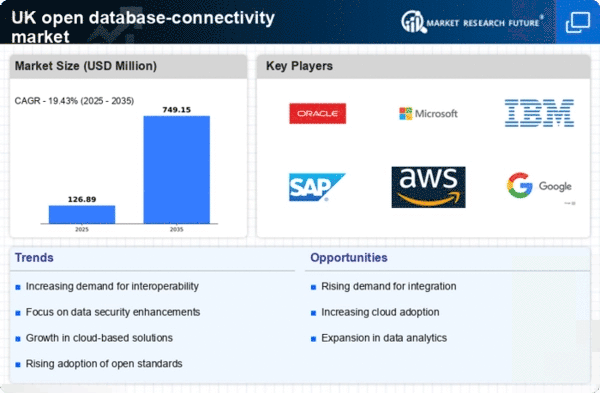
As per Market Research Future analysis, the UK open database-connectivity market size was estimated at 106.25 USD Million in 2024. The UK open database-connectivity market is projected to grow from 126.89 USD Million in 2025 to 749.15 USD Million by 2035, exhibiting a compound annual growth rate (CAGR) of 19.4% during the forecast period 2025 - 2035

Key Market Trends & Highlights

The UK open database-connectivity market is experiencing robust growth driven by technological advancements and evolving user needs.

  • The demand for data integration solutions is increasing as organizations seek to streamline their operations.
  • User-friendly solutions are becoming a focal point, enhancing accessibility for non-technical users.
  • The market is witnessing a growing emphasis on regulatory compliance and data security measures.
  • Key drivers such as the rising adoption of cloud technologies and the emergence of big data analytics are propelling market expansion.

Market Size & Forecast

2024 Market Size 106.25 (USD Million)
2035 Market Size 749.15 (USD Million)
CAGR (2025 - 2035) 19.43%

Major Players

Oracle Corporation (US), Microsoft Corporation (US), IBM Corporation (US), SAP SE (DE), Amazon Web Services (US), Google LLC (US), Snowflake Inc. (US), Cloudera, Inc. (US), Teradata Corporation (US)

Our Impact
Enabled $4.3B Revenue Impact for Fortune 500 and Leading Multinationals
Partnering with 2000+ Global Organizations Each Year
30K+ Citations by Top-Tier Firms in the Industry

UK Open Database Connectivity Market Trends

the open database-connectivity market is evolving significantly., driven by the increasing demand for seamless data integration across various platforms. Organizations are recognizing the necessity of connecting disparate data sources to enhance operational efficiency and decision-making processes. This trend is further fueled by the rise of cloud computing and the growing reliance on data analytics. As businesses strive to leverage data for competitive advantage, the need for robust connectivity solutions becomes paramount. Moreover, regulatory frameworks are evolving, necessitating compliance with data protection standards, which influences the development of connectivity solutions. In addition, the open database-connectivity market is witnessing a shift towards more user-friendly interfaces and tools that facilitate access to data.. This democratization of data access allows non-technical users to engage with data more effectively, thereby fostering a data-driven culture within organizations. The emphasis on interoperability among different systems is also becoming increasingly critical, as organizations seek to create cohesive ecosystems that support their strategic objectives. As the landscape continues to evolve, stakeholders must remain vigilant to adapt to emerging technologies and changing market dynamics.

Increased Demand for Data Integration

The open database-connectivity market is seeing a surge in demand for solutions that enable seamless integration of diverse data sources. Organizations are increasingly recognizing the value of consolidating data from various platforms to enhance operational efficiency and improve decision-making.

Focus on User-Friendly Solutions

There is a growing emphasis on developing user-friendly tools within the open database-connectivity market. This trend aims to empower non-technical users to access and analyze data, fostering a culture of data-driven decision-making across organizations.

Regulatory Compliance and Data Security

As regulatory frameworks evolve, the open database-connectivity market is evolving to comply with data protection standards.. This focus on security is crucial for organizations that handle sensitive information, influencing the design and implementation of connectivity solutions.

UK Open Database Connectivity Market Drivers

Emergence of Big Data Analytics

The open database-connectivity market is significantly influenced by the emergence of big data analytics in the UK. As organizations increasingly rely on data-driven decision-making, the need for robust data connectivity solutions becomes paramount. The ability to analyze vast amounts of data from diverse sources requires efficient database connectivity to ensure timely insights. The UK big data market is expected to reach £2 billion by 2026, indicating a strong demand for tools that can integrate and manage data effectively. Consequently, the open database-connectivity market is poised to benefit from this trend, as businesses seek solutions that enhance their analytical capabilities.

Rising Adoption of Cloud Technologies

The open database-connectivity market is experiencing a notable surge due to the increasing adoption of cloud technologies across various sectors in the UK. Businesses are migrating their operations to cloud platforms, which necessitates seamless data integration and connectivity. This shift is driven by the need for scalability, flexibility, and cost-effectiveness. According to recent data, the cloud services market in the UK is projected to grow at a CAGR of 20% over the next five years. As organizations seek to leverage cloud capabilities, the demand for open database-connectivity solutions that facilitate efficient data access and management is likely to rise, thereby propelling the market forward.

Increased Focus on Real-Time Data Access

The open database-connectivity market is witnessing an increased focus on real-time data access, driven by the need for timely information in decision-making processes. In the UK, businesses are increasingly adopting technologies that enable instant data retrieval and analysis. This trend is particularly evident in sectors such as retail and finance, where real-time insights can significantly impact customer engagement and operational efficiency. The demand for solutions that facilitate real-time data connectivity is expected to grow, as organizations seek to enhance their responsiveness to market changes. This shift is likely to create new opportunities within the open database-connectivity market.

Growing Emphasis on Data Interoperability

In the open database-connectivity market, the growing emphasis on data interoperability is a critical driver. Organizations in the UK are increasingly recognizing the importance of integrating disparate data sources to create a unified view of information. This trend is particularly relevant in sectors such as healthcare and finance, where data silos can hinder operational efficiency. The UK government has also initiated various programs to promote data sharing and interoperability, further fueling the demand for open database-connectivity solutions. As businesses strive to enhance collaboration and streamline processes, the market for these connectivity solutions is expected to expand..

Advancements in Data Security Technologies

The open database-connectivity market is also being shaped by advancements in data security technologies. As organizations in the UK become more aware of the risks associated with data breaches and cyber threats, there is a growing demand for connectivity solutions that prioritize security. Innovations in encryption, access controls, and authentication methods are becoming essential features of open database-connectivity solutions. The UK cybersecurity market is projected to reach £8 billion by 2025, indicating a robust investment in security measures. This focus on data protection is likely to drive the adoption of secure open database-connectivity solutions, thereby influencing market dynamics.


Market Segment Insights

By Operating System: Windows (Largest) vs. Linux (Fastest-Growing)

In the UK open database-connectivity market, the operating system segment shows a clear distribution of market share among Windows, macOS, Linux, and Others. Windows holds the majority share, making it the dominant player, while macOS follows suit, appealing to a niche audience that values design and user experience. Linux, although smaller in comparison, is gaining traction due to its strong performance in server environments and the rise of open-source solutions, making it a compelling choice for developers and tech enthusiasts. Others represent a mix of various alternative operating systems that cater to specific use cases, though with limited overall presence. Growth trends in the operating system segment are compelling, particularly for Linux, which is recognized as the fastest-growing option. This growth is driven by increasing demands for open-source software, heightened security concerns, and the flexibility offered by Linux distributions. The ongoing transition towards cloud-based services further contributes to its popularity, as organizations seek cost-effective solutions that integrate seamlessly with various technologies. Meanwhile, Windows maintains its stronghold but faces competition from macOS in the creative sectors. The diversity of choices allows users to select platforms that align closely with their operational needs and preferences.

Windows (Dominant) vs. Linux (Emerging)

Windows remains the dominant operating system in the UK open database-connectivity market, largely due to its widespread adoption in enterprise environments and strong user familiarity. Its robust ecosystem supports various applications and services that enhance productivity, making it the go-to choice for many businesses. Conversely, Linux emerges as a flexible and cost-effective alternative, particularly favored in tech sectors that prioritize customization and performance. Its open-source nature allows for rapid innovation and adaptation, attracting a growing community of users who are increasingly shifting towards Linux for its reliability and security advantages. Together, these operating systems represent distinct yet complementary preferences among users in the market.

By Driver Type: Multi-Tier ODBC Driver (Largest) vs. Single-Tier ODBC Driver (Fastest-Growing)

In the UK open database-connectivity market, the Multi-Tier ODBC Driver currently holds the largest market share, consolidating its position due to its comprehensive capabilities in data access and management. This driver type's ability to efficiently connect multiple applications to diverse data sources has made it a preferred choice among enterprises seeking optimized performance and reliability. Conversely, the Single-Tier ODBC Driver is rapidly gaining traction, appealing to small to medium-sized businesses as it offers simplified integration and lower costs while still providing essential connectivity features.\n\nThe growth of the Single-Tier ODBC Driver can be attributed to the increasing demand for cost-effective solutions among businesses in the UK open database-connectivity market. As organizations prioritize efficiency and reduced operational expenses, the Single-Tier ODBC Driver is emerging as a go-to option for users looking for straightforward setup and performance. This segment is anticipated to continue its upward trajectory, driven by technological advancements and a greater focus on streamlined connectivity solutions that cater to evolving business needs.

Multi-Tier ODBC Driver (Dominant) vs. Single-Tier ODBC Driver (Emerging)

The Multi-Tier ODBC Driver is characterized by its robust architecture, facilitating connections to multiple data sources and applications simultaneously. This driver type is widely adopted by larger organizations that require high throughput and reliable data management across complex IT environments. With increased emphasis on data-driven decision-making, the Multi-Tier ODBC Driver continues to dominate the market due to its scalability and performance. On the other hand, the Single-Tier ODBC Driver is emerging as a popular choice for smaller enterprises, appreciating its ease of use and lower implementation costs. While the functionality may not match that of its multi-tier counterpart, it provides essential connectivity for businesses seeking efficient solutions. Both drivers cater to specific needs within the UK open database-connectivity market, reflecting the diverse landscape of users.

By Deployment: Cloud (Largest) vs. On-Premise (Fastest-Growing)

In the UK open database-connectivity market, the distribution of deployment segments shows a significant preference for cloud solutions, which dominate the market landscape. Cloud deployment captures the larger share due to its scalability, flexibility, and reduced operational costs, making it a preferred choice for various organizations. Conversely, although on-premise deployments represent a smaller portion of the overall market, they are gaining traction among enterprises seeking enhanced control over their data and infrastructure. Growth trends in this segment are driven by the increasing demand for agile and cost-effective solutions, with cloud technologies leading the charge. However, the rise of data privacy concerns and regulatory compliance is pushing several businesses to consider on-premise alternatives as a viable option. As the market evolves, the balance between cloud adoption and on-premise configurations will likely reshape the competitive landscape.

Deployment: Cloud (Dominant) vs. On-Premise (Emerging)

The cloud deployment segment stands out as the dominant force in the UK open database-connectivity market, characterized by its ability to offer rapid scalability, robust performance, and access to advanced features without the need for extensive infrastructure investments. This makes it especially attractive to startups and SMEs, which require flexibility to adapt quickly to market changes. In contrast, the on-premise segment is emerging, appealing to enterprises that prioritize data security and control. These organizations are increasingly recognizing the importance of maintaining their own infrastructure, especially in regulated industries where compliance with data privacy laws is critical. Both segments exhibit unique strengths, but their coexistence reflects a diverse range of business needs.

By End-User: Manufacturing (Largest) vs. BFSI (Fastest-Growing)

The market share distribution across end-user segments indicates that manufacturing holds the largest share in the UK open database-connectivity market, driven by the industrial sector's significant reliance on data integration and connectivity. Following manufacturing, the BFSI sector is gaining traction, showcasing substantial investment in technology to streamline operations and enhance customer service, representing a key component in the overall market dynamics. Growth trends in this segment reflect an increasing demand for streamlined data processing and connectivity solutions. BFSI, being the fastest-growing sector, benefits from advancements in fintech and regulatory requirements that necessitate better data handling. Meanwhile, manufacturing's robustness is bolstered by automation and IoT integrations, compelling organizations to adopt more advanced database connectivity solutions to remain competitive in a data-centric world.

Manufacturing: Dominant vs. BFSI: Emerging

Manufacturing stands as the dominant player in the UK open database-connectivity market, characterized by its mature infrastructure and established practices in data management. This sector capitalizes on integrated solutions to coordinate operations efficiently across various production lines. In contrast, BFSI is emerging rapidly, characterized by its agility and investment in cutting-edge technologies such as AI and machine learning to enhance data analytics capabilities. The regulatory landscape in the UK pushes BFSI to adopt superior connectivity solutions to ensure compliance and improve customer relations. Both segments exhibit unique characteristics; while manufacturing focuses on operational efficiency, BFSI prioritizes speed and adaptability in data processing.

Get more detailed insights about UK Open Database Connectivity Market

Key Players and Competitive Insights

The open database-connectivity market is characterized by a dynamic competitive landscape, driven by the increasing demand for seamless data integration and analytics capabilities. Major players such as Oracle Corporation (US), Microsoft Corporation (US), and Amazon Web Services (US) are at the forefront, each adopting distinct strategies to enhance their market positioning. Oracle Corporation (US) focuses on innovation through its cloud infrastructure, emphasizing advanced analytics and machine learning capabilities. Meanwhile, Microsoft Corporation (US) leverages its Azure platform to foster partnerships and expand its service offerings, particularly in hybrid cloud solutions. Amazon Web Services (US) continues to dominate with its extensive portfolio, emphasizing scalability and flexibility, which appeals to a broad range of enterprises. Collectively, these strategies contribute to a competitive environment that is increasingly centered around technological advancement and customer-centric solutions.In terms of business tactics, companies are increasingly localizing their operations to better serve regional markets, optimizing supply chains to enhance efficiency. The market structure appears moderately fragmented, with a mix of established players and emerging startups. This fragmentation allows for diverse offerings, yet the influence of key players remains substantial, as they set benchmarks for innovation and service quality.

In October Oracle Corporation (US) announced a strategic partnership with a leading UK-based fintech firm to enhance its data analytics capabilities. This collaboration aims to integrate advanced analytics tools into financial services, thereby improving decision-making processes for clients. The strategic importance of this partnership lies in Oracle's ability to penetrate the financial sector more deeply, leveraging its technological expertise to meet the specific needs of this industry.

In September Microsoft Corporation (US) unveiled a new initiative aimed at enhancing data security within its Azure platform. This initiative includes advanced encryption technologies and compliance features tailored for the UK market. The significance of this move is underscored by the growing concerns around data privacy and security, positioning Microsoft as a trusted provider in an increasingly competitive landscape.

In August Amazon Web Services (US) launched a new suite of tools designed to facilitate real-time data integration across various platforms. This initiative is particularly relevant for businesses seeking to streamline operations and enhance data accessibility. The strategic importance of this launch is evident in its potential to attract a wider customer base, particularly among organizations looking to modernize their data infrastructure.

As of November current trends in the open database-connectivity market are heavily influenced by digitalization, sustainability, and the integration of artificial intelligence. Strategic alliances are becoming increasingly vital, as companies seek to combine strengths and resources to innovate more effectively. Looking ahead, competitive differentiation is likely to evolve, shifting from traditional price-based competition to a focus on innovation, technological advancements, and supply chain reliability. This transition suggests that companies that prioritize these areas will be better positioned to thrive in an ever-evolving market.

Key Companies in the UK Open Database Connectivity Market include

Industry Developments

The market for Open Database Connectivity (ODBC) in the UK has grown significantly in 2025 thanks to hybrid database strategies and growing enterprise cloud adoption. Oracle released improved ODBC drivers for UK businesses in February 2025, focusing on the retail and financial industries in particular to increase real-time analytics and data interoperability.

In March 2025, Informatica released enhancements that make it easier to integrate various relational and non-relational platforms.In April 2025, MongoDB and Dremio unveiled new connectors that facilitate huge data pipelines and high-performance analytics. In May 2025, Red Hat, SAP, and Talend improved the scalability, security, and compatibility with several clouds of their systems.

In June 2025, Snowflake, IBM, and DataDirect Technologies enhanced their ODBC products, allowing businesses to effectively manage more complex transactional and analytical workloads. In order to maximize hybrid and cloud-native installations, Microsoft, Cloudera, and Amazon Web Services also improved their connectivity tools.

These changes show that UK companies are increasingly looking for ODBC solutions that are safe, scalable, and adaptable. These developments are being used by sectors like banking, healthcare, logistics, and e-commerce to improve data accessibility, expedite their digital transformation processes, and streamline operations.

Future Outlook

UK Open Database Connectivity Market Future Outlook

The Open Database Connectivity Market is projected to grow at a 19.43% CAGR from 2025 to 2035, driven by increasing data integration needs and cloud adoption.

New opportunities lie in:

  • Development of advanced API management solutions for seamless data access.
  • Creation of tailored data connectivity platforms for SMEs.
  • Expansion into IoT data integration services for real-time analytics.

By 2035, the market is expected to achieve substantial growth, driven by innovation and strategic partnerships.

Market Segmentation

UK Open Database Connectivity Market End-User Outlook

  • Manufacturing
  • BFSI
  • Government
  • IT and Telecommunication
  • Electronics
  • Healthcare
  • Automotive
  • Others

UK Open Database Connectivity Market Deployment Outlook

  • Cloud
  • On-Premise

UK Open Database Connectivity Market Driver Type Outlook

  • Multi-Tier ODBC Driver
  • Single-Tier ODBC Driver

UK Open Database Connectivity Market Operating System Outlook

  • Windows
  • macOS
  • Linux
  • Others

Report Scope

MARKET SIZE 2024 106.25(USD Million)
MARKET SIZE 2025 126.89(USD Million)
MARKET SIZE 2035 749.15(USD Million)
COMPOUND ANNUAL GROWTH RATE (CAGR) 19.43% (2025 - 2035)
REPORT COVERAGE Revenue Forecast, Competitive Landscape, Growth Factors, and Trends
BASE YEAR 2024
Market Forecast Period 2025 - 2035
Historical Data 2019 - 2024
Market Forecast Units USD Million
Key Companies Profiled Oracle Corporation (US), Microsoft Corporation (US), IBM Corporation (US), SAP SE (DE), Amazon Web Services (US), Google LLC (US), Snowflake Inc. (US), Cloudera, Inc. (US), Teradata Corporation (US)
Segments Covered Operating System, Driver Type, Deployment, End-User
Key Market Opportunities Integration of advanced analytics and artificial intelligence in the open database-connectivity market.
Key Market Dynamics Rising demand for seamless data integration drives innovation in open database-connectivity solutions across various sectors.
Countries Covered UK
Leave a Comment

FAQs

What is the projected market size of the UK Open Database Connectivity Market in 2024?

The UK Open Database Connectivity Market is expected to be valued at 106.25 million USD in 2024.

What is the expected market value for the UK Open Database Connectivity Market by 2035?

By 2035, the UK Open Database Connectivity Market is anticipated to reach a value of 680.62 million USD.

What is the expected CAGR for the UK Open Database Connectivity Market during the forecast period?

The market is expected to grow at a CAGR of 18.393% from 2025 to 2035.

Which operating system segment will have the largest market value in 2035?

In 2035, the Windows operating system segment is projected to have the largest market value at 295.5 million USD.

What is the expected market value for the macOS segment in 2024?

The macOS segment of the UK Open Database Connectivity Market is expected to be valued at 30.0 million USD in 2024.

Which company is one of the major players in the UK Open Database Connectivity Market?

Major players in the market include Oracle, Informatica, and MongoDB, among others.

What will be the market value for the Linux segment in 2035?

The Linux segment is anticipated to reach a market value of 122.0 million USD by 2035.

What is the projected market size for the Others segment in 2024?

The Others segment is projected to have a market size of 12.5 million USD in 2024.

How is the Linux operating system segment growth rate compared to other segments from 2024 to 2035?

The Linux segment is expected to grow significantly, reaching 122.0 million USD in 2035 from 18.75 million USD in 2024.

What market value is expected for the Windows segment by 2025?

The Windows segment's market value is expected to continue growing, with a substantial contribution exceeding 45.0 million USD as of 2024.

Download Free Sample

Kindly complete the form below to receive a free sample of this Report

Compare Licence

×
Features License Type
Single User Multiuser License Enterprise User
Price $4,950 $5,950 $7,250
Maximum User Access Limit 1 User Upto 10 Users Unrestricted Access Throughout the Organization
Free Customization
Direct Access to Analyst
Deliverable Format
Platform Access
Discount on Next Purchase 10% 15% 15%
Printable Versions