×
Request Free Sample ×

Kindly complete the form below to receive a free sample of this Report

* Please use a valid business email

Leading companies partner with us for data-driven Insights

clients tt-cursor
Hero Background

UK Medical Disposables Market

ID: MRFR/MED/50872-HCR
200 Pages
Garvit Vyas
February 2026

UK Medical Disposables Market Research Report By Product (Wound Management Products, Drug Delivery Products, Diagnostic and Laboratory Disposables, Dialysis Disposable, Incontinence Products, Respiratory Supplies, Sterilization Supplies, Non-woven Disposables, Disposable Masks, Disposable Eye Gear, Disposable Gloves, Hand Sanitizers, Others), By Raw Material (Plastic Resin, Nonwoven Material, Rubber, Paper and Paperboard, Metals, Glass, Others) and By End Use (Hospitals, Home Healthcare, Outpatient/Primary Care Facilities, Others) - Growth & Industry Forecast 2025 To 2035

Share:
Download PDF ×

We do not share your information with anyone. However, we may send you emails based on your report interest from time to time. You may contact us at any time to opt-out.

UK Medical Disposables Market Infographic
Purchase Options

UK Medical Disposables Market Summary

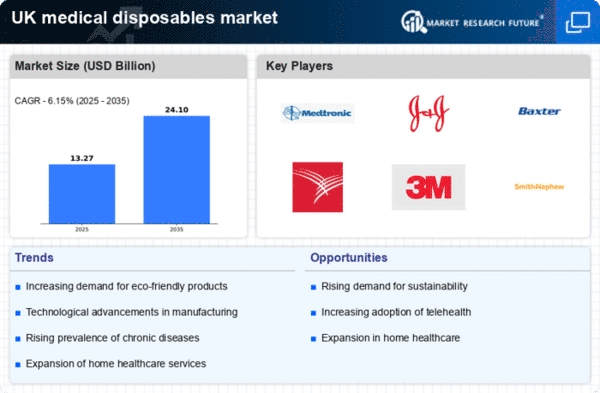
As per Market Research Future analysis, the UK medical disposables market size was estimated at 12.5 USD Billion in 2024.. The UK medical disposables market is projected to grow from 13.27 USD Billion in 2025 to 24.1 USD Billion by 2035, exhibiting a compound annual growth rate (CAGR) of 6.1% during the forecast period 2025 - 2035

Key Market Trends & Highlights

The UK medical disposables market is experiencing robust growth driven by technological advancements and increasing healthcare demands.

  • Technological advancements are enhancing the efficiency and effectiveness of medical disposables, particularly in the surgical and wound care segments.
  • The regulatory compliance landscape is becoming increasingly stringent, necessitating higher standards for product safety and efficacy.
  • Sustainability initiatives are gaining traction, with manufacturers focusing on eco-friendly materials and waste reduction strategies.
  • The rising demand for healthcare services and innovations in product development are key drivers propelling market growth.

Market Size & Forecast

2024 Market Size 12.5 (USD Billion)
2035 Market Size 24.1 (USD Billion)
CAGR (2025 - 2035) 6.15%

Major Players

Medtronic (US), Johnson & Johnson (US), Baxter International (US), Cardinal Health (US), 3M (US), Smith & Nephew (GB), B. Braun Melsungen AG (DE), Halyard Health (US), Terumo Corporation (JP)

Our Impact
Enabled $4.3B Revenue Impact for Fortune 500 and Leading Multinationals
Partnering with 2000+ Global Organizations Each Year
30K+ Citations by Top-Tier Firms in the Industry

UK Medical Disposables Market Trends

The medical disposables market is currently experiencing notable growth. This growth is driven by various factors, including technological advancements and increasing healthcare demands. The rise in chronic diseases and the aging population are contributing to a heightened need for efficient and safe medical supplies. Furthermore, innovations in materials and manufacturing processes are enhancing the quality and functionality of these products, making them more appealing to healthcare providers. As a result, the market is evolving to meet the changing needs of patients and healthcare systems alike. In addition, regulatory frameworks are becoming more stringent, which may influence the production and distribution of medical disposables. Manufacturers are likely focusing on compliance with safety standards and environmental regulations, which could lead to increased operational costs. However, this also presents opportunities for companies that can innovate and adapt to these challenges. Overall, the medical disposables market appears poised for continued expansion, with a strong emphasis on quality, safety, and sustainability in the coming years.

Technological Advancements

The medical disposables market is witnessing rapid technological innovations that enhance product efficiency and safety. New materials and designs are being developed to improve usability and reduce the risk of infections. These advancements are likely to attract healthcare providers seeking reliable solutions for patient care.

Regulatory Compliance

Increasing regulatory scrutiny is shaping the landscape of the medical disposables market. Manufacturers are focusing on meeting stringent safety and quality standards, which may lead to higher production costs. However, compliance can also enhance product credibility and market acceptance.

Sustainability Initiatives

There is a growing emphasis on sustainability within the medical disposables market. Companies are exploring eco-friendly materials and practices to reduce environmental impact. This trend may resonate with healthcare institutions aiming to adopt greener practices, potentially influencing purchasing decisions.

UK Medical Disposables Market Drivers

Innovations in Product Development

Innovations in product development are playing a crucial role in shaping the medical disposables market. Manufacturers are increasingly investing in research and development to create advanced disposable products that meet the evolving needs of healthcare providers. For instance, the introduction of smart disposables equipped with sensors for monitoring patient health is gaining traction. This trend is supported by the UK government’s commitment to enhancing healthcare technology, which may lead to a projected growth rate of 7% in the medical disposables market over the next five years. Additionally, the development of biodegradable materials for disposable products aligns with sustainability goals, potentially attracting environmentally conscious consumers. As these innovations continue to emerge, they are likely to redefine the landscape of the medical disposables market.

Increased Focus on Infection Control

The heightened focus on infection control is significantly influencing the medical disposables market. Healthcare facilities in the UK are prioritising stringent infection prevention protocols, which necessitate the use of single-use disposable products. This trend is underscored by data indicating that hospital-acquired infections affect approximately 300,000 patients annually in the UK, prompting healthcare providers to adopt more disposable solutions. The medical disposables market is likely to benefit from this shift, as products such as gloves, masks, and gowns become essential in maintaining hygiene standards. Furthermore, the ongoing emphasis on patient safety and quality of care is expected to drive the demand for high-quality disposable items, thereby fostering growth in the market.

Expansion of Home Healthcare Services

The expansion of home healthcare services is emerging as a significant driver for the medical disposables market. With an increasing number of patients opting for home-based care, there is a growing need for disposable medical products that facilitate safe and effective treatment in non-hospital settings. The UK government’s initiatives to promote home healthcare are likely to contribute to this trend, as they aim to reduce hospital admissions and enhance patient comfort. As a result, the medical disposables market may see a surge in demand for items such as wound care supplies, diagnostic kits, and personal protective equipment tailored for home use. This shift towards home healthcare could potentially reshape the market landscape, creating new opportunities for manufacturers.

Rising Demand for Healthcare Services

The medical disposables market is experiencing a notable increase in demand due to the rising need for healthcare services in the UK. Factors such as an aging population and the prevalence of chronic diseases are driving this trend. According to recent data, the UK population aged 65 and over is projected to reach 23% by 2035, which may lead to a higher consumption of medical disposables. This demographic shift necessitates more frequent medical interventions, thereby boosting the market. Furthermore, the increasing focus on preventive healthcare and outpatient services is likely to further enhance the demand for various disposable medical products, including syringes, gloves, and surgical instruments. As healthcare providers adapt to these changes, the medical disposables market is expected to grow significantly.

Cost-Effectiveness of Disposable Products

The cost-effectiveness of disposable products is a pivotal factor driving the medical disposables market. Healthcare providers in the UK are increasingly recognising the financial benefits associated with using disposable items, which can reduce the need for sterilisation and maintenance of reusable products. This trend is particularly relevant in the context of budget constraints faced by many healthcare facilities. Data suggests that the use of disposable medical products can lead to savings of up to 30% in operational costs. As healthcare systems strive to optimise resources while maintaining quality care, the medical disposables market is likely to experience sustained growth. The economic advantages of disposables may encourage wider adoption across various healthcare settings, further solidifying their role in the industry.


Market Segment Insights

By Product: Disposable Gloves (Largest) vs. Wound Management Products (Fastest-Growing)

In the UK medical disposables market, the distribution of market share reveals that Disposable Gloves is the largest segment, favored for their versatility and essential role in infection control. Following closely are Wound Management Products, which have been gaining traction due to increasing incidences of chronic wounds and surgical procedures, thus capturing a substantial portion of the market. Growth trends indicate a shift towards more specialized and advanced products within the segments. Wound Management Products are experiencing the fastest growth, driven by rising demand for personalized healthcare solutions and innovative technologies. Additionally, awareness about hygiene has propelled the adoption of Disposable Masks and Hand Sanitizers, signaling a significant trend towards enhanced infection prevention across healthcare settings.

Gloves (Dominant) vs. Wound Management Products (Emerging)

Disposable Gloves dominate the market due to their critical necessity in various medical settings, providing safety for both patients and healthcare professionals. They are available in multiple materials, including latex, vinyl, and nitrile, catering to different user needs. On the other hand, Wound Management Products represent an emerging segment, characterized by an increasing focus on advanced wound care technologies. These products, such as hydrocolloid dressings and bioactive implants, address complex wounds and promote healing. Their rising adoption is fueled by demographic shifts, including an aging population and the prevalence of chronic conditions such as diabetes, leading to greater demand for effective wound management solutions.

By Raw Material: Plastic Resin (Largest) vs. Nonwoven Material (Fastest-Growing)

In the UK medical disposables market, the distribution of market share among raw material segments reveals that plastic resin dominates, constituting a significant portion due to its versatility and cost-effectiveness. Nonwoven materials are also gaining traction, capturing a noteworthy share as they become increasingly utilized in various disposable medical products, thereby transforming the landscape of material usage in this sector. Growth trends indicate a robust demand for environmentally friendly materials, particularly nonwoven fabrics, spurred by regulatory pressures and consumer preferences for sustainable options. This shift is influencing manufacturers to innovate and develop biodegradable alternatives. The ongoing advancements in manufacturing technologies are also driving efficiency, ultimately fostering a competitive environment that benefits both dominant and emerging materials in the UK medical disposables market.

Plastic Resin (Dominant) vs. Nonwoven Material (Emerging)

Plastic resin is well-established as the dominant material in the UK medical disposables market, primarily due to its adaptability and lower production costs. It is extensively used in products such as syringes, containers, and various packaging solutions. Conversely, nonwoven materials are emerging as a valuable component due to their absorbency, lightweight nature, and ability to be engineered into specific functionalities. With a growing emphasis on hygiene and disposability in the healthcare sector, nonwoven fabrics are increasingly employed in surgical gowns, drapes, and masks. The rising trend towards sustainability is paving the way for innovation in nonwoven technology, making it a competitive alternative to traditional materials.

By End Use: Hospitals (Largest) vs. Home Healthcare (Fastest-Growing)

In the UK medical disposables market, the hospitals segment commands the largest share, significantly outpacing other end-use sectors. This segment benefits from high demand driven by an increasing number of patients requiring surgical procedures, which consequently boosts the consumption of disposable devices. Conversely, home healthcare is emerging as a vital segment, rapidly gaining traction due to the shift towards outpatient care and the aging population needing care in a home setting. The growth trends within the end use segments are influenced by several factors, including technological advancements in medical devices, an increasing emphasis on infection control, and patient preference for at-home care solutions. Hospitals are likely to maintain their dominance, while home healthcare is poised for substantial growth, fueled by innovations in telehealth and the rising trend of chronic disease management, thereby reshaping care delivery models.

Hospitals (Dominant) vs. Home Healthcare (Emerging)

The hospitals segment in the UK medical disposables market is characterized by a robust infrastructure supporting extensive surgical and procedural activities, leading to high demand for various disposable products such as gloves, surgical instruments, and drapes. This segment is crucial for medical device manufacturers, ensuring a stable revenue stream. On the other hand, the home healthcare segment is gaining prominence, associated with the increasing preference for personalized and convenient care solutions. This emerging segment focuses on products that enhance patient comfort and safety at home, including diagnostic devices and portable medical supplies. The contrasting dynamics of these segments highlight the ongoing shift in healthcare delivery, where hospitals remain pivotal, yet home healthcare is evolving rapidly, driven by the need for cost-effective care solutions.

Get more detailed insights about UK Medical Disposables Market

Key Players and Competitive Insights

The medical disposables market in the UK is characterized by a competitive landscape that is both dynamic and multifaceted. Key growth drivers include an increasing demand for healthcare services, advancements in technology, and a heightened focus on infection control. Major players such as Medtronic (US), Johnson & Johnson (US), and Smith & Nephew (GB) are strategically positioned to leverage these trends. Medtronic (US) emphasizes innovation in product development, particularly in advanced wound care and surgical solutions, while Johnson & Johnson (US) focuses on expanding its portfolio through strategic acquisitions and partnerships. Smith & Nephew (GB) is enhancing its operational focus on digital health solutions, which collectively shapes a competitive environment that is increasingly reliant on technological advancements and strategic collaborations.
Key business tactics within the market include localizing manufacturing to reduce costs and optimize supply chains, which appears to be a common strategy among leading firms. The competitive structure of the market is moderately fragmented, with several key players exerting influence over various segments. This fragmentation allows for niche players to thrive, while larger companies consolidate their market positions through strategic initiatives and partnerships.
In October 2025, Medtronic (US) announced a partnership with a leading UK-based healthcare provider to enhance the distribution of its advanced wound care products. This collaboration is expected to streamline supply chains and improve access to innovative solutions, thereby reinforcing Medtronic's market presence. The strategic importance of this partnership lies in its potential to enhance patient outcomes through improved product availability and localized support.
In September 2025, Johnson & Johnson (US) launched a new line of surgical disposables aimed at minimizing infection rates in operating rooms. This product line is a direct response to the growing demand for safety and efficacy in surgical environments. The introduction of these products not only strengthens Johnson & Johnson's market position but also reflects a broader trend towards prioritizing patient safety and infection control in healthcare settings.
In August 2025, Smith & Nephew (GB) unveiled a digital platform designed to integrate its medical disposables with real-time data analytics. This initiative aims to enhance operational efficiency and provide healthcare professionals with actionable insights. The strategic significance of this move lies in its alignment with the increasing trend towards digitalization in healthcare, positioning Smith & Nephew as a leader in the integration of technology and medical disposables.
As of November 2025, current competitive trends are increasingly defined by digitalization, sustainability, and the integration of artificial intelligence (AI) into product offerings. Strategic alliances are shaping the landscape, enabling companies to pool resources and expertise to drive innovation. Looking ahead, competitive differentiation is likely to evolve from traditional price-based competition towards a focus on innovation, technological advancements, and supply chain reliability. This shift underscores the importance of adaptability and forward-thinking strategies in maintaining a competitive edge in the medical disposables market.

Key Companies in the UK Medical Disposables Market include

Industry Developments

The UK Medical Disposables Market has seen significant activity in recent months, particularly in the context of recent mergers and acquisitions among key players. In August 2023, Medtronic announced its acquisition of Mazor Robotics, which is expected to enhance its offerings in surgical robotics, influencing the market's competitive landscape. Similarly, in September 2023, B. Braun Melsungen finalized its acquisition of a specialized disposable product manufacturer, positioning itself favorably against other major players like Smith and Nephew and 3 M. 

The overall market valuation is expected to grow due to increasing healthcare demands, driven by a rising elderly population and a focus on infection prevention, as highlighted by recent NHS reports. Johnson and Johnson has also indicated a strategic push towards sustainability in their medical disposable products, which is gaining traction amid growing environmental concerns among consumers and healthcare providers. Furthermore, in the last couple of years, there have been ongoing innovations in wound care products, primarily led by companies like Coloplast and Acelity, contributing to the overall development of the sector in the UK.


Future Outlook

UK Medical Disposables Market Future Outlook

The Medical Disposables Market is projected to grow at a 6.15% CAGR from 2025 to 2035, driven by technological advancements, increasing healthcare demands, and regulatory support.

New opportunities lie in:

  • Development of biodegradable medical disposables to meet sustainability goals.
  • Expansion of telehealth services incorporating disposable diagnostic tools.
  • Investment in automated manufacturing processes to enhance production efficiency.

By 2035, the market is expected to achieve robust growth, driven by innovation and strategic investments.

Market Segmentation

UK Medical Disposables Market End Use Outlook

  • Hospitals
  • Home Healthcare
  • Outpatient/Primary Care Facilities
  • Others

UK Medical Disposables Market Product Outlook

  • Wound Management Products
  • Drug Delivery Products
  • Diagnostic and Laboratory Disposables
  • Dialysis Disposable
  • Incontinence Products
  • Respiratory Supplies
  • Sterilization Supplies
  • Non-woven Disposables
  • Disposable Masks
  • Disposable Eye Gear
  • Disposable Gloves
  • Hand Sanitizers
  • Others

UK Medical Disposables Market Raw Material Outlook

  • Plastic Resin
  • Nonwoven Material
  • Rubber
  • Paper and Paperboard
  • Metals
  • Glass
  • Others

Report Scope

MARKET SIZE 2024 12.5(USD Billion)
MARKET SIZE 2025 13.27(USD Billion)
MARKET SIZE 2035 24.1(USD Billion)
COMPOUND ANNUAL GROWTH RATE (CAGR) 6.15% (2025 - 2035)
REPORT COVERAGE Revenue Forecast, Competitive Landscape, Growth Factors, and Trends
BASE YEAR 2024
Market Forecast Period 2025 - 2035
Historical Data 2019 - 2024
Market Forecast Units USD Billion
Key Companies Profiled Medtronic (US), Johnson & Johnson (US), Baxter International (US), Cardinal Health (US), 3M (US), Smith & Nephew (GB), B. Braun Melsungen AG (DE), Halyard Health (US), Terumo Corporation (JP)
Segments Covered Product, Raw Material, End Use
Key Market Opportunities Integration of smart technology in medical disposables enhances patient monitoring and operational efficiency.
Key Market Dynamics Rising demand for eco-friendly medical disposables drives innovation and regulatory adaptations in the market.
Countries Covered UK
Leave a Comment

FAQs

What is the expected market size of the UK Medical Disposables Market in 2024?

The UK Medical Disposables Market is expected to be valued at 12.0 USD Billion in the year 2024.

What is the forecasted market size of the UK Medical Disposables Market by 2035?

By 2035, the UK Medical Disposables Market is projected to reach a value of 27.5 USD Billion.

What is the expected CAGR for the UK Medical Disposables Market from 2025 to 2035?

The expected CAGR for the UK Medical Disposables Market during the period from 2025 to 2035 is 7.83%.

Which product segment is expected to dominate the UK Medical Disposables Market?

The Wound Management Products segment is expected to dominate the market, valued at 3.0 USD Billion in 2024 and increasing to 7.0 USD Billion by 2035.

What are the key players in the UK Medical Disposables Market?

Major players in the market include Smith & Nephew, Covidien, B. Braun Melsungen, HARTMANN, and Medtronic, among others.

What is the expected market size for Drug Delivery Products in 2024?

The Drug Delivery Products segment is valued at 3.5 USD Billion in the year 2024.

What growth is projected for the Diagnostic and Laboratory Disposables segment by 2035?

The Diagnostic and Laboratory Disposables segment is projected to grow from 2.5 USD Billion in 2024 to 6.0 USD Billion by 2035.

What challenges are faced by the UK Medical Disposables Market?

The market faces challenges such as regulatory compliance and increasing competition among key players.

What opportunities are available in the UK Medical Disposables Market?

Opportunities in the market include the adoption of advanced materials and innovative product designs.

What will be the market size for Incontinence Products in 2035?

The Incontinence Products segment is expected to grow to 2.5 USD Billion by 2035, up from 1.5 USD Billion in 2024.

Download Free Sample

Kindly complete the form below to receive a free sample of this Report

Compare Licence

×
Features License Type
Single User Multiuser License Enterprise User
Price $4,950 $5,950 $7,250
Maximum User Access Limit 1 User Upto 10 Users Unrestricted Access Throughout the Organization
Free Customization
Direct Access to Analyst
Deliverable Format
Platform Access
Discount on Next Purchase 10% 15% 15%
Printable Versions