×
Request Free Sample ×

Kindly complete the form below to receive a free sample of this Report

* Please use a valid business email

Leading companies partner with us for data-driven Insights

clients tt-cursor
Hero Background

UK Live Cell Encapsulation Market

ID: MRFR/MED/52133-HCR
200 Pages
Rahul Gotadki
February 2026

UK Live Cell Encapsulation Market Research Report By Type (Simple Dripping, Electrostatic Dripping), By Polymer Type (Alginate, HEMA-MMA, Chitosan, PAN-PVC) and By Application (Drug Delivery, Others) - Growth & Industry Forecast 2025 To 2035

Share:
Download PDF ×

We do not share your information with anyone. However, we may send you emails based on your report interest from time to time. You may contact us at any time to opt-out.

UK Live Cell Encapsulation Market Infographic
Purchase Options

UK Live Cell Encapsulation Market Summary

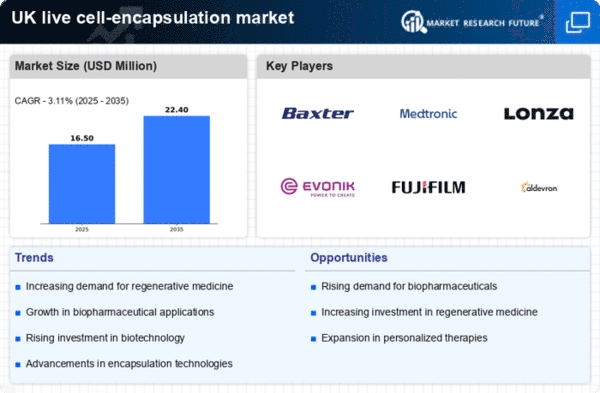
As per Market Research Future analysis, the UK live cell-encapsulation market size was estimated at 16.0 USD Million in 2024. The UK live cell-encapsulation market is projected to grow from 16.5 USD Million in 2025 to 22.4 USD Million by 2035, exhibiting a compound annual growth rate (CAGR) of 3.1% during the forecast period 2025 - 2035

Key Market Trends & Highlights

The UK live cell-encapsulation market is poised for substantial growth driven by technological advancements and increasing demand for biopharmaceuticals.

  • The market is witnessing a rising demand for biopharmaceuticals, indicating a shift towards more innovative therapeutic solutions.
  • Advancements in material science are enhancing the efficacy and safety of cell encapsulation techniques.
  • The focus on personalized medicine is driving the development of tailored therapies, particularly in the largest segment of regenerative medicine.
  • Key market drivers include increasing investment in biotechnology and growing prevalence of chronic diseases, which are likely to propel market expansion.

Market Size & Forecast

2024 Market Size 16.0 (USD Million)
2035 Market Size 22.4 (USD Million)
CAGR (2025 - 2035) 3.11%

Major Players

Baxter International Inc (US), Medtronic plc (IE), Lonza Group AG (CH), Evonik Industries AG (DE), Fujifilm Corporation (JP), Aldevron LLC (US), Sartorius AG (DE), Synlogic Inc (US)

Our Impact
Enabled $4.3B Revenue Impact for Fortune 500 and Leading Multinationals
Partnering with 2000+ Global Organizations Each Year
30K+ Citations by Top-Tier Firms in the Industry

UK Live Cell Encapsulation Market Trends

The live cell-encapsulation market is currently experiencing notable advancements, driven by increasing applications in pharmaceuticals and biotechnology. This technology, which involves enclosing living cells within a semi-permeable membrane, offers potential benefits such as enhanced cell viability and controlled release of therapeutic agents. As research progresses, the demand for innovative solutions in drug delivery and regenerative medicine appears to be on the rise. Furthermore, the growing emphasis on personalized medicine is likely to propel the market forward, as encapsulated cells can be tailored to meet individual patient needs. In addition, regulatory support and funding initiatives from governmental bodies are fostering an environment conducive to growth. The live cell-encapsulation market is also witnessing collaborations between academic institutions and industry players, which may lead to breakthroughs in cell-based therapies. As the landscape evolves, it seems that the integration of advanced materials and technologies will play a crucial role in shaping future developments. Overall, the market is poised for expansion, with various stakeholders actively exploring opportunities to leverage this innovative approach in healthcare and beyond.

Rising Demand for Biopharmaceuticals

The live cell-encapsulation market is witnessing an increase in demand for biopharmaceuticals, as these products offer targeted therapies with fewer side effects. This trend is likely driven by the growing prevalence of chronic diseases and the need for effective treatment options. Encapsulated cells can enhance the efficacy of biopharmaceuticals, making them more appealing to healthcare providers and patients alike.

Advancements in Material Science

Innovations in material science are significantly impacting the live cell-encapsulation market. The development of new biocompatible materials is enhancing the performance of encapsulated cells, allowing for better nutrient exchange and waste removal. This progress may lead to improved cell survival rates and functionality, which are critical for successful therapeutic applications.

Focus on Personalized Medicine

The shift towards personalized medicine is influencing the live cell-encapsulation market. As healthcare moves towards tailored treatments, encapsulated cells can be customized to meet specific patient requirements. This trend suggests a growing interest in developing therapies that are not only effective but also aligned with individual patient profiles, potentially improving treatment outcomes.

UK Live Cell Encapsulation Market Drivers

Growing Prevalence of Chronic Diseases

The rising incidence of chronic diseases in the UK is a significant driver for the live cell-encapsulation market. As healthcare providers seek more effective treatment options, the demand for innovative therapies that can deliver sustained therapeutic effects is increasing. Chronic conditions such as diabetes and cancer require advanced treatment modalities, and live cell-encapsulation technologies offer promising solutions. In 2025, it is estimated that chronic diseases will account for over 70% of healthcare expenditures in the UK, highlighting the urgent need for effective therapeutic interventions. This growing prevalence is likely to propel the live cell-encapsulation market forward, as healthcare systems look for ways to improve patient outcomes and reduce long-term costs.

Increasing Investment in Biotechnology

The live cell-encapsulation market is experiencing a surge in investment from both public and private sectors in the UK. This influx of capital is primarily directed towards research and development initiatives aimed at enhancing the efficacy of biopharmaceuticals. In 2025, the UK government allocated approximately £500 million to biotechnology research, which is expected to bolster the live cell-encapsulation market. This financial support is likely to facilitate the development of innovative encapsulation techniques, thereby improving the delivery and stability of therapeutic cells. Furthermore, as the demand for advanced biopharmaceuticals rises, the live cell-encapsulation market is poised to benefit from increased funding, which may lead to the introduction of novel products and technologies that cater to specific medical needs.

Regulatory Support for Advanced Therapies

The regulatory landscape in the UK is becoming increasingly supportive of advanced therapeutic modalities, including those utilizing live cell-encapsulation technologies. The Medicines and Healthcare products Regulatory Agency (MHRA) has streamlined approval processes for innovative therapies, which is likely to encourage more companies to enter the live cell-encapsulation market. This regulatory facilitation is crucial, as it reduces the time and cost associated with bringing new products to market. In 2025, it is anticipated that the number of approved live cell-encapsulation products will increase by 20%, reflecting the positive impact of regulatory support. Such developments not only enhance market growth but also foster a competitive environment that drives innovation within the live cell-encapsulation market.

Rising Awareness of Regenerative Medicine

There is a growing awareness and acceptance of regenerative medicine among healthcare professionals and patients in the UK. This trend is driving interest in live cell-encapsulation technologies, which are integral to the development of regenerative therapies. As more healthcare providers recognize the potential of these technologies to restore function and improve quality of life, the demand for live cell-encapsulation products is expected to rise. In 2025, it is anticipated that the market will see a 25% increase in demand driven by this heightened awareness. This shift in perception is likely to encourage investment in research and development, further propelling the live cell-encapsulation market and fostering collaborations between academia and industry.

Technological Advancements in Cell Encapsulation

Technological innovations are playing a pivotal role in shaping the live cell-encapsulation market. Recent advancements in materials science and engineering have led to the development of more efficient and biocompatible encapsulation materials. These innovations enhance the viability and functionality of encapsulated cells, making them more effective for therapeutic applications. In 2025, it is projected that the introduction of new encapsulation technologies will increase the market's growth rate by approximately 15%. As researchers continue to explore novel materials and techniques, the live cell-encapsulation market is likely to witness a wave of new products that improve treatment efficacy and patient safety, thereby expanding its applications across various therapeutic areas.


Market Segment Insights

By Application: Drug Delivery (Largest) vs. Tissue Engineering (Fastest-Growing)

In the UK live cell-encapsulation market, the application segment shows diverse preferences among Drug Delivery, Tissue Engineering, Regenerative Medicine, and Biological Research. Drug Delivery stands out as the largest segment, capturing significant attention due to its critical role in enhancing therapeutic efficacy. Tissue Engineering, while smaller in comparison, is gaining momentum as advancements in biotechnology and research spur interest. The growth dynamics within this segment are primarily driven by increasing investments in healthcare innovations and technologies. Drug Delivery methods continue to evolve, making treatments more effective, while Tissue Engineering is seeing breakthroughs that enable better tissue regeneration. Regulatory approvals and demand for personalized medicine are boosting interest in Regenerative Medicine and Biological Research, further shaping the trajectory of this market segment.

Drug Delivery (Dominant) vs. Tissue Engineering (Emerging)

Drug Delivery remains the dominant application within the UK live cell-encapsulation market due to its substantial implications for patient treatment and healthcare outcomes. Characterized by the use of encapsulated cells to deliver therapeutic agents precisely and efficiently, it is essential for chronic disease management and targeted therapies. On the other hand, Tissue Engineering is emerging rapidly, driven by innovations in scaffolding and regenerative techniques. This sector seeks to replicate and restore biological tissues, paving the way for regenerative solutions that could revolutionize medicine. Both segments are poised for significant growth, although Drug Delivery currently holds a more established market presence, while Tissue Engineering is capturing increasing interest from researchers and the healthcare industry.

By Technology: Microencapsulation (Largest) vs. Nanoencapsulation (Fastest-Growing)

In the UK live cell-encapsulation market, Microencapsulation holds the largest market share, driven by its wide applications in pharmaceuticals and the food industry. This technique allows for controlled release and improved stability of active ingredients, making it a preferred choice for various applications. Nanoencapsulation, although smaller in share, is rapidly gaining traction as a preferred method in drug delivery and targeted therapies, thanks to its ability to deliver compounds at a nanoscale. Growth trends indicate a significant rise in the adoption of Nanoencapsulation, spurred by technological advancements and increasing demand for personalized medicine. Innovations in materials and methods are enhancing the efficiency of both Microencapsulation and Nanoencapsulation, allowing for better product formulations. The need for improved bioavailability and therapeutic efficacy is driving investment and research in these encapsulation technologies.

Technology: Microencapsulation (Dominant) vs. Nanoencapsulation (Emerging)

Microencapsulation is well established as the dominant technology in the UK live cell-encapsulation market, known for its effectiveness in protecting sensitive compounds and facilitating controlled release. Its versatility across various sectors such as pharmaceuticals, food, and cosmetics has positioned it as a go-to solution for formulators. On the other hand, Nanoencapsulation is emerging rapidly due to its unique properties that allow for the delivery of bioactive agents at the molecular level. This technology is particularly favored in the field of biomedicine for targeted therapy applications. As the demand for innovative and efficient delivery systems grows, both segment values are witnessing increased investments and research, ensuring their critical standing in the encapsulation landscape.

By End-Use: Pharmaceuticals (Largest) vs. Biotechnology (Fastest-Growing)

In the UK live cell-encapsulation market, the distribution among end-use segments reveals that Pharmaceuticals holds the largest market share, contributing significantly to the overall growth of the sector. This segment benefits from the expanding demand for innovative therapies and is showing robust investments in drug development, resulting in a strong foothold in the market. On the other hand, the Biotechnology segment is identified as the fastest-growing sector, driven by advancements in biopharmaceuticals and personalized medicine. Research Laboratories and Academic Institutions also play vital roles, particularly in fostering R&D activities and collaborations that are crucial for innovations in cell-encapsulation techniques, significantly impacting the market landscape.

Pharmaceuticals (Dominant) vs. Biotechnology (Emerging)

The Pharmaceuticals segment stands as the dominant force within the UK live cell-encapsulation market, characterized by its reliance on sophisticated encapsulation technologies to enhance drug delivery systems. This sector focuses on developing treatments that are more effective and have fewer side effects. In contrast, the Biotechnology segment is emerging, fueled by a surge in R&D for new therapeutic modalities and biologics. This growing emphasis on biotechnological advancements is attracting investment and fostering innovation, allowing it to rapidly gain ground against the traditionally established pharmaceutical sector. Together, these segments depict a dynamic landscape where traditional methods intersect with cutting-edge biotechnological approaches, steering the industry toward holistic healthcare solutions.

By Material: Alginate (Largest) vs. Polymers (Fastest-Growing)

In the UK live cell-encapsulation market, alginate currently holds the largest market share among the materials utilized, primarily due to its widespread acceptance and versatility in various applications. Polymers, particularly those tailored for cell encapsulation, follow closely and exhibit significant potential as innovations in material science drive their adoption. Hydrogel and silicon materials also contribute to the segment, albeit to a lesser extent, highlighting the diverse approaches taken in cell encapsulation technologies. The growth trends within this segment are largely influenced by increased research and development activities focusing on biocompatible materials. Alginate's established market presence as a dominant choice for encapsulation continues, but polymers are rapidly emerging as the fastest-growing material, driven by advancements that enhance their properties and functionality in live cell applications. This dynamic shift indicates a changing landscape where innovation plays a critical role in shaping future market preferences.

Alginate (Dominant) vs. Polymers (Emerging)

Alginate demonstrates a robust market position as a dominant material in the UK live cell-encapsulation market due to its excellent biocompatibility and gel-forming capabilities. It is extensively employed in various biomedical applications, which has solidified its preference among researchers and manufacturers. Conversely, polymers are emerging as a compelling alternative, driven by ongoing innovations that significantly improve their encapsulation effectiveness. As these synthetic materials continue to evolve, they are being recognized for their potential in advanced therapeutic applications, creating a significant shift in market dynamics. This emerging category promises to challenge existing preferences and may reshape future product offerings in the live cell-encapsulation landscape.

Get more detailed insights about UK Live Cell Encapsulation Market

Key Players and Competitive Insights

The live cell-encapsulation market is currently characterized by a dynamic competitive landscape, driven by advancements in biotechnology and increasing demand for innovative therapeutic solutions. Key players such as Baxter International Inc (US), Medtronic plc (IE), and Lonza Group AG (CH) are strategically positioning themselves through a combination of innovation, partnerships, and regional expansion. Baxter International Inc (US) has focused on enhancing its product portfolio through strategic collaborations, which appear to bolster its market presence. Meanwhile, Medtronic plc (IE) emphasizes digital transformation and the integration of advanced technologies into its offerings, thereby enhancing operational efficiency and customer engagement. Lonza Group AG (CH) is also notable for its commitment to sustainability and innovation, which collectively shapes a competitive environment that is increasingly focused on technological advancement and strategic partnerships.
In terms of business tactics, companies are localizing manufacturing and optimizing supply chains to enhance responsiveness to market demands. The market structure is moderately fragmented, with several key players exerting influence over various segments. This fragmentation allows for a diverse range of products and services, fostering competition that drives innovation and efficiency across the sector.
In October 2025, Baxter International Inc (US) announced a strategic partnership with a leading biotechnology firm to co-develop a new line of encapsulated cell therapies aimed at treating chronic diseases. This collaboration is expected to leverage both companies' strengths in research and development, potentially accelerating the time-to-market for these innovative therapies. Such strategic moves indicate a trend towards collaborative innovation, which may redefine competitive dynamics in the market.
In September 2025, Medtronic plc (IE) launched a new digital platform designed to enhance the monitoring and management of encapsulated cell therapies. This platform integrates AI-driven analytics to provide real-time insights into patient outcomes, thereby improving treatment efficacy. The introduction of this technology underscores Medtronic's commitment to digitalization and positions the company as a leader in the integration of technology within therapeutic solutions.
In August 2025, Lonza Group AG (CH) expanded its manufacturing capabilities in the UK by investing €50 million in a new facility dedicated to the production of encapsulated cell therapies. This expansion not only enhances Lonza's production capacity but also aligns with its sustainability goals by utilizing eco-friendly manufacturing processes. Such investments reflect a broader trend towards sustainable practices within the industry, which may become a key differentiator among competitors.
As of November 2025, current trends in the live cell-encapsulation market include a strong emphasis on digitalization, sustainability, and the integration of AI technologies. Strategic alliances are increasingly shaping the competitive landscape, as companies recognize the value of collaboration in driving innovation. Looking ahead, competitive differentiation is likely to evolve from traditional price-based competition to a focus on technological innovation, supply chain reliability, and sustainable practices. This shift suggests that companies that prioritize these areas may gain a competitive edge in the rapidly evolving market.

Key Companies in the UK Live Cell Encapsulation Market include

Industry Developments

Recent developments in the UK Live Cell Encapsulation Market have seen significant progress, particularly in the area of biopharmaceuticals. Companies such as Capsugel, Covalent Bioscience, and Regeneron Pharmaceuticals have been actively pursuing advancements in cell encapsulation technologies to enhance drug delivery systems and improve patient outcomes. 

Notably, in October 2023, Roche Holding announced a new partnership with Evonik Industries to develop innovative encapsulation systems aiming to improve the stability and efficacy of biologics. Additionally, the market has witnessed increasing investments, with Novartis and Merck KGaA expanding their Research and Development capabilities in the field. The demand for cell therapies is projected to grow, prompting Lonza Group and Fujifilm Diosynth Biotechnologies to enhance their manufacturing capabilities.

In terms of mergers and acquisitions, BioTime and Baxter International have made strategic moves in recent months, acquiring smaller firms focused on live cell technology to broaden their portfolios. Notably, in August 2023, AstraZeneca announced the acquisition of a prominent biotechnology firm that specializes in live cell encapsulation technologies, demonstrating the growing interest of major players in this market segment. The UK’s regulatory environment continues to support these innovations, further propelling the market growth.


Future Outlook

UK Live Cell Encapsulation Market Future Outlook

The Live Cell Encapsulation Market is projected to grow at a 3.11% CAGR from 2025 to 2035, driven by advancements in biotechnology and increasing demand for personalized medicine.

New opportunities lie in:

  • Development of biocompatible materials for enhanced cell viability
  • Integration of AI for optimized encapsulation processes
  • Expansion into regenerative medicine applications for diverse therapies

By 2035, the market is expected to achieve substantial growth, driven by innovation and strategic investments.

Market Segmentation

UK Live Cell Encapsulation Market End-Use Outlook

  • Pharmaceuticals
  • Biotechnology
  • Research Laboratories
  • Academic Institutions

UK Live Cell Encapsulation Market Material Outlook

  • Polymers
  • Alginate
  • Hydrogels
  • Silicon

UK Live Cell Encapsulation Market Technology Outlook

  • Microencapsulation
  • Nanoencapsulation
  • Spray Drying
  • Coacervation

UK Live Cell Encapsulation Market Application Outlook

  • Drug Delivery
  • Tissue Engineering
  • Regenerative Medicine
  • Biological Research

Report Scope

MARKET SIZE 2024 16.0(USD Million)
MARKET SIZE 2025 16.5(USD Million)
MARKET SIZE 2035 22.4(USD Million)
COMPOUND ANNUAL GROWTH RATE (CAGR) 3.11% (2025 - 2035)
REPORT COVERAGE Revenue Forecast, Competitive Landscape, Growth Factors, and Trends
BASE YEAR 2024
Market Forecast Period 2025 - 2035
Historical Data 2019 - 2024
Market Forecast Units USD Million
Key Companies Profiled Baxter International Inc (US), Medtronic plc (IE), Lonza Group AG (CH), Evonik Industries AG (DE), Fujifilm Corporation (JP), Aldevron LLC (US), Sartorius AG (DE), Synlogic Inc (US)
Segments Covered Application, Technology, End-Use, Material
Key Market Opportunities Advancements in biocompatible materials enhance applications in drug delivery within the live cell-encapsulation market.
Key Market Dynamics Technological advancements in live cell-encapsulation enhance therapeutic applications, driving market growth and competitive dynamics.
Countries Covered UK
Leave a Comment

FAQs

What is the projected market size of the UK Live Cell Encapsulation Market in 2024?

The UK Live Cell Encapsulation Market is projected to be valued at 16.0 million USD in 2024.

How much is the UK Live Cell Encapsulation Market expected to grow by 2035?

By 2035, the market is expected to reach a valuation of 24.0 million USD.

What is the compound annual growth rate (CAGR) of the UK Live Cell Encapsulation Market from 2025 to 2035?

The expected CAGR for the UK Live Cell Encapsulation Market is 3.755% from 2025 to 2035.

Which segment of the UK Live Cell Encapsulation Market is projected to hold a larger share in 2024?

The Simple Dripping segment is projected to be valued at 9.5 million USD in 2024, making it the larger share holder.

What will be the value of the Electrostatic Dripping segment by 2035?

The Electrostatic Dripping segment is expected to reach 9.5 million USD by 2035.

Who are some key players in the UK Live Cell Encapsulation Market?

Key players include Capsugel, Covalent Bioscience, Regeneron Pharmaceuticals, and Roche Holding, among others.

What growth opportunities exist in the UK Live Cell Encapsulation Market?

Emerging trends include advancements in technology and increasing demand for targeted therapies, providing ample growth opportunities.

What impact does the current global scenario have on the UK Live Cell Encapsulation Market?

Current global conditions can influence supply chains and investment in new technologies affecting market dynamics.

What are the expected market trends in the UK Live Cell Encapsulation Market through 2035?

Key trends include the increasing use of live cell therapies and innovations in encapsulation techniques.

Which type of encapsulation is expected to see quicker growth, Simple Dripping or Electrostatic Dripping?

Simple Dripping is poised for quicker growth given its initial higher market valuation and demand trends.

Download Free Sample

Kindly complete the form below to receive a free sample of this Report

Compare Licence

×
Features License Type
Single User Multiuser License Enterprise User
Price $4,950 $5,950 $7,250
Maximum User Access Limit 1 User Upto 10 Users Unrestricted Access Throughout the Organization
Free Customization
Direct Access to Analyst
Deliverable Format
Platform Access
Discount on Next Purchase 10% 15% 15%
Printable Versions