×
Request Free Sample ×

Kindly complete the form below to receive a free sample of this Report

* Please use a valid business email

Leading companies partner with us for data-driven Insights

clients tt-cursor
Hero Background

UK Fingerprint Biometrics Market

ID: MRFR/ICT/58750-HCR
200 Pages
Aarti Dhapte
February 2026

UK Fingerprint Biometrics Market Size, Share and Trends Analysis Report By Type (AFIS Technology, Non-AFIS Technology), By Offering (Hardware, Software, Services) and By End User (IT and Telecom, Government and Defense, Automotive, BFSI, Healthcare, Others)-Forecast to 2035

Share:
Download PDF ×

We do not share your information with anyone. However, we may send you emails based on your report interest from time to time. You may contact us at any time to opt-out.

UK Fingerprint Biometrics Market Infographic
Purchase Options

UK Fingerprint Biometrics Market Summary

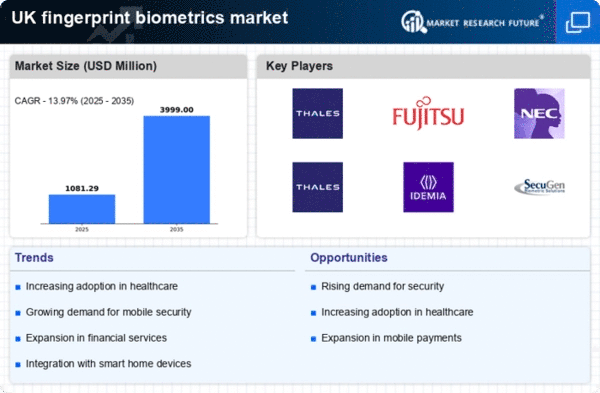
As per Market Research Future analysis, the UK fingerprint biometrics market size was estimated at 948.75 USD Million in 2024. The UK fingerprint biometrics market is projected to grow from 1081.29 USD Million in 2025 to 3999.0 USD Million by 2035, exhibiting a compound annual growth rate (CAGR) of 13.9% during the forecast period 2025 - 2035

Key Market Trends & Highlights

The UK fingerprint biometrics market is experiencing robust growth driven by technological advancements and increasing security concerns.

  • The financial services segment represents the largest share of the UK fingerprint biometrics market, reflecting a strong demand for secure transaction methods.
  • Mobile device integration is the fastest-growing segment, as consumers increasingly prefer biometric authentication for convenience and security.
  • Regulatory compliance and data privacy are becoming critical factors influencing market dynamics, prompting organizations to adopt biometric solutions.
  • Rising security concerns and consumer demand for convenience are key drivers propelling the growth of the UK fingerprint biometrics market.

Market Size & Forecast

2024 Market Size 948.75 (USD Million)
2035 Market Size 3999.0 (USD Million)
CAGR (2025 - 2035) 13.97%

Major Players

Thales (FR), Fujitsu (JP), NEC Corporation (JP), Gemalto (NL), IDEMIA (FR), SecuGen (US), Crossmatch (US), MorphoTrust (US), BIO-key International (US)

Our Impact
Enabled $4.3B Revenue Impact for Fortune 500 and Leading Multinationals
Partnering with 2000+ Global Organizations Each Year
30K+ Citations by Top-Tier Firms in the Industry

UK Fingerprint Biometrics Market Trends

The fingerprint biometrics market is currently experiencing a notable evolution, driven by advancements in technology and increasing demand for secure identification methods. As organizations across various sectors recognize the importance of safeguarding sensitive information, the adoption of fingerprint biometrics has surged. This technology offers a reliable solution for access control, time and attendance tracking, and identity verification. The integration of biometric systems into mobile devices and financial services further enhances their appeal, as consumers seek convenient yet secure methods for transactions and personal identification. Moreover, the regulatory landscape in the UK is evolving to accommodate the growing use of biometric technologies. Government initiatives aimed at enhancing security measures in public and private sectors are likely to bolster the fingerprint biometrics market. The emphasis on data protection and privacy is also shaping the development of these systems, as stakeholders strive to balance security needs with individual rights. As the market continues to mature, innovations in fingerprint recognition technology, such as improved algorithms and sensor capabilities, are expected to drive further growth and adoption across diverse applications.

Increased Adoption in Financial Services

The fingerprint biometrics market is witnessing a rise in adoption within the financial services sector. Institutions are increasingly implementing biometric authentication to enhance security for online banking and transactions. This trend reflects a broader shift towards digital solutions that prioritize user convenience while ensuring robust protection against fraud.

Integration with Mobile Devices

There is a growing trend of integrating fingerprint biometrics into mobile devices. Manufacturers are incorporating advanced biometric sensors into smartphones and tablets, allowing users to unlock devices and authorize transactions seamlessly. This integration not only enhances user experience but also reinforces security measures in personal technology.

Regulatory Compliance and Data Privacy

The fingerprint biometrics market is influenced by evolving regulations concerning data privacy and security. Organizations are compelled to adopt biometric solutions that comply with stringent legal frameworks. This trend underscores the importance of developing systems that not only provide security but also respect individual privacy rights.

UK Fingerprint Biometrics Market Drivers

Rising Security Concerns

The fingerprint biometrics market is experiencing a surge in demand due to escalating security concerns across various sectors in the UK. With increasing incidents of identity theft and cybercrime, organizations are prioritizing robust security measures. The biometric authentication method, particularly fingerprint recognition, offers a reliable solution to mitigate these risks. In 2025, the market is projected to grow at a CAGR of approximately 15%, driven by the need for enhanced security protocols. Businesses are investing in fingerprint biometrics to protect sensitive data and ensure secure access to facilities. This trend is particularly evident in sectors such as banking, healthcare, and government, where safeguarding personal information is paramount. As security threats evolve, the fingerprint biometrics market is likely to expand further, providing innovative solutions to meet the demands of a security-conscious society.

Technological Advancements

Technological advancements play a pivotal role in shaping the fingerprint biometrics market. Innovations in sensor technology, algorithms, and data processing capabilities are enhancing the accuracy and speed of fingerprint recognition systems. In the UK, the integration of artificial intelligence and machine learning into biometric systems is revolutionizing the industry. These advancements not only improve the user experience but also increase the reliability of fingerprint authentication. The market is witnessing a shift towards multi-modal biometric systems, which combine fingerprint recognition with other biometric modalities for enhanced security. As technology continues to evolve, the fingerprint biometrics market is expected to see a significant increase in adoption rates, particularly in sectors that require high-security measures. By 2025, the market could potentially reach a valuation of £3 billion, reflecting the growing reliance on advanced biometric solutions.

Integration with IoT Devices

The integration of fingerprint biometrics with Internet of Things (IoT) devices is emerging as a key driver for the market. As the IoT ecosystem expands, the need for secure authentication methods becomes increasingly critical. Fingerprint biometrics offers a reliable solution for securing access to various IoT applications, from smart home devices to industrial automation systems. In the UK, the adoption of smart technologies is on the rise, and consumers are seeking secure ways to manage their connected devices. This trend is likely to propel the fingerprint biometrics market forward, as manufacturers incorporate biometric authentication into their IoT products. By 2025, the market for fingerprint biometrics in IoT applications could potentially account for a substantial share of the overall market, reflecting the growing interconnectivity of devices and the need for enhanced security measures.

Consumer Demand for Convenience

The fingerprint biometrics market is also driven by the growing consumer demand for convenience and seamless user experiences. In an era where speed and efficiency are paramount, consumers are increasingly favoring biometric authentication methods over traditional passwords. The ease of use associated with fingerprint recognition systems is appealing to a wide range of users, from smartphone owners to online banking customers. In the UK, the proliferation of mobile devices equipped with fingerprint sensors is facilitating this trend. As more consumers adopt biometric solutions for everyday transactions, the market is likely to expand significantly. By 2025, it is estimated that over 50% of mobile devices in the UK will incorporate fingerprint biometrics, further solidifying its position in the consumer technology landscape. This shift towards convenience is expected to drive innovation and competition within the fingerprint biometrics market.

Government Initiatives and Funding

Government initiatives and funding are crucial drivers of the fingerprint biometrics market in the UK. The government is increasingly recognizing the importance of biometric technologies in enhancing national security and public safety. Initiatives aimed at modernizing law enforcement and border control systems are leading to substantial investments in fingerprint biometrics. For instance, the UK Home Office has allocated significant resources to upgrade biometric identification systems, which is expected to bolster the market. Additionally, public sector organizations are collaborating with private firms to develop innovative biometric solutions. This partnership is likely to accelerate the deployment of fingerprint biometrics across various applications, including immigration control and criminal identification. As these initiatives gain momentum, the fingerprint biometrics market is poised for growth, with projections indicating a potential increase in market size by 20% over the next five years.


Market Segment Insights

By Type: AFIS Technology (Largest) vs. Non-AFIS Technology (Fastest-Growing)

In the UK fingerprint biometrics market, AFIS Technology holds a significant market share, owing to its established presence in law enforcement and security verification applications. This technology has been widely adopted for its reliability and accuracy in fingerprint matching. On the other hand, Non-AFIS Technology, while currently smaller in market share, is rapidly gaining traction due to advancements in consumer electronics and mobile applications that require efficient biometric verification. Growth trends indicate that Non-AFIS Technology is becoming increasingly popular for personal identification and access control in various sectors, including finance and retail. The rising adoption of mobile devices equipped with fingerprint sensors and the growing demand for enhanced security solutions are key drivers of this segment’s rapid expansion. AFIS Technology continues to dominate, but the innovation within Non-AFIS Technology is poised to disrupt the market dynamics.

Technology: AFIS (Dominant) vs. Non-AFIS (Emerging)

AFIS Technology, which stands for Automated Fingerprint Identification System, remains the dominant player in the UK fingerprint biometrics market due to its extensive use in governmental and institutional applications where security is paramount. It offers robust performance and is trusted for its precision in large-scale fingerprint databases. In contrast, Non-AFIS Technology is emerging as a competitive force, particularly in sectors that prioritize user convenience and quick authentication processes. This technology is designed for integration into mobile devices and consumer products, catering to a younger demographic that values seamless interaction. The growing trend towards IoT and smart devices further bolsters the potential of Non-AFIS solutions, making them essential for future growth in the fingerprint biometrics landscape.

By Offering: Hardware (Largest) vs. Software (Fastest-Growing)

The UK fingerprint biometrics market exhibits a varied distribution among different offerings, with hardware being the predominant segment, accounting for a significant share of the market. This dominance is attributed to the increasing demand for secure authentication solutions across various sectors, including government, finance, and healthcare. Software also holds a substantial market presence, playing a crucial role in enhancing the functionality of fingerprint biometric systems through advanced algorithms and user-friendly interfaces. In terms of growth trends, the software segment is recognized as the fastest-growing, driven by rapid advancements in technology and the rising adoption of biometrics in digital identity verification. The increasing emphasis on enhancing cybersecurity measures further fuels this trend, as organizations seek robust solutions to mitigate risks associated with data breaches and fraudulent activities. Additionally, the rising demand for integrated systems that combine hardware and software solutions is reshaping the landscape of the UK fingerprint biometrics market.

Hardware: Dominant vs. Software: Emerging

The hardware segment remains the dominant force within the UK fingerprint biometrics market, encompassing various devices such as scanners and readers designed for security applications. Its strength lies in the reliability and accuracy of physical devices, which are essential in environments requiring stringent access control. In contrast, the software segment is emerging rapidly, driven by innovations in machine learning and artificial intelligence that enhance fingerprint recognition accuracy and speed. This segment's growth is spurred by increasing deployment in mobile devices and cloud-based solutions, making biometric services more accessible and versatile. The synergy between hardware and software is pivotal, as the integration of these elements leads to comprehensive biometric systems that cater to the growing demand for security in both physical and digital spaces.

By End User: BFSI (Largest) vs. Healthcare (Fastest-Growing)

The UK fingerprint biometrics market exhibits varied distribution among its end users, with the BFSI segment holding the largest share. This segment's extensive adoption is driven by the growing need for secure transaction methods. Government and defense sectors also contribute significantly, alongside IT and telecom, which leverage biometrics for user authentication and security enhancements. The automotive and healthcare sectors are gradually increasing their market presence as awareness about biometric solutions rises. Growth trends show that the healthcare sector is the fastest growing within the UK fingerprint biometrics market, fueled by the demand for patient identification solutions and data protection measures. As technology continues to evolve, various sectors are likely to increase investments in biometric systems, promoting growth across the board. Factors such as rising security threats and the increased need for seamless identification processes are driving this expansion.

BFSI (Dominant) vs. Healthcare (Emerging)

The BFSI sector remains dominant in the UK fingerprint biometrics market due to its critical reliance on secure transaction and user verification systems. Financial institutions are integrating biometric authentication to mitigate fraud and enhance customer trust, making it a major player for market stability. The healthcare sector, emerging rapidly, focuses on patient safety and efficient identification processes. As patient data security becomes increasingly paramount, healthcare providers are adopting biometric solutions to streamline operations and ensure regulatory compliance. The contrasting positions of these segments highlight the BFSI's established presence against healthcare's dynamic growth, paired with innovative solutions that cater to evolving security needs.

Get more detailed insights about UK Fingerprint Biometrics Market

Key Players and Competitive Insights

The fingerprint biometrics market is currently characterized by a dynamic competitive landscape, driven by technological advancements and increasing demand for secure identification solutions. Key players such as Thales (France), IDEMIA (France), and Fujitsu (Japan) are at the forefront, each adopting distinct strategies to enhance their market positioning. Thales (France) emphasizes innovation through continuous investment in R&D, focusing on integrating biometric solutions with advanced security systems. IDEMIA (France) leverages its expertise in identity verification to expand its offerings, particularly in mobile biometrics, while Fujitsu (Japan) is concentrating on regional expansion and partnerships to enhance its service delivery in the UK.The market structure appears moderately fragmented, with several players competing for market share. Key tactics such as localizing manufacturing and optimizing supply chains are prevalent among these companies, allowing them to respond swiftly to market demands and regulatory changes. The collective influence of these major players shapes a competitive environment where innovation and operational efficiency are paramount.

In September IDEMIA (France) announced a strategic partnership with a leading telecommunications provider to enhance mobile biometric authentication services. This collaboration is poised to significantly improve user experience and security in mobile transactions, reflecting IDEMIA's commitment to integrating biometric technology into everyday applications. The strategic importance of this partnership lies in its potential to capture a larger share of the growing mobile payment market, which is increasingly reliant on secure identification methods.

In October Thales (France) unveiled a new biometric identification platform designed for law enforcement agencies, which incorporates advanced AI algorithms for real-time identification. This development underscores Thales's focus on innovation and its intent to address the specific needs of public safety sectors. The introduction of this platform is likely to enhance operational efficiency for law enforcement, thereby solidifying Thales's position as a leader in the biometric space.Moreover, in August 2025, Fujitsu (Japan) expanded its biometric solutions portfolio by launching a new line of fingerprint scanners tailored for healthcare applications. This move not only diversifies Fujitsu's offerings but also aligns with the growing demand for secure patient identification in healthcare settings. The strategic importance of this launch lies in its potential to address critical security challenges faced by healthcare providers, thereby enhancing patient safety and data integrity.

As of November the competitive trends in the fingerprint biometrics market are increasingly defined by digitalization, AI integration, and a focus on sustainability. Strategic alliances are becoming more prevalent, as companies recognize the need to collaborate to enhance their technological capabilities and market reach. Looking ahead, competitive differentiation is likely to evolve from traditional price-based competition to a focus on innovation, technology integration, and supply chain reliability. This shift suggests that companies will need to invest in cutting-edge technologies and sustainable practices to maintain a competitive edge in this rapidly evolving market.

Key Companies in the UK Fingerprint Biometrics Market include

Industry Developments

The UK Fingerprint Biometrics Market is experiencing significant advancements, with companies like IDEMIA, Fingerprint Cards, and Thales leading innovations in secure identification technologies. In March 2023, Gemalto announced a collaboration with UK law enforcement agencies to enhance the security and efficiency of identification processes, addressing growing concerns related to seamless identity verification. Notable growth was observed in the market valuation of M2SYS Technology and SecuGen, driven by their expanding portfolios of biometric solutions designed for various sectors, including financial services and healthcare.

Additionally, in February 2023, Aurora disclosed its acquisition of BioKeys, allowing them to integrate advanced biometric technologies into their platforms, substantiating their commitment to capitalizing on emerging market trends. Over the past two to three years, a notable market shift towards mobile biometric solutions has been reported, particularly with Zebra Technologies launching updated scanners equipped with fingerprint recognition capabilities. This trend is compounded by the UK's emphasis on enhancing its technological infrastructure, including a focus on cybersecurity, thus embedding biometrics as a vital element within government and commercial sectors.

The overall dynamics signal a robust growth trajectory for the UK Fingerprint Biometrics Market amidst increasing demands for security and authentication.

Future Outlook

UK Fingerprint Biometrics Market Future Outlook

The Fingerprint Biometrics Market is projected to grow at 13.97% CAGR from 2025 to 2035, driven by advancements in security technology, increasing demand for mobile authentication, and regulatory compliance.

New opportunities lie in:

  • Integration of biometric systems in smart home devices
  • Development of biometric payment solutions for retail
  • Expansion of biometric access control in corporate environments

By 2035, the market is expected to achieve substantial growth, driven by innovation and increased adoption.

Market Segmentation

UK Fingerprint Biometrics Market Type Outlook

  • AFIS Technology
  • Non-AFIS Technology

UK Fingerprint Biometrics Market End User Outlook

  • IT and Telecom
  • Government and Defense
  • Automotive
  • BFSI
  • Healthcare
  • Others

UK Fingerprint Biometrics Market Offering Outlook

  • Hardware
  • Software
  • Services

Report Scope

MARKET SIZE 2024 948.75(USD Million)
MARKET SIZE 2025 1081.29(USD Million)
MARKET SIZE 2035 3999.0(USD Million)
COMPOUND ANNUAL GROWTH RATE (CAGR) 13.97% (2025 - 2035)
REPORT COVERAGE Revenue Forecast, Competitive Landscape, Growth Factors, and Trends
BASE YEAR 2024
Market Forecast Period 2025 - 2035
Historical Data 2019 - 2024
Market Forecast Units USD Million
Key Companies Profiled Thales (FR), Fujitsu (JP), NEC Corporation (JP), Gemalto (NL), IDEMIA (FR), SecuGen (US), Crossmatch (US), MorphoTrust (US), BIO-key International (US)
Segments Covered Type, Offering, End User
Key Market Opportunities Integration of advanced artificial intelligence in fingerprint biometrics enhances security and user experience.
Key Market Dynamics Rising demand for secure authentication drives innovation and competition in the fingerprint biometrics market.
Countries Covered UK
Leave a Comment

FAQs

What is the projected market size of the UK Fingerprint Biometrics Market in 2024?

The UK Fingerprint Biometrics Market is expected to be valued at 1.58 USD Billion in 2024.

What will the market value of the UK Fingerprint Biometrics Market be in 2035?

By 2035, the UK Fingerprint Biometrics Market is projected to reach a value of 6.28 USD Billion.

What is the expected compound annual growth rate (CAGR) for the UK Fingerprint Biometrics Market from 2025 to 2035?

The expected CAGR for the UK Fingerprint Biometrics Market from 2025 to 2035 is 13.353%.

What is the market size for AFIS Technology in the UK Fingerprint Biometrics Market in 2024?

In 2024, the AFIS Technology segment of the UK Fingerprint Biometrics Market is valued at 0.64 USD Billion.

What will the market size for Non-AFIS Technology be in 2035?

The Non-AFIS Technology segment of the UK Fingerprint Biometrics Market is expected to reach 3.72 USD Billion by 2035.

Who are some of the key players in the UK Fingerprint Biometrics Market?

Key players in the UK Fingerprint Biometrics Market include Aurora, Gemalto, Fingerprint Cards, Thales, and IDEMIA.

What market share does the AFIS Technology hold in 2024?

The AFIS Technology segment will have a share of 0.64 USD Billion of the total market size in 2024.

How significant is the growth of the Non-AFIS Technology segment up to 2035?

The Non-AFIS Technology segment is expected to grow significantly, reaching 3.72 USD Billion by 2035.

What are some emerging trends in the UK Fingerprint Biometrics Market?

Emerging trends in the UK Fingerprint Biometrics Market include the adoption of advanced authentication methods and increased demand in security applications.

What challenges could impact the growth of the UK Fingerprint Biometrics Market?

Challenges could include technical limitations and privacy concerns regarding biometric data management.

Download Free Sample

Kindly complete the form below to receive a free sample of this Report

Compare Licence

×
Features License Type
Single User Multiuser License Enterprise User
Price $4,950 $5,950 $7,250
Maximum User Access Limit 1 User Upto 10 Users Unrestricted Access Throughout the Organization
Free Customization
Direct Access to Analyst
Deliverable Format
Platform Access
Discount on Next Purchase 10% 15% 15%
Printable Versions