×
Request Free Sample ×

Kindly complete the form below to receive a free sample of this Report

* Please use a valid business email

Leading companies partner with us for data-driven Insights

clients tt-cursor
Hero Background

UK Fertility Services Market

ID: MRFR/HC/43234-HCR
200 Pages
Rahul Gotadki
February 2026

UK Fertility Services Market Research Report: Size, Share, Trend Analysis By Underlying Cause (Male Infertility, Female Infertility) and By Treatment Type (ART, Infertility Drugs) - Growth Outlook & Industry Forecast 2025 To 2035

Share:
Download PDF ×

We do not share your information with anyone. However, we may send you emails based on your report interest from time to time. You may contact us at any time to opt-out.

UK Fertility Services Market Infographic
Purchase Options

UK Fertility Services Market Summary

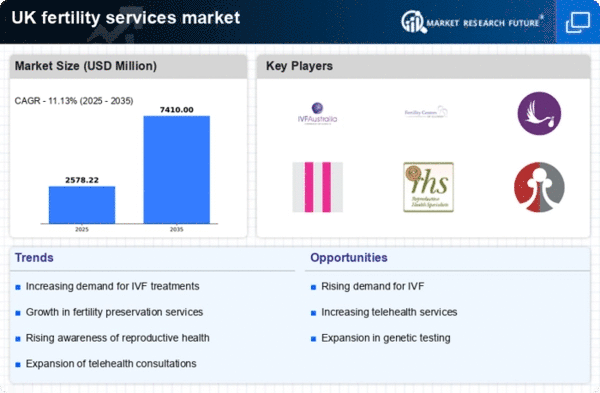
As per Market Research Future analysis, the UK fertility services market size was estimated at 2320.0 $ Million in 2024. The UK fertility services market is projected to grow from 2578.22 $ Million in 2025 to 7410.0 $ Million by 2035, exhibiting a compound annual growth rate (CAGR) of 11.1% during the forecast period 2025 - 2035

Key Market Trends & Highlights

The UK fertility services market is experiencing a transformative shift driven by technological advancements and changing societal norms.

  • Technological advancements are enhancing treatment efficacy and patient outcomes in the UK fertility services market.
  • The largest segment in the market is in vitro fertilization (IVF), while the fastest-growing segment is egg freezing services.
  • Increased accessibility to fertility treatments is evident, with more clinics opening across urban and rural areas.
  • Rising infertility rates and government initiatives are key drivers propelling the growth of the UK fertility services market.

Market Size & Forecast

2024 Market Size 2320.0 (USD Million)
2035 Market Size 7410.0 (USD Million)
CAGR (2025 - 2035) 11.13%

Major Players

IVF Australia (AU), Fertility Centers of Illinois (US), New Hope Fertility Center (US), CCRM Fertility (US), Reproductive Health Specialists (US), Boston IVF (US), The Fertility Institute (US), Clinica Santa Maria (ES)

Our Impact
Enabled $4.3B Revenue Impact for Fortune 500 and Leading Multinationals
Partnering with 2000+ Global Organizations Each Year
30K+ Citations by Top-Tier Firms in the Industry

UK Fertility Services Market Trends

The fertility services market is currently experiencing notable transformations, driven by advancements in medical technology and evolving societal attitudes towards family planning. Increasing awareness of reproductive health issues has led to a rise in demand for various fertility treatments, including in vitro fertilization (IVF) and egg freezing. As individuals and couples seek to delay parenthood for personal or professional reasons, the market is adapting to meet these changing needs. Furthermore, the integration of telemedicine into fertility services is enhancing accessibility, allowing patients to consult with specialists remotely, which may improve treatment outcomes and patient satisfaction. In addition, the fertility services market is witnessing a growing emphasis on personalized treatment plans. Clinics are increasingly utilizing genetic testing and other diagnostic tools to tailor interventions to individual patients. This trend not only aims to improve success rates but also addresses the emotional and psychological aspects of fertility challenges. As the landscape continues to evolve, stakeholders in the fertility services market must remain attuned to these shifts to effectively cater to the diverse needs of their clientele.

Technological Advancements

The fertility services market is benefiting from rapid technological innovations, particularly in areas such as embryo selection and cryopreservation techniques. These advancements enhance the effectiveness of treatments, potentially leading to higher success rates and improved patient experiences.

Increased Accessibility

There is a noticeable trend towards greater accessibility in the fertility services market, driven by the rise of telehealth solutions. Patients can now access consultations and follow-up care remotely, which may reduce barriers to treatment and expand the reach of services.

Personalized Treatment Approaches

The focus on personalized medicine is becoming more pronounced within the fertility services market. Clinics are increasingly employing genetic testing and tailored treatment plans to address the unique needs of patients, thereby improving overall outcomes.

UK Fertility Services Market Drivers

Changing Societal Norms

Shifts in societal norms regarding family planning and childbearing are influencing the fertility services market in the UK. More individuals are prioritizing career development and personal goals before starting families, leading to delayed parenthood. This trend has resulted in a higher demand for fertility services, as older parents may face increased challenges in conceiving. Data suggests that the average age of first-time mothers has risen to 30.7 years, which may contribute to a growing reliance on assisted reproductive technologies. The fertility services market is adapting to these changes, offering tailored solutions that cater to the evolving needs of prospective parents.

Rising Infertility Rates

The fertility services market in the UK is experiencing growth due to rising infertility rates among couples. Recent data indicates that approximately 1 in 7 couples face difficulties conceiving, which translates to around 3.5 million people affected. This trend is likely to drive demand for fertility services, as individuals seek medical assistance to overcome reproductive challenges. Factors contributing to infertility include lifestyle choices, delayed parenthood, and medical conditions. As awareness of these issues increases, more couples are turning to fertility clinics for support, thereby expanding the market. The fertility services market is poised to benefit from this growing need, as healthcare providers enhance their offerings to cater to a larger demographic seeking assistance with conception.

Increased Awareness and Education

The fertility services market in the UK is benefiting from increased awareness and education surrounding reproductive health. Public discussions and educational programs are helping to destigmatize infertility, encouraging individuals to seek help sooner. Surveys indicate that nearly 60% of the population is now aware of available fertility treatments, a significant increase from previous years. This heightened awareness is likely to lead to greater utilization of fertility services, as more people understand their options. The fertility services market is thus positioned for growth, as educational initiatives continue to empower individuals to take charge of their reproductive health.

Government Initiatives and Funding

Government initiatives aimed at improving reproductive health are playing a crucial role in the fertility services market in the UK. The National Health Service (NHS) has been increasing funding for fertility treatments, with reports indicating that over £200 million is allocated annually to support assisted reproductive technologies. This financial backing not only makes treatments more accessible but also encourages clinics to expand their services. Furthermore, public health campaigns aimed at educating the population about fertility issues are likely to increase awareness and utilization of available services. As a result, the fertility services market is expected to grow, driven by enhanced public support and funding for reproductive health services.

Advancements in Reproductive Technologies

Innovations in reproductive technologies are significantly impacting the fertility services market in the UK. Techniques such as in vitro fertilization (IVF), preimplantation genetic testing (PGT), and cryopreservation are becoming more sophisticated and widely available. The market for IVF alone is projected to reach £1.5 billion by 2026, reflecting a growing acceptance and reliance on these advanced methods. As technology continues to evolve, clinics are likely to offer more effective and efficient treatments, attracting a broader clientele. The fertility services market is thus positioned to thrive, as patients increasingly seek out cutting-edge solutions to their fertility challenges.


Market Segment Insights

By Treatment Type: In Vitro Fertilization (Largest) vs. Intracytoplasmic Sperm Injection (Fastest-Growing)

In the UK fertility services market, In Vitro Fertilization (IVF) is the largest treatment type, commanding a significant share due to its widespread recognition and efficacy. Following IVF, Intracytoplasmic Sperm Injection (ICSI) is becoming increasingly relevant, particularly among couples facing male infertility issues. This treatment complements IVF and captures a growing segment of the population seeking assisted reproductive technologies. Other treatment types such as Artificial Insemination, Donor Egg, and Surrogacy hold smaller shares but play essential roles in meeting diverse patient needs. The growth trends in this segment reflect advancements in reproductive technologies and changing societal attitudes towards fertility treatments. The rising acceptance of assisted reproductive methods combined with increased awareness and access to these services drives demand for IVF and ICSI. Furthermore, factors such as the aging population and improved success rates of treatments position these segments as key players in the evolving landscape of fertility services in the UK.

In Vitro Fertilization (Dominant) vs. Intracytoplasmic Sperm Injection (Emerging)

In Vitro Fertilization (IVF) continues to dominate the UK fertility services market, largely due to its established track record and high success rates. IVF is recognized for its effectiveness in treating various infertility issues, making it the go-to choice for many couples. As a comprehensive treatment option, it offers patients a structured approach to overcome fertility challenges. In contrast, Intracytoplasmic Sperm Injection (ICSI) is emerging as a critical procedure, addressing specific reproductive challenges, particularly those related to male infertility. As more patients become aware of ICSI's capabilities and its role as a complement to IVF, its adoption is rapidly increasing, making it a significant focus within the evolving fertility treatment landscape.

By Patient Type: Female Infertility (Largest) vs. Male Infertility (Fastest-Growing)

In the UK fertility services market, Female Infertility is the largest segment, commanding a significant share due to higher awareness and societal acceptance of female infertility treatments. This segment is characterized by robust demand for assisted reproduction technologies and a variety of treatments targeting female reproductive health issues, leading to a considerable portion of overall market transactions. Conversely, Male Infertility is emerging as the fastest-growing segment within the market. An increasing recognition of male fertility issues and changing social perceptions are driving growth in this area. Moreover, advancements in treatments and technologies aimed explicitly at male infertility contribute to the rising demand, showcasing a notable shift towards inclusivity in fertility services in the UK.

Female Infertility: Dominant vs. Male Infertility: Emerging

Female Infertility remains the dominant segment within the UK fertility services market, largely due to the growing emphasis on female reproductive health and technological advancements in IVF and hormonal therapies. This segment benefits from a wealth of treatment options and is supported by a strong societal focus on addressing female infertility. In contrast, Male Infertility, while currently an emerging segment, is gaining momentum with increasing awareness of male reproductive health issues and the availability of targeted treatments. The market is seeing innovative solutions specifically designed for male patients, which enhances their chances of successful conception. This shift indicates a dynamic evolution in patient types seeking fertility services, pointing towards a more balanced approach in addressing infertility challenges faced by both genders.

By End User: Fertility Clinics (Largest) vs. Hospitals (Fastest-Growing)

In the UK fertility services market, the segment of Fertility Clinics holds the largest share among the end users. These clinics have become the primary destination for couples seeking fertility treatments, significantly dominating the landscape due to their specialization and advanced technology. Hospitals, while they have a notable presence, are gradually losing share in comparison, as more patients prefer the focused services provided by dedicated fertility clinics. Growth trends indicate a shift towards personalized fertility treatments, leading to a rise in the number of fertility clinics, which capitalizes on this demand. Conversely, hospitals are adapting to include more fertility services, though their growth is mainly driven by the integration of advanced reproductive technologies and partnerships with fertility specialists, marking them as the fastest-growing segment in the market.

Fertility Clinics (Dominant) vs. Hospitals (Emerging)

Fertility Clinics are characterized by their specialized focus on reproductive health services, offering a wide range of treatments such as IVF, IUI, and egg freezing. These clinics often boast state-of-the-art technology and highly trained professionals, making them the go-to choice for patients seeking quality care for fertility issues. Their dominant market position stems from their ability to provide personalized care and advanced methodologies that enhance success rates in fertility treatments. On the other hand, Hospitals are emerging in this sector by expanding their reproductive health offerings, often integrating new technologies and forming alliances with fertility specialists. Although they serve a broader healthcare function, their entry into fertility services is resulting in innovative approaches that appeal to a different demographic seeking comprehensive medical care.

By Service Type: Consultation Services (Largest) vs. Treatment Services (Fastest-Growing)

In the UK fertility services market, Consultation Services hold the largest market share, dominating the segment due to their critical role in initial assessments and guiding patients through the fertility journey. This segment's established reputation and trust contribute significantly to its leading position, appealing to prospective parents looking for reliable support. On the other hand, Treatment Services, which encompass a range of assisted reproductive technologies, are emerging as the fastest-growing segment. The increasing demand for effective fertility solutions is driving growth in this area, as more couples seek advanced medical interventions. Growth trends in the UK fertility services market highlight a rising awareness of fertility issues and an increasing societal acceptance of assisted reproductive technologies. A growing number of patients are now open to pursuing diverse treatment options, leading to the rapid expansion of Treatment Services. Furthermore, advancements in technology and better success rates are encouraging more individuals to seek professional assistance sooner in their family planning journeys, thereby fueling the overall demand across all service types.

Consultation Services (Dominant) vs. Treatment Services (Emerging)

Consultation Services in the UK fertility services market are characterized by their pivotal role in patient engagement and care management. They provide essential initial evaluations, personalized guidance, and expert recommendations, making them a dominant force in the sector. As the first point of contact for individuals experiencing fertility challenges, these services build a solid foundation of trust and support. In contrast, Treatment Services, representing cutting-edge reproductive technologies and methods, are emerging rapidly as they adapt to evolving patient needs and expectations. With ongoing innovations and improved outcomes, Treatment Services are appealing to a broader audience, particularly as public awareness and accessibility to these options increase. This dynamic creates a competitive landscape where both services complement each other, catering to the complete spectrum of fertility care.

Get more detailed insights about UK Fertility Services Market

Key Players and Competitive Insights

The fertility services market in the UK is characterized by a dynamic competitive landscape, driven by increasing demand for assisted reproductive technologies and a growing awareness of fertility issues. Key players are actively engaging in strategic initiatives to enhance their market positioning. For instance, CCRM Fertility (US) has focused on expanding its service offerings through innovative treatment protocols and personalized care, which appears to resonate well with patients seeking tailored solutions. Meanwhile, IVF Australia (AU) has been investing in digital transformation, enhancing its online presence and telehealth services to improve patient accessibility and engagement. These strategies collectively contribute to a competitive environment that emphasizes patient-centric care and technological advancement.
In terms of business tactics, companies are increasingly localizing their operations to better serve regional markets, which may optimize supply chains and reduce operational costs. The market structure is moderately fragmented, with several key players holding significant market shares while numerous smaller clinics operate in niche segments. This fragmentation allows for diverse service offerings, yet the influence of major players like Boston IVF (US) and New Hope Fertility Center (US) remains substantial, as they set benchmarks for quality and innovation.
In October 2025, Boston IVF (US) announced a partnership with a leading biotechnology firm to develop next-generation embryo screening technologies. This strategic move is likely to enhance their service offerings, potentially increasing success rates for patients undergoing IVF treatments. By integrating advanced genetic testing into their protocols, Boston IVF positions itself at the forefront of innovation, which could attract a broader patient base seeking higher success rates.
In September 2025, New Hope Fertility Center (US) launched a new initiative aimed at increasing awareness and accessibility of fertility preservation options for cancer patients. This initiative not only addresses a critical need but also aligns with the growing trend of personalized healthcare. By focusing on this demographic, New Hope Fertility Center may strengthen its market position and enhance its reputation as a leader in compassionate care.
In November 2025, IVF Australia (AU) unveiled a comprehensive digital platform designed to streamline patient interactions and provide educational resources about fertility treatments. This digital initiative reflects a broader trend towards digitalization in healthcare, which is becoming increasingly important in enhancing patient experience and operational efficiency. By prioritizing technology, IVF Australia is likely to improve patient retention and satisfaction, further solidifying its competitive edge.
As of November 2025, the competitive trends in the fertility solutions market are increasingly defined by digitalization, sustainability, and the integration of artificial intelligence in treatment protocols. Strategic alliances among key players are shaping the landscape, fostering innovation and enhancing service delivery. Looking ahead, it appears that competitive differentiation will increasingly pivot from price-based strategies to those centered on technological innovation, patient experience, and supply chain reliability. This shift may redefine how companies compete, emphasizing the importance of quality and advanced solutions in attracting and retaining patients.

Key Companies in the UK Fertility Services Market include

Industry Developments

The UK Fertility Services Market has seen notable developments recently, reflecting advancements and shifts within the sector. In October 2023, The Fertility Partnership announced an expansion of its services to accommodate the increasing demand for assisted reproductive technologies, indicating a positive trend in service uptake. Liverpool Women's Hospital and St Mary’s Hospital have reported improvements in patient outcomes due to the introduction of innovative fertility treatments over the last two years. Additionally, Care Fertility and IVF England are experiencing steady growth, supported by a rise in public awareness regarding fertility treatment options.

Notably, in September 2023, Manchester Fertility and City Fertility engaged in a collaborative project aimed at integrating advanced techniques to enhance patient experiences.

The UK government has supported these advancements by increasing funding for fertility research, which has stimulated market growth. While no recent mergers or acquisitions involving the specified companies have been publicly reported, the overall market valuation reflects a stronger position due to heightened demand and evolving treatment methodologies. This surge is driven by changing societal attitudes towards fertility, fostering a conducive environment for both patients and providers within the UK Fertility Services Market landscape.

Future Outlook

UK Fertility Services Market Future Outlook

The Fertility Services Market is projected to grow at 11.13% CAGR from 2025 to 2035, driven by technological advancements, increasing awareness, and rising infertility rates.

New opportunities lie in:

  • Expansion of telehealth services for remote consultations and follow-ups.
  • Development of personalized fertility treatment plans using AI analytics.
  • Investment in cryopreservation technologies for long-term storage solutions.

By 2035, the market is expected to achieve substantial growth, driven by innovation and increased accessibility.

Market Segmentation

UK Fertility Services Market End User Outlook

  • Fertility Clinics
  • Hospitals
  • Home Care

UK Fertility Services Market Patient Type Outlook

  • Female Infertility
  • Male Infertility
  • Couples with Unexplained Infertility
  • Same-Sex Couples
  • Single Parents

UK Fertility Services Market Service Type Outlook

  • Consultation Services
  • Diagnostic Services
  • Treatment Services

UK Fertility Services Market Treatment Type Outlook

  • In Vitro Fertilization
  • Intracytoplasmic Sperm Injection
  • Artificial Insemination
  • Donor Egg
  • Surrogacy

Report Scope

MARKET SIZE 2024 2320.0(USD Million)
MARKET SIZE 2025 2578.22(USD Million)
MARKET SIZE 2035 7410.0(USD Million)
COMPOUND ANNUAL GROWTH RATE (CAGR) 11.13% (2025 - 2035)
REPORT COVERAGE Revenue Forecast, Competitive Landscape, Growth Factors, and Trends
BASE YEAR 2024
Market Forecast Period 2025 - 2035
Historical Data 2019 - 2024
Market Forecast Units USD Million
Key Companies Profiled IVF Australia (AU), Fertility Centers of Illinois (US), New Hope Fertility Center (US), CCRM Fertility (US), Reproductive Health Specialists (US), Boston IVF (US), The Fertility Institute (US), Clinica Santa Maria (ES)
Segments Covered Treatment Type, Patient Type, End User, Service Type
Key Market Opportunities Integration of advanced genetic testing technologies enhances personalized fertility treatment options.
Key Market Dynamics Rising demand for advanced reproductive technologies drives innovation and competition in the fertility services market.
Countries Covered UK
Leave a Comment

FAQs

What is the expected market size of the UK Fertility Services Market in 2024?

The UK Fertility Services Market is expected to be valued at 1.94 billion USD in 2024.

What is the projected market size for the UK Fertility Services Market by 2035?

By 2035, the market is projected to reach a value of 5.94 billion USD.

What is the expected compound annual growth rate (CAGR) for the UK Fertility Services Market from 2025 to 2035?

The expected CAGR for the market from 2025 to 2035 is 10.728 percent.

Which segment of the market has a higher projected value in 2024, male infertility or female infertility?

In 2024, the female infertility segment is projected to be valued at 1.26 billion USD, compared to 0.68 billion USD for male infertility.

What will be the market value for male infertility services by 2035?

The male infertility segment is expected to reach a value of 2.05 billion USD by 2035.

What will be the projected market value for female infertility services by 2035?

By 2035, the market value for female infertility services is anticipated to be 3.89 billion USD.

Who are some of the key players in the UK Fertility Services Market?

Key players in the market include The Fertility Partnership, Liverpool Women's Hospital, and Care Fertility among others.

What are the main drivers contributing to the growth of the UK Fertility Services Market?

Key growth drivers include increasing awareness of fertility treatments and advancements in reproductive technologies.

What is the expected market growth rate for the UK Fertility Services Market across the forecast period?

The market is expected to grow significantly at a rate of 10.728 percent from 2025 to 2035.

Is there a significant demand for fertility services in specific regions of the UK?

Yes, there is a notable demand for fertility services in urban areas, reflecting higher access to specialized care.

Download Free Sample

Kindly complete the form below to receive a free sample of this Report

Compare Licence

×
Features License Type
Single User Multiuser License Enterprise User
Price $4,950 $5,950 $7,250
Maximum User Access Limit 1 User Upto 10 Users Unrestricted Access Throughout the Organization
Free Customization
Direct Access to Analyst
Deliverable Format
Platform Access
Discount on Next Purchase 10% 15% 15%
Printable Versions