×
Request Free Sample ×

Kindly complete the form below to receive a free sample of this Report

* Please use a valid business email

Leading companies partner with us for data-driven Insights

clients tt-cursor
Hero Background

UK Federal Edge Computing Market

ID: MRFR/ICT/58590-HCR
200 Pages
Garvit Vyas
February 2026

UK Federal Edge Computing Market Research Report By Component (Hardware, Software, Services), By Application (Smart Cities, Industrial Internet of Things (IoT), Remote Monitoring, Content Delivery, Augmented Reality (AR), Virtual Reality (VR), Others), and By Organization Size (Large Enterprises, SMEs)- Forecast to 2035

Share:
Download PDF ×

We do not share your information with anyone. However, we may send you emails based on your report interest from time to time. You may contact us at any time to opt-out.

UK Federal Edge Computing Market Infographic
Purchase Options

UK Federal Edge Computing Market Summary

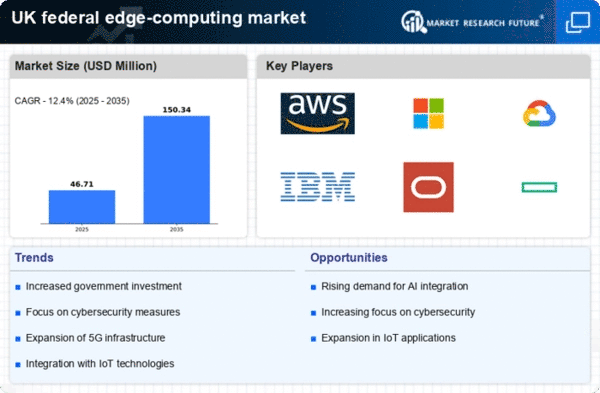
As per Market Research Future analysis, the UK federal edge-computing market Size was estimated at 41.56 USD Million in 2024. The UK federal edge-computing market is projected to grow from 46.71 USD Million in 2025 to 150.34 USD Million by 2035, exhibiting a compound annual growth rate (CAGR) of 12% during the forecast period 2025 - 2035

Key Market Trends & Highlights

The UK federal edge-computing market is experiencing robust growth driven by technological advancements and increasing demand for real-time data processing.

  • The largest segment in the UK federal edge-computing market is the IoT devices sector, which is witnessing increased adoption across various applications.
  • Investment in infrastructure modernization is a key trend, as organizations seek to enhance their operational capabilities and efficiency.
  • The fastest-growing segment is the AI and machine learning integration, reflecting a shift towards more intelligent edge solutions.
  • Market drivers such as growing demand for real-time data processing and enhanced network reliability and performance are propelling market expansion.

Market Size & Forecast

2024 Market Size 41.56 (USD Million)
2035 Market Size 150.34 (USD Million)
CAGR (2025 - 2035) 12.4%

Major Players

Amazon Web Services (US), Microsoft (US), Google Cloud (US), IBM (US), Oracle (US), Hewlett Packard Enterprise (US), Dell Technologies (US), Cisco Systems (US), Edgewise Networks (US)

Our Impact
Enabled $4.3B Revenue Impact for Fortune 500 and Leading Multinationals
Partnering with 2000+ Global Organizations Each Year
30K+ Citations by Top-Tier Firms in the Industry

UK Federal Edge Computing Market Trends

The federal edge-computing market is currently experiencing a transformative phase, driven by the increasing demand for real-time data processing and analytics. This shift is largely influenced by the need for enhanced operational efficiency and improved decision-making capabilities within government agencies. As organizations seek to leverage data closer to its source, the adoption of edge computing technologies is becoming more prevalent. This trend is further supported by advancements in network infrastructure and the proliferation of IoT devices, which facilitate seamless data transmission and processing at the edge. Moreover, the emphasis on data security and privacy is prompting federal entities to explore edge computing solutions that minimize latency and reduce the risk of data breaches. By processing sensitive information locally, agencies can ensure compliance with stringent regulations while maintaining the integrity of their operations. The ongoing investment in edge computing infrastructure indicates a commitment to modernizing IT frameworks, ultimately leading to more agile and responsive government services. As the landscape evolves, collaboration between public and private sectors will likely play a crucial role in shaping the future of this market.

Increased Adoption of IoT Devices

The rise of IoT devices is significantly influencing the federal edge-computing market. As more devices connect to networks, the need for efficient data processing at the edge becomes critical. This trend is expected to enhance operational capabilities and improve service delivery within government agencies.

Focus on Data Security and Compliance

With growing concerns over data privacy, the federal edge-computing market is witnessing a heightened focus on security measures. Agencies are increasingly adopting edge solutions to ensure compliance with regulations while safeguarding sensitive information from potential breaches.

Investment in Infrastructure Modernization

There is a notable trend towards investing in modernizing infrastructure to support edge computing initiatives. Federal agencies are prioritizing upgrades to their IT frameworks, which is likely to enhance their ability to process data efficiently and respond to emerging challenges.

UK Federal Edge Computing Market Drivers

Increased Focus on Cybersecurity Measures

The heightened focus on cybersecurity measures is a crucial driver in the federal edge-computing market. As cyber threats evolve, UK government agencies are prioritizing the protection of sensitive information. Edge computing offers enhanced security features by processing data closer to its source, thereby reducing the risk of data breaches during transmission. The federal edge-computing market is projected to grow as agencies implement advanced security protocols that leverage edge technologies. This shift is particularly relevant in sectors such as healthcare and finance, where data integrity is paramount. By investing in edge computing solutions, agencies can bolster their cybersecurity posture while ensuring compliance with national security standards. Consequently, the emphasis on cybersecurity is likely to propel the growth of the federal edge-computing market.

Regulatory Compliance and Data Sovereignty

Regulatory compliance and data sovereignty are significant drivers in the federal edge-computing market. UK government agencies are under pressure to adhere to stringent data protection regulations, such as the Data Protection Act and GDPR. These regulations necessitate that sensitive data remains within national borders, which edge computing can facilitate by processing data locally. The federal edge-computing market is expected to benefit from this trend, as agencies seek solutions that ensure compliance while optimizing data management. The market's growth is indicative of a broader shift towards localized data processing, which not only addresses regulatory concerns but also enhances data security. As agencies navigate the complexities of compliance, the demand for edge computing solutions that align with legal requirements is likely to increase.

Enhanced Network Reliability and Performance

Network reliability and performance are increasingly critical in the federal edge-computing market. With the rise of remote operations and the need for uninterrupted service, UK government entities are investing in edge computing solutions that enhance connectivity and reduce latency. The market is projected to grow at a CAGR of 25% over the next five years, driven by the necessity for robust network infrastructures. Edge computing allows data to be processed closer to the source, minimizing delays and ensuring that critical applications remain operational even during network disruptions. This focus on reliability is particularly relevant for sectors such as defense and public safety, where consistent performance is non-negotiable. As a result, the federal edge-computing market is likely to see increased investments aimed at bolstering network capabilities.

Growing Demand for Real-Time Data Processing

The increasing need for real-time data processing is a pivotal driver in the federal edge-computing market. As government agencies in the UK seek to enhance operational efficiency, the ability to process data at the edge becomes crucial. This demand is reflected in the projected growth of the market, which is expected to reach £1.5 billion by 2026. Real-time analytics enable agencies to make informed decisions swiftly, thereby improving service delivery. Furthermore, the integration of edge computing with IoT devices facilitates immediate data collection and analysis, which is essential for applications such as surveillance and emergency response. Consequently, the federal edge-computing market is likely to expand as agencies prioritize technologies that support rapid data processing capabilities.

Advancements in AI and Machine Learning Integration

Advancements in AI and machine learning integration are driving innovation within the federal edge-computing market. The ability to deploy AI algorithms at the edge allows for more efficient data processing and analysis, which is essential for applications such as predictive maintenance and anomaly detection. UK government agencies are increasingly recognizing the potential of these technologies to enhance decision-making processes. The federal edge-computing market is expected to expand as agencies adopt AI-driven solutions that improve operational efficiency and service delivery. This trend is indicative of a broader movement towards intelligent systems that can adapt to changing conditions in real-time. As AI and machine learning continue to evolve, their integration into edge computing is likely to reshape the landscape of the federal edge-computing market.


Market Segment Insights

By Component: Hardware (Largest) vs. Services (Fastest-Growing)

In the UK federal edge-computing market, the component segment showcases a diverse distribution among hardware, software, and services. Hardware currently holds the largest market share, as it forms the backbone of edge computing infrastructure, enabling data processing closer to the source. In contrast, software plays a significant role, facilitating the necessary applications and management tools essential for optimizing edge solutions. Services, while smaller in market share, are rapidly gaining traction due to increasing demand for specialized support and integration, essential to realizing the benefits of edge computing. Examining growth trends within the component segment reveals a clear shift towards services as the fastest-growing sector. This growth is propelled by the need for customization and support, as organizations seek to leverage edge computing capabilities to enhance operational efficiency. Hardware continues to experience steady demand, driven by advancements in technology and the need for robust infrastructure. Meanwhile, the software sector also shows promising growth, particularly as businesses invest in sophisticated applications that can maximize the potential of edge computing. Together, these trends illustrate a dynamic landscape where the relationship between hardware, software, and services is evolving rapidly.

Hardware (Dominant) vs. Services (Emerging)

The hardware segment is the dominant force in the UK federal edge-computing market, primarily because of its foundational role in enabling edge computing solutions. It includes a range of devices such as servers, routers, and other physical components crucial for data processing at the edge. Hardware offers reliability, performance, and scalability essential for federal applications. Conversely, the services segment is emerging as a critical player in this market, focusing on integration, support, and consulting to help organizations transition to edge solutions effectively. This shift reflects a growing realization of the need for tailored approaches, driving demand for services that accommodate specific federal needs. As organizations invest more in technology adoption, the services segment is poised to capture significant growth opportunities.

By Application: Smart Cities (Largest) vs. Industrial Internet of Things (IoT) (Fastest-Growing)

The UK federal edge-computing market exhibits a diverse distribution among its application segments. Smart Cities hold the largest share, driven by the increasing demand for integrated urban services and infrastructure management. Meanwhile, segments such as Industrial IoT are showing robust growth, fueled by the surge in automation and connectivity in manufacturing processes, illustrating a clear trend towards more efficient, technology-driven operations. Growth trends in this market reflect a strong alignment with government initiatives focused on digital transformation and smart infrastructure. The rise of data-driven decision-making and real-time analytics is accelerating adoption across various sectors. These trends indicate that as more organizations invest in edge-computing solutions, the reliance on technologies like AR, VR, and remote monitoring will further intensify, propelling the entire segment forward.

Smart Cities (Dominant) vs. Industrial Internet of Things (IoT) (Emerging)

Smart Cities represent the dominant application within the UK federal edge-computing market, characterized by their reliance on advanced analytics, IoT sensors, and network connectivity to enhance urban living and government services. This segment focuses on optimizing city operations, improving energy management, and facilitating seamless communication between various services. In contrast, the Industrial Internet of Things (IoT) is emerging rapidly, as enterprises leverage edge computing to enhance operational efficiency, predictive maintenance, and supply chain visibility. This segment is gaining traction due to the proliferation of smart devices in industrial settings, with businesses seeking real-time insights to drive productivity and reduce downtime. Both segments demonstrate strong potential for innovation and growth, aligning closely with national priorities in technology adoption.

By Organization Size: Large Enterprises (Largest) vs. SMEs (Fastest-Growing)

In the UK federal edge-computing market, Large Enterprises command a significant share of the overall market, leveraging their extensive resources and established infrastructures to implement advanced edge solutions. These organizations benefit from economies of scale, enabling them to invest heavily in innovative technologies that optimize their operations and enhance service delivery. In contrast, SMEs, while representing a smaller portion of the market, show a notable upward trend in adoption, driven by the need for agile solutions that foster competitiveness and efficiency. Their growth is indicative of a broader shift towards decentralized computing, which smaller firms find increasingly vital. The growth trends within this segment indicate a strong inclination towards digital transformation across both Large Enterprises and SMEs. Factors driving this trend include the necessity for real-time data processing, reduced latency, and improved operational resilience. Large Enterprises are focusing on integrating edge computing into their existing IT strategies, while SMEs are rapidly recognizing its potential to drive innovation without significant capital expenditures. This dynamic is expected to produce a robust competition landscape, as both segments adapt their strategies to capitalize on the emerging opportunities in edge computing.

Large Enterprises (Dominant) vs. SMEs (Emerging)

Large Enterprises in the UK federal edge-computing market are characterized by their substantial investments in technology and infrastructure, allowing them to dominate the space. They typically have dedicated teams focused on integrating edge solutions into their operations, ensuring they maintain a competitive edge. On the other hand, SMEs represent an emerging force, increasingly adopting edge computing to enhance efficiency, cost-effectiveness, and service delivery. These organizations are often more agile and willing to experiment with new technologies, making them quick adaptors of edge solutions. Despite their smaller size, SMEs are becoming critical players in the market, seeking innovative ways to leverage edge computing for growth and differentiation against larger competitors.

Get more detailed insights about UK Federal Edge Computing Market

Key Players and Competitive Insights

The federal edge-computing market is currently characterized by a dynamic competitive landscape, driven by the increasing demand for real-time data processing and enhanced security measures. Major players such as Amazon Web Services (US), Microsoft (US), and IBM (US) are strategically positioning themselves through innovation and partnerships. For instance, Amazon Web Services (US) has focused on expanding its edge services portfolio, while Microsoft (US) emphasizes its hybrid cloud solutions to cater to federal agencies. These strategies collectively enhance their competitive edge, fostering an environment where agility and technological advancement are paramount.
Key business tactics within this market include localizing manufacturing and optimizing supply chains to meet the specific needs of federal clients. The competitive structure appears moderately fragmented, with several key players exerting influence over various segments. This fragmentation allows for a diverse range of solutions, yet the presence of dominant firms like Microsoft (US) and Amazon Web Services (US) suggests a concentration of market power that could shape future developments.
In September 2025, Microsoft (US) announced a strategic partnership with a leading cybersecurity firm to enhance its edge-computing security offerings. This move is significant as it not only strengthens Microsoft's position in the federal sector but also addresses growing concerns regarding data security and compliance. By integrating advanced security features into its edge solutions, Microsoft (US) is likely to attract more federal clients seeking robust protection against cyber threats.
In October 2025, IBM (US) unveiled a new edge-computing platform designed specifically for government applications, emphasizing AI integration and data analytics capabilities. This initiative is crucial as it aligns with the federal government's push towards digital transformation and data-driven decision-making. By offering tailored solutions that leverage AI, IBM (US) positions itself as a leader in providing innovative technologies that meet the unique needs of federal agencies.
In August 2025, Amazon Web Services (US) expanded its edge services in the UK by launching a new data center focused on supporting federal clients. This expansion is indicative of AWS's commitment to enhancing its infrastructure and service delivery in the region. By establishing a local presence, AWS (US) not only improves latency and performance but also demonstrates its dedication to meeting the regulatory requirements of federal agencies.
As of November 2025, current trends in the federal edge-computing market include a strong emphasis on digitalization, sustainability, and AI integration. Strategic alliances are increasingly shaping the competitive landscape, as companies recognize the need for collaboration to drive innovation. Looking ahead, competitive differentiation is likely to evolve from traditional price-based competition towards a focus on technological innovation, reliability in supply chains, and the ability to deliver tailored solutions that address the specific needs of federal clients.

Key Companies in the UK Federal Edge Computing Market include

Industry Developments

With backing from NVIDIA, HPE, Dell, and Intel, the UK government announced a £1 billion (USD 1.34 billion) AI infrastructure initiative in July 2025 with the goal of doubling the capacity of public computing through the integration of supercomputers such as Isambard-AI in Bristol and Dawn in Cambridge.

In order to promote innovation in public and academic services, NVIDIA announced multi-release sovereign AI deals through the UK Sovereign AI Industry Forum in June 2025; Nscale pledged to deploy 10,000 Blackwell AI GPUs nationwide by the end of 2026; and Nebius prepared to set up an AI factory with 4,000 GPUs.

The government previously declared AI Growth Zones in January 2025 along with a £14 billion data center building plan, enlisting companies like Nscale and Kyndryl to provide centralized compute infrastructure.

A high-profile government agreement with Google was reached in February 2025 to provide free AI training and tools to public organizations including the NHS and local councils; this agreement raised concerns about sovereignty but was intended to modernize.

The UK Technology Secretary's July 2025 speech further reaffirmed the need of collaborations with digital giants like Google, Microsoft, and Amazon in updating government's antiquated systems.

AWS, Microsoft, Google, Oracle, NVIDIA, Dell, Cisco, IBM, HPE, and up-and-coming UK-focused providers are all actively involved in creating sovereign edge and cloud ecosystems as part of the UK federal digital infrastructure agenda, as these strategic developments demonstrate.

Future Outlook

UK Federal Edge Computing Market Future Outlook

The federal edge-computing market is projected to grow at a 12.4% CAGR from 2025 to 2035, driven by increased demand for real-time data processing and enhanced security measures.

New opportunities lie in:

  • Development of secure edge computing solutions for defense applications.
  • Implementation of AI-driven analytics at edge locations.
  • Partnerships with telecom providers for enhanced connectivity solutions.

By 2035, the market is expected to achieve substantial growth, driven by technological advancements and strategic partnerships.

Market Segmentation

UK Federal Edge Computing Market Component Outlook

  • Hardware
  • Software
  • Services

UK Federal Edge Computing Market Application Outlook

  • Smart Cities
  • Industrial Internet of Things (IoT)
  • Remote Monitoring
  • Content Delivery
  • Augmented Reality (AR)
  • Virtual Reality (VR)
  • Others

UK Federal Edge Computing Market Organization Size Outlook

  • Large Enterprises
  • SMEs

Report Scope

MARKET SIZE 2024 41.56(USD Million)
MARKET SIZE 2025 46.71(USD Million)
MARKET SIZE 2035 150.34(USD Million)
COMPOUND ANNUAL GROWTH RATE (CAGR) 12.4% (2025 - 2035)
REPORT COVERAGE Revenue Forecast, Competitive Landscape, Growth Factors, and Trends
BASE YEAR 2024
Market Forecast Period 2025 - 2035
Historical Data 2019 - 2024
Market Forecast Units USD Million
Key Companies Profiled Amazon Web Services (US), Microsoft (US), Google Cloud (US), IBM (US), Oracle (US), Hewlett Packard Enterprise (US), Dell Technologies (US), Cisco Systems (US), Edgewise Networks (US)
Segments Covered Component, Application, Organization Size
Key Market Opportunities Integration of advanced cybersecurity measures in federal edge-computing systems enhances data protection and operational efficiency.
Key Market Dynamics Growing demand for real-time data processing drives innovation in federal edge-computing solutions and regulatory compliance.
Countries Covered UK
Leave a Comment

FAQs

What is the projected market size of the UK Federal Edge Computing Market in 2024?

The UK Federal Edge Computing Market is expected to be valued at 42.97 million USD in 2024.

What will the market value of the UK Federal Edge Computing Market be by 2035?

By 2035, the UK Federal Edge Computing Market is projected to reach a value of 256.12 million USD.

What is the expected compound annual growth rate (CAGR) for the UK Federal Edge Computing Market from 2025 to 2035?

The expected CAGR for the UK Federal Edge Computing Market from 2025 to 2035 is 17.62%.

Which segment of the UK Federal Edge Computing Market is anticipated to have the highest market value by 2035?

The Hardware segment is projected to have the highest market value at 90.0 million USD by 2035.

What is the expected market size for Software in the UK Federal Edge Computing Market by 2035?

By 2035, the Software segment is expected to reach a market size of 70.0 million USD.

What trends are currently influencing the growth of the UK Federal Edge Computing Market?

Key trends influencing growth include increasing demand for real-time data processing and adoption of IoT applications.

Who are the major players in the UK Federal Edge Computing Market?

Major players in the market include Cisco, Hewlett Packard Enterprise, NVIDIA, and Dell Technologies.

What is the anticipated market value for Services in the UK Federal Edge Computing Market by 2035?

The Services segment is expected to reach a value of 96.12 million USD by 2035.

How is the competitive landscape shaping in the UK Federal Edge Computing Market?

The competitive landscape is rapidly evolving with significant contributions from tech giants and emerging startups.

What challenges is the UK Federal Edge Computing Market currently facing?

Challenges include ensuring data security and managing the complexity of edge computing environments.

Download Free Sample

Kindly complete the form below to receive a free sample of this Report

Compare Licence

×
Features License Type
Single User Multiuser License Enterprise User
Price $4,950 $5,950 $7,250
Maximum User Access Limit 1 User Upto 10 Users Unrestricted Access Throughout the Organization
Free Customization
Direct Access to Analyst
Deliverable Format
Platform Access
Discount on Next Purchase 10% 15% 15%
Printable Versions