×
Request Free Sample ×

Kindly complete the form below to receive a free sample of this Report

* Please use a valid business email

Leading companies partner with us for data-driven Insights

clients tt-cursor
Hero Background

UK Digital Identity In Government Sector Market

ID: MRFR/ICT/58638-HCR
200 Pages
Aarti Dhapte
February 2026

UK Digital Identity in Government Sector Market Size, Share and Trends Analysis Report By Offering (Solutions, Services), By Solution Type (Identity Verification, Authentication, Identity Lifecycle Management, Other Solution Types), By Identity Type (Biometric, Non-biometric) and By Organization Size (Large Organization, SMEs)- Forecast to 2035

Share:
Download PDF ×

We do not share your information with anyone. However, we may send you emails based on your report interest from time to time. You may contact us at any time to opt-out.

UK Digital Identity In Government Sector Market Infographic
Purchase Options

UK Digital Identity In Government Sector Market Summary

As per Market Research Future analysis, the UK digital identity-in-government-sector market size was estimated at 97.61 USD Million in 2024. The UK digital identity-in-government-sector market is projected to grow from 115.55 USD Million in 2025 to 623.81 USD Million by 2035, exhibiting a compound annual growth rate (CAGR) of 18.3% during the forecast period 2025 - 2035

Key Market Trends & Highlights

The UK digital identity-in-government-sector market is experiencing a transformative shift towards enhanced security and regulatory compliance.

  • The largest segment in the UK digital identity market is biometric technologies, which are witnessing increased adoption across government services.
  • The fastest-growing segment is blockchain-based identity management, driven by its potential to enhance security and transparency.
  • There is a notable emphasis on data privacy regulations, reflecting a broader trend towards safeguarding personal information in digital transactions.
  • Key market drivers include the growing demand for secure digital services and the need for regulatory compliance and standards.

Market Size & Forecast

2024 Market Size 97.61 (USD Million)
2035 Market Size 623.81 (USD Million)
CAGR (2025 - 2035) 18.37%

Major Players

IDEMIA (FR), Gemalto (NL), Thales Group (FR), Accenture (IE), Microsoft (US), IBM (US), Oracle (US), Veridos (DE), NEC Corporation (JP)

Our Impact
Enabled $4.3B Revenue Impact for Fortune 500 and Leading Multinationals
Partnering with 2000+ Global Organizations Each Year
30K+ Citations by Top-Tier Firms in the Industry

UK Digital Identity In Government Sector Market Trends

The digital identity-in-government-sector market is currently experiencing a transformative phase. This shift is driven by the increasing need for secure and efficient identification methods. Governments are recognizing the importance of digital identities in enhancing service delivery, improving citizen engagement, and ensuring compliance with regulatory frameworks. As technology evolves, the integration of biometric systems, blockchain, and artificial intelligence is becoming more prevalent, potentially reshaping how identities are verified and managed. This shift appears to be fostering a more streamlined approach to public services, where citizens can access essential services with greater ease and security. Moreover, the emphasis on data privacy and security is paramount in the digital identity landscape. Recent initiatives by the UK government indicate a commitment to establishing robust frameworks that protect personal information while facilitating seamless interactions between citizens and government entities. The ongoing development of digital identity solutions suggests a future where identity verification is not only efficient but also secure, potentially reducing fraud and enhancing trust in public services. As the digital identity-in-government-sector market continues to evolve, it may pave the way for innovative solutions that address the diverse needs of citizens and government alike.

Increased Adoption of Biometric Technologies

The digital identity-in-government-sector market is witnessing a notable rise in the adoption of biometric technologies. Governments are increasingly implementing fingerprint, facial recognition, and iris scanning systems to enhance identity verification processes. This trend suggests a shift towards more secure and reliable methods of confirming identities, potentially reducing instances of fraud and identity theft.

Focus on Data Privacy Regulations

There is a growing emphasis on data privacy regulations within the digital identity-in-government-sector market. Recent legislative efforts indicate a commitment to safeguarding personal information while ensuring that digital identity solutions comply with stringent privacy standards. This focus may lead to the development of more transparent and accountable systems that prioritize user consent and data protection.

Integration of Blockchain for Identity Management

The integration of blockchain technology is emerging as a significant trend in the digital identity-in-government-sector market. By leveraging decentralized ledgers, governments may enhance the security and integrity of identity management systems. This approach could facilitate more efficient data sharing among agencies while ensuring that citizens maintain control over their personal information.

UK Digital Identity In Government Sector Market Drivers

Regulatory Compliance and Standards

Regulatory compliance plays a crucial role in shaping the digital identity-in-government-sector market. The UK government has implemented various regulations aimed at safeguarding personal data and ensuring secure identity verification processes. The introduction of the General Data Protection Regulation (GDPR) has heightened the focus on data protection, compelling government entities to adopt compliant digital identity solutions. This regulatory landscape is expected to drive the market as agencies seek to align their identity management systems with legal requirements. Furthermore, adherence to standards not only mitigates risks but also enhances public trust in digital services, which is essential for the sustained growth of the digital identity-in-government-sector market.

Growing Demand for Secure Digital Services

The digital identity-in-government-sector market is experiencing a notable increase in demand for secure digital services. Citizens are increasingly seeking efficient and secure ways to access government services online. This trend is driven by the need for convenience and the desire to minimize physical interactions. According to recent data, approximately 70% of UK citizens prefer online services for government interactions. This shift towards digital platforms necessitates robust identity verification solutions, thereby propelling the growth of the digital identity-in-government-sector market. As government agencies strive to enhance user experience while ensuring security, investments in advanced identity management systems are likely to rise, further stimulating market expansion.

Collaboration Between Public and Private Sectors

Collaboration between public and private sectors is emerging as a key driver in the digital identity-in-government-sector market. Partnerships with technology firms enable government agencies to leverage cutting-edge solutions and expertise in identity management. This synergy fosters innovation and accelerates the development of secure digital identity frameworks. The UK government has initiated several collaborative projects aimed at enhancing digital identity verification processes, which are expected to yield significant improvements in service delivery. Such collaborations not only enhance the capabilities of government systems but also contribute to the overall growth of the digital identity-in-government-sector market, as they facilitate the integration of advanced technologies.

Technological Advancements in Identity Verification

Technological advancements are significantly influencing the digital identity-in-government-sector market. Innovations such as artificial intelligence (AI) and machine learning are being integrated into identity verification processes, enhancing accuracy and efficiency. These technologies enable government agencies to analyze vast amounts of data quickly, improving the speed of identity checks. As a result, the market is likely to witness a surge in the adoption of AI-driven identity solutions. Moreover, the UK government has allocated substantial funding towards research and development in this area, indicating a commitment to modernizing identity verification systems. This focus on technology is expected to propel the digital identity-in-government-sector market forward.

Public Awareness and Trust in Digital Identity Solutions

Public awareness regarding the importance of digital identity solutions is on the rise, positively impacting the digital identity-in-government-sector market. As citizens become more informed about the benefits of secure digital identities, their willingness to adopt these solutions increases. Trust is a critical factor; therefore, government initiatives aimed at educating the public about the security measures in place are essential. Surveys indicate that over 60% of UK citizens express concerns about identity theft, which underscores the need for reliable digital identity systems. Consequently, as trust in these solutions grows, the digital identity-in-government-sector market is likely to expand, driven by increased user adoption.


Market Segment Insights

By Offering: Solutions (Largest) vs. Services (Fastest-Growing)

Within the segment of offerings, Solutions hold the largest market share in the UK digital identity-in-government-sector market. This dominance is reflective of the increasing reliance on technological advancements and integrated solutions that streamline government processes. Solutions provide security and efficiency, appealing to various governmental departments that require robust identification systems to serve their citizens. Conversely, Services exhibit rapid growth due to public demand for specialized support and installation services which assist in the implementation of identity solutions. Services are unique due to their tailored applications, which are vital for optimizing the performance of digital identity systems. The growth of Services is propelling this segment to new heights, driven by the increasing complexity of identity management challenges faced by governments. Emerging technologies and the evolving regulatory landscape add pressure for service adaptation, propelling demand. This growth is further supported by partnerships and collaborations among tech companies and government bodies, making Services indispensable for modern digital infrastructure. Over time, as the government pursues more integrated systems, the need for responsive and effective Services will only intensify, bolstering its position in the market.

Solutions (Dominant) vs. Services (Emerging)

Solutions are characterized by their comprehensive nature, providing a suite of tools and applications that address various aspects of digital identity, from authentication to data management. Their dominance in the UK digital identity-in-government-sector market is evidenced by their widespread adoption across multiple departments, enabling streamlined operations and enhanced security for citizen services. On the other hand, Services represent an emerging segment, crucial for implementing and supporting these Solutions. This category includes consulting, integration, and ongoing support, allowing governmental entities to realize the full potential of their digital identity systems. As the sector evolves, the interplay between Solutions and Services will shape the landscape, ensuring that government entities not only adopt technologies but also maximize their efficiency and effectiveness in serving the public.

By Solution Type: Identity Verification (Largest) vs. Authentication (Fastest-Growing)

In the UK digital identity-in-government-sector market, the Identity Verification segment commands the largest share, reflecting its critical role in ensuring secure and reliable identification for citizens. Authentication is not far behind and is recognized as the fastest-growing segment, driven by increasing security demands and technological advancements. Growth in the market is primarily fueled by the rising need for robust security measures to combat identity fraud and enhance user trust. New regulations and initiatives from the government further propel the adoption of these solutions. Organizations are increasingly investing in innovative technologies such as biometrics and machine learning to enhance their authentication processes, reinforcing the overall growth trajectory of this vital segment.

Identity Verification (Dominant) vs. Authentication (Emerging)

The Identity Verification segment is characterized by its established presence in the UK digital identity-in-government-sector market, driven by its necessity in providing secure access to services. As a dominant force, it ensures compliance with regulatory standards while enabling seamless user experiences. On the other hand, Authentication is emerging rapidly as organizations seek to implement more advanced security protocols. This segment leverages cutting-edge technologies, including multi-factor authentication and biometric solutions, to address the evolving landscape of cyber threats. While Identity Verification remains integral to governance, Authentication is becoming increasingly crucial in safeguarding identities against unauthorized access, highlighting the dynamic interplay between security and user accessibility in the sector.

By Identity Type: Biometric (Largest) vs. Non-biometric (Fastest-Growing)

The market distribution within the identity type segment shows that biometric solutions hold a dominant share, reflecting their essential role in enhancing security and user verification processes. As public services increasingly adopt digital strategies, biometric identities are becoming the preferred choice due to their reliability and technological advancements. On the other hand, non-biometric solutions are gaining traction, appealing to sectors that favor user convenience and privacy, albeit with a smaller market share. Looking ahead, the growth trends indicate a robust demand for both identities as the UK digital identity-in-government-sector market evolves. Biometric solutions are expected to continue expanding, driven by increasing investment in security and fraud prevention. Non-biometric identities are the fastest-growing segment, propelled by innovations that prioritize ease of use and user-centric approaches, carving out a significant niche within the overall market.

Biometric (Dominant) vs. Non-biometric (Emerging)

Biometric identity solutions are characterized by their sophisticated technologies that utilize unique physical traits such as fingerprints, facial recognition, and iris scans. This segment is seen as dominant due to its pivotal role in bolstering security protocols across government services, addressing the rising concerns surrounding data breaches and identity theft. In contrast, non-biometric identities are emerging rapidly, offering flexible solutions that focus on user experience and privacy. These include password and PIN-based systems, which are often less intrusive. As the market landscape evolves, both segments are likely to coexist, with biometrics providing enhanced security and non-biometric solutions catering to a broader audience seeking convenience.

By Organization Size: Large Organization (Largest) vs. SMEs (Fastest-Growing)

In the UK digital identity-in-government-sector market, large organizations command a significant share, owing to their extensive resources and established infrastructure that supports comprehensive digital identity solutions. These entities have been early adopters of advanced technologies which helps solidify their leading position in the market. Meanwhile, SMEs are gaining prominence, driven by their agility and innovative approaches to digital identity implementations, contributing to a rapidly increasing market share. The growth trend for SMEs is particularly robust, fueled by the increasing demand for cost-effective and flexible solutions in the digital identity space. As government initiatives encourage digital transformation, SMEs are capitalizing on opportunities to provide tailored services, thus rapidly evolving into key players. The trend showcases a shift towards inclusive participation in the digital identity provision, highlighting a vibrant ecosystem of varying organizational sizes.

Large Organizations (Dominant) vs. SMEs (Emerging)

Large organizations in the UK digital identity-in-government-sector market demonstrate significant advantages through established expertise, extensive networks, and access to resources that enable comprehensive solutions integration. They are often contracted for larger government projects due to their reliability and proven track records. Conversely, SMEs emerge as agile and innovative, often leveraging niche technologies and tailored solutions to offer competitive advantages in service delivery. They are increasingly positioned to respond quickly to market changes and customer requirements, indicating an evolving competitive landscape where both large organizations and SMEs can thrive. This dynamic fosters diversity, ensuring a range of offerings that can meet diverse government needs.

Get more detailed insights about UK Digital Identity In Government Sector Market

Key Players and Competitive Insights

The digital identity-in-government-sector market in the UK is characterized by a rapidly evolving competitive landscape, driven by the increasing demand for secure and efficient identity verification solutions. Key players such as IDEMIA (France), Thales Group (France), and Accenture (Ireland) are at the forefront, each adopting distinct strategies to enhance their market positioning. IDEMIA (France) focuses on innovation through advanced biometric solutions, while Thales Group (France) emphasizes partnerships with governmental bodies to expand its service offerings. Accenture (Ireland) leverages its consulting expertise to drive digital transformation initiatives, thereby shaping a competitive environment that prioritizes technological advancement and strategic collaborations.The market structure appears moderately fragmented, with several players vying for dominance. Key business tactics include localizing manufacturing to reduce costs and optimize supply chains, which enhances responsiveness to government needs. The collective influence of these major companies fosters a dynamic ecosystem where innovation and strategic partnerships are paramount, allowing them to adapt to the evolving regulatory landscape and technological advancements.

In September IDEMIA (France) announced a partnership with the UK government to implement a new biometric identification system aimed at streamlining public service access. This strategic move is significant as it not only reinforces IDEMIA's commitment to enhancing security but also positions the company as a leader in the digital identity space, potentially increasing its market share in government contracts.

In October Thales Group (France) launched a new digital identity platform designed to integrate seamlessly with existing government systems. This initiative is crucial as it demonstrates Thales's focus on interoperability and user-centric design, which are essential for gaining trust among government agencies and citizens alike. Such advancements may enhance Thales's competitive edge in a market that increasingly values efficiency and user experience.

In August Accenture (Ireland) expanded its collaboration with local authorities to develop AI-driven identity verification solutions. This strategic action highlights Accenture's commitment to leveraging cutting-edge technology to improve service delivery in the public sector. By integrating AI, Accenture may not only enhance operational efficiency but also set a benchmark for innovation in the digital identity landscape.

As of November current trends in the market indicate a strong emphasis on digitalization, sustainability, and AI integration. Strategic alliances among key players are shaping the competitive landscape, fostering an environment where collaboration is essential for success. Looking ahead, competitive differentiation is likely to evolve, shifting from price-based competition to a focus on innovation, technological advancements, and supply chain reliability. This transition underscores the importance of adaptability and forward-thinking strategies in maintaining a competitive edge in the digital identity sector.

Key Companies in the UK Digital Identity In Government Sector Market include

Industry Developments

The UK Digital Identity in the Government Sector Market has seen various notable developments recently. The UK Government Digital Service (GDS) replaced GOV.UK Verify with a set of changes in September 2023 as part of its "One Login for Government" project. In addition to providing mobile onboarding and biometric verification, the new identification system is expected to support more than 100 public services from different ministries by 2025.Thales UK and Cisco UK&I established a strategic partnership in July 2023 that would secure digital identification infrastructure for applications in the public sector.

Deploying scalable identity access solutions and zero-trust frameworks to assist digital government activities is part of their collaborative efforts.Accenture UK started collaborating with the Department for Work and Pensions (DWP) in August 2023 to use AI-powered verification technologies to improve identification and fraud prevention procedures in welfare and pension systems. By offering identity assurance layers for digital patient services through the NHS App, Atos UK has extended its partnership with NHS Digital.

Future Outlook

UK Digital Identity In Government Sector Market Future Outlook

The Digital Identity in Government Sector Market is projected to grow at 18.37% CAGR from 2025 to 2035, driven by technological advancements, regulatory support, and increasing demand for secure identity solutions.

New opportunities lie in:

  • Development of AI-driven identity verification systems for enhanced security.
  • Integration of blockchain technology for secure data management.
  • Expansion of mobile identity applications for citizen engagement and service delivery.

By 2035, the market is expected to achieve substantial growth, driven by innovation and increasing adoption.

Market Segmentation

UK Digital Identity In Government Sector Market Offering Outlook

  • Solutions
  • Services

UK Digital Identity In Government Sector Market Identity Type Outlook

  • Biometric
  • Non-biometric

UK Digital Identity In Government Sector Market Solution Type Outlook

  • Identity Verification
  • Authentication
  • Identity Lifecycle Management
  • Other Solution Types

UK Digital Identity In Government Sector Market Organization Size Outlook

  • Large Organization
  • SMEs

Report Scope

MARKET SIZE 2024 97.61(USD Million)
MARKET SIZE 2025 115.55(USD Million)
MARKET SIZE 2035 623.81(USD Million)
COMPOUND ANNUAL GROWTH RATE (CAGR) 18.37% (2025 - 2035)
REPORT COVERAGE Revenue Forecast, Competitive Landscape, Growth Factors, and Trends
BASE YEAR 2024
Market Forecast Period 2025 - 2035
Historical Data 2019 - 2024
Market Forecast Units USD Million
Key Companies Profiled IDEMIA (FR), Gemalto (NL), Thales Group (FR), Accenture (IE), Microsoft (US), IBM (US), Oracle (US), Veridos (DE), NEC Corporation (JP)
Segments Covered Offering, Solution Type, Identity Type, Organization Size
Key Market Opportunities Integration of advanced biometric solutions enhances security and efficiency in the digital identity-in-government-sector market.
Key Market Dynamics Growing emphasis on secure digital identity solutions drives innovation and regulatory adaptation in the government sector.
Countries Covered UK
Leave a Comment

FAQs

What is the estimated market size of the UK Digital Identity in Government Sector market for the year 2024?

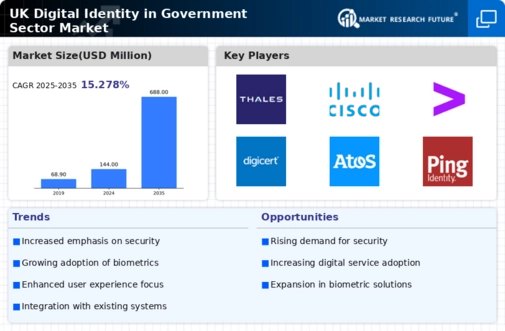
The estimated market size for the UK Digital Identity in Government Sector market in 2024 is 144.0 million USD.

What is the expected market size of the UK Digital Identity in Government Sector market by 2035?

By 2035, the UK Digital Identity in Government Sector market is expected to expand to a value of 688.0 million USD.

What is the expected compound annual growth rate (CAGR) for the UK Digital Identity in Government Sector market from 2025 to 2035?

The expected CAGR for the UK Digital Identity in Government Sector market from 2025 to 2035 is 15.278%.

Which key players are significantly impacting the UK Digital Identity in Government Sector market?

Major players in the UK Digital Identity in Government Sector market include Thales, Cisco, Accenture, and Microsoft among others.

What will be the market value for Solutions in the UK Digital Identity in Government Sector by 2035?

The market value for Solutions in the UK Digital Identity in Government Sector is projected to reach 400.0 million USD by 2035.

What is the projected market size for Services in the UK Digital Identity in Government Sector market in 2024?

In 2024, the projected market size for Services in the UK Digital Identity in Government Sector is estimated at 59.0 million USD.

What are the growth drivers for the UK Digital Identity in Government Sector market?

Key growth drivers for the market include increasing demand for secure digital transactions and a rise in identity theft awareness.

What challenges does the UK Digital Identity in Government Sector market face?

The market faces challenges such as regulatory compliance and cybersecurity threats that could hinder growth.

How do solutions and services differ in terms of market value in the UK Digital Identity space?

Solutions are valued at 85.0 million USD in 2024 while Services are valued at 59.0 million USD in the same year.

What are the opportunities for growth in the UK Digital Identity in Government Sector market?

Opportunities for growth are prevalent in the adoption of advanced technologies and solutions for enhancing digital identity verification.

Download Free Sample

Kindly complete the form below to receive a free sample of this Report

Compare Licence

×
Features License Type
Single User Multiuser License Enterprise User
Price $4,950 $5,950 $7,250
Maximum User Access Limit 1 User Upto 10 Users Unrestricted Access Throughout the Organization
Free Customization
Direct Access to Analyst
Deliverable Format
Platform Access
Discount on Next Purchase 10% 15% 15%
Printable Versions