×
Request Free Sample ×

Kindly complete the form below to receive a free sample of this Report

* Please use a valid business email

Leading companies partner with us for data-driven Insights

clients tt-cursor
Hero Background

Italy Digital Identity in Government Sector Market

ID: MRFR/ICT/58537-HCR
200 Pages
Aarti Dhapte
February 2026

Italy Digital Identity in Government Sector Market Size, Share and Trends Analysis Report By Offering (Solutions, Services), By Solution Type (Identity Verification, Authentication, Identity Lifecycle Management, Other Solution Types), By Identity Type (Biometric, Non-biometric) and By Organization Size (Large Organization, SMEs)-Forecast to 2035

Share:
Download PDF ×

We do not share your information with anyone. However, we may send you emails based on your report interest from time to time. You may contact us at any time to opt-out.

Italy Digital Identity in Government Sector Market Infographic
Purchase Options

Italy Digital Identity in Government Sector Market Summary

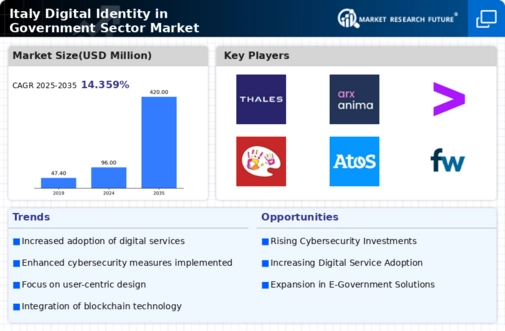
As per Market Research Future analysis, the Italy digital identity-in-government-sector market Size was estimated at 52.06 USD Million in 2024. The Italy digital identity-in-government-sector market is projected to grow from 61.15 USD Million in 2025 to 305.29 USD Million by 2035, exhibiting a compound annual growth rate (CAGR) of 17.4% during the forecast period 2025 - 2035

Key Market Trends & Highlights

The Italy digital identity-in-government-sector market is experiencing a transformative shift towards enhanced security and user-centric solutions.

  • The market is witnessing increased adoption of biometric solutions to enhance identity verification processes.
  • Interoperability among various digital identity systems is becoming a focal point to streamline public services.
  • There is a growing emphasis on user privacy and data protection, reflecting heightened public awareness and regulatory scrutiny.
  • Government initiatives for digital transformation and rising cybersecurity concerns are driving the demand for efficient public services.

Market Size & Forecast

2024 Market Size 52.06 (USD Million)
2035 Market Size 305.29 (USD Million)
CAGR (2025 - 2035) 17.45%

Major Players

IDEMIA (FR), Gemalto (NL), Thales Group (FR), Accenture (IE), Microsoft (US), IBM (US), Oracle (US), Veridos (DE), Sopra Steria (FR)

Our Impact
Enabled $4.3B Revenue Impact for Fortune 500 and Leading Multinationals
Partnering with 2000+ Global Organizations Each Year
30K+ Citations by Top-Tier Firms in the Industry

Italy Digital Identity in Government Sector Market Trends

The digital identity-in-government-sector market in Italy is currently experiencing a transformative phase, driven by the increasing need for secure and efficient identification methods. Government initiatives are focusing on enhancing digital services, which are essential for improving citizen engagement and streamlining administrative processes. The push towards digitalization is evident in various sectors, including healthcare, taxation, and public services, where digital identity solutions are being integrated to facilitate seamless interactions between citizens and government entities. This shift not only aims to enhance security but also to foster trust in digital platforms, which is crucial for widespread adoption. Moreover, the Italian government is actively investing in technologies that support digital identity verification, such as biometrics and blockchain. These advancements are expected to bolster the integrity of identity management systems, thereby reducing fraud and ensuring compliance with regulatory standards. As the landscape evolves, collaboration between public and private sectors is likely to play a pivotal role in shaping the future of digital identity solutions. The emphasis on user-centric design and accessibility will further enhance the effectiveness of these systems, making them more adaptable to the diverse needs of the population. Overall, the digital identity-in-government-sector market appears poised for significant growth, driven by innovation and a commitment to improving public services.

Increased Adoption of Biometric Solutions

The digital identity-in-government-sector market is witnessing a notable shift towards biometric technologies. These solutions, which include fingerprint and facial recognition systems, are being integrated into various government services to enhance security and streamline processes. The adoption of biometrics is expected to improve the accuracy of identity verification, thereby reducing instances of fraud and identity theft.

Focus on Interoperability

Interoperability among different digital identity systems is becoming increasingly important. The government is prioritizing the development of standards that allow various platforms to communicate effectively. This focus on interoperability aims to create a cohesive ecosystem where citizens can access multiple services using a single digital identity, thus simplifying user experience.

Emphasis on User Privacy and Data Protection

As the digital identity-in-government-sector market evolves, there is a growing emphasis on user privacy and data protection. The government is implementing stringent regulations to safeguard personal information and ensure that citizens have control over their data. This trend reflects a broader commitment to building trust in digital services, which is essential for encouraging adoption.

Italy Digital Identity in Government Sector Market Drivers

Rising Cybersecurity Concerns

With the increasing digitization of public services, cybersecurity has emerged as a critical concern for the digital identity-in-government-sector market. The Italian government has recognized the need to bolster its cybersecurity framework to protect citizens' personal data and maintain trust in digital services. Reports indicate that cyberattacks targeting government systems have risen by 30% in recent years, prompting a reevaluation of security protocols. Consequently, investments in advanced cybersecurity measures are expected to surge, potentially reaching €500 million by 2026. This focus on security not only safeguards sensitive information but also encourages citizens to adopt digital identity solutions, thereby driving growth in the digital identity-in-government-sector market.

Increased Demand for Efficient Public Services

The demand for more efficient public services is a significant driver for the digital identity-in-government-sector market in Italy. Citizens increasingly expect seamless access to government services, which has led to a push for digital identity solutions that facilitate this access. As of 2025, surveys indicate that over 80% of Italians prefer online services over traditional methods, highlighting a shift in consumer behavior. This trend is likely to compel government agencies to adopt digital identity systems that streamline processes and reduce wait times. The digital identity-in-government-sector market is poised to expand as agencies seek to meet these expectations, potentially leading to a market growth rate of 15% annually.

Government Initiatives for Digital Transformation

The Italian government has been actively pursuing initiatives aimed at enhancing digital transformation across various sectors, including the digital identity-in-government-sector market. This drive is evidenced by the implementation of the Digital Administration Code, which mandates the use of digital identities for accessing public services. As of 2025, approximately 70% of public services are expected to be accessible through digital identity solutions, reflecting a significant shift towards digitalization. This initiative not only streamlines service delivery but also enhances transparency and efficiency in government operations. The digital identity-in-government-sector market is likely to benefit from increased funding and support from governmental bodies, which may further accelerate the adoption of digital identity solutions in Italy.

Legislative Support for Digital Identity Solutions

Legislative frameworks play a pivotal role in shaping the digital identity-in-government-sector market. In Italy, recent laws have been enacted to promote the use of digital identities for public services, thereby providing a legal foundation for their implementation. The introduction of the eIDAS regulation has facilitated cross-border recognition of electronic identities, which is expected to enhance the usability of digital identity solutions. As of November 2025, approximately 60% of public institutions are compliant with these regulations, indicating a robust legislative environment that supports the growth of the digital identity-in-government-sector market. This legal backing not only fosters innovation but also instills confidence among users, further driving adoption.

Technological Advancements in Identity Verification

Technological advancements are significantly influencing the digital identity-in-government-sector market in Italy. Innovations in artificial intelligence and machine learning are enhancing identity verification processes, making them more efficient and reliable. As of 2025, it is estimated that 50% of government agencies are utilizing AI-driven solutions for identity verification, which reduces the risk of fraud and improves user experience. These advancements are likely to attract more citizens to engage with digital identity solutions, as they offer enhanced security and convenience. The digital identity-in-government-sector market is expected to experience substantial growth as these technologies become more integrated into public service delivery.


Market Segment Insights

By Offering: Solutions (Largest) vs. Services (Fastest-Growing)

In the Italy digital identity-in-government-sector market, Solutions hold a dominant share, showcasing significant adoption across numerous governmental functions. The overall market distribution indicates that Solutions are central to achieving streamlined processes, enhancing security, and improving user experience. Conversely, Services are emerging rapidly, capturing a growing portion of the market as they provide essential support and enhancements to existing Solutions, ensuring they remain current and effective. The growth trends for this segment are driven by the increasing need for efficient digital frameworks within government agencies. The push towards digital transformation and improved citizen engagement fuels the demand for Services, which focus on consulting, integration, and support. Additionally, advancements in technology, along with favorable policies, are accelerating growth in the Services segment, making it the fastest-growing area in this market.

Solutions (Dominant) vs. Services (Emerging)

Solutions in the Italy digital identity-in-government-sector market are characterized by their robust capabilities, providing essential infrastructure for identity verification and digital services. They are well-established, fulfilling the core needs of governmental entities by enhancing security, reliability, and efficiency in public services. On the other hand, Services represent the emerging facet of this market, focusing on the adaptation and continuous improvement of existing Solutions through consulting and integration efforts. The rapid evolution of Services is essential for ensuring that Solutions remain relevant in a fast-changing technological landscape, effectively meeting the dynamic requirements of government and its constituents.

By Solution Type: Identity Verification (Largest) vs. Authentication (Fastest-Growing)

The distribution of market share within the segment showcases Identity Verification as the largest component, reflecting its critical role in ensuring secure access and transactions in the digital identity landscape. Authentication follows closely, emerging as a significant player with robust integration across various services aimed at enhancing user trust and security. Notably, the 'Other Solution Types' category also contributes to the market, although to a lesser extent, encapsulating diverse functionalities not captured by the primary solutions. Growth trends indicate a substantial increase in demand for these solutions, fueled by rising cybersecurity threats and the need for efficient identity management processes within government operations. The proliferation of digital services in the public sector is a key driver, as entities seek to streamline access while safeguarding citizen data. Moreover, innovations in technology and heightened regulatory requirements further propel the adoption of advanced identity solutions, positioning Authentication as the fastest-growing segment in this space.

Identity Verification (Dominant) vs. Authentication (Emerging)

Identity Verification stands out as the dominant solution in the segment, characterized by its essential function in confirming the identity of individuals in digital transactions, thereby assuring trust and security in governmental processes. This solution is pivotal for compliance with various regulations and is integral to public services that necessitate secure identity checks. On the other hand, Authentication is gaining ground as an emerging solution, representing a shift towards more sophisticated methods of verifying identity through multi-factor authentication, biometrics, and other innovative technologies. This rising trend signifies a transformation in how organizations facilitate access while reinforcing security measures, appealing particularly to younger demographics accustomed to advanced digital interfaces.

By Identity Type: Biometric (Largest) vs. Non-biometric (Fastest-Growing)

In the Italy digital identity-in-government-sector market, the distribution of identity types shows that biometric solutions account for the largest share, driven by increasing demand for secure and reliable identification methods. On the other hand, non-biometric identity methods are emerging rapidly, appealing to segments that prioritize user convenience and lower costs. This duality reflects a diverse market landscape where both types coexist, albeit with different user bases and applications. The growth trends in this segment are influenced by technological advancements and increasing public awareness regarding digital security. Biometric systems are expected to maintain their dominance as government initiatives focus on enhancing security protocols. Meanwhile, non-biometric solutions are gaining traction among various administrative services, thereby establishing themselves as a convenient alternative. This creates a dynamic market with opportunities for both segments to flourish.

Biometric (Dominant) vs. Non-biometric (Emerging)

Biometric identity solutions are characterized by their reliance on physical attributes such as fingerprints, facial recognition, and iris scans, which significantly enhance security measures within government operations. This segment holds a dominant position due to its adoption in various law enforcement and administrative applications aimed at preventing fraud and identity theft. Conversely, non-biometric identity types rely on methods such as passwords and identification cards, positioning themselves as a cost-effective and versatile alternative. Despite being less secure, their emerging popularity is fueled by ease of use and a growing acceptance of digital verification methods among the general public. Together, these segments reflect the shifting dynamics of identity management within government sectors.

By Organization Size: Large Organization (Largest) vs. SMEs (Fastest-Growing)

In the Italy digital identity-in-government-sector market, the market share distribution reveals that large organizations hold a significant portion, reflecting their established infrastructure and resources. They benefit from comprehensive digital identity solutions and have the capability to invest heavily in technology, which positions them as leaders in market engagement. On the other hand, the SMEs, while holding a smaller share, are rapidly gaining traction due to their agility and adaptability in embracing digital transformation, catering to niche segments effectively. Growth trends indicate that while large organizations continue to dominate the market, SMEs are becoming the fastest-growing segment driven by increasing government initiatives aimed at supporting digital transformation in small to medium enterprises. Factors such as improving technological accessibility, tailored solutions for specific needs, and growing demand for efficient identity management contribute to this trend. The landscape is thus shifting, with SMEs poised to carve out a larger footprint in the market as they adopt innovative digital identity strategies.

Large Organization: Dominant vs. SMEs: Emerging

Large organizations within the Italy digital identity-in-government-sector market are characterized by their robust capabilities, consisting of extensive resources that allow for the implementation of advanced digital identity solutions. Their established presence and substantial customer base generate trust and reliability, which is crucial in governmental services. Conversely, SMEs, while emerging in this scenario, demonstrate remarkable adaptability and innovation, often leveraging cloud technologies and agile methodologies. They are positioned to meet specific local requirements and are increasingly favored due to their cost-effective solutions and emphasis on personalized service. The contrast between these two segments highlights the breadth of the market, with large organizations providing stability while SMEs inject dynamism and innovation.

Get more detailed insights about Italy Digital Identity in Government Sector Market

Key Players and Competitive Insights

The digital identity-in-government-sector market in Italy is characterized by a dynamic competitive landscape, driven by the increasing demand for secure and efficient identity verification solutions. Key players are actively engaging in strategic initiatives to enhance their market positioning. IDEMIA (FR) focuses on innovation in biometric technologies, aiming to provide advanced identity solutions that meet the evolving needs of government agencies. Meanwhile, Thales Group (FR) emphasizes partnerships with local governments to implement comprehensive digital identity frameworks, thereby strengthening its foothold in the region. These strategies collectively contribute to a competitive environment that is increasingly focused on technological advancement and customer-centric solutions.In terms of business tactics, companies are localizing their operations to better serve the Italian market, which appears to be a response to the growing emphasis on regional compliance and customer preferences. The market structure is moderately fragmented, with several key players vying for dominance. This fragmentation allows for a diverse range of solutions, but also intensifies competition among established firms and new entrants alike.

In October Accenture (IE) announced a collaboration with the Italian government to develop a new digital identity platform aimed at streamlining public services. This initiative is significant as it not only enhances the efficiency of government operations but also positions Accenture as a leader in digital transformation within the public sector. The partnership is expected to leverage advanced technologies such as AI and blockchain, which could redefine how citizens interact with government services.

In September Microsoft (US) launched a new initiative focused on integrating AI-driven identity verification solutions for public sector clients in Italy. This move is particularly noteworthy as it aligns with the broader trend of digitalization in government services. By incorporating AI, Microsoft aims to enhance security and user experience, potentially setting a new standard for identity management in the public sector.

In August Oracle (US) expanded its cloud-based identity management solutions tailored for government applications in Italy. This strategic expansion is indicative of Oracle's commitment to providing scalable and secure identity solutions. The emphasis on cloud technology suggests a shift towards more flexible and efficient identity management systems, which could significantly impact how government agencies operate.

As of November the competitive trends in the digital identity market are increasingly defined by the integration of AI, a focus on sustainability, and the push for digital transformation. Strategic alliances among key players are shaping the landscape, fostering innovation and enhancing service delivery. Looking ahead, it appears that competitive differentiation will increasingly hinge on technological innovation and supply chain reliability, rather than merely price-based competition. This shift underscores the importance of developing robust, forward-thinking solutions that can adapt to the rapidly changing demands of the public sector.

Key Companies in the Italy Digital Identity in Government Sector Market include

Industry Developments

In recent developments, the Italy Digital Identity in the Government Sector Market has seen significant advancements, particularly with the Italian government's push toward more robust digital identity solutions. The ongoing digital transformation initiatives have led to increased collaborations between key players like Accenture, Thales, and Leonardo. Accenture has enhanced solutions aimed at optimizing digital services for citizens.

Fastweb partnered with northern Italian municipal authorities in October 2023 to improve the security of digital identity verification in municipal e-services. As part of this partnership, user identification access control tools and encrypted authentication systems will be implemented for local government portals.The acquisition of Imperva by Thales in September 2023 greatly enhanced the company's cybersecurity and digital identification capabilities pertinent to Italian public sector identity services.

Through this purchase, Thalesď is better equipped to offer complete identity and access management solutions for infrastructure in the government.IDEMIA and Microsoft teamed in February 2024 to facilitate the implementation of Microsoft's Entra Verified ID in Italy. IDEMIA offers document verification and biometric liveness solutions that allow for safe citizen onboarding for customers in the public sector.In order to assist Italian public sector enterprises, Microsoft Italy enhanced its Entra ID (previously Azure Active Directory) infrastructure in early 2024. This expansion offers multi-factor authentication and advanced identity governance that is in line with EU digital identity requirements.

Future Outlook

Italy Digital Identity in Government Sector Market Future Outlook

The Digital Identity in Government Sector Market in Italy is projected to grow at a 17.45% CAGR from 2025 to 2035, driven by technological advancements and increasing security demands.

New opportunities lie in:

  • Development of biometric authentication systems for secure access
  • Implementation of blockchain technology for identity verification
  • Creation of mobile identity applications for citizen engagement

By 2035, the market is expected to achieve substantial growth and innovation.

Market Segmentation

Italy Digital Identity in Government Sector Market Offering Outlook

  • Solutions
  • Services

Italy Digital Identity in Government Sector Market Identity Type Outlook

  • Biometric
  • Non-biometric

Italy Digital Identity in Government Sector Market Solution Type Outlook

  • Identity Verification
  • Authentication
  • Identity Lifecycle Management
  • Other Solution Types

Italy Digital Identity in Government Sector Market Organization Size Outlook

  • Large Organization
  • SMEs

Report Scope

MARKET SIZE 2024 52.06(USD Million)
MARKET SIZE 2025 61.15(USD Million)
MARKET SIZE 2035 305.29(USD Million)
COMPOUND ANNUAL GROWTH RATE (CAGR) 17.45% (2025 - 2035)
REPORT COVERAGE Revenue Forecast, Competitive Landscape, Growth Factors, and Trends
BASE YEAR 2024
Market Forecast Period 2025 - 2035
Historical Data 2019 - 2024
Market Forecast Units USD Million
Key Companies Profiled IDEMIA (FR), Gemalto (NL), Thales Group (FR), Accenture (IE), Microsoft (US), IBM (US), Oracle (US), Veridos (DE), Sopra Steria (FR)
Segments Covered Offering, Solution Type, Identity Type, Organization Size
Key Market Opportunities Integration of blockchain technology enhances security and efficiency in the digital identity-in-government-sector market.
Key Market Dynamics Growing emphasis on secure digital identity solutions driven by regulatory changes and technological advancements in government services.
Countries Covered Italy
Leave a Comment

FAQs

What is the expected market size of the Italy Digital Inspection Market in 2024?

The Italy Digital Inspection Market is expected to be valued at 171.9 million USD in 2024.

What will the market value be in 2035 for the Italy Digital Inspection Market?

The market is projected to reach a value of 515.7 million USD by 2035.

What is the expected compound annual growth rate (CAGR) for the Italy Digital Inspection Market from 2025 to 2035?

The expected CAGR for the market during this period is 10.503%.

Which segment of the Italy Digital Inspection Market is expected to have the highest value in 2035?

The Robotic Inspection segment is anticipated to reach 120.0 million USD by 2035.

What are some key players in the Italy Digital Inspection Market?

Major players include Kongsberg Gruppen, Caterpillar, Omron, Honeywell, and General Electric.

How much is the Automated Inspection segment valued at in 2024?

The Automated Inspection segment is valued at 30.0 million USD in 2024.

What is the projected market size for the Drones segment by 2035?

The Drones segment is projected to reach a market size of 80.0 million USD by 2035.

What trends are driving the growth of the Italy Digital Inspection Market?

Key growth drivers include advancements in technology, increased demand for automation, and efficiency in inspection processes.

How is the Non-Destructive Testing segment expected to perform by 2035?

The Non-Destructive Testing segment is expected to grow to a value of 95.0 million USD by 2035.

What is the market size of the Computer Vision segment in 2024?

The Computer Vision segment is valued at 46.9 million USD in 2024.

Download Free Sample

Kindly complete the form below to receive a free sample of this Report

Compare Licence

×
Features License Type
Single User Multiuser License Enterprise User
Price $4,950 $5,950 $7,250
Maximum User Access Limit 1 User Upto 10 Users Unrestricted Access Throughout the Organization
Free Customization
Direct Access to Analyst
Deliverable Format
Platform Access
Discount on Next Purchase 10% 15% 15%
Printable Versions