×
Request Free Sample ×

Kindly complete the form below to receive a free sample of this Report

* Please use a valid business email

Leading companies partner with us for data-driven Insights

clients tt-cursor
Hero Background

UK Compounding Chemotherapy Market

ID: MRFR/Pharma/51472-HCR
200 Pages
Rahul Gotadki
February 2026

UK Compounding Chemotherapy Market Research Report By Dose (Chemotherapeutic, Non-Chemotherapeutics), By Delivery Method (Gravimetric Automated Compounding Device, Volumetric Automated Compounding Device), By Sterility (Sterile, Non-Sterile), and By Technology (With Robotic Arms, Without Robotic Arms) - Growth & Industry Forecast 2025 To 2035

Share:
Download PDF ×

We do not share your information with anyone. However, we may send you emails based on your report interest from time to time. You may contact us at any time to opt-out.

UK Compounding Chemotherapy Market Infographic
Purchase Options

UK Compounding Chemotherapy Market Summary

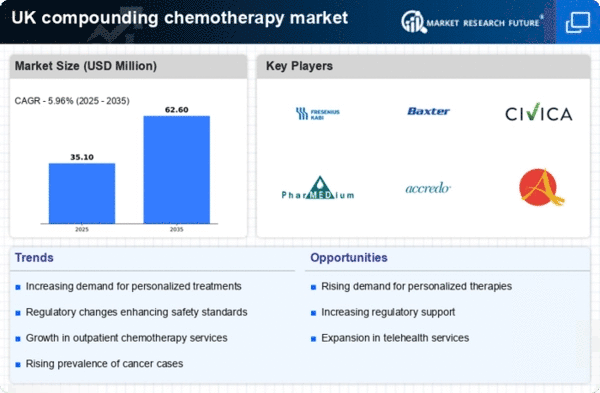
As per Market Research Future analysis, the UK compounding chemotherapy market size was estimated at 33.12 USD Million in 2024. The UK compounding chemotherapy market is projected to grow from 35.1 USD Million in 2025 to 62.6 USD Million by 2035, exhibiting a compound annual growth rate (CAGR) of 5.9% during the forecast period 2025 - 2035

Key Market Trends & Highlights

The UK compounding chemotherapy market is experiencing a transformative shift towards personalized medicine and technological advancements.

  • The market is witnessing a rise in personalized medicine, which tailors treatment to individual patient needs.
  • Regulatory enhancements are fostering a more supportive environment for compounding practices in the UK.
  • Technological innovations are driving efficiency and precision in the compounding process, particularly in the largest segment of injectable chemotherapy.
  • The increasing cancer incidence and growing demand for home healthcare are major drivers propelling market growth.

Market Size & Forecast

2024 Market Size 33.12 (USD Million)
2035 Market Size 62.6 (USD Million)
CAGR (2025 - 2035) 5.96%

Major Players

Fresenius Kabi (DE), Baxter International (US), Civica Rx (US), PharMEDium Services (US), Accredo Health Group (US), Athenex (US), Sagent Pharmaceuticals (US), B. Braun Melsungen AG (DE)

Our Impact
Enabled $4.3B Revenue Impact for Fortune 500 and Leading Multinationals
Partnering with 2000+ Global Organizations Each Year
30K+ Citations by Top-Tier Firms in the Industry

UK Compounding Chemotherapy Market Trends

the compounding chemotherapy market is undergoing notable transformations, driven by advancements in pharmaceutical technology and evolving regulatory frameworks. As healthcare providers increasingly recognize the importance of personalized medicine, the demand for tailored chemotherapy solutions appears to be on the rise. This shift is likely influenced by a growing emphasis on patient-centric care, which prioritizes individualized treatment plans that align with specific patient needs. Furthermore, the integration of innovative compounding practices is expected to enhance the efficacy and safety of chemotherapy regimens, thereby improving patient outcomes. In addition, the regulatory landscape surrounding the compounding chemotherapy market is evolving, with authorities implementing stricter guidelines to ensure quality and safety. This regulatory scrutiny may lead to increased compliance costs for compounding pharmacies, yet it also fosters a more reliable and trustworthy market environment. As a result, stakeholders in the healthcare sector are likely to invest in advanced compounding technologies and training programs to meet these new standards. Overall, the compounding chemotherapy market is poised for growth, driven by a combination of technological advancements and regulatory changes that prioritize patient safety and treatment efficacy.

Rise of Personalized Medicine

The compounding chemotherapy market is witnessing a shift towards personalized medicine, where treatments are tailored to individual patient profiles. This trend is driven by advancements in genetic testing and biomarker identification, allowing for more effective and targeted therapies. As healthcare providers focus on optimizing treatment outcomes, the demand for customized chemotherapy solutions is expected to increase.

Regulatory Enhancements

Recent developments in regulatory frameworks are shaping the compounding chemotherapy market. Authorities are implementing stricter guidelines to ensure the safety and quality of compounded medications. While this may impose additional compliance burdens on pharmacies, it also enhances consumer trust and encourages the adoption of best practices within the industry.

Technological Innovations

Technological advancements are playing a crucial role in the evolution of the compounding chemotherapy market. Innovations in compounding equipment and software are streamlining processes, improving accuracy, and reducing the risk of errors. These developments not only enhance operational efficiency but also contribute to better patient safety and treatment outcomes.

UK Compounding Chemotherapy Market Drivers

Increasing Cancer Incidence

the compounding chemotherapy market is growing due to the rising incidence of cancer in the UK.. According to recent statistics, cancer cases are projected to increase by approximately 2.5% annually, leading to a heightened demand for tailored chemotherapy solutions. This trend is particularly evident in the aging population, where the likelihood of developing cancer escalates. As healthcare providers seek to offer personalized treatment regimens, the compounding chemotherapy market is positioned to meet these needs. The ability to customize dosages and formulations allows for improved patient outcomes, which is becoming increasingly critical in oncology. Consequently, the compounding chemotherapy market is likely to expand as healthcare systems adapt to the growing burden of cancer. This adaptation necessitates innovative and effective treatment options..

Growing Demand for Home Healthcare

the compounding chemotherapy market is driven by the increasing demand for home healthcare services in the UK.. Patients are increasingly seeking treatment options that allow them to receive chemotherapy in the comfort of their homes, rather than in clinical settings. This shift is driven by a desire for convenience, reduced hospital visits, and improved quality of life. As a response, compounding pharmacies are adapting their services to provide home-based chemotherapy solutions, which may include personalized dosing and administration methods. The market for home healthcare is projected to grow by approximately 15% over the next five years, indicating a substantial opportunity for the compounding chemotherapy market to expand its offerings and cater to this emerging trend.

Rising Awareness of Chemotherapy Options

the compounding chemotherapy market is growing due to increased awareness among patients and healthcare providers regarding available chemotherapy options.. Educational campaigns and resources have increased understanding of the benefits of personalized chemotherapy, leading to greater patient engagement in treatment decisions. As patients become more informed, they are more likely to seek out compounding pharmacies that offer tailored chemotherapy solutions. This trend is further supported by healthcare professionals advocating for individualized treatment plans that consider patient-specific factors. Consequently, the compounding chemotherapy market is poised for expansion as awareness continues to grow, driving demand for customized treatment options that align with patient preferences.

Advancements in Pharmaceutical Compounding

The compounding chemotherapy market is benefiting from advancements in pharmaceutical compounding techniques. Innovations in compounding practices enable pharmacists to create customized chemotherapy formulations that cater to individual patient needs. This is particularly relevant in the context of oncology, where standard dosages may not be suitable for all patients. The introduction of new technologies, such as automated compounding systems, enhances precision and reduces the risk of errors. Furthermore, the UK government has been supportive of initiatives aimed at improving compounding practices, which may lead to increased regulatory compliance and safety standards. As a result, the compounding chemotherapy market is likely to see increased demand for customized formulations that align with the latest advancements in pharmaceutical science..

Regulatory Support for Compounding Practices

the compounding chemotherapy market will benefit from ongoing regulatory support to enhance compounding practices in the UK.. Regulatory bodies are increasingly recognizing the importance of ensuring patient safety and efficacy in compounded medications. Recent initiatives have focused on establishing clear guidelines and standards for compounding pharmacies, which may lead to improved quality assurance processes. This regulatory environment encourages compounding pharmacies to invest in better training and technology, ultimately enhancing the safety and effectiveness of compounded chemotherapy products. As regulations evolve, the compounding chemotherapy market is expected to grow, driven by a commitment to high-quality patient care and adherence to best practices.


Market Segment Insights

By Dose: Chemotherapeutic (Largest) vs. Non-Chemotherapeutics (Fastest-Growing)

In the UK compounding chemotherapy market, the chemotherapeutic segment holds a significant share, driven by the high demand for effective cancer treatments tailored to individual patient needs. This segment has established itself as a leader due to extensive research, proven efficacy, and broad acceptance among healthcare professionals and patients alike. In contrast, non-chemotherapeutics, although smaller in market share, demonstrate rapid growth as advancements in supportive care and alternative therapies gain traction, focusing on enhancing patient quality of life during treatment. The growth of the non-chemotherapeutics segment is primarily attributed to increasing awareness of supportive therapies that alleviate side effects associated with traditional chemotherapy. Innovations in non-invasive treatment options and a shift towards personalized medicine further align with patient preferences for less aggressive approaches. Additionally, the significant investments in research and development are fueling this segment's expansion, making it a noteworthy area for future exploration within the UK compounding chemotherapy market.

Chemotherapeutic (Dominant) vs. Non-Chemotherapeutics (Emerging)

The chemotherapeutic segment is characterized by its extensive portfolio of drugs that are specifically formulated to combat various types of cancers, making it the dominant player in the UK compounding chemotherapy market. Its strength lies in its established protocols and a wide range of formulations, catering to diverse patient needs. Meanwhile, the non-chemotherapeutics segment is emerging as a vital support pillar, focusing on therapies that manage or mitigate side effects and improve patient wellbeing. This segment is rapidly gaining ground, thanks to innovative treatments that emphasize personalized care and improved patient outcomes, thus carving out its niche and expanding its relevance in oncology.

By Delivery Method: Gravimetric Automated Compounding Device (Largest) vs. Volumetric Automated Compounding Device (Fastest-Growing)

The market for delivery methods in the UK compounding chemotherapy market is primarily dominated by gravimetric automated compounding devices, which hold the largest share among the various options available. These devices are widely recognized for their precision and efficiency in compounding, offering healthcare providers a reliable solution for preparing chemotherapy. Volumetric automated compounding devices, while smaller in market share, are swiftly gaining traction due to their increasing adoption in clinical settings, attributed to advancements in technology and enhanced user-friendliness. Growth trends in the delivery method segment are remarkably positive, driven by the rising demand for accuracy in drug preparation and increased patient safety measures within the healthcare system. The gravimetric devices are becoming the preferred choice for hospitals and pharmacies, whereas volumetric devices are attracting interest for their innovative features. Market players are actively investing in research and development to cater to the evolving needs of healthcare providers, with automation technologies playing a critical role in enhancing compounding efficiencies.

Delivery Method: Gravimetric Automated Compounding Device (Dominant) vs. Volumetric Automated Compounding Device (Emerging)

Gravimetric automated compounding devices are recognized as the dominant technology in the UK compounding chemotherapy market, known for their precise dosing capabilities, which are crucial in the preparation of chemotherapeutic agents. These devices help minimize human error and ensure compliance with safety standards, making them an essential tool in clinical environments. In contrast, volumetric automated compounding devices are viewed as an emerging technology, demonstrating rapid growth in adoption due to their ability to streamline workflows and simplify the compounding process. With features like real-time monitoring and user-friendly interfaces, volumetric devices are appealing to smaller pharmacies and outpatient facilities seeking efficient solutions.

By Sterility: Sterile (Largest) vs. Non-Sterile (Fastest-Growing)

The market share distribution within the UK compounding chemotherapy market reflects a strong preference for sterile products, which dominate the segment due to their critical role in ensuring patient safety and treatment efficacy. Non-sterile products, while gaining traction, remain significantly smaller in market share, driven by their use in specific applications and cost advantages. Regulatory compliance and quality assurance are paramount in shaping the preferences in this segment. Growth trends indicate that the demand for sterile compounds is set to continue its upward trajectory, primarily fueled by a rising patient population requiring chemotherapy and a focus on minimizing infection risks. Non-sterile compounds are anticipated to experience the fastest growth, attributed to innovations in dosing and adaptability for various treatment modalities. Providers are increasingly focusing on flexibility and efficiency to meet diverse patient needs, promoting a shift in market dynamics.

Sterile (Dominant) vs. Non-Sterile (Emerging)

Sterile products currently hold the dominant position in the UK compounding chemotherapy market, characterized by stringent quality controls and extensive regulatory oversight. These products are essential for safe administration of chemotherapy, aligning with the growing emphasis on patient safety. Non-sterile compounds, on the other hand, are considered emerging alternatives, offering potential cost benefits and flexibility in formulation. However, they face challenges in terms of regulatory acceptance and market penetration. As healthcare providers seek to optimize treatment efficacy while managing costs, both segments are expected to adapt, with sterile compounds maintaining their market leadership while non-sterile products carve out specific niches.

By Technology: With Robotic Arms (Largest) vs. Without Robotic Arms (Fastest-Growing)

In the UK compounding chemotherapy market, the segment "With Robotic Arms" holds a significant share, reflecting advancements in technology that enhance precision and safety in chemotherapy preparation. On the other hand, the segment "Without Robotic Arms" is rapidly growing, driven by increasing demand for cost-effective solutions and flexibility in compounding processes. This distribution illustrates a clear preference for automation while also highlighting opportunities in traditional methods.

Technology: With Robotic Arms (Dominant) vs. Without Robotic Arms (Emerging)

The "With Robotic Arms" segment is characterized by its focus on innovation and efficiency, providing healthcare facilities with the ability to minimize human error and reduce waste in chemotherapy compounding. These robotic systems are recognized for their ability to streamline operations, leading to improved patient safety and consistent drug quality. Conversely, the "Without Robotic Arms" segment, while currently smaller, is emerging rapidly due to its appeal among smaller facilities that may prioritize budget constraints and desire more hands-on, customizable approaches in drug preparation. The growth in this area reflects a broader trend toward more diverse solutions in compounding, catering to various market needs.

Get more detailed insights about UK Compounding Chemotherapy Market

Key Players and Competitive Insights

The compounding chemotherapy market is characterized by a dynamic competitive landscape, driven by the increasing demand for personalized medicine and the need for efficient drug delivery systems. Key players such as Fresenius Kabi (DE), Baxter International (US), and B. Braun Melsungen AG (DE) are actively shaping the market through strategic initiatives. Fresenius Kabi (DE) focuses on innovation in drug formulation and delivery, while Baxter International (US) emphasizes partnerships to enhance its product offerings. B. Braun Melsungen AG (DE) is investing in digital transformation to streamline operations and improve patient outcomes. Collectively, these strategies contribute to a competitive environment that prioritizes quality, efficiency, and patient-centric solutions.In terms of business tactics, companies are increasingly localizing manufacturing to reduce lead times and enhance supply chain resilience. The market appears moderately fragmented, with several players vying for market share. However, the influence of major companies is significant, as they leverage their resources to optimize supply chains and enhance product availability. This competitive structure fosters innovation and encourages smaller players to adopt advanced technologies to remain relevant.

In October Fresenius Kabi (DE) announced the launch of a new line of compounded chemotherapy products aimed at improving patient safety and efficacy. This strategic move underscores the company's commitment to innovation and aligns with the growing trend towards personalized medicine. By enhancing its product portfolio, Fresenius Kabi (DE) positions itself as a leader in the market, potentially increasing its market share and reinforcing its reputation for quality.

In September Baxter International (US) entered into a strategic partnership with a leading technology firm to develop AI-driven solutions for drug compounding. This collaboration is expected to enhance operational efficiency and reduce the risk of human error in the compounding process. By integrating advanced technology into its operations, Baxter International (US) demonstrates a forward-thinking approach that could set new industry standards and improve patient outcomes.

In August B. Braun Melsungen AG (DE) expanded its manufacturing capabilities in the UK, focusing on sustainable practices and reducing environmental impact. This expansion not only increases production capacity but also aligns with the growing emphasis on sustainability within the healthcare sector. By prioritizing eco-friendly practices, B. Braun Melsungen AG (DE) enhances its competitive positioning and appeals to environmentally conscious stakeholders.

As of November the compounding chemotherapy market is witnessing trends such as digitalization, sustainability, and the integration of AI technologies. Strategic alliances are becoming increasingly important, as companies collaborate to enhance their capabilities and market reach. The competitive landscape is shifting from price-based competition to a focus on innovation, technology, and supply chain reliability. This evolution suggests that companies that prioritize these aspects will likely achieve a competitive edge in the future.

Key Companies in the UK Compounding Chemotherapy Market include

Industry Developments

In recent months, the UK Compounding Chemotherapy Market has seen notable developments, including significant advancements in personalized medicine and individualized treatment protocols by companies such as AstraZeneca and Roche. Following new regulatory guidelines established in June 2023, pharmaceutical firms like Teva Pharmaceutical Industries and GlaxoSmithKline are investing in improved compounding practices to enhance the safety and efficacy of chemotherapy treatments. 

Additionally, there have been discussions surrounding a potential merger involving Eli Lilly and Company with several smaller biotech firms, aiming to strengthen their portfolio in oncology; this acquisition strategy has been met with approval from stakeholders in the healthcare community.Market valuations for companies like Pfizer and Merck Sharp and Dohme have experienced substantial growth, reflecting increased demand for customized oncology solutions in the UK, particularly post-pandemic. 

Moreover, Gilead Sciences has introduced innovative therapies, contributing to a more competitive landscape. Over the past few years, investments in Research and Development by companies like Bristol Myers Squibb and Novartis have also surged, further driving innovation and economic activity within the UK Compounding Chemotherapy Market, which is supported by ongoing collaborations with the National Health Service.

Future Outlook

UK Compounding Chemotherapy Market Future Outlook

The Compounding Chemotherapy Market is projected to grow at a 5.96% CAGR from 2025 to 2035, driven by technological advancements, increasing cancer prevalence, and regulatory support.

New opportunities lie in:

  • Development of personalized chemotherapy compounding solutions
  • Expansion of telepharmacy services for remote patient access
  • Investment in automated compounding technology to enhance efficiency

By 2035, the market is expected to achieve substantial growth, reflecting evolving healthcare demands.

Market Segmentation

UK Compounding Chemotherapy Market Dose Outlook

  • Chemotherapeutic
  • Non-Chemotherapeutics

UK Compounding Chemotherapy Market Sterility Outlook

  • Sterile
  • Non-Sterile

UK Compounding Chemotherapy Market Technology Outlook

  • With Robotic Arms
  • Without Robotic Arms

UK Compounding Chemotherapy Market Delivery Method Outlook

  • Gravimetric Automated Compounding Device
  • Volumetric Automated Compounding Device

Report Scope

MARKET SIZE 2024 33.12(USD Million)
MARKET SIZE 2025 35.1(USD Million)
MARKET SIZE 2035 62.6(USD Million)
COMPOUND ANNUAL GROWTH RATE (CAGR) 5.96% (2025 - 2035)
REPORT COVERAGE Revenue Forecast, Competitive Landscape, Growth Factors, and Trends
BASE YEAR 2024
Market Forecast Period 2025 - 2035
Historical Data 2019 - 2024
Market Forecast Units USD Million
Key Companies Profiled Fresenius Kabi (DE), Baxter International (US), Civica Rx (US), PharMEDium Services (US), Accredo Health Group (US), Athenex (US), Sagent Pharmaceuticals (US), B. Braun Melsungen AG (DE)
Segments Covered Dose, Delivery Method, Sterility, Technology
Key Market Opportunities Emerging personalized medicine trends drive demand for tailored solutions in the compounding chemotherapy market.
Key Market Dynamics Regulatory changes and technological advancements drive growth in the compounding chemotherapy market.
Countries Covered UK
Leave a Comment

FAQs

What is the expected market size of the UK Compounding Chemotherapy Market in 2024?

The UK Compounding Chemotherapy Market is expected to be valued at 23.85 million USD in 2024.

What will be the market size by the year 2035?

By 2035, the market is anticipated to reach a value of 48.74 million USD.

What is the expected compound annual growth rate (CAGR) for the UK Compounding Chemotherapy Market from 2025 to 2035?

The market is projected to grow at a CAGR of 6.713% from 2025 to 2035.

Which segment of the UK Compounding Chemotherapy Market is valued at 12.0 million USD in 2024?

The Chemotherapeutic segment is valued at 12.0 million USD in 2024.

What is the market value of the Non-Chemotherapeutic segment in 2024?

The Non-Chemotherapeutic segment is valued at 11.85 million USD in 2024.

Who are the major players in the UK Compounding Chemotherapy Market?

Some key players in the market include Teva Pharmaceutical Industries, GlaxoSmithKline, and Pfizer among others.

What is the forecasted market size for the Chemotherapeutic segment by 2035?

The Chemotherapeutic segment is expected to grow to 24.0 million USD by 2035.

What will be the projected market size for the Non-Chemotherapeutic segment by 2035?

The Non-Chemotherapeutic segment is anticipated to reach 24.74 million USD by 2035.

Which region is expected to show significant growth in the Compounding Chemotherapy Market?

The UK is expected to exhibit substantial growth in the Compounding Chemotherapy Market.

What key drivers are influencing the growth of the UK Compounding Chemotherapy Market?

Factors driving growth include advancements in medical technologies and increasing cancer prevalence.

Download Free Sample

Kindly complete the form below to receive a free sample of this Report

Compare Licence

×
Features License Type
Single User Multiuser License Enterprise User
Price $4,950 $5,950 $7,250
Maximum User Access Limit 1 User Upto 10 Users Unrestricted Access Throughout the Organization
Free Customization
Direct Access to Analyst
Deliverable Format
Platform Access
Discount on Next Purchase 10% 15% 15%
Printable Versions