×
Request Free Sample ×

Kindly complete the form below to receive a free sample of this Report

* Please use a valid business email

Leading companies partner with us for data-driven Insights

clients tt-cursor
Hero Background

UK Cloud Electronic Design Automation Market

ID: MRFR/ICT/60004-HCR
200 Pages
Aarti Dhapte
February 2026

UK Cloud Electronic Design Automation Market Size, Share and Trends Analysis Report By Application (Integrated Circuit Design, PCB Design, System on Chip Design, Embedded System Design), By Deployment Type (Public Cloud, Private Cloud, Hybrid Cloud), By End User (Semiconductor Manufacturers, Automotive Electronics, Consumer Electronics, Telecommunications), and By Service Type (Software as a Service, Platform as a Service, Infrastructure as a Service)- Forecast to 2035

Share:
Download PDF ×

We do not share your information with anyone. However, we may send you emails based on your report interest from time to time. You may contact us at any time to opt-out.

UK Cloud Electronic Design Automation Market Infographic
Purchase Options

UK Cloud Electronic Design Automation Market Summary

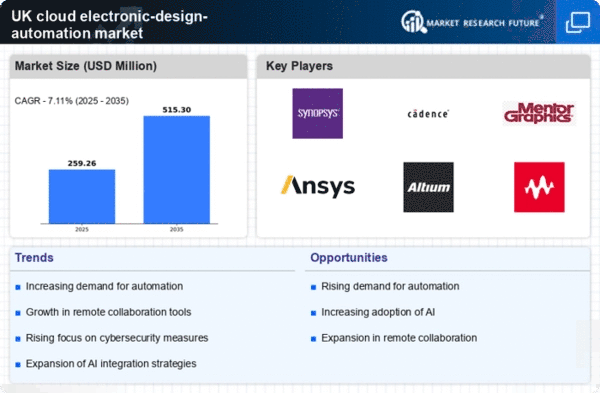
As per Market Research Future analysis, the UK cloud electronic-design-automation market size was estimated at 242.05 USD Million in 2024. The UK cloud electronic-design-automation market is projected to grow from 259.26 USD Million in 2025 to 515.3 USD Million by 2035, exhibiting a compound annual growth rate (CAGR) of 7.1% during the forecast period 2025 - 2035

Key Market Trends & Highlights

The UK cloud electronic-design-automation market is poised for substantial growth driven by technological advancements and evolving user needs.

  • The largest segment in the UK cloud electronic-design-automation market is the semiconductor design sector, while the fastest-growing segment is the automotive electronics design segment.
  • Increased collaboration and flexibility are becoming essential as teams adapt to remote work environments and seek efficient design processes.
  • A strong focus on sustainability is influencing design practices, prompting companies to adopt eco-friendly solutions and materials.
  • Rising demand for remote design solutions and enhanced security requirements are key drivers propelling market growth.

Market Size & Forecast

2024 Market Size 242.05 (USD Million)
2035 Market Size 515.3 (USD Million)
CAGR (2025 - 2035) 7.11%

Major Players

Synopsys (US), Cadence Design Systems (US), Mentor Graphics (US), Ansys (US), Altium (AU), Keysight Technologies (US), Siemens EDA (US), Zuken (JP)

Our Impact
Enabled $4.3B Revenue Impact for Fortune 500 and Leading Multinationals
Partnering with 2000+ Global Organizations Each Year
30K+ Citations by Top-Tier Firms in the Industry

UK Cloud Electronic Design Automation Market Trends

The cloud electronic-design-automation market was currently experiencing a transformative phase., driven by advancements in technology and increasing demand for efficient design processes. The integration of cloud computing into electronic design automation tools allows for enhanced collaboration among teams, enabling engineers to work seamlessly across different locations. This shift not only improves productivity but also reduces the time required for product development. Furthermore, the growing trend towards remote work has accelerated the adoption of cloud-based solutions, as organizations seek to maintain operational continuity and flexibility in their design workflows. In addition, the emphasis on sustainability and energy efficiency is influencing the cloud electronic-design-automation market. Companies are increasingly prioritizing eco-friendly practices, which is reflected in their choice of tools and processes. The ability to leverage cloud resources can lead to reduced energy consumption and lower carbon footprints, aligning with broader environmental goals. As the market evolves, it appears poised for further growth, with innovations in artificial intelligence and machine learning likely to enhance the capabilities of cloud-based design tools, making them more intuitive and powerful for users.

Increased Collaboration and Flexibility

The cloud electronic-design-automation market is witnessing a surge in collaborative tools that facilitate real-time communication among design teams. This trend allows for greater flexibility in project management, as teams can access and modify designs from various locations. The ability to share resources and insights instantaneously enhances overall efficiency and accelerates the design process.

Focus on Sustainability

Sustainability is becoming a central theme within the cloud electronic-design-automation market. Companies are increasingly adopting cloud solutions that minimize energy consumption and reduce waste. This shift not only aligns with corporate social responsibility goals but also meets the growing demand from consumers for environmentally friendly practices.

Integration of Advanced Technologies

The integration of advanced technologies such as artificial intelligence and machine learning is reshaping the cloud electronic-design-automation market. These innovations are enhancing the functionality of design tools, enabling automation of repetitive tasks and providing intelligent insights. As a result, designers can focus on more complex challenges, improving overall productivity.

UK Cloud Electronic Design Automation Market Drivers

Cost Efficiency and Resource Optimization

Cost efficiency remains a critical driver in the cloud electronic-design-automation market. By leveraging cloud-based solutions, companies can significantly reduce their capital expenditures on hardware and software. In the UK, firms are increasingly recognizing that cloud platforms can lower operational costs by up to 30%, allowing for better allocation of resources. This shift not only enhances financial performance but also enables smaller companies to access advanced design tools that were previously out of reach. The potential for resource optimization through cloud solutions is reshaping the competitive landscape, as businesses strive to maximize their return on investment. As a result, the cloud electronic-design-automation market is likely to see continued growth as organizations prioritize cost-effective solutions.

Rising Demand for Remote Design Solutions

The cloud electronic-design-automation market is experiencing a notable surge in demand for remote design solutions. This trend is largely driven by the increasing need for flexibility in design processes, allowing teams to collaborate seamlessly from various locations. In the UK, the market is projected to grow at a CAGR of approximately 15% over the next five years, reflecting the shift towards cloud-based platforms. Companies are increasingly adopting these solutions to enhance productivity and reduce time-to-market for electronic products. The ability to access design tools and resources from anywhere is becoming essential, particularly as businesses seek to optimize their operations in a competitive landscape. This driver indicates a significant transformation in how electronic design is approached, with cloud solutions at the forefront of this evolution.

Growing Adoption of Artificial Intelligence

The integration of artificial intelligence (AI) into the cloud electronic-design-automation market is emerging as a pivotal driver. AI technologies are being utilized to enhance design processes, automate repetitive tasks, and improve decision-making. In the UK, the adoption of AI in electronic design is projected to increase by over 20% in the coming years, as companies seek to leverage these capabilities for competitive advantage. This trend indicates a shift towards more intelligent design tools that can analyze vast amounts of data and provide insights that were previously unattainable. The potential for AI to streamline workflows and enhance creativity is likely to propel the cloud electronic-design-automation market forward, as organizations embrace innovation to stay ahead.

Increased Focus on Collaborative Development

Collaboration is becoming increasingly vital in the cloud electronic-design-automation market, as teams strive to work together more effectively. The rise of remote work has highlighted the need for tools that facilitate real-time collaboration among designers, engineers, and stakeholders. In the UK, the market is witnessing a shift towards platforms that support collaborative development, enabling multiple users to work on projects simultaneously. This driver suggests that the demand for integrated solutions that foster teamwork is likely to grow, as organizations recognize the benefits of collective input in the design process. Enhanced collaboration tools are expected to play a crucial role in shaping the future of the cloud electronic-design-automation market, driving innovation and improving project outcomes.

Enhanced Security and Compliance Requirements

As the cloud electronic-design-automation market expands, so do the concerns regarding data security and compliance. UK companies are increasingly prioritizing secure cloud environments to protect sensitive design data. The implementation of stringent regulations, such as GDPR, necessitates that businesses adopt cloud solutions that ensure compliance while safeguarding intellectual property. This driver suggests that the market is evolving to meet these heightened security demands, with providers offering advanced encryption and access controls. The emphasis on security is likely to influence purchasing decisions, as organizations seek reliable partners that can guarantee the protection of their data. Consequently, the cloud electronic-design-automation market is expected to adapt to these requirements, fostering trust and encouraging wider adoption.


Market Segment Insights

By Application: Integrated Circuit Design (Largest) vs. PCB Design (Fastest-Growing)

In the UK cloud electronic-design-automation market, Integrated Circuit Design holds the largest market share among the application segments. This dominance is driven by increasing demand for advanced semiconductor technologies and innovations from key players. PCB Design follows closely, capturing a significant portion of the market, fueled by the rising complexity of electronic devices and the need for efficient design solutions. Growth trends indicate that while Integrated Circuit Design remains the leader, PCB Design is emerging as the fastest-growing segment in this landscape. The rapid adoption of IoT devices and the expansion of smart technologies are propelling PCB Design. Additionally, System on Chip Design is gaining traction due to its efficiency in integrating multiple functionalities, while Embedded System Design continues to address the needs of automation and control applications.

Integrated Circuit Design (Dominant) vs. PCB Design (Emerging)

Integrated Circuit Design is the dominant application segment in the UK cloud electronic-design-automation market, characterized by its critical role in the development of cutting-edge semiconductor solutions. This segment benefits from continuous innovations, enabling the design of more powerful and efficient integrated circuits, which are essential for various industries. Conversely, PCB Design is an emerging segment, rapidly gaining momentum as electronic devices become increasingly complex and interconnected. The demand for innovative PCB solutions is heightened by trends such as miniaturization and enhanced performance specifications, driving growth in this area. While Integrated Circuit Design leads the way, the expanding capabilities of PCB Design position it as a vital player in shaping the future of electronic design and fabrication.

By Deployment Type: Public Cloud (Largest) vs. Hybrid Cloud (Fastest-Growing)

The deployment type segment in the UK cloud electronic-design-automation market reveals a significant market share distribution, with Public Cloud leading the way as the largest segment. This deployment model is favored by organizations looking for flexibility, cost-efficiency, and scalable solutions. In contrast, Hybrid Cloud is witnessing rapid adoption, driven by businesses wanting a blend of both public and private environments, thus addressing workload variability and security demands more effectively. Growth trends indicate that the Hybrid Cloud is the fastest-growing segment within the deployment types, as organizations increasingly transition to this model to leverage the benefits of both clouds. The rising need for integrated solutions and the flexibility of utilizing on-premises resources alongside public infrastructure is propelling this growth. Furthermore, the increasing emphasis on digital transformation and the need for fast, adaptable deployments drive interest in Hybrid Cloud solutions.

Public Cloud (Dominant) vs. Hybrid Cloud (Emerging)

In the context of the UK cloud electronic-design-automation market, the Public Cloud segment is the dominant force, providing extensive resources and economies of scale that make it appealing to a wide range of users. This model is characterized by its ease of access, reduced upfront costs, and managed service offerings, making it particularly suitable for startups and enterprises seeking agility. On the other hand, Hybrid Cloud is emerging as a significant player, combining the strengths of Public and Private Clouds. This deployment type supports a flexible approach, allowing organizations to optimize workloads and maintain critical applications on private infrastructure while benefiting from the scalability of public resources. As businesses continue to prioritize data security and compliance, the appeal of Hybrid Cloud solutions is expected to grow.

By End User: Semiconductor Manufacturers (Largest) vs. Automotive Electronics (Fastest-Growing)

In the UK cloud electronic-design-automation market, the distribution of market share reveals that Semiconductor Manufacturers dominate the landscape. This segment significantly benefits from the increasing demand for integrated circuits and high-performance electronic components. On the other hand, Automotive Electronics is rapidly gaining traction, driven by the surge in vehicle electrification and the rising adoption of autonomous driving technologies. This shift highlights the critical role of cloud-based EDA tools in supporting these advanced applications. Growth trends in this segment indicate a robust outlook, particularly for Automotive Electronics, which is experiencing accelerated growth due to the integration of advanced driver assistance systems (ADAS) and electric vehicles (EVs). The evolving landscape of connected vehicles and smart technologies is further propelling the demand for cloud electronic-design-automation solutions. Additionally, the Semiconductor Manufacturers' segment continues to expand in response to innovations in chip design and fabrication processes, positioning it as a key player in the market's future trajectory.

Semiconductor Manufacturers (Dominant) vs. Automotive Electronics (Emerging)

The Semiconductor Manufacturers segment is characterized by its robust infrastructure, advanced technologies, and a significant portfolio of intellectual property. This dominance is underpinned by the continuous innovation in semiconductor design and manufacturing processes. Companies in this sector are increasingly leveraging cloud electronic-design-automation tools to enhance their design efficiency and reduce time-to-market. Conversely, Automotive Electronics represents an emerging segment driven by the evolution of connected vehicle technologies and the necessity for sophisticated electronics in modern automobiles. The rapid development of EVs and autonomous systems is creating a unique demand for EDA solutions that can cater to the complex needs of automotive design, making it a critical area of growth and investment within the market.

By Service Type: Software as a Service (Largest) vs. Infrastructure as a Service (Fastest-Growing)

The market share distribution within the UK cloud electronic-design-automation market indicates that Software as a Service (SaaS) dominates, capturing a significant portion of the total market. Its robust offerings, including easier access to powerful tools and collaborative options, make it a preferred choice among businesses looking to enhance productivity and reduce operational costs. Conversely, Infrastructure as a Service (IaaS) is emerging as the fastest-growing segment, driven by the increasing demand for scalable computing solutions. The rise of remote work and cloud-native applications has bolstered investments in IaaS, pushing organizations to seek flexible infrastructure options that can adapt to their evolving needs while maintaining efficiency and cost-effectiveness.

Software as a Service (Dominant) vs. Infrastructure as a Service (Emerging)

Software as a Service (SaaS) stands out in the service type segment due to its established market presence and user-friendly model that allows organizations to access software applications via the cloud without the need for complex installations. This leads to lower IT overheads and quicker deployment times. In contrast, Infrastructure as a Service (IaaS) is rapidly gaining traction among businesses seeking agility in their IT operations. It offers the underlying infrastructure that can be scaled according to the specific requirements of projects, making it highly appealing in a dynamic market. Both segments cater to different organizational needs, with SaaS focusing on end-user applications and IaaS providing foundational IT resources.

Get more detailed insights about UK Cloud Electronic Design Automation Market

Key Players and Competitive Insights

The cloud electronic-design-automation market is currently characterized by a dynamic competitive landscape, driven by rapid technological advancements and increasing demand for efficient design solutions. Major players such as Synopsys (US), Cadence Design Systems (US), and Siemens EDA (US) are at the forefront, each adopting distinct strategies to enhance their market positioning. Synopsys (US) focuses on innovation through continuous investment in R&D, aiming to integrate AI capabilities into its design tools, thereby improving design efficiency and accuracy. Cadence Design Systems (US) emphasizes strategic partnerships, collaborating with leading semiconductor manufacturers to optimize their cloud-based solutions for specific industry needs. Siemens EDA (US) is leveraging its extensive portfolio to drive digital transformation initiatives, particularly in the automotive and aerospace sectors, which are increasingly reliant on advanced electronic design solutions.The business tactics employed by these companies reflect a concerted effort to localize operations and optimize supply chains, which is crucial in a moderately fragmented market. This competitive structure allows for a diverse range of offerings, yet the influence of key players remains substantial. The collective strategies of these companies not only enhance their individual market shares but also contribute to a more robust ecosystem that fosters innovation and collaboration.

In October Synopsys (US) announced a significant partnership with a leading AI firm to develop next-generation design automation tools. This collaboration is poised to enhance Synopsys's capabilities in machine learning, potentially revolutionizing the design process by enabling predictive analytics and automated decision-making. Such advancements could lead to substantial reductions in design cycle times, thereby providing a competitive edge in the market.

In September Cadence Design Systems (US) launched a new cloud-based platform aimed at streamlining the design process for complex integrated circuits. This platform integrates advanced simulation tools with real-time collaboration features, which is likely to attract a broader customer base seeking efficiency and flexibility in their design workflows. The introduction of this platform underscores Cadence's commitment to addressing the evolving needs of its clients in a fast-paced technological environment.

In August Siemens EDA (US) expanded its cloud offerings by acquiring a smaller firm specializing in cloud infrastructure for electronic design. This acquisition not only enhances Siemens's technological capabilities but also strengthens its position in the cloud market, allowing for more scalable and secure design solutions. The strategic move indicates Siemens's intent to capitalize on the growing trend of cloud adoption in electronic design, positioning itself as a leader in this space.

As of November the competitive trends in the cloud electronic-design-automation market are increasingly defined by digitalization, sustainability, and the integration of AI technologies. Strategic alliances are becoming more prevalent, as companies recognize the need for collaborative innovation to stay ahead. The shift from price-based competition to a focus on technological advancement and supply chain reliability is evident, suggesting that future competitive differentiation will hinge on the ability to innovate and adapt to changing market demands.

Key Companies in the UK Cloud Electronic Design Automation Market include

Industry Developments

With funding from the EU Chips Act and the UK National Semiconductor Strategy, Siemens teamed with the University of Southampton to open the Siemens Cre8venture Centre in the Faculty of Electronics and Computer Science (ECS) in September 2024.This Lab-to-Fab partnership supports automotive, IoT, and Industry 4.0 research in the UK by providing access to Siemens EDA tools for the development of cloud-based silicon twin prototypes and system-on-chip designs.

Access to venture financing, seed funding, and alignment with EU-approved semiconductor development plans are all made easier by the initiative. The UK's Competition and Markets Authority (CMA) officially approved Synopsys's $35 billion acquisition of Ansys in March 2025, with the condition that the company sell its optical solutions division.

This allowed Synopsys to expand its EDA-simulation offerings for cloud design workflows and integrate Ansys's multiphysics simulation tools. With the help of NVIDIA microservices and agentic reasoning models like Nemotron, Siemens EDA (Mentor Graphics) unveiled its generative and agentic AI-enhanced EDA platform at DAC 2025 in June.This platform can speed up PCB, SoC, layout, and verification design by up to 10×. UK engineering forums emphasized its secure, cloud-ready deployments and relevance for semiconductor design teams based in the UK.

Future Outlook

UK Cloud Electronic Design Automation Market Future Outlook

The Cloud Electronic Design Automation Market is projected to grow at a 7.11% CAGR from 2025 to 2035, driven by increased demand for design efficiency and scalability.

New opportunities lie in:

  • Development of AI-driven design tools for enhanced automation.
  • Expansion of subscription-based pricing models for cost-effective access.
  • Integration of IoT capabilities for real-time design collaboration.

By 2035, the market is expected to achieve substantial growth, driven by innovation and strategic investments.

Market Segmentation

UK Cloud Electronic Design Automation Market End User Outlook

  • Semiconductor Manufacturers
  • Automotive Electronics
  • Consumer Electronics
  • Telecommunications

UK Cloud Electronic Design Automation Market Application Outlook

  • Integrated Circuit Design
  • PCB Design
  • System on Chip Design
  • Embedded System Design

UK Cloud Electronic Design Automation Market Service Type Outlook

  • Software as a Service
  • Platform as a Service
  • Infrastructure as a Service

UK Cloud Electronic Design Automation Market Deployment Type Outlook

  • Public Cloud
  • Private Cloud
  • Hybrid Cloud

Report Scope

MARKET SIZE 2024 242.05(USD Million)
MARKET SIZE 2025 259.26(USD Million)
MARKET SIZE 2035 515.3(USD Million)
COMPOUND ANNUAL GROWTH RATE (CAGR) 7.11% (2025 - 2035)
REPORT COVERAGE Revenue Forecast, Competitive Landscape, Growth Factors, and Trends
BASE YEAR 2024
Market Forecast Period 2025 - 2035
Historical Data 2019 - 2024
Market Forecast Units USD Million
Key Companies Profiled Synopsys (US), Cadence Design Systems (US), Mentor Graphics (US), Ansys (US), Altium (AU), Keysight Technologies (US), Siemens EDA (US), Zuken (JP)
Segments Covered Application, Deployment Type, End User, Service Type
Key Market Opportunities Integration of artificial intelligence in cloud electronic-design-automation market enhances design efficiency and accelerates innovation.
Key Market Dynamics Rising demand for cloud electronic-design-automation solutions driven by technological advancements and competitive pressures in the UK.
Countries Covered UK
Leave a Comment

FAQs

What is the expected market size of the UK Cloud Electronic Design Automation Market in 2024?

The UK Cloud Electronic Design Automation Market is expected to be valued at approximately 193.9 USD Million in 2024.

What projected value is the UK Cloud Electronic Design Automation Market expected to reach by 2035?

By 2035, the market is projected to reach a value of about 578.9 USD Million.

What is the Compound Annual Growth Rate (CAGR) of the UK Cloud Electronic Design Automation Market from 2025 to 2035?

The market is expected to grow at a CAGR of 10.455% from 2025 to 2035.

Which key application segment is expected to dominate the UK Cloud Electronic Design Automation Market by 2035?

The Integrated Circuit Design segment is anticipated to dominate with an estimated market value of 135.0 USD Million by 2035.

How much is the PCB Design segment expected to be valued by 2035 in the UK Cloud Electronic Design Automation Market?

The PCB Design segment is projected to reach a value of 120.0 USD Million by 2035.

Who are the major players in the UK Cloud Electronic Design Automation Market?

Major players in the market include Altium, Synopsys, Cadence Design Systems, and Keysight Technologies among others.

What is the expected market value for the Embedded System Design application in 2024?

The Embedded System Design application is expected to be valued at approximately 58.9 USD Million in 2024.

What market size is projected for the System on Chip Design segment by 2035?

The System on Chip Design segment is projected to reach a value of about 150.0 USD Million by 2035.

What are the current growth drivers for the UK Cloud Electronic Design Automation Market?

Growth drivers include increasing demand for innovative electronic designs and the rise of advanced technologies in various sectors.

How does the current global scenario impact the UK Cloud Electronic Design Automation Market?

The current global scenario fosters innovation and could create both challenges and opportunities within the market.

Download Free Sample

Kindly complete the form below to receive a free sample of this Report

Compare Licence

×
Features License Type
Single User Multiuser License Enterprise User
Price $4,950 $5,950 $7,250
Maximum User Access Limit 1 User Upto 10 Users Unrestricted Access Throughout the Organization
Free Customization
Direct Access to Analyst
Deliverable Format
Platform Access
Discount on Next Purchase 10% 15% 15%
Printable Versions