×
Request Free Sample ×

Kindly complete the form below to receive a free sample of this Report

* Please use a valid business email

Leading companies partner with us for data-driven Insights

clients tt-cursor
Hero Background

UK Busbar Systems Market

ID: MRFR/EnP/53496-HCR
200 Pages
Chitranshi Jaiswal
February 2026

UK Busbar Systems Market Research Report By Conductor (Copper, Aluminum), By Power Rating (Low, Medium, High) and By End-Use Industry (Residential, Industrial, Commercial)- Forecast to 2035

Share:
Download PDF ×

We do not share your information with anyone. However, we may send you emails based on your report interest from time to time. You may contact us at any time to opt-out.

UK Busbar Systems Market Infographic
Purchase Options

UK Busbar Systems Market Summary

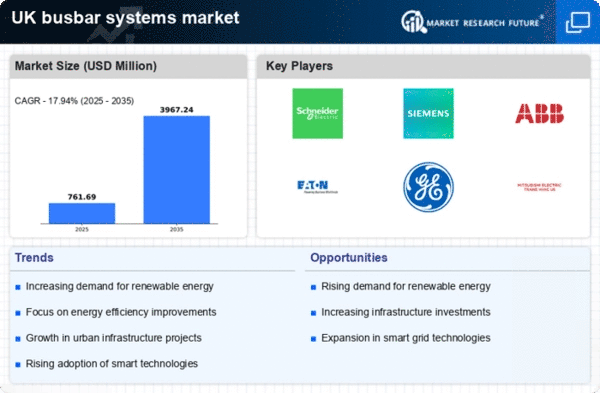
As per Market Research Future analysis, the UK busbar systems market size was estimated at 645.82 USD Million in 2024. The UK busbar systems market is projected to grow from 761.69 USD Million in 2025 to 3967.24 USD Million by 2035, exhibiting a compound annual growth rate (CAGR) of 17.9% during the forecast period 2025 - 2035

Key Market Trends & Highlights

The UK busbar systems market is experiencing a transformative shift driven by technological advancements and a focus on renewable energy.

  • The market is witnessing increased adoption of renewable energy sources, which is reshaping power distribution strategies.
  • Technological advancements in busbar systems are enhancing efficiency and reliability in power distribution networks.
  • The largest segment in the market is the industrial sector, while the commercial sector is emerging as the fastest-growing segment.
  • Key market drivers include the growing demand for efficient power distribution and infrastructure development initiatives.

Market Size & Forecast

2024 Market Size 645.82 (USD Million)
2035 Market Size 3967.24 (USD Million)
CAGR (2025 - 2035) 17.94%

Major Players

Schneider Electric (FR), Siemens (DE), ABB (CH), Eaton (IE), General Electric (US), Mitsubishi Electric (JP), Legrand (FR), C&S Electric (IN), Rittal (DE)

Our Impact
Enabled $4.3B Revenue Impact for Fortune 500 and Leading Multinationals
Partnering with 2000+ Global Organizations Each Year
30K+ Citations by Top-Tier Firms in the Industry

UK Busbar Systems Market Trends

The busbar systems market is currently experiencing a notable transformation, driven by the increasing demand for efficient power distribution solutions. This shift is largely influenced by the growing emphasis on renewable energy sources and the need for reliable electrical infrastructure. As industries and commercial sectors seek to enhance their energy efficiency, busbar systems are emerging as a preferred choice due to their ability to minimize energy losses and optimize space utilization. Furthermore, advancements in technology are facilitating the development of innovative busbar designs that cater to diverse applications, thereby expanding their market reach. In addition, regulatory frameworks are evolving to support the adoption of sustainable energy practices, which further propels the busbar systems market. The integration of smart technologies into electrical systems is also gaining traction, as it allows for better monitoring and management of energy consumption. This trend indicates a shift towards more intelligent and responsive electrical networks, where busbar systems play a crucial role. Overall, the current landscape suggests a promising future for the busbar systems market, characterized by innovation, sustainability, and enhanced performance.

Increased Adoption of Renewable Energy

The transition towards renewable energy sources is significantly influencing the busbar systems market. As more organizations invest in solar, wind, and other sustainable energy solutions, the demand for efficient power distribution systems rises. Busbar systems are well-suited for integrating these energy sources, facilitating seamless connections and reducing energy losses.

Technological Advancements

Ongoing technological innovations are reshaping the busbar systems market. Enhanced materials and design techniques are leading to the development of more efficient and compact busbar solutions. These advancements not only improve performance but also cater to the specific needs of various industries, making busbars a versatile choice for modern electrical systems.

Regulatory Support for Energy Efficiency

Government policies aimed at promoting energy efficiency are positively impacting the busbar systems market. Regulations encouraging the use of advanced electrical infrastructure are driving investments in busbar technology. This support is likely to foster growth, as businesses seek to comply with sustainability standards and enhance their operational efficiency.

UK Busbar Systems Market Drivers

Integration of Smart Technologies

The integration of smart technologies into the busbar systems market is transforming the landscape of power distribution in the UK. As the demand for intelligent energy management solutions grows, busbar systems are evolving to incorporate advanced features such as real-time monitoring, automated control, and data analytics. These innovations enable users to optimize energy consumption, enhance operational efficiency, and reduce costs. By 2025, it is projected that the adoption of smart busbar systems will increase by approximately 25%, driven by the need for more responsive and adaptable power distribution solutions. This trend aligns with the broader movement towards smart grids and digitalization in the energy sector, positioning the busbar systems market as a key player in the future of energy management.

Infrastructure Development Initiatives

Infrastructure development initiatives in the UK are playing a crucial role in propelling the busbar systems market forward. The government has committed substantial investments in upgrading and expanding electrical infrastructure, which includes the integration of advanced busbar systems. These initiatives aim to modernize the power grid, enhance reliability, and accommodate the increasing energy demands of urban areas. In 2025, the UK government is expected to allocate over £10 billion towards infrastructure projects, which will likely create a conducive environment for the busbar systems market to flourish. The emphasis on smart grid technologies and renewable energy integration further underscores the importance of robust power distribution systems, positioning busbars as essential components in the evolving energy landscape.

Focus on Safety and Reliability Standards

Safety and reliability are paramount in the busbar systems market, particularly in the context of the UK's stringent regulatory environment. The increasing emphasis on safety standards and compliance is driving the adoption of advanced busbar systems that meet these requirements. Manufacturers are investing in innovative technologies to enhance the safety features of their products, ensuring they can withstand various operational challenges. In 2025, it is anticipated that the market will see a shift towards busbar systems that incorporate advanced monitoring and control mechanisms, thereby improving reliability and reducing the risk of electrical failures. This focus on safety not only protects infrastructure but also enhances the overall performance of power distribution systems, making them more appealing to end-users.

Rising Urbanization and Industrialization

The rapid urbanization and industrialization trends in the UK are significantly influencing the busbar systems market. As cities expand and industries grow, the demand for reliable and efficient power distribution systems intensifies. Urban areas are witnessing a surge in population, leading to increased energy consumption and the need for robust electrical infrastructure. The busbar systems market is likely to benefit from this trend, as these systems offer a compact and efficient solution for power distribution in densely populated regions. By 2025, urban areas are projected to account for over 70% of the total energy consumption in the UK, further emphasizing the necessity for advanced busbar systems to meet the rising energy demands of urban infrastructure and industrial facilities.

Growing Demand for Efficient Power Distribution

The busbar systems market is experiencing a notable surge in demand due to the increasing need for efficient power distribution solutions across various sectors in the UK. As industries strive to enhance their operational efficiency, the adoption of busbar systems has become a strategic choice. These systems facilitate the effective transmission of electricity, reducing energy losses and improving overall performance. In 2025, the market is projected to grow at a CAGR of approximately 6.5%, driven by the rising focus on energy efficiency and sustainability. This trend is particularly evident in commercial and industrial applications, where the need for reliable and high-capacity power distribution is paramount. Consequently, the busbar systems market is positioned to benefit significantly from this growing demand, as businesses seek to optimize their energy consumption and reduce operational costs.


Market Segment Insights

By Conductor: Copper (Largest) vs. Aluminum (Fastest-Growing)

In the UK busbar systems market, the conductor segment is primarily dominated by copper, which holds the largest share due to its excellent conductivity and reliability in electrical applications. Copper's characteristics make it a preferred choice for many manufacturers, contributing to its strong presence in various industrial sectors. On the other hand, aluminum is emerging as a significant player, gaining traction owing to its lightweight properties and cost-effectiveness, which allow for more flexible designs and installations. The growth trends in this segment are largely driven by advancements in technology and increasing demand for energy-efficient solutions in the busbar systems market. The shift towards renewable energy sources and sustainable practices is further pushing the adoption of aluminum, which is seen as a more eco-friendly alternative. Additionally, as industries seek to reduce weight without compromising performance, aluminum's appeal is rapidly increasing, making it the fastest-growing conductor in the market.

Conductor: Copper (Dominant) vs. Aluminum (Emerging)

Copper is the dominant conductor in the UK busbar systems market, primarily due to its superior electrical conductivity, durability, and resistance to corrosion. This heavy metal is widely utilized in high-performance applications where reliability and efficiency are critical. Conversely, aluminum is identified as an emerging conductor, rapidly gaining market share due to its lighter weight and lower cost compared to copper. As industries prioritize both sustainability and cost-efficiency, aluminum's popularity is surging. It presents a compelling alternative for many manufacturers looking to enhance performance while being mindful of budget constraints. The unique properties of both materials position them effectively within the market, catering to different segments and specific application needs.

By Power Rating: Medium (Largest) vs. Low (Fastest-Growing)

The power rating segment of the UK busbar systems market reveals a clear distribution among its values. Currently, the medium power rating holds the largest share, dominating the market landscape due to its optimal balance of capacity and efficiency. Contrastingly, low power rating systems are emerging steadily, appealing primarily to smaller applications and projects seeking cost-effective solutions. Growth trends indicate a rising demand for low power rating systems as more businesses focus on energy efficiency and sustainability. This shift is driven by the need for compact solutions in urban areas and a strong regulatory push towards reducing energy consumption. The medium power rating segment, while currently dominant, must innovate continually to maintain its position against the rapidly growing low power rating segment.

Medium (Dominant) vs. Low (Emerging)

The medium power rating in the UK busbar systems market is characterized by its ability to handle substantial electrical loads while ensuring safety and efficiency. This segment is prevalent in commercial buildings and industrial applications where power capacity is a significant concern. In contrast, low power rating systems are gaining traction, particularly among small businesses and residential projects. They offer a compact, economical choice, making them increasingly favored by end-users looking for budget-friendly options. As industries adapt to stricter energy regulations, the emergence of low power solutions demonstrates a shift toward environmentally conscious practices, positioning them as a noteworthy competitor in the market.

By End-Use Industry: Industrial (Largest) vs. Residential (Fastest-Growing)

The UK busbar systems market showcases a diverse distribution among its end-use segments, with the industrial segment holding the largest share. This segment benefits from extensive applications in manufacturing, construction, and energy sectors, driving significant demand for efficient electrical distribution. In contrast, the residential segment is witnessing rapid growth, primarily due to the increasing adoption of advanced electrical solutions in homes, along with the push for energy-efficient systems. Growth trends in the UK busbar systems market are propelled by factors such as rising energy demands and stringent regulations promoting sustainable practices. The industrial sector remains a stable pillar, while the burgeoning residential segment is influenced by urbanization and advancements in smart home technologies. As home automation becomes more prevalent, the demand for sophisticated electrical distribution systems is set to rise, marking a notable shift in market dynamics.

Industrial (Dominant) vs. Residential (Emerging)

The industrial segment of the UK busbar systems market is characterized by its dominant position, primarily driven by large-scale operations that require robust and reliable electrical distribution solutions. This segment caters to various industries, including manufacturing and energy, where efficiency and safety are paramount. On the other hand, the residential segment is emerging as a significant player, propelled by trends towards smart home installations and energy-efficient systems. As more homeowners seek to optimize energy consumption, the demand for innovative busbar solutions tailored for residential applications is increasing. This shift is indicative of changing consumer preferences, where convenience and sustainability are prioritized, setting the stage for future growth in the residential sector.

Get more detailed insights about UK Busbar Systems Market

Key Players and Competitive Insights

The busbar systems market in the UK is characterized by a competitive landscape that is increasingly shaped by technological advancements and sustainability initiatives. Key players such as Schneider Electric (FR), Siemens (DE), and ABB (CH) are actively pursuing strategies that emphasize innovation and digital transformation. Schneider Electric (FR), for instance, has focused on enhancing its product offerings through smart technology integration, which aligns with the growing demand for energy-efficient solutions. Siemens (DE) appears to be leveraging its strong R&D capabilities to develop advanced busbar systems that cater to the evolving needs of industrial applications, while ABB (CH) is concentrating on expanding its market presence through strategic partnerships and acquisitions, thereby enhancing its competitive edge.
The market structure is moderately fragmented, with several players vying for market share. Key business tactics include localizing manufacturing to reduce costs and optimize supply chains, which is particularly relevant in the context of rising material costs and logistical challenges. The collective influence of these major companies shapes the competitive dynamics, as they continuously adapt to market demands and regulatory changes.
In October 2025, Schneider Electric (FR) announced the launch of its new range of eco-friendly busbar systems designed to reduce carbon emissions by 30%. This strategic move not only reinforces the company's commitment to sustainability but also positions it favorably in a market increasingly driven by environmental considerations. The introduction of these products is likely to attract customers seeking to enhance their energy efficiency and reduce their carbon footprint.
In September 2025, Siemens (DE) unveiled a partnership with a leading technology firm to develop AI-driven solutions for busbar systems. This collaboration aims to enhance predictive maintenance capabilities, thereby reducing downtime and operational costs for end-users. The integration of AI into their offerings suggests a forward-thinking approach that could redefine operational efficiencies in the sector.
In August 2025, ABB (CH) completed the acquisition of a regional competitor, which is expected to bolster its market share and expand its product portfolio. This acquisition not only enhances ABB's capabilities in delivering comprehensive solutions but also signifies a strategic move to consolidate its position in the UK market. Such actions reflect a broader trend of consolidation among key players, aiming to leverage synergies and improve competitive positioning.
As of November 2025, the competitive trends in the busbar systems market are increasingly defined by digitalization, sustainability, and the integration of advanced technologies such as AI. Strategic alliances are becoming more prevalent, as companies recognize the need to collaborate to innovate and meet customer demands effectively. The shift from price-based competition to a focus on technological innovation and supply chain reliability is evident, suggesting that future competitive differentiation will hinge on the ability to deliver cutting-edge solutions that align with sustainability goals.

Key Companies in the UK Busbar Systems Market include

Industry Developments

Recent developments in the UK Busbar Systems Market have seen increasing investments and technological advancements aimed at enhancing efficiency and sustainability. Companies such as Siemens, Schneider Electric, and General Electric are focusing on innovative solutions that address the rising demand for energy-efficient infrastructures. In July 2023, Panasonic expanded its offerings in the UK market by introducing new busbar systems designed to meet the growing needs of commercial buildings, thereby solidifying its presence. Additionally, in August 2023, Emerson Electric announced its strategy to acquire Busbar Systems Ltd, enhancing its portfolio and market share significantly.

This strategic acquisition is expected to create synergies through advanced product development and an expanded customer base. 

The market's valuation has seen a positive trajectory, with estimated growth of 4-5% from 2022 to 2023, fueled by increasing construction activities and a push towards renewable energy sources. Furthermore, companies like Mitsubishi Electric and Eaton are also expanding their market presence in the UK, contributing to competitive dynamics in the busbar systems segment. Over the past 2-3 years, initiatives aimed at improving electrical safety standards have also gained momentum within the industry, aligning with government goals for modernizing electrical infrastructure.


Future Outlook

UK Busbar Systems Market Future Outlook

The Busbar Systems Market is projected to grow at a 17.94% CAGR from 2025 to 2035, driven by increasing demand for efficient power distribution and renewable energy integration.

New opportunities lie in:

  • Development of modular busbar systems for rapid deployment in construction projects.
  • Expansion into smart grid technologies to enhance energy management solutions.
  • Partnerships with renewable energy firms for integrated busbar solutions.

By 2035, the busbar systems market is expected to achieve substantial growth, driven by innovation and strategic partnerships.

Market Segmentation

UK Busbar Systems Market Conductor Outlook

  • Copper
  • Aluminum

UK Busbar Systems Market Power Rating Outlook

  • Low
  • Medium
  • High

UK Busbar Systems Market End-Use Industry Outlook

  • Residential
  • Industrial
  • Commercial

Report Scope

MARKET SIZE 2024 645.82(USD Million)
MARKET SIZE 2025 761.69(USD Million)
MARKET SIZE 2035 3967.24(USD Million)
COMPOUND ANNUAL GROWTH RATE (CAGR) 17.94% (2025 - 2035)
REPORT COVERAGE Revenue Forecast, Competitive Landscape, Growth Factors, and Trends
BASE YEAR 2024
Market Forecast Period 2025 - 2035
Historical Data 2019 - 2024
Market Forecast Units USD Million
Key Companies Profiled Schneider Electric (FR), Siemens (DE), ABB (CH), Eaton (IE), General Electric (US), Mitsubishi Electric (JP), Legrand (FR), C&S Electric (IN), Rittal (DE)
Segments Covered Conductor, Power Rating, End-Use Industry
Key Market Opportunities Integration of renewable energy sources drives demand for advanced busbar systems in the UK.
Key Market Dynamics Growing demand for energy-efficient solutions drives innovation and competition in the busbar systems market.
Countries Covered UK
Leave a Comment

FAQs

What is the expected market size of the UK Busbar Systems Market in 2024?

The UK Busbar Systems Market is expected to be valued at 947.1 million USD in 2024.

What is the projected market size for the UK Busbar Systems Market by 2035?

By 2035, the UK Busbar Systems Market is projected to reach a value of 3693.8 million USD.

What is the expected compound annual growth rate (CAGR) for the UK Busbar Systems Market from 2025 to 2035?

The expected CAGR for the UK Busbar Systems Market from 2025 to 2035 is 13.171%.

What are the main segments of the UK Busbar Systems Market by conductor type?

The main segments by conductor type in the UK Busbar Systems Market are Copper and Aluminum.

How much is the Copper segment of the UK Busbar Systems Market expected to be valued at in 2024?

The Copper segment of the market is expected to be valued at 400.0 million USD in 2024.

What is the expected value of the Aluminum segment in the UK Busbar Systems Market by 2035?

The Aluminum segment is expected to reach a value of 2193.8 million USD by 2035.

Who are the key players in the UK Busbar Systems Market?

Key players in the market include Panasonic, Siemens, Emerson Electric, and General Electric among others.

What is driving the growth of the UK Busbar Systems Market?

The growth is driven by increasing infrastructure development and rising demand for efficient power distribution systems.

What challenges might the UK Busbar Systems Market face in the coming years?

Challenges may include fluctuations in raw material prices and the need for technological advancements.

What are the applications of Busbar Systems in the UK market?

Busbar Systems are widely used in commercial buildings, industrial facilities, and power generation plants.

Download Free Sample

Kindly complete the form below to receive a free sample of this Report

Compare Licence

×
Features License Type
Single User Multiuser License Enterprise User
Price $4,950 $5,950 $7,250
Maximum User Access Limit 1 User Upto 10 Users Unrestricted Access Throughout the Organization
Free Customization
Direct Access to Analyst
Deliverable Format
Platform Access
Discount on Next Purchase 10% 15% 15%
Printable Versions