×
Request Free Sample ×

Kindly complete the form below to receive a free sample of this Report

* Please use a valid business email

Leading companies partner with us for data-driven Insights

clients tt-cursor
Hero Background

UK Artificial Intelligence in Manufacturing Market

ID: MRFR/ICT/56590-HCR
200 Pages
Aarti Dhapte
February 2026

UK Artificial Intelligence AI in Manufacturing Market Size, Share and Trends Analysis Report By Application (Predictive Maintenance, Quality Control, Supply Chain Management, Robotics, Production Planning), By Technology (Machine Learning, Natural Language Processing, Computer Vision, Robotic Process Automation, Deep Learning), By Deployment Type (On-Premise, Cloud, Hybrid) and By End Use Industry (Automotive, Electronics, Aerospace, Food and Beverage, Pharmaceuticals)- Forecast to 2035

Share:
Download PDF ×

We do not share your information with anyone. However, we may send you emails based on your report interest from time to time. You may contact us at any time to opt-out.

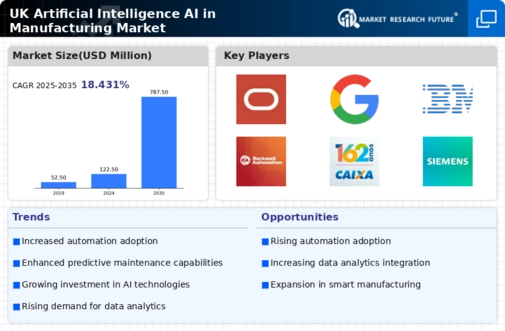
UK Artificial Intelligence in Manufacturing Market Infographic
Purchase Options

UK Artificial Intelligence in Manufacturing Market Summary

As per analysis, the UK artificial intelligence in manufacturing market is projected to grow from USD 227.48 Billion in 2025 to USD 2365.97 Billion by 2035, exhibiting a compound annual growth rate (CAGR) of 26.69% during the forecast period (2025 - 2035).

Key Market Trends & Highlights

The UK artificial intelligence in manufacturing market is poised for substantial growth driven by automation and data-centric strategies.

  • Predictive maintenance emerges as the largest segment, enhancing operational efficiency across various manufacturing sectors.
  • Process automation is the fastest-growing segment, reflecting a shift towards streamlined operations and reduced labor costs.
  • Automotive manufacturing remains the largest sector utilizing AI, while electronics manufacturing is rapidly adopting AI technologies.
  • Key market drivers include enhanced operational efficiency and regulatory support, which are likely to propel further advancements in AI applications.

Market Size & Forecast

2024 Market Size 175.36 (USD Billion)
2035 Market Size 2365.97 (USD Billion)
CAGR (2025 - 2035) 26.69%

Major Players

DeepMind (GB), Darktrace (GB), Ocado Group (GB), C3.ai (US), Siemens (DE), ABB (CH), Rockwell Automation (US), IBM (US), Microsoft (US)

Our Impact
Enabled $4.3B Revenue Impact for Fortune 500 and Leading Multinationals
Partnering with 2000+ Global Organizations Each Year
30K+ Citations by Top-Tier Firms in the Industry

UK Artificial Intelligence in Manufacturing Market Trends

The UK artificial intelligence in manufacturing market is currently experiencing a transformative phase, driven by advancements in technology and a growing emphasis on efficiency. Manufacturers are increasingly adopting AI solutions to optimize production processes, enhance quality control, and reduce operational costs. This shift appears to be influenced by the need for greater competitiveness in a rapidly evolving industrial landscape. As companies integrate AI into their operations, they are likely to witness improvements in productivity and innovation, which may lead to a more resilient manufacturing sector. Moreover, the UK government has been actively promoting the adoption of artificial intelligence within the manufacturing industry. Initiatives aimed at fostering research and development, alongside funding opportunities for AI projects, suggest a supportive environment for businesses looking to leverage these technologies. The collaboration between academia and industry is also gaining traction, potentially leading to the development of cutting-edge AI applications tailored to the unique challenges faced by UK manufacturers. This synergy may further accelerate the integration of AI, positioning the UK as a leader in the manufacturing sector.

Increased Automation

The UK artificial intelligence in manufacturing market is witnessing a trend towards heightened automation. Manufacturers are increasingly utilizing AI-driven systems to automate repetitive tasks, thereby enhancing efficiency and reducing human error. This shift not only streamlines operations but also allows human workers to focus on more complex and strategic activities.

Data-Driven Decision Making

Another notable trend is the emphasis on data-driven decision making within the UK artificial intelligence in manufacturing market. Companies are harnessing AI to analyze vast amounts of data generated during production processes. This analytical capability enables manufacturers to make informed decisions, optimize resource allocation, and improve overall operational performance.

Sustainability Initiatives

Sustainability is becoming a focal point in the UK artificial intelligence in manufacturing market. Manufacturers are increasingly leveraging AI technologies to enhance energy efficiency and reduce waste. By implementing AI solutions, companies can monitor and manage their environmental impact, aligning with broader sustainability goals and regulatory requirements.

UK Artificial Intelligence in Manufacturing Market Drivers

Workforce Transformation

The UK artificial intelligence in manufacturing market is experiencing a transformation in workforce dynamics. As AI technologies become more prevalent, there is a growing emphasis on reskilling and upskilling the workforce to adapt to new roles that AI creates. The UK government has initiated various programs aimed at fostering skills development in AI and automation, which is crucial for maintaining a competitive workforce. Reports indicate that by 2025, approximately 1.5 million jobs in the manufacturing sector may require advanced AI skills. This shift not only addresses the skills gap but also empowers employees to work alongside AI systems, enhancing job satisfaction and productivity. Consequently, the integration of AI is reshaping the workforce landscape in the UK manufacturing sector.

Supply Chain Optimization

Supply chain optimization is a critical driver in the UK artificial intelligence in manufacturing market. AI technologies are being utilized to enhance supply chain visibility and efficiency, enabling manufacturers to respond swiftly to changes in demand. For instance, AI algorithms can analyze vast amounts of data to predict inventory needs, reducing excess stock and minimizing waste. Recent studies suggest that AI-driven supply chain solutions can lead to a 15% reduction in operational costs. Furthermore, the UK government is actively promoting the adoption of AI in supply chain management through various initiatives, recognizing its potential to bolster economic growth. As manufacturers increasingly leverage AI for supply chain optimization, they are likely to achieve greater agility and resilience in their operations.

Regulatory Support and Funding

Regulatory support and funding are pivotal drivers in the UK artificial intelligence in manufacturing market. The UK government has established various funding programs aimed at encouraging the adoption of AI technologies in manufacturing. Initiatives such as the Industrial Strategy Challenge Fund provide financial support for projects that integrate AI into manufacturing processes. This regulatory backing is crucial for small and medium-sized enterprises (SMEs) that may lack the resources to invest in AI independently. Furthermore, the government is actively working to create a favorable regulatory environment that promotes innovation while ensuring ethical AI use. As a result, the combination of financial incentives and supportive regulations is likely to accelerate the adoption of AI in the UK manufacturing sector, fostering growth and innovation.

Enhanced Operational Efficiency

The UK artificial intelligence in manufacturing market is witnessing a notable shift towards enhanced operational efficiency. AI technologies, such as machine learning and predictive analytics, are being integrated into manufacturing processes to optimize production schedules and reduce downtime. According to recent data, manufacturers that have adopted AI-driven solutions report a 20% increase in productivity. This trend is likely to continue as companies seek to streamline operations and minimize costs. The implementation of AI not only improves efficiency but also allows for real-time monitoring of equipment, leading to proactive maintenance strategies. As a result, manufacturers are better positioned to respond to market demands and fluctuations, thereby enhancing their competitive edge in the UK market.

Innovation in Product Development

Innovation in product development is a significant driver within the UK artificial intelligence in manufacturing market. AI technologies facilitate rapid prototyping and testing, allowing manufacturers to bring new products to market more efficiently. By utilizing AI-driven simulations and data analysis, companies can identify consumer preferences and market trends, leading to more informed product design decisions. The UK government has been supportive of innovation initiatives, providing funding for research and development in AI applications. As a result, manufacturers are increasingly adopting AI to enhance their product development processes, which not only accelerates time-to-market but also improves product quality. This focus on innovation is likely to drive competitiveness in the UK manufacturing sector.


Market Segment Insights

By Application: Predictive Maintenance (Largest) vs. Process Automation (Fastest-Growing)

In the UK artificial intelligence in manufacturing market, Predictive Maintenance holds the largest share, driven by its ability to reduce downtime and maintenance costs. This segment leverages AI algorithms to analyze equipment data, predicting failures before they occur, which enhances operational efficiency across industries. Following closely is Quality Control, which utilizes AI for real-time inspections. Supply Chain Optimization is also notable, as manufacturers increasingly seek efficiencies through data analysis and forecasting. The growth trends indicate significant advancements in Process Automation, which is emerging as the fastest-growing segment due to escalating demands for operational efficiency. The increasing adoption of AI technologies in manufacturing processes reflects a shift towards minimizing human intervention, thereby maximizing production rates. Factors like the need for agility in production and the availability of robust data-driven solutions are propelling this segment forward, indicating a vibrant future for AI integration in manufacturing applications.

Quality Control (Dominant) vs. Supply Chain Optimization (Emerging)

Quality Control, as a dominant application of AI in manufacturing, focuses on enhancing product standards through automated inspection systems and deep learning algorithms. This approach significantly reduces human error and accelerates the inspection process, ensuring that products meet rigorous quality standards. On the other hand, Supply Chain Optimization is an emerging segment that is gaining traction through AI's ability to predict demand fluctuations and optimize inventory levels. Both segments play pivotal roles in the landscape of AI manufacturing, with Quality Control aimed at maintaining high standards for products, while Supply Chain Optimization seeks to streamline operations and improve logistics efficiency. Together, they represent the dual forces driving the evolution of AI in the manufacturing sector.

By End Use: Automotive Manufacturing (Largest) vs. Electronics Manufacturing (Fastest-Growing)

In the UK artificial intelligence in manufacturing market, the automotive manufacturing sector holds the largest market share, driven by ongoing advancements in automation and precision engineering. This segment benefits from the high demand for electric vehicles (EVs) and smart manufacturing practices, making it the focus of significant investment from both manufacturers and technology providers.

Automotive Manufacturing (Dominant) vs. Electronics Manufacturing (Emerging)

The automotive manufacturing sector is characterized by substantial integration of AI technologies for optimizing production efficiency and quality control, positioning it as a dominant player among end-use segments. Major automotive manufacturers are leveraging AI for predictive maintenance, supply chain optimization, and enhancing the customer experience through connected vehicles. On the other hand, the electronics manufacturing sector is emerging rapidly, focusing on AI applications in quality assurance and production automation. As consumer demand for innovative electronics grows, this sector is increasingly adopting AI to improve production speed and reduce costs, making it a competitive landscape driven by innovation.

By Technology: Machine Learning (Largest) vs. Robotics (Fastest-Growing)

In the UK artificial intelligence in manufacturing market, Machine Learning holds the largest share, reflecting its wide-ranging capabilities in data analysis and predictive maintenance. This sector leverages algorithms and statistical models to facilitate automation, improve decision-making processes, and enhance manufacturing efficiency, making it a crucial component of AI adoption. Robotics follows, showcasing rapid growth as integration into manufacturing continues to evolve, with increasing demand for automation driving innovation and investment in this area.

Technology: Machine Learning (Dominant) vs. Robotics (Emerging)

Machine Learning is characterized by its ability to learn from data and improve over time, making it indispensable in predictive analytics, quality control, and process optimization. In contrast, Robotics is emerging strongly, with advancements in AI propelling the development of intelligent robots capable of performing complex tasks. The synergy between Machine Learning and Robotics is becoming critical, as manufacturers seek to enhance productivity and safeguard operational efficiency. The potential for increased flexibility and scalability in robotic applications positions this segment for significant future growth in the manufacturing sector.

By Functionality: Data Analysis (Largest) vs. Automation (Fastest-Growing)

The UK artificial intelligence in manufacturing market showcases a diverse functionality segment, with Data Analysis holding the largest share. This segment focuses on leveraging AI to extract meaningful insights from vast datasets, thus enabling manufacturers to enhance efficiency and optimize operations. Process Optimization and Decision Support also contribute significantly, yet they trail behind Data Analysis in market share, reflecting the ongoing prioritization of data-driven decision-making in manufacturing processes. In recent years, the automation segment has emerged as the fastest-growing area within this market, driven by advancements in technology and a growing emphasis on efficiency. The increasing adoption of AI-driven robots and systems aims to streamline production lines and reduce manual errors, propelled by labor shortages and the need for cost-effective operations. As automation technologies become more accessible, they are expected to witness exponential growth, demanding significant investments and innovations from industry players.

Data Analysis: Dominant vs. Automation: Emerging

Within the UK artificial intelligence in manufacturing market, Data Analysis stands out as the dominant functionality, providing manufacturers with the critical insights needed for informed decision-making. This segment relies on sophisticated algorithms and analytics tools to interpret vast amounts of data, enabling real-time insights that drive efficiency, product quality, and predictive maintenance. Conversely, Automation is recognized as an emerging force in the market, leveraging AI technologies to enhance production processes through robotics and smart machinery that minimize human intervention. As manufacturers increasingly face challenges like labor shortages and heightened production demands, Automation is gaining momentum, showcasing its potential to reshape operational strategies while improving overall productivity and reducing costs.

Get more detailed insights about UK Artificial Intelligence in Manufacturing Market

Key Players and Competitive Insights

The UK artificial intelligence in manufacturing market is currently characterized by a dynamic competitive landscape, driven by rapid technological advancements and increasing demand for automation. Key players such as DeepMind (GB), Darktrace (GB), and Ocado Group (GB) are strategically positioning themselves through innovation and partnerships. DeepMind (GB) focuses on leveraging AI for predictive maintenance and operational efficiency, while Darktrace (GB) emphasizes cybersecurity solutions tailored for manufacturing environments. Ocado Group (GB) is enhancing its logistics and supply chain capabilities through AI-driven automation, thereby reshaping the competitive environment with a strong emphasis on digital transformation.

The market structure appears moderately fragmented, with a mix of established players and emerging startups. Key business tactics include localizing manufacturing processes and optimizing supply chains to enhance responsiveness and reduce costs. The collective influence of these major players fosters a competitive atmosphere where innovation and technological integration are paramount, allowing them to maintain a competitive edge.

In December 2025, DeepMind (GB) announced a collaboration with several UK manufacturers to implement AI-driven predictive maintenance systems. This strategic move is likely to enhance operational efficiency and reduce downtime, positioning DeepMind (GB) as a leader in AI applications within the manufacturing sector. The collaboration underscores the growing importance of AI in optimizing manufacturing processes and minimizing operational disruptions.

In November 2025, Darktrace (GB) launched a new AI-powered cybersecurity platform specifically designed for the manufacturing sector. This initiative aims to address the increasing threat of cyberattacks on manufacturing systems, highlighting Darktrace's commitment to safeguarding critical infrastructure. The introduction of this platform may significantly enhance the resilience of manufacturing operations against cyber threats, thereby reinforcing Darktrace's market position.

In October 2025, Ocado Group (GB) expanded its partnership with various technology firms to enhance its AI capabilities in supply chain management. This strategic alliance is expected to streamline logistics and improve inventory management, reflecting Ocado's focus on integrating advanced technologies into its operations. Such partnerships may provide Ocado with a competitive advantage in the rapidly evolving landscape of AI in manufacturing.

As of January 2026, current trends in the market indicate a strong emphasis on digitalization, sustainability, and AI integration. Strategic alliances among key players are shaping the competitive landscape, fostering innovation and collaboration. The shift from price-based competition to a focus on technological advancement and supply chain reliability is becoming increasingly evident. Moving forward, competitive differentiation will likely hinge on the ability to innovate and adapt to emerging technologies, positioning companies to thrive in an ever-evolving market.

Key Companies in the UK Artificial Intelligence in Manufacturing Market include

Industry Developments

The UK Artificial Intelligence in Manufacturing Market has seen notable developments recently. In September 2023, Oracle announced advancements in its AI-driven manufacturing solutions aimed at optimizing supply chains and enhancing operational efficiency. Google also showcased its latest machine learning algorithms specifically designed for predicting manufacturing equipment failure, thereby improving maintenance schedules and reducing downtime. 

Meanwhile, ABB launched a new AI platform that integrates seamlessly into existing manufacturing workflows, helping companies better analyze production data. In October 2022, IBM entered into a strategic partnership with Siemens to accelerate digital transformation in the manufacturing sector through AI technologies. Additionally, Honeywell announced a significant growth investment in AI research to develop innovative solutions tailored for the UK manufacturing landscape. 

Notably, the UK government has been promoting the adoption of AI in manufacturing through various funding initiatives that aim to boost innovation and economic growth as part of its industrial strategy. The overall market for Artificial Intelligence in the UK's manufacturing sector continues to thrive, fueled by technological advancements and strategic partnerships among key players including Microsoft, C3.ai, and Rockwell Automation, reflecting a robust trend toward digital transformation in the industry.

Future Outlook

UK Artificial Intelligence in Manufacturing Market Future Outlook

The UK artificial intelligence in manufacturing market is poised for growth at 26.69% CAGR from 2025 to 2035, driven by automation, data analytics, and enhanced productivity.

New opportunities lie in:

  • Integration of AI-driven predictive maintenance solutions
  • Development of customized AI algorithms for supply chain optimization
  • Implementation of AI-powered quality control systems

By 2035, the market is expected to be robust, driven by innovation and strategic investments.

Market Segmentation

UK Artificial Intelligence in Manufacturing Market End Use Outlook

  • Automotive Manufacturing
  • Electronics Manufacturing
  • Aerospace Manufacturing
  • Food and Beverage Manufacturing

UK Artificial Intelligence in Manufacturing Market Technology Outlook

  • Machine Learning
  • Natural Language Processing
  • Computer Vision
  • Robotics

UK Artificial Intelligence in Manufacturing Market Application Outlook

  • Predictive Maintenance
  • Quality Control
  • Supply Chain Optimization
  • Process Automation

UK Artificial Intelligence in Manufacturing Market Functionality Outlook

  • Data Analysis
  • Process Optimization
  • Decision Support
  • Automation

Report Scope

MARKET SIZE 2024175.36(USD Billion)
MARKET SIZE 2025227.48(USD Billion)
MARKET SIZE 20352365.97(USD Billion)
COMPOUND ANNUAL GROWTH RATE (CAGR)26.69% (2024 - 2035)
REPORT COVERAGERevenue Forecast, Competitive Landscape, Growth Factors, and Trends
BASE YEAR2024
Market Forecast Period2025 - 2035
Historical Data2019 - 2024
Market Forecast UnitsUSD Billion
Key Companies ProfiledDeepMind (GB), Darktrace (GB), Ocado Group (GB), C3.ai (US), Siemens (DE), ABB (CH), Rockwell Automation (US), IBM (US), Microsoft (US)
Segments CoveredApplication, End Use, Technology, Functionality
Key Market OpportunitiesIntegration of advanced machine learning algorithms to enhance predictive maintenance in the uk artificial intelligence in manufacturing market.
Key Market DynamicsGrowing integration of artificial intelligence technologies enhances operational efficiency in the UK manufacturing sector.
Countries CoveredUK
Leave a Comment

FAQs

What is the current valuation of the UK artificial intelligence in manufacturing market?

As of 2024, the market valuation was 175.36 USD Billion.

What is the projected market size for the UK artificial intelligence in manufacturing market by 2035?

The market is projected to reach 2365.97 USD Billion by 2035.

What is the expected CAGR for the UK artificial intelligence in manufacturing market during the forecast period 2025 - 2035?

The expected CAGR for this market is 26.69% during the forecast period.

Which application segment holds the largest market share in the UK artificial intelligence in manufacturing market?

Process Automation, valued at 815.97 USD Billion, appears to hold the largest market share among application segments.

How does the automotive manufacturing sector contribute to the UK artificial intelligence in manufacturing market?

The automotive manufacturing sector was valued at 500.0 USD Billion in 2024, indicating its substantial contribution to the market.

What role do key players like DeepMind and Siemens play in the UK artificial intelligence in manufacturing market?

Key players such as DeepMind and Siemens are likely to drive innovation and market growth through advanced AI solutions.

Which technology segment is projected to grow the fastest in the UK artificial intelligence in manufacturing market?

Machine Learning, with a valuation of 1000.0 USD Billion, is projected to be a leading growth driver in the technology segment.

What functionality segment is expected to dominate the UK artificial intelligence in manufacturing market?

Automation, valued at 865.97 USD Billion, is expected to dominate the functionality segment.

How does the food and beverage manufacturing sector impact the UK artificial intelligence in manufacturing market?

The food and beverage manufacturing sector was valued at 965.97 USD Billion in 2024, indicating a significant impact on the overall market.

What are the implications of the projected growth in the UK artificial intelligence in manufacturing market for businesses?

The projected growth suggests that businesses may need to invest in AI technologies to remain competitive and leverage emerging opportunities.

Download Free Sample

Kindly complete the form below to receive a free sample of this Report

Compare Licence

×
Features License Type
Single User Multiuser License Enterprise User
Price $4,950 $5,950 $7,250
Maximum User Access Limit 1 User Upto 10 Users Unrestricted Access Throughout the Organization
Free Customization
Direct Access to Analyst
Deliverable Format
Platform Access
Discount on Next Purchase 10% 15% 15%
Printable Versions