×
Request Free Sample ×

Kindly complete the form below to receive a free sample of this Report

* Please use a valid business email

Leading companies partner with us for data-driven Insights

clients tt-cursor
Hero Background

Japan Artificial Intelligence in Manufacturing Market

ID: MRFR/ICT/56593-HCR
200 Pages
Aarti Dhapte
February 2026

Japan Artificial Intelligence AI in Manufacturing Market Size, Share and Trends Analysis Report By Application (Predictive Maintenance, Quality Control, Supply Chain Management, Robotics, Production Planning), By Technology (Machine Learning, Natural Language Processing, Computer Vision, Robotic Process Automation, Deep Learning), By Deployment Type (On-Premise, Cloud, Hybrid) and By End Use Industry (Automotive, Electronics, Aerospace, Food and Beverage, Pharmaceuticals)- Forecast to 2035

Share:
Download PDF ×

We do not share your information with anyone. However, we may send you emails based on your report interest from time to time. You may contact us at any time to opt-out.

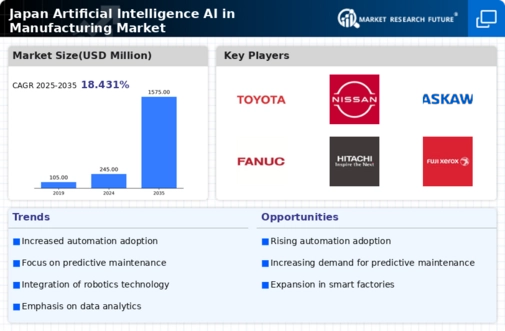
Japan Artificial Intelligence in Manufacturing Market Infographic
Purchase Options

Japan Artificial Intelligence in Manufacturing Market Summary

As per analysis, the Japan Artificial Intelligence in Manufacturing Market is projected to grow from USD 230.17 Billion in 2024 to USD 3105.34 Billion by 2035, exhibiting a compound annual growth rate (CAGR) of 26.69% during the forecast period (2025 - 2035).

Key Market Trends & Highlights

The Japan Artificial Intelligence in Manufacturing Market is poised for substantial growth driven by automation and predictive maintenance advancements.

  • The predictive maintenance segment remains the largest, reflecting a strong emphasis on operational efficiency.
  • Robotics automation is the fastest-growing segment, indicating a shift towards more intelligent manufacturing processes.
  • The automotive sector continues to dominate the market, while the electronics sector is experiencing rapid growth.
  • Rising demand for smart manufacturing solutions and government initiatives are key drivers propelling market expansion.

Market Size & Forecast

2024 Market Size 230.17 (USD Billion)
2035 Market Size 3105.34 (USD Billion)
CAGR (2025 - 2035) 26.69%

Major Players

Fanuc (JP), Mitsubishi Electric (JP), Yaskawa Electric (JP), Omron (JP), Hitachi (JP), NEC (JP), Fujitsu (JP), Sony (JP), Toyota Industries (JP)

Our Impact
Enabled $4.3B Revenue Impact for Fortune 500 and Leading Multinationals
Partnering with 2000+ Global Organizations Each Year
30K+ Citations by Top-Tier Firms in the Industry

Japan Artificial Intelligence in Manufacturing Market Trends

The Japan Artificial Intelligence in Manufacturing Market is currently experiencing a transformative phase, driven by advancements in technology and a growing emphasis on efficiency. Japanese manufacturers are increasingly integrating artificial intelligence solutions to enhance production processes, optimize supply chains, and improve product quality. This shift appears to be influenced by the need for greater competitiveness in a rapidly evolving industrial landscape. As companies adopt AI-driven tools, they are likely to witness significant improvements in operational efficiency and decision-making capabilities. Moreover, the government of Japan is actively promoting the adoption of artificial intelligence in various sectors, including manufacturing. Initiatives aimed at fostering innovation and supporting research and development are likely to play a crucial role in shaping the future of this market. The focus on smart factories and automation suggests a potential for increased collaboration between technology providers and manufacturers. As the landscape evolves, the integration of AI technologies may redefine traditional manufacturing paradigms, leading to enhanced productivity and sustainability in the industry.

Increased Automation

The trend towards automation in the japan artificial intelligence in manufacturing market is becoming more pronounced. Manufacturers are leveraging AI technologies to automate repetitive tasks, which not only enhances productivity but also reduces human error. This shift is likely to lead to a more streamlined production process, allowing companies to allocate resources more effectively.

Enhanced Predictive Maintenance

Predictive maintenance is gaining traction within the japan artificial intelligence in manufacturing market. By utilizing AI algorithms, manufacturers can analyze data from machinery to predict failures before they occur. This proactive approach may result in reduced downtime and maintenance costs, ultimately contributing to improved operational efficiency.

Focus on Sustainability

Sustainability is emerging as a key consideration in the japan artificial intelligence in manufacturing market. Companies are increasingly adopting AI solutions to optimize resource usage and minimize waste. This trend suggests a growing awareness of environmental impact, as manufacturers seek to align their operations with sustainable practices.

Japan Artificial Intelligence in Manufacturing Market Drivers

Advancements in AI Technologies

The rapid advancements in AI technologies are propelling the Japan artificial intelligence in manufacturing market forward. Innovations in machine learning, computer vision, and robotics are enabling manufacturers to implement more sophisticated AI solutions. These technologies allow for improved automation, predictive analytics, and enhanced decision-making processes. For instance, the use of AI-driven robotics in assembly lines has shown to increase efficiency by up to 40%. As these technologies continue to evolve, they are likely to create new opportunities for manufacturers to optimize their operations and reduce costs. The ongoing research and development in AI signify a promising future for the manufacturing sector in Japan.

Growing Focus on Quality Control

Quality control remains a paramount concern within the Japan artificial intelligence in manufacturing market. The integration of AI technologies facilitates advanced quality assurance processes, which are essential for maintaining high standards in production. AI-driven systems can analyze vast amounts of data to identify defects and anomalies in real-time, thereby reducing waste and improving product quality. Recent studies indicate that manufacturers utilizing AI for quality control have seen a 30% reduction in defects. This focus on quality not only enhances customer satisfaction but also strengthens brand reputation, making it a vital driver for AI adoption in the manufacturing sector.

Government Initiatives and Support

The Japan artificial intelligence in manufacturing market benefits significantly from government initiatives aimed at promoting AI adoption. The Japanese government has launched various programs to support the integration of AI technologies in manufacturing. For instance, the 'Society 5.0' initiative emphasizes the importance of digital transformation across industries, including manufacturing. This initiative encourages collaboration between public and private sectors, fostering an environment conducive to innovation. Furthermore, financial incentives and grants are available for companies investing in AI solutions, which could potentially accelerate the adoption rate. Such government backing not only enhances the credibility of AI technologies but also encourages manufacturers to explore and implement AI-driven solutions.

Labor Shortages and Workforce Transformation

Japan's manufacturing sector is currently grappling with labor shortages, which is a significant driver for the Japan artificial intelligence in manufacturing market. As the workforce ages and fewer young individuals enter the manufacturing field, companies are increasingly turning to AI solutions to fill the gaps. AI technologies can automate repetitive tasks, allowing human workers to focus on more complex and value-added activities. This transformation not only addresses labor shortages but also enhances overall productivity. It is estimated that by 2026, AI could potentially augment the capabilities of the existing workforce, leading to a more efficient manufacturing environment.

Rising Demand for Smart Manufacturing Solutions

The Japan artificial intelligence in manufacturing market is experiencing a notable surge in demand for smart manufacturing solutions. This trend is driven by the need for enhanced operational efficiency and productivity. According to recent data, approximately 60% of manufacturers in Japan are actively investing in AI technologies to optimize their production processes. The integration of AI enables real-time data analysis, which facilitates informed decision-making and reduces downtime. As companies strive to remain competitive in a global market, the adoption of smart manufacturing solutions appears to be a critical strategy. This shift not only enhances productivity but also aligns with Japan's broader goals of innovation and technological advancement in the manufacturing sector.


Market Segment Insights

By Application: Predictive Maintenance (Largest) vs. Robotics Automation (Fastest-Growing)

In the Japan artificial intelligence in manufacturing market, the application segment is characterized by a diverse range of solutions with varying market shares. Predictive Maintenance stands out as the largest application, taking a significant share of the market due to its critical role in minimizing downtime and enhancing equipment reliability. Following closely, Quality Control and Supply Chain Optimization contribute substantially, while Robotics Automation emerges as a rapidly growing area fueled by advancements in AI and increasing automation across manufacturing processes. Growth trends in the application segment are primarily driven by the need for operational efficiency and competitive advantage in the manufacturing sector. Companies are increasingly adopting AI technologies to optimize production processes, manage supply chains, and ensure product quality. The integration of AI in Robotics Automation is particularly noteworthy, as it enables greater flexibility and precision in manufacturing operations, positioning it as the fastest-growing area in the market, reflecting a shift towards more automated manufacturing environments.

Predictive Maintenance: Dominant vs. Robotics Automation: Emerging

Predictive Maintenance has established itself as a dominant force in the Japan artificial intelligence in manufacturing market, providing manufacturers with tools to anticipate equipment failures and reduce maintenance costs. This segment leverages AI algorithms to analyze data from machine sensors and predict when maintenance should be performed, thereby enhancing operational efficiency. In contrast, Robotics Automation is an emerging segment that is rapidly gaining traction. It involves the integration of AI with robotic systems to automate various manufacturing tasks, resulting in increased productivity and reduced labor costs. The rise of Industry 4.0 and smart factories is propelling the demand for robotic solutions, making Robotics Automation a vital player in the transformative landscape of manufacturing AI applications.

By End Use: Automotive (Largest) vs. Electronics (Fastest-Growing)

In the Japan artificial intelligence in manufacturing market, the end-use segment showcases a diverse distribution across various industries. The automotive sector is the largest, predominantly leveraging AI for automation, predictive maintenance, and supply chain optimization. Conversely, the electronics sector is rapidly expanding as manufacturers adopt AI technologies for quality control, design improvements, and enhanced production efficiency, indicating a significant shift in market dynamics towards electronics.

Automotive (Dominant) vs. Electronics (Emerging)

The automotive sector remains dominant in the application of AI within the Japanese manufacturing landscape, driven by the continuous need for innovation in vehicle production and the push towards autonomous vehicles. Manufacturers are increasingly employing AI-driven solutions for robotics, assembly line optimization, and real-time data analytics. On the other hand, the electronics sector is emerging as a pivotal area for AI, fuelled by rapid technological advancements and the demand for smarter devices. This segment is characterized by the integration of AI in production processes, helping to streamline operations, reduce defects, and enhance overall product quality.

By Technology: Machine Learning (Largest) vs. Natural Language Processing (Fastest-Growing)

In the Japan artificial intelligence in manufacturing market, Machine Learning holds the largest market share, representing a significant portion of the segment. This technology has become increasingly integrated into various manufacturing processes, driving efficiency and innovation. On the other hand, Natural Language Processing (NLP) is rapidly gaining traction, showcasing the fastest growth among the segments. Companies are leveraging NLP for better interaction with equipment and enhanced communication within operational platforms, illustrating its expanding role in manufacturing practices.

Technology: Machine Learning (Dominant) vs. Natural Language Processing (Emerging)

Machine Learning is pivotal in the Japan artificial intelligence in manufacturing market, acting as the cornerstone for predictive analytics and optimization tasks. It enables manufacturers to analyze complex data, enhancing decision-making and operational efficiencies. Meanwhile, Natural Language Processing is emerging as a vital tool for automating communication, providing engineers and operators with real-time insights and support. This technological synergy optimizes workflows and improves productivity, suggesting that NLP's rapid expansion will soon make it a key player, complementing the established leadership of Machine Learning.

By Deployment Type: Cloud-Based (Largest) vs. Hybrid (Fastest-Growing)

In the Japan artificial intelligence in manufacturing market, the deployment type segment is predominantly led by Cloud-Based solutions, which hold the largest share due to their scalability, flexibility, and cost-effectiveness. Many enterprises are increasingly opting for cloud solutions to enhance operational efficiencies without the need for significant upfront investment. On-Premises setups, while essential for certain applications requiring high security and control, play a smaller role in comparison to cloud-based alternatives, which have gained traction among manufacturers seeking to innovate and expand their AI capabilities in a competitive landscape. The growth trends in this segment are highly influenced by technological advancements and changing business needs. Cloud-Based solutions are particularly favored for their ease of integration and real-time accessibility, driving enterprises towards digital transformation. Hybrid models are emerging as the fastest-growing segment as they offer the best of both worlds, allowing companies to enjoy the security of on-premises deployments alongside the scalability of cloud solutions. As manufacturers continue to seek more agile and responsive AI strategies, the hybrid deployment type is expected to attract significant attention and adoption in the upcoming years.

Cloud-Based (Dominant) vs. Hybrid (Emerging)

Cloud-Based deployment in the Japan artificial intelligence in manufacturing market is characterized by its vast capability to handle large volumes of data and provide high computational power without necessitating substantial physical infrastructure investments. This approach allows manufacturers to leverage advanced analytics and machine learning technologies efficiently. In contrast, Hybrid deployment is emerging as a flexible alternative, blending both on-premises and cloud solutions to meet specific operational needs. Companies adopting hybrid models can optimize resource utilization and enhance data security while benefiting from cloud scalability. As the need for dynamic and responsive AI solutions grows in the manufacturing sector, hybrid deployment will likely facilitate a smoother transition for companies moving towards fully digitalized operations, positioning it as a key player in the market.

By Organization Size: Medium Enterprises (Largest) vs. Small Enterprises (Fastest-Growing)

In the Japan artificial intelligence in manufacturing market, medium enterprises hold the largest share, benefiting from their established operational frameworks and access to necessary resources, which allows for rapid AI integration. In contrast, small enterprises, while currently smaller in market share, are the fastest-growing segment as they adopt AI technologies to enhance agility and competitiveness. This shift is primarily driven by the need for improved operational efficiency and innovation.

Medium Enterprises (Dominant) vs. Small Enterprises (Emerging)

Medium enterprises in the Japan AI manufacturing space are well-positioned due to their capacity to leverage existing infrastructure and market knowledge, making them adept at adopting AI solutions to streamline production processes. As dominant players, they can often outpace small enterprises in terms of investment in AI tools and resources. Conversely, small enterprises are emerging rapidly as they harness AI to optimize operations and respond quickly to market changes. Their nimbleness combined with an increasing willingness to invest in AI technology positions them as a critical growth driver in the market, appealing to venture capital and innovation-driven initiatives.

Get more detailed insights about Japan Artificial Intelligence in Manufacturing Market

Key Players and Competitive Insights

The artificial intelligence in manufacturing market in Japan is characterized by a dynamic competitive landscape, driven by rapid technological advancements and increasing demand for automation. Key players such as Fanuc (Japan), Mitsubishi Electric (Japan), and Yaskawa Electric (Japan) are at the forefront, each adopting distinct strategies to enhance their market positioning. Fanuc (Japan) focuses on innovation in robotics and AI-driven solutions, while Mitsubishi Electric (Japan) emphasizes digital transformation and smart factory initiatives. Yaskawa Electric (Japan) is leveraging its expertise in motion control and robotics to integrate AI into manufacturing processes, thereby enhancing operational efficiency. Collectively, these strategies contribute to a competitive environment that is increasingly centered around technological innovation and operational excellence.

In terms of business tactics, companies are localizing manufacturing to better serve domestic markets and optimize supply chains. The market structure appears moderately fragmented, with several key players exerting influence over various segments. This fragmentation allows for a diverse range of solutions, catering to different manufacturing needs, while also fostering competition among established firms and emerging startups.

In December 2025, Fanuc (Japan) announced a partnership with a leading AI research institute to develop next-generation robotics that utilize advanced machine learning algorithms. This collaboration is expected to enhance the capabilities of Fanuc's robotic systems, enabling them to adapt to complex manufacturing environments more effectively. The strategic importance of this partnership lies in its potential to position Fanuc as a leader in AI-driven automation, thereby strengthening its competitive edge in the market.

In November 2025, Mitsubishi Electric (Japan) launched a new AI-based predictive maintenance system designed to minimize downtime in manufacturing operations. This system utilizes real-time data analytics to forecast equipment failures before they occur, which could significantly reduce operational costs for manufacturers. The introduction of this technology underscores Mitsubishi Electric's commitment to digital transformation and its focus on providing value-added solutions to its customers.

In October 2025, Yaskawa Electric (Japan) unveiled a new line of collaborative robots (cobots) that incorporate AI for enhanced human-robot interaction. These cobots are designed to work alongside human operators, improving safety and productivity on the factory floor. This strategic move reflects Yaskawa's dedication to innovation and its recognition of the growing demand for flexible automation solutions in the manufacturing sector.

As of January 2026, current trends in the competitive landscape include a strong emphasis on digitalization, sustainability, and the integration of AI technologies. Strategic alliances among key players are shaping the market, fostering collaboration that enhances innovation and accelerates the development of advanced manufacturing solutions. Looking ahead, competitive differentiation is likely to evolve, with a shift from price-based competition to a focus on innovation, technological advancements, and supply chain reliability. This transition may redefine the parameters of success in the market, as companies strive to leverage cutting-edge technologies to meet the evolving demands of the manufacturing sector.

Key Companies in the Japan Artificial Intelligence in Manufacturing Market include

Industry Developments

Recent developments in the Japan Artificial Intelligence AI in Manufacturing Market include significant advancements in automation and smart manufacturing solutions, reflecting a growing emphasis on integrating AI technologies. In September 2023, Toyota announced investments in AI research to enhance its manufacturing processes, while Nissan is focusing on AI-driven predictive maintenance to improve operational efficiency. 

Companies such as Yaskawa Electric and Fanuc are innovating in robotics, utilizing AI for enhanced precision and reliability.In terms of mergers and acquisitions, August 2023 saw Panasonic acquiring a stake in a robotics firm to bolster its AI capabilities, aiming to integrate AI solutions in production facilities. Meanwhile, Hitachi has been expanding its AI partnerships, particularly in data analytics to streamline manufacturing operations.

The market has been positively influenced by government initiatives to promote digital transformation, with the Ministry of Economy, Trade and Industry (METI) emphasizing the adoption of AI and IoT technologies to enhance productivity. Overall, the market is witnessing robust growth in valuation as companies increasingly adopt AI technologies to remain competitive and efficient in their production processes.

Future Outlook

Japan Artificial Intelligence in Manufacturing Market Future Outlook

The Japan artificial intelligence in manufacturing market is poised for growth at 26.69% CAGR from 2025 to 2035, driven by automation, data analytics, and enhanced productivity.

New opportunities lie in:

  • Integration of AI-driven predictive maintenance solutions
  • Development of customized AI algorithms for supply chain optimization
  • Implementation of AI-powered quality control systems

By 2035, the market is expected to be robust, driven by innovation and strategic investments.

Market Segmentation

Japan Artificial Intelligence in Manufacturing Market End Use Outlook

  • Automotive
  • Electronics
  • Aerospace
  • Pharmaceuticals
  • Food and Beverage

Japan Artificial Intelligence in Manufacturing Market Technology Outlook

  • Machine Learning
  • Natural Language Processing
  • Computer Vision
  • Robotic Process Automation
  • Deep Learning

Japan Artificial Intelligence in Manufacturing Market Application Outlook

  • Predictive Maintenance
  • Quality Control
  • Supply Chain Optimization
  • Production Planning
  • Robotics Automation

Japan Artificial Intelligence in Manufacturing Market Deployment Type Outlook

  • On-Premises
  • Cloud-Based
  • Hybrid

Japan Artificial Intelligence in Manufacturing Market Organization Size Outlook

  • Small Enterprises
  • Medium Enterprises
  • Large Enterprises

Report Scope

MARKET SIZE 2024230.17(USD Billion)
MARKET SIZE 2025298.57(USD Billion)
MARKET SIZE 20353105.34(USD Billion)
COMPOUND ANNUAL GROWTH RATE (CAGR)26.69% (2024 - 2035)
REPORT COVERAGERevenue Forecast, Competitive Landscape, Growth Factors, and Trends
BASE YEAR2024
Market Forecast Period2025 - 2035
Historical Data2019 - 2024
Market Forecast UnitsUSD Billion
Key Companies ProfiledFanuc (JP), Mitsubishi Electric (JP), Yaskawa Electric (JP), Omron (JP), Hitachi (JP), NEC (JP), Fujitsu (JP), Sony (JP), Toyota Industries (JP)
Segments CoveredApplication, End Use, Technology, Deployment Type, Organization Size
Key Market OpportunitiesIntegration of advanced robotics and machine learning enhances efficiency in the japan artificial intelligence in manufacturing market.
Key Market DynamicsRising integration of artificial intelligence enhances operational efficiency and competitiveness in Japan's manufacturing sector.

Countries CoveredJapan
Leave a Comment

FAQs

What is the current valuation of the Japan artificial intelligence in manufacturing market?

The market valuation was 230.17 USD Billion in 2024.

What is the projected market size for the Japan artificial intelligence in manufacturing market by 2035?

The market is projected to reach 3105.34 USD Billion by 2035.

What is the expected CAGR for the Japan artificial intelligence in manufacturing market during the forecast period?

The expected CAGR for the market from 2025 to 2035 is 26.69%.

Which application segment holds the highest valuation in the Japan artificial intelligence in manufacturing market?

The Supply Chain Optimization segment holds a valuation of 800.0 USD Billion.

What are the key technologies driving the Japan artificial intelligence in manufacturing market?

Key technologies include Robotic Process Automation, valued at 1200.0 USD Billion, and Computer Vision, valued at 1000.0 USD Billion.

Which end-use sector is projected to have the largest market share in 2035?

The Food and Beverage sector is projected to reach 1005.34 USD Billion by 2035.

Who are the leading players in the Japan artificial intelligence in manufacturing market?

Key players include Fanuc, Mitsubishi Electric, and Yaskawa Electric.

What is the valuation of the Cloud-Based deployment type in the market?

The Cloud-Based deployment type is valued at 1200.0 USD Billion.

How does the market valuation for large enterprises compare to small enterprises?

Large enterprises are valued at 1905.34 USD Billion, significantly higher than small enterprises at 400.0 USD Billion.

What is the valuation of the Quality Control application segment?

The Quality Control application segment is valued at 600.0 USD Billion.

Download Free Sample

Kindly complete the form below to receive a free sample of this Report

Compare Licence

×
Features License Type
Single User Multiuser License Enterprise User
Price $4,950 $5,950 $7,250
Maximum User Access Limit 1 User Upto 10 Users Unrestricted Access Throughout the Organization
Free Customization
Direct Access to Analyst
Deliverable Format
Platform Access
Discount on Next Purchase 10% 15% 15%
Printable Versions