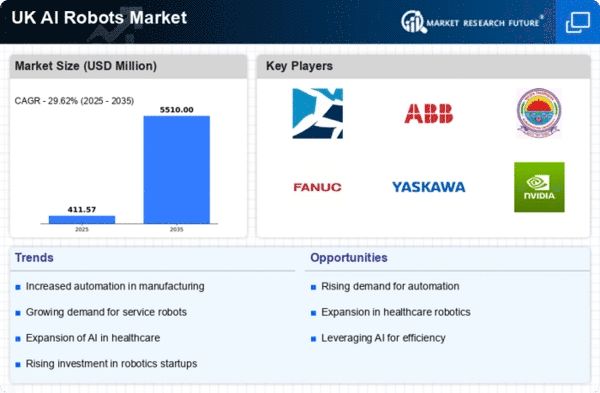
Growing Investment in R&D
Investment in research and development (R&D) is a critical driver for the ai robots market in the UK. Companies and government entities are increasingly allocating resources to explore innovative applications of robotics and AI technologies. This focus on R&D is fostering the development of cutting-edge solutions that can transform various industries, including manufacturing, healthcare, and agriculture. Recent statistics indicate that R&D spending in the robotics sector has increased by over 15% in the past year alone. Such investments are essential for driving technological breakthroughs and enhancing the capabilities of ai robots. Consequently, the ai robots market stands to gain from this influx of funding, which is likely to accelerate the pace of innovation and market growth.
Rising Demand for Efficiency
The ai robots market in the UK is experiencing a notable surge in demand for efficiency across various sectors. Businesses are increasingly adopting automation solutions to enhance productivity and reduce operational costs. According to recent data, companies that integrate ai robots into their processes report efficiency improvements of up to 30%. This trend is particularly evident in manufacturing and logistics, where ai robots streamline workflows and minimize human error. As industries strive to remain competitive, the push for efficiency is likely to drive further investments in ai robots, fostering innovation and technological advancements. The ai robots market is thus positioned to benefit from this growing emphasis on operational excellence, as organizations seek to leverage automation to achieve their strategic goals.
Technological Advancements in AI
The rapid evolution of artificial intelligence technologies is significantly influencing the ai robots market in the UK. Innovations in machine learning, computer vision, and natural language processing are enabling robots to perform increasingly complex tasks. For instance, advancements in AI algorithms have improved robots' ability to learn from their environments, enhancing their adaptability and functionality. This technological progress is expected to propel the market forward, with projections indicating a compound annual growth rate (CAGR) of approximately 20% over the next five years. As businesses recognize the potential of these advancements, the ai robots market is likely to witness a surge in demand for sophisticated robotic solutions that can address diverse operational challenges.
Expansion of E-commerce and Logistics
The growth of e-commerce in the UK is significantly impacting the ai robots market. As online shopping continues to rise, logistics and warehousing operations are under pressure to enhance efficiency and speed. Ai robots are increasingly being deployed in warehouses to automate sorting, packing, and inventory management processes. This trend is expected to continue, with the logistics sector projected to grow by 25% over the next five years. The ai robots market is poised to capitalize on this expansion, as businesses seek to optimize their supply chains and meet the demands of a rapidly evolving retail landscape. The integration of ai robots in logistics not only improves operational efficiency but also enhances customer satisfaction through faster delivery times.
Increased Focus on Safety and Compliance
The ai robots market in the UK is witnessing an increased focus on safety and compliance regulations. As industries adopt automation technologies, ensuring the safety of both workers and robots becomes paramount. Regulatory bodies are establishing guidelines to govern the use of ai robots, particularly in sectors such as manufacturing and healthcare. Compliance with these regulations is essential for companies to mitigate risks and avoid potential liabilities. This heightened emphasis on safety is driving the demand for advanced ai robots equipped with safety features and compliance capabilities. The ai robots market is thus adapting to these requirements, leading to the development of robots that not only enhance productivity but also prioritize safety in their operations.