×
Request Free Sample ×

Kindly complete the form below to receive a free sample of this Report

* Please use a valid business email

Leading companies partner with us for data-driven Insights

clients tt-cursor
Hero Background

UK Aesthetic Lasers Market

ID: MRFR/MED/50318-HCR
200 Pages
Garvit Vyas
February 2026

UK Aesthetic Lasers Market Research Report: Size, Share, Trend Analysis By Applications (Hair Removal, Skin Rejuvenation, Tattoo Removal, Pigmentation Treatment, Scar Treatment), By Technology (Solid-State Lasers, Gas Lasers, Dye Lasers, Diode Lasers), By End Use (Dermatology Clinics, Beauty Salon, Hospitals, Medical Spas) and By Product Type (Alexandrite Laser, Nd YAG Laser, Diode Laser, CO2 Laser) - Growth Outlook & Industry Forecast 2025 To 2035

Share:
Download PDF ×

We do not share your information with anyone. However, we may send you emails based on your report interest from time to time. You may contact us at any time to opt-out.

UK Aesthetic Lasers Market Infographic
Purchase Options

UK Aesthetic Lasers Market Summary

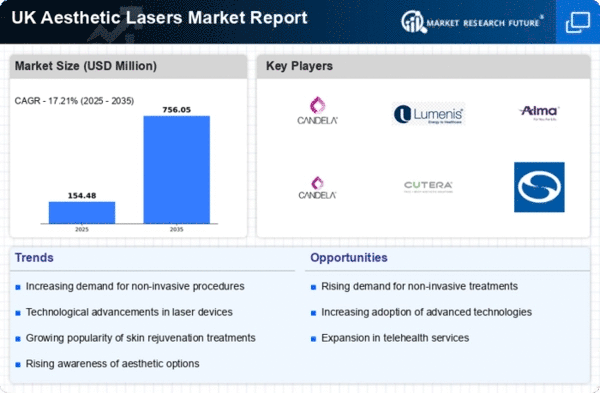
As per Market Research Future analysis, the UK aesthetic lasers market Size was estimated at 131.8 USD Million in 2024. The UK aesthetic lasers market is projected to grow from 154.48 USD Million in 2025 to 756.05 USD Million by 2035, exhibiting a compound annual growth rate (CAGR) of 17.2% during the forecast period 2025 - 2035

Key Market Trends & Highlights

The UK aesthetic lasers market is experiencing robust growth driven by technological advancements and increasing consumer demand.

  • Technological advancements in laser systems are enhancing treatment efficacy and safety, thereby attracting more consumers.
  • The medical aesthetics segment remains the largest, while the non-invasive procedures segment is the fastest-growing in the UK market.
  • Consumer awareness and demand for aesthetic treatments are rising, fueled by the growing influence of social media.
  • Key market drivers include rising aesthetic consciousness and innovations in laser technology, which are expanding treatment accessibility.

Market Size & Forecast

2024 Market Size 131.8 (USD Million)
2035 Market Size 756.05 (USD Million)
CAGR (2025 - 2035) 17.21%

Major Players

Candela Medical (US), Lumenis (IL), Alma Lasers (IL), Syneron Candela (IL), Cutera (US), Sciton (US), Bausch Health (CA), Hologic (US), Fotona (SI)

Our Impact
Enabled $4.3B Revenue Impact for Fortune 500 and Leading Multinationals
Partnering with 2000+ Global Organizations Each Year
30K+ Citations by Top-Tier Firms in the Industry

UK Aesthetic Lasers Market Trends

The aesthetic lasers market is currently experiencing notable growth, driven by increasing consumer demand for non-invasive cosmetic procedures. This trend is largely influenced by a rising awareness of personal aesthetics and the desire for enhanced appearance without the need for surgical interventions. As technology advances, the efficacy and safety of laser treatments continue to improve, attracting a broader demographic. Furthermore, the integration of innovative technologies, such as artificial intelligence and advanced imaging systems, is enhancing treatment precision and outcomes, thereby fostering consumer confidence in these procedures. In addition, regulatory frameworks in the UK are evolving to ensure safety and efficacy in aesthetic treatments. This regulatory oversight is likely to bolster consumer trust, encouraging more individuals to seek laser treatments. The market is also witnessing a shift towards personalized treatment plans, as practitioners increasingly tailor procedures to meet individual needs. This customization not only improves patient satisfaction but also enhances the overall effectiveness of treatments. As the aesthetic lasers market continues to expand, it appears poised for further growth, driven by technological advancements and changing consumer preferences.

Technological Advancements

The aesthetic lasers market is benefiting from rapid technological innovations. New laser systems are being developed that offer improved precision and reduced recovery times. These advancements are likely to enhance treatment outcomes and attract a wider range of clients seeking effective solutions for skin rejuvenation and other cosmetic concerns.

Regulatory Developments

Regulatory bodies in the UK are increasingly focusing on the safety and efficacy of aesthetic laser treatments. Stricter guidelines and standards are being implemented, which may lead to greater consumer confidence in these procedures. This regulatory environment is expected to shape the market by ensuring that practitioners adhere to high standards of care.

Consumer Awareness and Demand

There is a growing awareness among consumers regarding the benefits of aesthetic laser treatments. As more individuals seek non-invasive options for enhancing their appearance, the demand for these services is likely to rise. This trend is further supported by social media and online platforms that promote aesthetic procedures, influencing public perception and interest.

UK Aesthetic Lasers Market Drivers

Rising Aesthetic Consciousness

The aesthetic lasers market in the UK is experiencing a notable surge in demand, driven by an increasing societal focus on personal appearance. This trend is particularly evident among younger demographics, who are more inclined to seek cosmetic enhancements. According to recent surveys, approximately 40% of individuals aged 18-34 express interest in aesthetic procedures, indicating a shift in cultural norms towards acceptance of such treatments. This growing aesthetic consciousness is likely to propel the market forward, as more individuals seek non-invasive solutions for skin rejuvenation and body contouring. The aesthetic lasers market is thus positioned to benefit from this evolving mindset, as clinics and practitioners adapt their offerings to meet the rising expectations of consumers.

Expansion of Medical Aesthetics

The aesthetic lasers market is benefiting from the broader expansion of the medical aesthetics field, which encompasses a range of non-surgical procedures. As more healthcare professionals enter this sector, the availability of aesthetic laser treatments is increasing. This trend is supported by a growing number of training programs and certifications for practitioners, enhancing the quality of services offered. The market is projected to reach £1 billion by 2027, reflecting the increasing acceptance of aesthetic procedures as part of routine healthcare. The aesthetic lasers market is thus poised for growth, as it aligns with the evolving landscape of medical aesthetics and consumer preferences.

Innovations in Laser Technology

Technological advancements in laser systems are significantly influencing the aesthetic lasers market. Innovations such as fractional laser technology and picosecond lasers have enhanced treatment efficacy and safety, attracting a broader clientele. For instance, the introduction of non-ablative lasers has reduced recovery times, making procedures more appealing to busy individuals. The market is projected to grow at a CAGR of 12% over the next five years, largely due to these technological improvements. As practitioners adopt the latest laser technologies, the aesthetic lasers market is likely to see an influx of new treatments, further stimulating consumer interest and investment in aesthetic procedures.

Growing Influence of Social Media

The aesthetic lasers market is increasingly shaped by the influence of social media platforms, where beauty standards and trends are rapidly disseminated. Influencers and celebrities often showcase their aesthetic procedures, creating a ripple effect that encourages followers to pursue similar treatments. This phenomenon has led to a rise in inquiries and bookings for laser treatments, particularly among younger consumers. Data suggests that clinics reporting active social media engagement have seen a 30% increase in client consultations. As the aesthetic lasers market continues to leverage social media for marketing, it is likely to attract a new generation of clients eager to enhance their appearance.

Increased Accessibility of Treatments

The aesthetic lasers market is witnessing a trend towards greater accessibility of treatments, which is likely to drive growth. With the proliferation of aesthetic clinics across urban and suburban areas, more individuals can access laser treatments without significant travel. Additionally, competitive pricing strategies have emerged, making procedures more affordable. Reports indicate that the average cost of laser treatments has decreased by approximately 15% over the past three years, making them more attainable for a wider audience. This increased accessibility is expected to expand the customer base for the aesthetic lasers market, as more people consider these treatments as viable options for enhancing their appearance.


Market Segment Insights

By Application: Hair Removal (Largest) vs. Skin Rejuvenation (Fastest-Growing)

In the UK aesthetic lasers market, Hair Removal leads with a significant market share, driven by increasing consumer demand for permanent hair reduction solutions. Following closely, Skin Rejuvenation is acknowledged for its rapid growth, attracting attention from individuals seeking skin enhancement and anti-aging treatments. Other segments like Tattoo Removal, Pigmentation Treatment, and Scar Treatment also contribute notably but with lesser shares compared to the top two applications. The growth of the Hair Removal segment is primarily fueled by technological advancements and a rising acceptance of laser treatments. Meanwhile, Skin Rejuvenation is gaining traction, driven by growing awareness of skin health and innovative products that enhance effectiveness. Additionally, urban lifestyle changes and a focus on beauty and self-care further propel the demand for these treatments across demographic groups, especially among younger populations.

Hair Removal (Dominant) vs. Skin Rejuvenation (Emerging)

Hair Removal remains the dominant application in the market, characterized by its reliability and widespread acceptance among consumers seeking efficiency and long-lasting results. This segment benefits from continual advancements in laser technology, ensuring improved safety and comfort during procedures. In contrast, Skin Rejuvenation is emerging as a vital contender, appealing to a broad audience interested in aesthetic improvement and skin vitality. Innovations in laser modalities enhance treatment effectiveness, promoting greater consumer engagement and satisfaction. While Hair Removal caters traditionally to a more restricted clientele, Skin Rejuvenation witnesses diverse interest, with both men and women seeking to address signs of aging or enhance skin tone, thereby reshaping the market landscape.

By Technology: Diode Lasers (Largest) vs. Solid-State Lasers (Fastest-Growing)

In the UK aesthetic lasers market, the distribution of market share among different laser technologies reveals that diode lasers hold the largest share, owing to their versatility and efficiency. Solid-state lasers are also significant contributors, while gas lasers and dye lasers hold smaller portions of the market. These dynamics highlight the competitive landscape and the varying applications that each technology serves in aesthetic treatments. Growth trends indicate that while diode lasers dominate currently, solid-state lasers are emerging as the fastest-growing segment due to advancements in technology and increasing adoption in aesthetic procedures. Factors driving this growth include a growing awareness of non-invasive skin treatments and increasing investments in aesthetic clinics, which further supports the expansion of solid-state systems into new applications.

Technology: Diode Lasers (Dominant) vs. Solid-State Lasers (Emerging)

Diode lasers are recognized as the dominant technology in the UK aesthetic lasers market, offering efficient solutions for hair removal, skin rejuvenation, and other aesthetic procedures. Their advantages include compactness, cost-effectiveness, and adaptability to various skin types. On the other hand, solid-state lasers are emerging quickly due to their high efficacy and innovative applications in skin treatments. They boast high-energy output and multiple wavelength capabilities, making them increasingly popular among aesthetic practitioners. The combination of robust technology and growing consumer demand positions solid-state lasers for significant growth, creating increased competition within the segment.

By End Use: Dermatology Clinics (Largest) vs. Beauty Salons (Fastest-Growing)

In the UK aesthetic lasers market, the distribution of market share among end-use segments reveals that dermatology clinics hold the largest portion, driven by their focus on advanced skin treatments and high patient turnover. Beauty salons are increasingly embracing advanced aesthetic laser technologies, contributing to their rapid growth and appeal among consumers seeking non-invasive beauty solutions. The growth trends in this segment are propelled by a surging demand for cosmetic procedures, skincare improvements, and rising consumer awareness about aesthetic treatments. Medical spas also play a crucial role in the market by providing integrated services that combine wellness and aesthetic treatments. The overall market is witnessing a shift towards more accessible and affordable aesthetic services, catering to a broader demographic.

Dermatology Clinics (Dominant) vs. Beauty Salons (Emerging)

Dermatology clinics have established themselves as the dominant force in the UK aesthetic lasers market, offering specialized services that leverage advanced technology for effective skin treatments and conditions. Their strong reputation and patient reliance contribute to a loyal customer base, ensuring consistent demand. In contrast, beauty salons are emerging as a key player, rapidly adopting laser technology to diversify their service offerings. They are particularly appealing to younger demographics seeking accessible beauty treatments. The transition of beauty salons into this space signifies a growing trend towards non-invasive procedures that align with consumer desires for convenience and effectiveness. The competition between these segments is shaping the future landscape of aesthetic services.

By Product Type: Alexandrite Laser (Largest) vs. Nd:YAG Laser (Fastest-Growing)

The market share distribution among the product types in the UK aesthetic lasers market reveals that the Alexandrite Laser holds a significant portion, making it the largest segment. This dominance is attributed to its versatility and effectiveness in laser hair removal and other dermatological treatments. In contrast, the Nd:YAG Laser, while smaller in market share, is rapidly gaining traction due to its efficacy in treating deeper skin issues and vascular lesions. Growth trends in the product types indicate a shift towards technologies that provide higher efficiency and patient comfort. The increase in demand for minimally invasive procedures is propelling the Nd:YAG Laser forward as the fastest-growing segment. Additionally, advancements in laser technology and increasing awareness of aesthetic procedures are key drivers for the overall market growth, potentially enhancing the competitive landscape for all product types.

Alexandrite Laser (Dominant) vs. Diode Laser (Emerging)

The Alexandrite Laser is known for its high-speed and effectiveness in various cosmetic treatments, making it the dominant choice in the market. It operates at a wavelength that is highly effective for hair removal on light to olive skin tones and is recognized for its long-lasting results. On the other hand, the Diode Laser is emerging as a viable option due to its versatility, compact size, and ability to treat a wider range of skin types. It is particularly noted for its applications in hair removal and is gaining popularity because of its efficiency and lower risk of side effects. As both lasers exhibit unique advantages, the competitive dynamics continue to evolve, catering to diverse client needs in the aesthetic lasers market.

Get more detailed insights about UK Aesthetic Lasers Market

Key Players and Competitive Insights

The aesthetic lasers market is currently characterized by a dynamic competitive landscape, driven by technological advancements and increasing consumer demand for non-invasive cosmetic procedures. Key players such as Candela Medical (US), Lumenis (IL), and Alma Lasers (IL) are at the forefront, each adopting distinct strategies to enhance their market presence. Candela Medical (US) focuses on innovation, particularly in developing advanced laser technologies that cater to a diverse range of aesthetic applications. Lumenis (IL) emphasizes strategic partnerships and collaborations to expand its product offerings and enhance its market reach. Meanwhile, Alma Lasers (IL) is concentrating on regional expansion, particularly in emerging markets, to capitalize on the growing demand for aesthetic treatments. Collectively, these strategies contribute to a competitive environment that is increasingly characterized by innovation and strategic positioning.In terms of business tactics, companies are increasingly localizing manufacturing and optimizing supply chains to enhance operational efficiency. The market structure appears moderately fragmented, with several key players exerting influence over various segments. This fragmentation allows for a diverse range of products and services, catering to different consumer preferences and price points. The collective influence of these key players shapes the competitive dynamics, as they vie for market share through differentiated offerings and strategic initiatives.

In October Candela Medical (US) announced the launch of its latest laser system, which integrates AI technology to enhance treatment precision and patient outcomes. This strategic move underscores the company's commitment to innovation and positions it favorably in a market that increasingly values technological advancements. The integration of AI not only improves treatment efficacy but also aligns with the growing trend of personalized medicine, potentially attracting a broader customer base.

In September Lumenis (IL) entered into a strategic partnership with a leading skincare brand to co-develop a new line of laser treatments. This collaboration is significant as it allows Lumenis to leverage the skincare brand's established customer base while enhancing its product portfolio. Such partnerships are indicative of a broader trend in the market, where companies seek to combine expertise across different sectors to create comprehensive solutions for consumers.

In August Alma Lasers (IL) expanded its operations into the Asian market, establishing a new manufacturing facility in India. This expansion is strategically important as it not only reduces production costs but also positions the company to better serve the rapidly growing demand for aesthetic treatments in the region. By localizing production, Alma Lasers can enhance its supply chain reliability and responsiveness to market needs, which is increasingly critical in today's fast-paced environment.

As of November current trends in the aesthetic lasers market are heavily influenced by digitalization, sustainability, and the integration of AI technologies. Companies are increasingly forming strategic alliances to enhance their competitive positioning and drive innovation. The shift from price-based competition to a focus on technological differentiation and supply chain reliability is evident. Moving forward, competitive differentiation will likely evolve as companies prioritize innovation and sustainability, ensuring they remain relevant in a rapidly changing market.

Key Companies in the UK Aesthetic Lasers Market include

Industry Developments

The UK Aesthetic Lasers Market has recently seen significant developments, notably with Syneron Candela and Revance Therapeutics exploring expansion strategies to capture a larger share of the growing demand for non-invasive cosmetic procedures. In September 2023, Lumenis announced new advancements in their laser technologies, aimed at enhancing patient outcomes and satisfaction, indicating a focus on continuous Research and Development in this area. Additionally, the market is experiencing growth in valuation, with estimates suggesting it may reach 1 billion by 2025, driven by increasing consumer interest in aesthetic treatments.

There have been notable mergers and acquisitions; for instance, in August 2023, Cynosure completed an acquisition of a smaller competitor to bolster its product offerings. The last two to three years have seen a marked increase in the use of high-technology lasers within the aesthetics sector, with a reported 40% rise in treatments performed from 2020 to 2022, indicating growing acceptance among the UK population. The government's support for aesthetic practices and stringent regulations around safety continue to shape the market landscape, promoting innovation while ensuring patient safety.

Future Outlook

UK Aesthetic Lasers Market Future Outlook

The Aesthetic Lasers Market is projected to grow at a 17.21% CAGR from 2025 to 2035, driven by technological advancements, increasing demand for non-invasive procedures, and rising disposable incomes.

New opportunities lie in:

  • Development of portable laser devices for home use
  • Expansion of telemedicine platforms for remote consultations
  • Partnerships with beauty clinics for exclusive laser treatment packages

By 2035, the market is expected to achieve substantial growth, reflecting evolving consumer preferences and technological innovations.

Market Segmentation

UK Aesthetic Lasers Market End Use Outlook

  • Dermatology Clinics
  • Beauty Salon
  • Hospitals
  • Medical Spas

UK Aesthetic Lasers Market Technology Outlook

  • Solid-State Lasers
  • Gas Lasers
  • Dye Lasers
  • Diode Lasers

UK Aesthetic Lasers Market Application Outlook

  • Hair Removal
  • Skin Rejuvenation
  • Tattoo Removal
  • Pigmentation Treatment
  • Scar Treatment

UK Aesthetic Lasers Market Product Type Outlook

  • Alexandrite Laser
  • Nd:YAG Laser
  • Diode Laser
  • CO2 Laser

Report Scope

MARKET SIZE 2024131.8(USD Million)
MARKET SIZE 2025154.48(USD Million)
MARKET SIZE 2035756.05(USD Million)
COMPOUND ANNUAL GROWTH RATE (CAGR)17.21% (2025 - 2035)
REPORT COVERAGERevenue Forecast, Competitive Landscape, Growth Factors, and Trends
BASE YEAR2024
Market Forecast Period2025 - 2035
Historical Data2019 - 2024
Market Forecast UnitsUSD Million
Key Companies ProfiledCandela Medical (US), Lumenis (IL), Alma Lasers (IL), Syneron Candela (IL), Cutera (US), Sciton (US), Bausch Health (CA), Hologic (US), Fotona (SI)
Segments CoveredApplication, Technology, End Use, Product Type
Key Market OpportunitiesEmergence of advanced laser technologies enhancing treatment efficacy and patient satisfaction in the aesthetic lasers market.
Key Market DynamicsTechnological advancements drive innovation in aesthetic lasers, enhancing treatment efficacy and expanding consumer adoption in the UK.
Countries CoveredUK
Leave a Comment

FAQs

What is the expected market size of the UK Aesthetic Lasers Market in 2024?

The UK Aesthetic Lasers Market is expected to be valued at 294.8 million USD in 2024.

What is the projected market size for the UK Aesthetic Lasers Market by 2035?

By 2035, the UK Aesthetic Lasers Market is projected to reach a value of 1204.0 million USD.

What is the expected CAGR for the UK Aesthetic Lasers Market from 2025 to 2035?

The market is anticipated to grow at a CAGR of 13.646% from 2025 to 2035.

Which application is expected to dominate the market in 2024?

Hair removal is expected to dominate the market with a valuation of 80.0 million USD in 2024.

How much is the skin rejuvenation application expected to generate in 2035?

Skin rejuvenation application is projected to generate 378.0 million USD by 2035.

Who are the key players in the UK Aesthetic Lasers Market?

Major players include Syneron Candela, Revance Therapeutics, Candela, Quanta System, and Sciton, among others.

What is the market size for tattoo removal in 2024?

The tattoo removal application is valued at 45.0 million USD in 2024.

What growth opportunities exist in the UK Aesthetic Lasers Market?

The market presents growth opportunities in hair removal, skin rejuvenation, and scar treatment applications.

What is the market size for pigmentation treatment in 2035?

Pigmentation treatment is expected to reach a market size of 147.0 million USD by 2035.

How much will the scar treatment application be worth in 2035?

Scar treatment is projected to be valued at 184.0 million USD by 2035.

Download Free Sample

Kindly complete the form below to receive a free sample of this Report

Compare Licence

×
Features License Type
Single User Multiuser License Enterprise User
Price $4,950 $5,950 $7,250
Maximum User Access Limit 1 User Upto 10 Users Unrestricted Access Throughout the Organization
Free Customization
Direct Access to Analyst
Deliverable Format
Platform Access
Discount on Next Purchase 10% 15% 15%
Printable Versions