Rising Demand for Real-Time Data
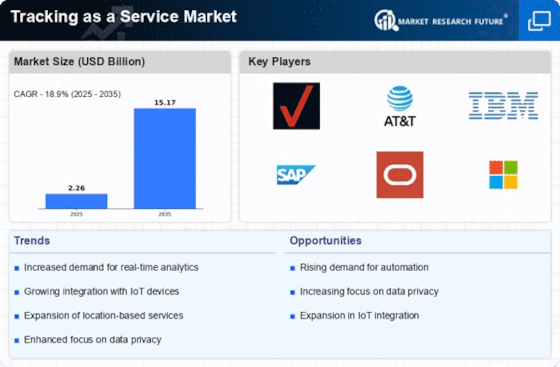
The Tracking as a Service Market is experiencing a notable increase in demand for real-time data analytics. Businesses across various sectors are recognizing the value of immediate insights for decision-making processes. This trend is particularly evident in logistics and supply chain management, where timely tracking of assets can lead to enhanced operational efficiency. According to recent estimates, the market for real-time tracking solutions is projected to grow at a compound annual growth rate of approximately 20% over the next five years. This surge is driven by the need for businesses to optimize their operations and improve customer satisfaction through timely updates and transparency.
Integration of Artificial Intelligence
The Tracking as a Service Market is witnessing a transformative impact due to the integration of artificial intelligence (AI) technologies. AI enhances tracking solutions by enabling predictive analytics, anomaly detection, and automated reporting. This integration allows businesses to anticipate potential issues and optimize their tracking processes. As AI technologies continue to evolve, it is expected that the market for AI-driven tracking solutions will expand significantly, with projections indicating a growth rate of around 25% annually. This trend underscores the importance of leveraging advanced technologies to improve operational efficiency and reduce costs.
Increased Adoption of Cloud Technologies
The Tracking as a Service Market is significantly influenced by the widespread adoption of cloud technologies. Organizations are increasingly migrating their tracking solutions to cloud-based platforms, which offer scalability, flexibility, and cost-effectiveness. This transition allows businesses to access tracking data from anywhere, facilitating better collaboration and decision-making. As of 2025, it is estimated that over 60% of tracking solutions will be cloud-based, reflecting a shift towards more agile and responsive business models. The integration of cloud technologies not only enhances data accessibility but also supports the growing need for remote monitoring and management of assets.
Growing Regulatory Compliance Requirements
The Tracking as a Service Market is increasingly shaped by the need for compliance with regulatory standards. Various industries, including transportation and healthcare, are subject to stringent regulations that mandate accurate tracking and reporting of assets. This compliance requirement drives organizations to adopt tracking solutions that ensure adherence to legal standards. As regulations become more complex, the demand for reliable tracking services is expected to rise. By 2025, it is anticipated that compliance-related tracking solutions will account for a significant portion of the market, highlighting the critical role of regulatory frameworks in shaping industry dynamics.
Expansion of E-Commerce and Logistics Sectors
The Tracking as a Service Market is benefiting from the rapid expansion of e-commerce and logistics sectors. As online shopping continues to grow, the demand for efficient tracking solutions has surged. Consumers expect real-time updates on their orders, prompting businesses to invest in advanced tracking technologies. The logistics sector, in particular, is adopting tracking services to enhance supply chain visibility and improve delivery times. Recent data suggests that the e-commerce logistics market is projected to reach a valuation of over 500 billion by 2026, further driving the need for robust tracking solutions. This expansion presents significant opportunities for service providers in the tracking industry.