×
Request Free Sample ×

Kindly complete the form below to receive a free sample of this Report

* Please use a valid business email

Leading companies partner with us for data-driven Insights

clients tt-cursor
Hero Background

Spain Inverter Market

ID: MRFR/EnP/61742-CR
200 Pages
Chitranshi Jaiswal
August 2025

Spain Inverter Market Research Report Information by Type (Solar Inverter (Central Inverter, String Inverter, Micro-inverter, Hybrid Inverter), Vehicle Inverter (Battery Electric Vehicle, Hybrid Electric Vehicle, Plug-in Hybrid Electric Vehicle), Others), by Application (Residential, Commercial, Industrial), by Power Capacity (1-10 kW, 10-100 kW, Above 100 kW), by Sales Channel (Direct, Indirect), by Distribution Channel (OEMs, Aftermarket), by Connection Type (Standalone, Grid-tied (Conventional, Smart)), by Output Voltage (100 – 300V, 300-500V, Above 500V) and Country (Spain)-Forecast till 2035

Share:
Download PDF ×

We do not share your information with anyone. However, we may send you emails based on your report interest from time to time. You may contact us at any time to opt-out.

Spain Inverter Market Infographic
Purchase Options

Spain Inverter Market Summary

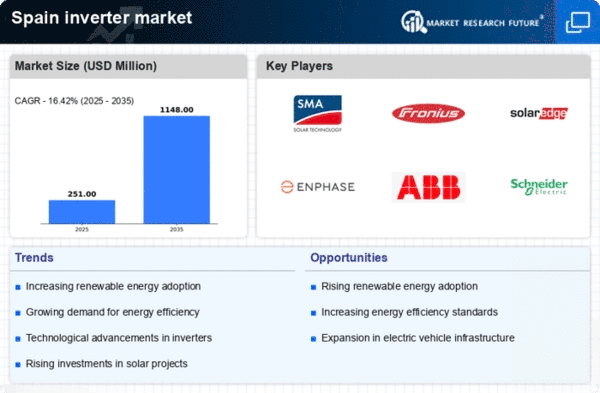
As per Market Research Future analysis, the Spain inverter market Size was estimated at 215.6 USD Million in 2024. The Inverter market is projected to grow from 251.0 USD Million in 2025 to 1148.0 USD Million by 2035, exhibiting a compound annual growth rate (CAGR) of 16.4% during the forecast period 2025 - 2035

Key Market Trends & Highlights

The Spain inverter market is experiencing robust growth driven by technological advancements and increasing consumer awareness.

  • Technological advancements in inverter design are enhancing efficiency and performance across the market.
  • Government incentives are playing a crucial role in promoting the adoption of inverters in residential and commercial sectors.
  • The residential segment remains the largest, while the commercial segment is identified as the fastest-growing in the Spain inverter market.
  • Growing demand for renewable energy and regulatory framework enhancements are key drivers propelling market expansion.

Market Size & Forecast

2024 Market Size 215.6 (USD Million)
2035 Market Size 1148.0 (USD Million)
CAGR (2025 - 2035) 16.42%

Major Players

SMA Solar Technology AG (DE), Fronius International GmbH (AT), SolarEdge Technologies Inc (US), Enphase Energy Inc (US), ABB Ltd (CH), Schneider Electric SE (FR), TMEIC Corporation (JP), Huawei Technologies Co Ltd (CN), Victron Energy B.V. (NL)

Our Impact
Enabled $4.3B Revenue Impact for Fortune 500 and Leading Multinationals
Partnering with 2000+ Global Organizations Each Year
30K+ Citations by Top-Tier Firms in the Industry

Spain Inverter Market Trends

The inverter market in Spain is currently experiencing a notable transformation, driven by a combination of technological advancements and increasing demand for renewable energy solutions. The shift towards sustainable energy sources has prompted both residential and commercial sectors to adopt inverters that enhance energy efficiency and reliability. This trend is further supported by government initiatives aimed at promoting clean energy, which appear to be fostering a favorable environment for inverter adoption. As a result, manufacturers are increasingly focusing on innovation, developing products that not only meet regulatory standards but also cater to the evolving needs of consumers. In addition, the growing awareness of energy conservation among the Spanish populace is likely to contribute to the expansion of the inverter market. Consumers are becoming more informed about the benefits of using inverters, such as reduced energy costs and lower carbon footprints. This heightened awareness, coupled with the availability of various financing options for renewable energy projects, seems to be encouraging more households and businesses to invest in inverter technology. Overall, the inverter market in Spain is poised for growth, with a clear trajectory towards more efficient and sustainable energy solutions.

Technological Advancements

The inverter market is witnessing rapid technological innovations, particularly in the areas of efficiency and smart technology integration. Manufacturers are developing advanced inverters that offer enhanced performance, including features such as real-time monitoring and grid compatibility. These advancements are likely to attract more consumers seeking reliable and efficient energy solutions.

Government Incentives

Government policies in Spain are increasingly favoring the adoption of renewable energy technologies, including inverters. Incentives such as subsidies and tax breaks for solar energy installations are encouraging both residential and commercial sectors to invest in inverter systems. This supportive regulatory framework appears to be a key driver of market growth.

Rising Consumer Awareness

There is a noticeable increase in consumer awareness regarding energy efficiency and sustainability in Spain. As individuals and businesses become more conscious of their energy consumption, the demand for inverters that facilitate energy savings is likely to rise. This trend suggests a shift towards more environmentally friendly practices in energy usage.

Spain Inverter Market Drivers

Regulatory Framework Enhancements

Spain's regulatory environment is evolving to support the growth of the inverter market. Recent legislation aimed at promoting energy efficiency and reducing carbon emissions has created a favorable landscape for inverter manufacturers. The government has introduced standards that mandate the use of high-efficiency inverters in new installations, which could potentially increase market penetration. Furthermore, compliance with these regulations may lead to a surge in demand for advanced inverter technologies, as stakeholders seek to align with national energy policies and sustainability goals.

Growing Demand for Renewable Energy

The increasing emphasis on renewable energy sources in Spain is driving the inverter market. As the country aims to meet its renewable energy targets, the demand for inverters, which are essential for converting solar and wind energy into usable electricity, is expected to rise. In 2025, Spain's renewable energy capacity is projected to reach approximately 50 GW, with solar energy contributing significantly. This shift towards sustainable energy solutions is likely to enhance the inverter market, as more installations require efficient inverter systems to optimize energy conversion and usage.

Expansion of Electric Vehicle Infrastructure

The expansion of electric vehicle (EV) infrastructure in Spain is creating new opportunities for the inverter market. As the government promotes the adoption of EVs, the need for efficient charging solutions, which often incorporate advanced inverter technologies, is increasing. By 2025, the number of public charging stations is expected to exceed 10,000, necessitating the deployment of high-performance inverters to manage energy flow. This growth in EV infrastructure is likely to stimulate demand for inverters, as they play a crucial role in ensuring efficient energy conversion and distribution.

Technological Innovations in Inverter Design

Innovations in inverter technology are significantly impacting the inverter market in Spain. The development of smart inverters, which offer enhanced functionalities such as grid support and real-time monitoring, is becoming increasingly prevalent. These advanced systems not only improve energy efficiency but also facilitate better integration of renewable energy sources into the grid. As of 2025, it is estimated that smart inverters could account for over 30% of the total inverter market, reflecting a shift towards more sophisticated energy management solutions.

Increased Investment in Energy Storage Solutions

The rising interest in energy storage systems is likely to bolster the inverter market in Spain. As consumers and businesses seek to enhance energy independence and reliability, the integration of inverters with battery storage systems is becoming more common. This trend is expected to grow, with investments in energy storage projected to reach €1 billion by 2026. The synergy between inverters and storage solutions not only optimizes energy usage but also supports the stability of the grid, thereby driving demand within the inverter market.


Market Segment Insights

By Output Power Rating: 10-50 kW (Largest) vs. Below 10 kW (Fastest-Growing)

In the Spain inverter market, the output power rating segment has distinct values that showcase varying market shares. The 10-50 kW range holds the largest share, driven by its suitability for both residential and small commercial applications. Conversely, the below 10 kW segment is experiencing rapid growth due to increasing demand for compact, efficient solutions that cater to the rising number of small-scale renewable energy installations, particularly in residential setups. The growth trends in this segment are significantly influenced by regulatory initiatives favoring renewable energy sources, as well as growing consumer awareness towards energy efficiency. The shift towards sustainability and energy independence is propelling demand in the below 10 kW category, making it the fastest-growing segment. Meanwhile, the 10-50 kW segment benefits from established market players and a broad range of applications, ensuring its continued dominance within the market.

10-50 kW (Dominant) vs. Below 10 kW (Emerging)

The 10-50 kW output power rating segment is recognized as the dominant segment in the Spain inverter market, favored for its versatility and ability to serve various applications, including small businesses and larger residential systems. Its established presence is backed by a wide array of product offerings and a comprehensive support ecosystem. In contrast, the below 10 kW segment is considered an emerging category with significant growth potential. This segment appeals primarily to residential users seeking affordable and compact solutions for energy generation. As the trend towards decentralized energy sources grows, so too does the demand for below 10 kW inverters, which are perceived as essential for off-grid and on-grid systems aimed at maximizing energy efficiency and lowering electricity costs.

By End User: Residential (Largest) vs. Photovoltaic (PV) Plants (Fastest-Growing)

The Spain inverter market sees a significant distribution of market share among various end users. The residential sector holds a commanding position, driven by increasing adoption of solar energy solutions and incentivization from government policies. In contrast, Photovoltaic (PV) Plants are rising rapidly, fueled by advancements in technology and the growing need for renewable energy sources. The automotive sector and other segments remain smaller but essential contributors to the overall market. Growth trends in the Spain inverter market are largely influenced by the increasing demand for sustainable energy solutions. Residential users are motivated by both economic and environmental factors, leading to a rise in installations. PV Plants are emerging as the fastest-growing segment due to the integration of large-scale renewable projects aimed at enhancing energy independence. This growth is further supported by favorable policies and the declining cost of solar technology, making it a viable option for extensive energy production.

Residential (Dominant) vs. Photovoltaic (PV) Plants (Emerging)

The residential segment in the Spain inverter market is characterized by its significant market share, primarily due to the increasing number of homeowners investing in solar energy systems. This segment benefits from government incentives, public awareness regarding energy efficiency, and a strong push towards renewable energy implementation. In contrast, Photovoltaic (PV) Plants represent an emerging segment that is showing rapid growth potential, primarily because of large-scale renewable energy projects. The transition towards greener energy sources makes PV Plants an attractive investment for energy producers, fostering innovation and technological advancements that continue to drive their development. As the market evolves, the differentiation between these segments will play a crucial role in shaping the competitive landscape.

By Type: Solar Inverter (Largest) vs. Vehicle Inverter (Fastest-Growing)

In the Spain inverter market, the distribution of market share among segment values is quite distinct. Solar inverters hold a significant portion of the market, largely due to the increasing adoption of renewable energy and governmental incentives promoting solar installations. In contrast, vehicle inverters, though a smaller segment, are rapidly gaining traction as electric vehicles become more prevalent, leading to heightened demand. Growth trends indicate a robust trajectory for both solar and vehicle inverters. The solar inverter segment benefits from strong ecological policies and declining installation costs, fostering widespread consumer adoption. Meanwhile, the vehicle inverter segment is bolstered by technological advancements in electric vehicles and rising consumer interest in alternative energy solutions, positioning it as the fastest-growing category within the market.

Solar Inverter (Dominant) vs. Vehicle Inverter (Emerging)

Solar inverters are recognized as the dominant force within the Spain inverter market, characterized by their extensive integration in residential and commercial solar projects. They are crucial for converting the direct current (DC) generated by solar panels into alternating current (AC) used by most home appliances. On the other hand, vehicle inverters are an emerging segment, primarily supporting the rising trend of electric vehicles. These devices enable electric cars to power household electronics, reflecting a shift in consumer behavior towards electric mobility. As technological innovation continues, the vehicle inverter segment is set to expand significantly, while solar inverters will maintain their stronghold due to established infrastructure and sustained market demand.

By Output Voltage: 301-500 V (Largest) vs. Above 500 V (Fastest-Growing)

The output voltage segment of the Spain inverter market is primarily dominated by the 301-500 V range, which holds a substantial share due to its widespread applicability in commercial and residential setups. Following closely are the 100-300 V and Above 500 V segments, which, while smaller, are critical in specific applications such as specialized industrial processes and high-capacity energy solutions. As energy efficiency becomes increasingly paramount, the distribution among these voltage ranges reflects evolving user preferences and technological advancements. In recent years, the above 500 V segment has emerged as the fastest-growing category, driven by a surge in demand for higher efficiency and performance in energy systems. This demand is influenced by the increasing installation of renewable energy sources, leading to a need for inverters that can handle higher voltages. Additionally, advancements in technology, including improved inverter designs and better materials, have significantly enhanced the capabilities of inverters in this segment, further propelling their growth in the market.

301-500 V (Dominant) vs. Above 500 V (Emerging)

The 301-500 V output voltage segment stands as the dominant force in the Spain inverter market, primarily utilized in a variety of applications ranging from residential buildings to commercial energy systems. This segment benefits from its versatility and proven efficiency that aligns with standard energy requirements. On the other hand, the Above 500 V segment, though currently smaller, is gaining momentum as an emerging category catering to industrial needs and large-scale solar applications. As the market evolves, the trend towards higher output voltages is becoming evident, driven by advancements in inverter technology that enable safer and more effective energy management.

By Connection Type: Grid-tied (Largest) vs. Standalone (Fastest-Growing)

In the Spain inverter market, the dominant connection type is grid-tied, which comprises a significant portion of the market share. This configuration allows for seamless integration with the existing electrical grid, providing reliable energy supply and enabling net metering options. Conversely, the standalone segment, though smaller in comparison, demonstrates a growing appeal among consumers looking for energy independence and off-grid solutions. This trend highlights a shift towards self-sufficiency in energy use. Growth trends in the connection type segment are largely driven by advancements in technology and changing consumer preferences. The grid-tied configuration continues to grow steadily, supported by government incentives and an expanding infrastructure. Meanwhile, the standalone segment is emerging rapidly, propelled by increasing energy costs and a heightened awareness of sustainability. As consumers seek efficient energy solutions, both segments are poised for growth, with standalone setups showing a particularly fast upward trajectory.

Grid-tied (Dominant) vs. Standalone (Emerging)

Grid-tied inverters are characterized by their ability to connect directly to the electrical grid, enabling users to sell excess energy back to the grid and reduce energy costs effectively. This connection type is favored for its reliability, efficiency, and the opportunity to utilize net metering. On the other hand, standalone inverters serve as a rapidly growing alternative, especially appealing to off-grid consumers looking to maximize energy independence. These systems are tailored for individuals or businesses that desire autonomy from traditional power sources. The growing interest in renewable energy solutions coupled with environmental considerations positions standalone inverters as a viable and attractive emerging segment within the Spain inverter market.

By Sales Channel: Direct (Largest) vs. Indirect (Fastest-Growing)

In the Spain inverter market, the market share distribution reveals that the Direct sales channel holds a significant position as the largest segment. This channel enables manufacturers to sell directly to consumers, creating a transparent pricing structure and stronger customer relationships. In contrast, the Indirect sales channel, while smaller in market share, has been rapidly gaining traction due to its ability to penetrate diverse customer segments through established distributors and retailers. The growth trends in this segment are driven by increasing demand for inverters among consumers looking for reliable and efficient energy solutions. The Direct channel benefits from evolving digital sales methods and a focus on customer service, while the Indirect channel is benefiting from growing partnerships with retail chains and e-commerce platforms, both of which enhance accessibility and convenience for customers seeking inverter solutions.

Sales Channel: Direct (Dominant) vs. Indirect (Emerging)

The Direct sales channel is characterized by its strong market presence and the ability to maintain close customer contact, ensuring tailored services and direct feedback mechanisms. It plays a dominant role by fostering brand loyalty and enabling greater control over pricing strategies. On the other hand, the Indirect sales channel is emerging as a formidable player in the Spain inverter market, leveraging existing distribution networks and retail partnerships to expand its reach. This channel provides consumers with multiple purchasing options and enhanced accessibility, appealing to a wider audience, particularly those seeking convenience and competitive pricing. Both segments are crucial in shaping the overall dynamics of the inverter market.

Get more detailed insights about Spain Inverter Market

Key Players and Competitive Insights

The inverter market in Spain is characterized by a dynamic competitive landscape, driven by increasing demand for renewable energy solutions and advancements in technology. Major players such as SMA Solar Technology AG (DE), SolarEdge Technologies Inc (US), and Huawei Technologies Co Ltd (CN) are actively shaping the market through strategic initiatives. SMA Solar Technology AG (DE) focuses on innovation in energy management systems, enhancing their product offerings to cater to the growing demand for efficient solar solutions. Meanwhile, SolarEdge Technologies Inc (US) emphasizes partnerships with local installers to expand its market reach, thereby strengthening its competitive positioning. Huawei Technologies Co Ltd (CN) is leveraging its expertise in digital technology to integrate AI into its inverter solutions, which appears to be a significant differentiator in the current market.
The business tactics employed by these companies reflect a trend towards localizing manufacturing and optimizing supply chains to enhance operational efficiency. The market structure is moderately fragmented, with a mix of established players and emerging companies vying for market share. This fragmentation allows for diverse offerings, yet the collective influence of key players like ABB Ltd (CH) and Fronius International GmbH (AT) ensures a competitive environment where innovation and quality are paramount.
In October 2025, ABB Ltd (CH) announced a strategic partnership with a leading Spanish renewable energy firm to co-develop advanced inverter technologies tailored for the local market. This collaboration is likely to enhance ABB's product portfolio and strengthen its foothold in Spain, aligning with the increasing demand for customized energy solutions. The partnership underscores the importance of local expertise in driving innovation and meeting specific market needs.
In September 2025, Fronius International GmbH (AT) launched a new line of inverters designed specifically for residential applications, featuring enhanced monitoring capabilities and user-friendly interfaces. This product launch is indicative of Fronius's commitment to innovation and customer-centric design, which may help the company capture a larger share of the residential market segment in Spain. The focus on user experience could potentially set a new standard in the industry, influencing competitors to enhance their offerings.
In November 2025, Enphase Energy Inc (US) unveiled a new software platform that integrates seamlessly with its inverter systems, allowing for real-time energy management and optimization. This development is significant as it positions Enphase as a leader in digital transformation within the inverter market. The integration of software solutions with hardware is likely to become a critical factor in competitive differentiation, as customers increasingly seek comprehensive energy management solutions.

As of November 2025, current trends in the inverter market include a strong emphasis on digitalization, sustainability, and the integration of AI technologies. Strategic alliances are becoming increasingly important, as companies recognize the value of collaboration in driving innovation and enhancing product offerings. Looking ahead, the competitive landscape is expected to evolve, with a shift from price-based competition towards differentiation through technology, innovation, and supply chain reliability. This transition may redefine how companies position themselves in the market, emphasizing the need for agility and responsiveness to changing consumer demands.

Key Companies in the Spain Inverter Market include

Future Outlook

Spain Inverter Market Future Outlook

The Inverter Market in Spain is projected to grow at a 16.42% CAGR from 2025 to 2035, driven by renewable energy adoption, technological advancements, and increasing energy efficiency demands.

New opportunities lie in:

  • Development of smart inverter solutions for residential solar systems.
  • Expansion into energy storage integration for commercial applications.
  • Partnerships with electric vehicle manufacturers for charging infrastructure.

By 2035, the inverter market is expected to achieve substantial growth, reflecting evolving energy needs.

Market Segmentation

Spain Inverter Market Type Outlook

  • Solar inverter
  • Vehicle inverter
  • Others

Spain Inverter Market End User Outlook

  • Residential
  • Photovoltaic (PV) Plants
  • Automotive
  • Others

Spain Inverter Market Sales Channel Outlook

  • Direct
  • Indirect

Spain Inverter Market Output Voltage Outlook

  • 100-300 V
  • 301-500 V
  • Above 500 V

Spain Inverter Market Connection Type Outlook

  • Standalone
  • Grid-tied

Spain Inverter Market Output Power Rating Outlook

  • Below 10 kW
  • 10-50 kW
  • 51-100 kW
  • Above 100 kW

Report Scope

MARKET SIZE 2024 215.6(USD Million)
MARKET SIZE 2025 251.0(USD Million)
MARKET SIZE 2035 1148.0(USD Million)
COMPOUND ANNUAL GROWTH RATE (CAGR) 16.42% (2025 - 2035)
REPORT COVERAGE Revenue Forecast, Competitive Landscape, Growth Factors, and Trends
BASE YEAR 2024
Market Forecast Period 2025 - 2035
Historical Data 2019 - 2024
Market Forecast Units USD Million
Key Companies Profiled SMA Solar Technology AG (DE), Fronius International GmbH (AT), SolarEdge Technologies Inc (US), Enphase Energy Inc (US), ABB Ltd (CH), Schneider Electric SE (FR), TMEIC Corporation (JP), Huawei Technologies Co Ltd (CN), Victron Energy B.V. (NL)
Segments Covered Output Power Rating, End User, Type, Output Voltage, Connection Type, Sales Channel
Key Market Opportunities Growing demand for renewable energy solutions drives innovation in the inverter market.
Key Market Dynamics Rising demand for renewable energy sources drives innovation and competition in the inverter market.

Countries Covered Spain
Leave a Comment

FAQs

How much is the Spain Inverter Market?

The Spain Inverter Market was valued at USD 820.07 Million in 2024.

Which Distribution Channel holds the largest market share?

The Aftermarket segment by Distribution Channel holds the largest market share and grows at a CAGR of 14.63% during the forecast period.

Who are the prominent players in the Spain Inverter Market?

Abb, Huawei Technologies Co., Ltd, Delta Electronics, Inc, Schneider Electric, Inc, Eaton are prominent players in the Spain Inverter Market.

Which Application segment led the Spain Inverter Market?

The Residential segment dominated the market in 2024.

Download Free Sample

Kindly complete the form below to receive a free sample of this Report

Compare Licence

×
Features License Type
Single User Multiuser License Enterprise User
Price $4,950 $5,950 $7,250
Maximum User Access Limit 1 User Upto 10 Users Unrestricted Access Throughout the Organization
Free Customization
Direct Access to Analyst
Deliverable Format
Platform Access
Discount on Next Purchase 10% 15% 15%
Printable Versions