×
Request Free Sample ×

Kindly complete the form below to receive a free sample of this Report

* Please use a valid business email

Leading companies partner with us for data-driven Insights

clients tt-cursor
Hero Background

Spain Hair Transplant Market

ID: MRFR/HC/43499-HCR
200 Pages
Rahul Gotadki
February 2026

Spain Hair Transplant Market Research Report By Hair Transplant Surgical Method (Follicular Unit Transplantation, Follicular Unit Extraction, Follicular Isolation Technique, Robotic Hair Transplantation) and By Hair Transplant Surgery Type (Head Hair Transplant, Eyebrow Transplant, Frontal Hairline Lowering) - Growth & Industry Forecast 2025 To 2035

Share:
Download PDF ×

We do not share your information with anyone. However, we may send you emails based on your report interest from time to time. You may contact us at any time to opt-out.

Spain Hair Transplant Market Infographic
Purchase Options

Spain Hair Transplant Market Summary

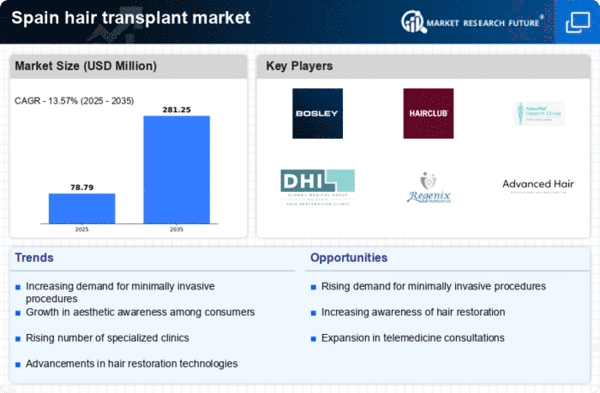
As per Market Research Future analysis, the Spain hair transplant market Size was estimated at 69.38 USD Million in 2024. The Spain hair transplant market is projected to grow from 78.79 USD Million in 2025 to 281.25 USD Million by 2035, exhibiting a compound annual growth rate (CAGR) of 13.5% during the forecast period 2025 - 2035

Key Market Trends & Highlights

The Spain hair transplant market is experiencing robust growth driven by technological advancements and increasing consumer awareness.

  • Technological advancements in hair transplant procedures are enhancing patient outcomes and satisfaction.
  • The largest segment in the Spain hair transplant market is the surgical hair restoration segment, while the fastest-growing segment is non-surgical options.
  • Consumer awareness regarding hair loss solutions is rising, significantly influencing market dynamics.
  • Key market drivers include rising aesthetic consciousness and advancements in surgical techniques, which are propelling demand.

Market Size & Forecast

2024 Market Size 69.38 (USD Million)
2035 Market Size 281.25 (USD Million)
CAGR (2025 - 2035) 13.57%

Major Players

Bosley (US), Hair Club (US), NewMe Health (US), DHI Global Medical Group (GR), Regenix (US), Advanced Hair Restoration (US), Alvi Armani (CA), FUE Clinics (GB), The Private Clinic (GB)

Our Impact
Enabled $4.3B Revenue Impact for Fortune 500 and Leading Multinationals
Partnering with 2000+ Global Organizations Each Year
30K+ Citations by Top-Tier Firms in the Industry

Spain Hair Transplant Market Trends

The hair transplant market in Spain is currently experiencing notable growth, driven by increasing awareness of aesthetic procedures and advancements in technology. The rise in disposable income among the population appears to contribute to a greater willingness to invest in personal appearance. Additionally, the influence of social media and celebrity endorsements seems to play a significant role in shaping public perception and acceptance of hair restoration techniques. As a result, more individuals are seeking solutions for hair loss, leading to a surge in demand for various transplant methods. Moreover, the regulatory environment in Spain supports the expansion of the hair transplant market. The presence of qualified professionals and accredited clinics enhances consumer confidence, which is crucial for the industry's growth. Furthermore, the integration of innovative techniques, such as robotic-assisted procedures and minimally invasive methods, indicates a shift towards more efficient and effective treatments. This evolution not only improves patient outcomes but also attracts a broader demographic, including younger individuals who are increasingly concerned about hair loss. Overall, the hair transplant market in Spain is poised for continued expansion, reflecting changing societal attitudes towards personal grooming and self-care.

Technological Advancements

The hair transplant market is witnessing a transformation due to technological innovations. Techniques such as Follicular Unit Extraction (FUE) and robotic-assisted surgeries are becoming more prevalent. These advancements enhance precision and reduce recovery times, making procedures more appealing to potential clients.

Increased Consumer Awareness

There is a growing awareness among consumers regarding hair restoration options. Educational campaigns and online resources are helping individuals understand the benefits and risks associated with hair transplants. This heightened awareness is likely to drive demand as more people seek effective solutions for hair loss.

Regulatory Support and Standards

The regulatory framework in Spain is evolving to ensure high standards in the hair transplant market. Accreditation of clinics and certification of practitioners are becoming more stringent, which may enhance consumer trust. This regulatory support is crucial for fostering a safe environment for patients.

Spain Hair Transplant Market Drivers

Growing Aging Population

The demographic shift towards an aging population in Spain is a significant driver for the hair transplant market. As individuals age, hair loss becomes a common concern, prompting many to seek effective solutions. Current statistics suggest that nearly 40% of men and 25% of women over the age of 50 experience noticeable hair thinning or loss. This demographic trend is expected to continue, with projections indicating that by 2030, the proportion of individuals aged 65 and older will reach 25% of the total population. Consequently, the hair transplant market is likely to expand as clinics cater to this growing segment. Additionally, older adults are increasingly open to cosmetic procedures, viewing them as a means to enhance their quality of life. This evolving mindset, combined with the rising prevalence of hair loss, positions the market for sustained growth in the coming years.

Rising Aesthetic Consciousness

The hair transplant market in Spain is experiencing a notable surge due to the increasing aesthetic consciousness among the population. As societal norms evolve, individuals are becoming more concerned with their appearance, leading to a heightened demand for cosmetic procedures, including hair transplants. Recent surveys indicate that approximately 30% of the Spanish population is considering aesthetic enhancements, with hair restoration being a prominent choice. This trend is particularly evident among younger demographics, who are more inclined to invest in their looks. The hair transplant market is thus benefiting from this cultural shift, as clinics report a steady increase in consultations and procedures. Furthermore, the rise of social media platforms has amplified the visibility of hair restoration success stories, further driving interest and acceptance of these procedures. Consequently, the market is poised for continued growth as more individuals seek solutions to hair loss.

Economic Factors and Affordability

Economic factors play a crucial role in shaping the hair transplant market in Spain. With a growing middle class and increasing disposable income, more individuals are willing to invest in cosmetic procedures. Recent economic data suggests that consumer spending on personal care and aesthetics has risen by approximately 15% over the past year. This trend indicates a shift in priorities, where individuals are allocating more resources towards enhancing their appearance. The hair transplant market is benefiting from this economic climate, as clinics are able to offer a range of financing options to make procedures more accessible. Additionally, competitive pricing strategies among clinics are further driving affordability, allowing a broader demographic to consider hair restoration. As economic conditions continue to improve, the market is expected to expand, attracting a diverse clientele seeking effective solutions for hair loss.

Advancements in Surgical Techniques

Innovations in surgical techniques are significantly impacting the hair transplant market in Spain. The introduction of minimally invasive methods, such as Follicular Unit Extraction (FUE) and Direct Hair Implantation (DHI), has transformed the landscape of hair restoration. These techniques not only reduce recovery time but also enhance the overall aesthetic results, making them more appealing to potential clients. Clinics adopting these advanced methods report a 25% increase in patient satisfaction, which is crucial for word-of-mouth referrals. Moreover, the hair transplant market is witnessing a shift towards personalized treatment plans, allowing for tailored solutions that cater to individual needs. As technology continues to evolve, the market is likely to see further enhancements in surgical precision and outcomes, thereby attracting a broader clientele. This trend underscores the importance of staying abreast of technological advancements to remain competitive in the industry.

Influence of Social Media and Celebrity Endorsements

The hair transplant market in Spain is significantly influenced by social media and celebrity endorsements. As public figures openly share their experiences with hair restoration, they contribute to normalizing the procedure and reducing stigma. This visibility has led to a marked increase in inquiries and procedures, particularly among younger audiences who are heavily engaged on platforms like Instagram and TikTok. Reports indicate that clinics have seen a 20% rise in consultations following high-profile endorsements. The hair transplant market is thus leveraging these trends by enhancing their online presence and marketing strategies to attract potential clients. Furthermore, the interactive nature of social media allows for real-time feedback and testimonials, which can further bolster consumer confidence in hair restoration procedures. As this trend continues, the market is likely to evolve, adapting to the preferences and behaviors of a digitally savvy clientele.


Market Segment Insights

By Surgical Technique: Follicular Unit Extraction (FUE) (Largest) vs. Follicular Unit Transplantation (FUT) (Fastest-Growing)

In the Spain hair transplant market, Follicular Unit Extraction (FUE) stands out as the largest segment, accounting for a significant share of the total market. This technique is preferred due to its minimally invasive nature and effective results. On the other hand, Follicular Unit Transplantation (FUT) is gaining traction and is considered the fastest-growing segment, appealing to those looking for cost-effective solutions with reliable outcomes. The growth of these techniques is driven by increasing awareness and acceptance of hair transplant procedures among the population. Factors such as advancements in medical technology, enhanced aesthetic standards, and the rise in male and female pattern baldness are fueling demand. As patient preferences evolve, both FUE and FUT are expected to play critical roles in defining the future landscape of hair restoration solutions.

Follicular Unit Extraction (FUE) (Dominant) vs. Follicular Unit Transplantation (FUT) (Emerging)

Follicular Unit Extraction (FUE) dominates the Spain hair transplant market due to its sophisticated approach of extracting individual hair follicles, resulting in minimal scarring and quicker recovery times. This technique is preferred by patients seeking natural-looking results with a lower risk of complications. In contrast, Follicular Unit Transplantation (FUT) is emerging as a viable alternative, especially for patients requiring extensive transplants. While it involves removing a strip of scalp, it is seen as a cost-effective method for those looking for more substantial coverage. The growing interest in these techniques showcases the diverse preferences patients have when it comes to hair restoration solutions.

By Application: Male Pattern Baldness (Largest) vs. Female Pattern Baldness (Fastest-Growing)

In the Spain hair transplant market, Male Pattern Baldness represents the largest share, capturing a significant portion of the market due to high prevalence among men. It accounts for a dominant segment of those seeking hair restoration procedures, driven by social pressures and increased awareness of available treatment options. Conversely, Female Pattern Baldness is emerging as a significant segment, reflecting the changing perceptions of female hair loss and the growing willingness among women to seek surgical solutions. Growth trends show that the demand for hair transplant procedures is spurred by advancing techniques and greater accessibility to services. Factors such as the rising influence of social media and celebrity endorsements are making hair transplants more appealing to both men and women. Furthermore, as awareness surrounding various hair loss conditions increases, segments like Scarring Alopecia and Hair Loss from Trauma are also witnessing gradual growth, but they remain less prominent compared to Male and Female Pattern Baldness.

Male Pattern Baldness (Dominant) vs. Female Pattern Baldness (Emerging)

Male Pattern Baldness is characterized by a well-established market presence, with a broad spectrum of treatment options tailored to men's specific needs. This segment benefits from extensive research and product development focusing on innovative solutions, making it the leading choice for hair restoration. In contrast, Female Pattern Baldness, while smaller in market share, is rapidly gaining attention as awareness grows regarding women's hair loss issues. Women seeking hair transplants tend to prioritize natural-looking results and minimally invasive techniques, which has led to the development of specialized strategies catering to their unique requirements. Both segments reflect the evolving landscape of hair restoration, highlighting the need for personalized approaches.

By End User: Clinics (Largest) vs. Home Care (Fastest-Growing)

In the Spain hair transplant market, clinics have established themselves as the largest segment, capturing a significant share due to their specialized services and skilled professionals. These clinics often offer a range of advanced techniques and personalized care, attracting numerous patients seeking effective solutions for hair loss. In contrast, hospitals and home care solutions represent smaller segments, but they contribute to the diversity of options available, catering to various patient preferences and needs. The growth trends within the end user segment reveal an increasing inclination towards home care options, marking it as the fastest-growing area. This rise is driven by an expanding awareness of hair transplant procedures and a desire for convenience, as more individuals look for alternatives that provide satisfactory results without the need for hospital visits. Additionally, advancements in at-home treatment technologies and the availability of product offerings further bolster this trend, attracting a younger demographic seeking efficient hair restoration solutions.

Clinics: Specialized (Dominant) vs. Home Care: Innovative (Emerging)

Clinics in the Spain hair transplant market stand out as the dominant players, emphasizing specialized care with highly trained staff and cutting-edge technology. They are often viewed as the go-to option for patients needing comprehensive assessments and tailored treatment plans. Their reputation for delivering consistent results positions them prominently in the market. On the other hand, home care solutions are emerging, driven by innovation in product development that allows individuals to engage in treatment regimens at their convenience. This segment caters primarily to tech-savvy consumers looking for accessible, effective, and discreet options to manage hair loss, making it a vital component of the evolving market landscape.

By Gender: Male (Largest) vs. Female (Fastest-Growing)

In the Spain hair transplant market, males constitute the largest segment, representing a significant portion of the overall demand. This trend can be attributed to increasing awareness of hair loss solutions among men, who often view hair restoration as crucial to their self-image. On the other hand, the female segment, although smaller, is experiencing rapid growth as more women recognize the benefits of hair transplant procedures and seek effective treatments for thinning hair or baldness. The growth trends in this segment are driven by changing societal attitudes towards beauty and self-care among both genders. Innovative marketing strategies that specifically target women are helping to enhance awareness and accessibility of hair transplant options. Additionally, the rising influence of social media and celebrity endorsements is encouraging a younger demographic of women to consider hair transplants, thus driving market expansion for this segment.

Male: Dominant vs. Female: Emerging

The male segment remains the dominant force in the market, characterized by a higher propensity for hair restoration procedures. Men often seek these services due to societal pressures and personal desire for a youthful appearance. In contrast, the female segment is emerging as a significant player, approaching the market with distinct motivations such as the desire for fuller hair amidst changing beauty standards. Women are increasingly willing to invest in hair transplants, driven by both emotional and practical needs. This duality in the gender segments highlights evolving consumer behavior and a broader acceptance of hair restoration as a viable solution for both men and women in Spain.

Get more detailed insights about Spain Hair Transplant Market

Key Players and Competitive Insights

The hair transplant market in Spain is characterized by a competitive landscape that is increasingly shaped by innovation, strategic partnerships, and a focus on patient-centric services. Key players such as Bosley (US), DHI Global Medical Group (GR), and Alvi Armani (CA) are actively redefining their operational strategies to enhance their market presence. Bosley (US), for instance, emphasizes a comprehensive approach to hair restoration, integrating advanced technologies and personalized treatment plans, which positions it favorably against competitors. DHI Global Medical Group (GR) focuses on expanding its clinic network across Europe, thereby enhancing accessibility and brand recognition, while Alvi Armani (CA) leverages its reputation for high-quality results to attract a discerning clientele, suggesting a trend towards premium service offerings in the market.
The business tactics employed by these companies reflect a moderately fragmented market structure, where localized strategies and supply chain optimization play crucial roles. Companies are increasingly localizing their services to cater to regional preferences, which not only enhances customer satisfaction but also improves operational efficiency. This localized approach, combined with the collective influence of major players, creates a dynamic environment where competition is driven by service quality and technological advancements rather than solely by price.
In October 2025, DHI Global Medical Group (GR) announced the opening of a new clinic in Madrid, aimed at expanding its footprint in the Spanish market. This strategic move is significant as it not only increases the company's operational capacity but also enhances its ability to serve a growing customer base in a key urban center. The expansion aligns with the company's broader strategy of increasing accessibility to its services, which is likely to bolster its competitive position in the region.
In September 2025, Alvi Armani (CA) launched a new digital platform designed to streamline the consultation process for potential clients. This initiative reflects a growing trend towards digital transformation within the industry, as it allows for more efficient patient engagement and enhances the overall customer experience. By investing in technology, Alvi Armani (CA) appears to be positioning itself as a leader in customer service, which could yield long-term benefits in terms of client retention and brand loyalty.
In November 2025, Bosley (US) unveiled a partnership with a leading technology firm to integrate AI-driven solutions into its treatment planning processes. This collaboration is indicative of a broader trend towards the incorporation of artificial intelligence in healthcare, which may enhance diagnostic accuracy and treatment personalization. Such innovations are likely to set Bosley (US) apart from its competitors, as the market increasingly values technological advancements that improve patient outcomes.
As of November 2025, the competitive trends within the hair transplant market are increasingly defined by digitalization, sustainability, and the integration of advanced technologies. Strategic alliances are becoming more prevalent, as companies recognize the value of collaboration in enhancing service offerings and operational efficiencies. Looking ahead, it is anticipated that competitive differentiation will evolve, with a shift from price-based competition to a focus on innovation, technology, and supply chain reliability. This evolution suggests that companies that prioritize these aspects will likely emerge as leaders in the market.

Key Companies in the Spain Hair Transplant Market include

Industry Developments

In the Spain Hair Transplant Market, several developments have recently surfaced. Clinicana and Esteworld have been increasing their services and client outreach, leveraging digital marketing strategies to attract international clients seeking hair restoration solutions. DHI Global Medical Group continues to expand its network, enhancing its reputation within Spain, while Advanced Hair Clinics has reported steady growth in clientele, emphasizing minimally invasive techniques. In terms of mergers and acquisitions, no significant activity has been reported among the key players like Surgery in Spain, HDC Hair Clinic, or Vita Hair Clinic.

The market has seen a considerable increase in demand, especially post-pandemic in 2021, leading to an overall growth estimate for the sector, with revenues projected to rise significantly. This growth is largely driven by advancements in technology and the rising societal acceptance of cosmetic procedures in Spain. Furthermore, initiatives by organizations such as the Spanish Society of Plastic, Aesthetic, and Reconstructive Surgery have improved standards and consumer awareness surrounding hair transplant practices, thereby positively influencing the overall market environment.

In recent years, an increase in medical tourism related to hair transplantation has also been notable, positioning Spain as a competitive destination in this field.

Spain Hair Transplant Market Segmentation Insights

Spain Hair Transplant Market Hair Transplant Surgical Method Outlook

    • Follicular Unit Transplantation

    • Follicular Unit Extraction

    • Follicular Isolation Technique

    • Robotic Hair Transplantation

Spain Hair Transplant Market Hair Transplant Surgery Type Outlook

    • Head Hair Transplant

    • Eyebrow Transplant

    • Frontal Hairline Lowering

Future Outlook

Spain Hair Transplant Market Future Outlook

The Hair Transplant Market in Spain is projected to grow at a 13.57% CAGR from 2025 to 2035, driven by technological advancements and increasing consumer awareness.

New opportunities lie in:

  • Expansion of telemedicine consultations for pre- and post-operative care.
  • Development of personalized hair restoration products using AI technology.
  • Partnerships with wellness centers to offer integrated hair health services.

By 2035, the market is expected to be robust, reflecting substantial growth and innovation.

Market Segmentation

Spain Hair Transplant Market Gender Outlook

  • Male
  • Female

Spain Hair Transplant Market End User Outlook

  • Clinics
  • Hospitals
  • Home Care

Spain Hair Transplant Market Application Outlook

  • Male Pattern Baldness
  • Female Pattern Baldness
  • Scarring Alopecia
  • Hair Loss from Trauma

Spain Hair Transplant Market Surgical Technique Outlook

  • Follicular Unit Extraction (FUE)
  • Follicular Unit Transplantation (FUT)
  • Scalp Reduction
  • Tissue Expansion

Report Scope

MARKET SIZE 2024 69.38(USD Million)
MARKET SIZE 2025 78.79(USD Million)
MARKET SIZE 2035 281.25(USD Million)
COMPOUND ANNUAL GROWTH RATE (CAGR) 13.57% (2025 - 2035)
REPORT COVERAGE Revenue Forecast, Competitive Landscape, Growth Factors, and Trends
BASE YEAR 2024
Market Forecast Period 2025 - 2035
Historical Data 2019 - 2024
Market Forecast Units USD Million
Key Companies Profiled Bosley (US), Hair Club (US), NewMe Health (US), DHI Global Medical Group (GR), Regenix (US), Advanced Hair Restoration (US), Alvi Armani (CA), FUE Clinics (GB), The Private Clinic (GB)
Segments Covered Surgical Technique, Application, End User, Gender
Key Market Opportunities Adoption of advanced minimally invasive techniques enhances patient satisfaction in the hair transplant market.
Key Market Dynamics Rising consumer demand for minimally invasive hair restoration techniques drives innovation in the hair transplant market.
Countries Covered Spain
Leave a Comment

FAQs

What is the expected market size of the Spain Hair Transplant Market in 2024?

The Spain Hair Transplant Market is expected to be valued at 140.0 USD Million in 2024.

What will be the market size of the Spain Hair Transplant Market by 2035?

By 2035, the Spain Hair Transplant Market is anticipated to reach a valuation of 420.0 USD Million.

What is the expected compound annual growth rate (CAGR) for the Spain Hair Transplant Market from 2025 to 2035?

The expected CAGR for the Spain Hair Transplant Market from 2025 to 2035 is 10.503%.

What segment of the Spain Hair Transplant Market is expected to dominate in 2024?

The Follicular Unit Extraction segment is expected to dominate the Spain Hair Transplant Market with a value of 50.0 USD Million in 2024.

Which hair transplant surgical method is projected to grow the most by 2035?

The Follicular Unit Extraction method is projected to grow the most, reaching 150.0 USD Million by 2035.

Who are the key players in the Spain Hair Transplant Market?

Key players in the market include Clinicana, Transplant Hair, HDC Hair Clinic, and DHI Global Medical Group.

What is the market value of Follicular Unit Transplantation in 2024?

The market value for Follicular Unit Transplantation is expected to be 40.0 USD Million in 2024.

What challenges does the Spain Hair Transplant Market face?

Challenges in the Spain Hair Transplant Market include competition from emerging technologies and the need for skilled practitioners.

What are the growth drivers for the Spain Hair Transplant Market?

Growth drivers include increasing awareness of hair restoration procedures and rising urbanization and disposable income.

What was the market value for Robotic Hair Transplantation in 2024?

In 2024, the market value for Robotic Hair Transplantation is projected to be 20.0 USD Million.

Download Free Sample

Kindly complete the form below to receive a free sample of this Report

Compare Licence

×
Features License Type
Single User Multiuser License Enterprise User
Price $4,950 $5,950 $7,250
Maximum User Access Limit 1 User Upto 10 Users Unrestricted Access Throughout the Organization
Free Customization
Direct Access to Analyst
Deliverable Format
Platform Access
Discount on Next Purchase 10% 15% 15%
Printable Versions