×
Request Free Sample ×

Kindly complete the form below to receive a free sample of this Report

* Please use a valid business email

Leading companies partner with us for data-driven Insights

clients tt-cursor
Hero Background

Spain DNA Synthesis Market

ID: MRFR/MED/50505-HCR
200 Pages
Rahul Gotadki
February 2026

Spain DNA Synthesis Market Research Report: Size, Share, Trend Analysis By Applications (Gene Therapy, Synthetic Biology, Molecular Diagnostics, Vaccine Development), By Product Type (Oligonucleotides, Gene Fragments, Gene Libraries), By End Users (Academic Research Institutions, Pharmaceutical Companies, Biotechnology Companies, Clinical Laboratories) and By Technology (Solid-Phase Synthesis, Liquid-Phase Synthesis, PCR-Based Synthesis) - Growth Outlook & Industry Forecast 2025 To 2035

Share:
Download PDF ×

We do not share your information with anyone. However, we may send you emails based on your report interest from time to time. You may contact us at any time to opt-out.

Spain DNA Synthesis Market Infographic
Purchase Options

Spain DNA Synthesis Market Summary

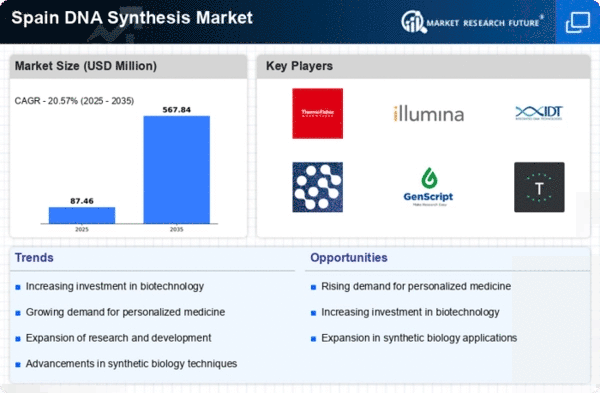
As per Market Research Future analysis, the Spain DNA Synthesis Market size was estimated at 72.54 USD Million in 2024. The Dna Synthesis market is projected to grow from 87.46 USD Million in 2025 to 567.84 USD Million by 2035, exhibiting a compound annual growth rate (CAGR) of 20.5% during the forecast period 2025 - 2035

Key Market Trends & Highlights

The Spain DNA synthesis market is experiencing robust growth driven by technological advancements and increasing demand for personalized medicine.

  • Technological advancements are enhancing the efficiency and accuracy of DNA synthesis processes.
  • The largest segment in the Spain DNA synthesis market is the biotechnology sector, while the fastest-growing segment is personalized medicine.
  • Government support and funding initiatives are fostering innovation and collaboration in the DNA synthesis landscape.
  • Key market drivers include the growing biotech sector and increased research funding, which are propelling market expansion.

Market Size & Forecast

2024 Market Size 72.54 (USD Million)
2035 Market Size 567.84 (USD Million)
CAGR (2025 - 2035) 20.57%

Major Players

Thermo Fisher Scientific (US), Illumina (US), Integrated DNA Technologies (US), Eurofins Genomics (DE), GenScript (CN), Twist Bioscience (US), Synthetic Genomics (US), Bioneer (KR), DNA2.0 (US)

Our Impact
Enabled $4.3B Revenue Impact for Fortune 500 and Leading Multinationals
Partnering with 2000+ Global Organizations Each Year
30K+ Citations by Top-Tier Firms in the Industry

Spain DNA Synthesis Market Trends

The Spain DNA Synthesis Market is currently experiencing notable growth, driven by advancements in biotechnology and increasing demand for synthetic DNA in various applications. In Spain, the market is influenced by a robust research environment, with numerous academic institutions and biotech companies focusing on genetic research and development. This environment fosters innovation and collaboration, which are essential for the evolution of the dna synthesis market. Furthermore, the Spanish government supports initiatives aimed at enhancing biotechnology, which may further stimulate market expansion. In addition, the rising interest in personalized medicine and genetic testing is likely to propel the demand for synthetic DNA. As healthcare providers and researchers seek to develop tailored therapies, the need for high-quality, customized DNA synthesis services becomes increasingly critical. The integration of automation and advanced technologies in dna synthesis processes may also enhance efficiency and reduce costs, making these services more accessible to a broader range of users. Overall, The DNA synthesis market in Spain appears poised for continued growth, driven by innovation, government support, and evolving healthcare needs.

Technological Advancements

Recent innovations in dna synthesis technologies are transforming the landscape of the market. Automation and high-throughput synthesis methods are enhancing efficiency and accuracy, allowing for the rapid production of synthetic DNA. These advancements may lead to increased adoption among research institutions and biotech companies, as they seek to streamline their workflows and improve outcomes.

Rising Demand for Personalized Medicine

The growing emphasis on personalized medicine is significantly impacting the dna synthesis market. As healthcare providers increasingly focus on tailored treatments, the need for custom synthetic DNA is likely to rise. This trend suggests that companies offering specialized synthesis services may experience heightened demand, aligning with the broader shift towards individualized healthcare solutions.

Government Support and Funding

Government initiatives aimed at promoting biotechnology research are playing a crucial role in the dna synthesis market. In Spain, funding programs and support for biotech startups are fostering innovation and collaboration. This environment may encourage the development of new applications for synthetic DNA, further driving market growth and positioning Spain as a key player in the biotechnology sector.

Spain DNA Synthesis Market Drivers

Growing Biotech Sector

The biotechnology sector in Spain is experiencing robust growth, which is likely to drive the dna synthesis market. With an increase in biotech startups and established companies focusing on genetic research, the demand for synthetic DNA is expected to rise. In 2025, the biotech industry in Spain is projected to reach a valuation of approximately €5 billion, indicating a compound annual growth rate (CAGR) of around 8%. This growth is fueled by advancements in genetic engineering and synthetic biology, which require high-quality DNA synthesis services. As more companies invest in research and development, the dna synthesis market is poised to benefit significantly from this expanding ecosystem.

Increased Research Funding

Research funding in Spain has seen a notable increase, particularly in the fields of genomics and molecular biology. The Spanish government, along with private investors, is allocating more resources to scientific research, which is likely to enhance the capabilities of the dna synthesis market. In 2025, public and private funding for life sciences research is expected to exceed €1 billion, creating a favorable environment for innovation. This influx of capital enables researchers to pursue ambitious projects that require advanced dna synthesis technologies, thereby stimulating market growth. The emphasis on scientific excellence and collaboration among institutions further supports the expansion of the dna synthesis market.

Rising Applications in Agriculture

The application of dna synthesis in agriculture is gaining traction in Spain, driven by the need for sustainable farming practices. The dna synthesis market is witnessing increased demand for genetically modified organisms (GMOs) that can withstand environmental stresses and improve crop yields. In 2025, the market for agricultural biotechnology in Spain is anticipated to grow by 10%, reflecting a shift towards innovative solutions in food production. This trend is likely to encourage investment in dna synthesis technologies, as agricultural companies seek to develop new traits in crops. The integration of synthetic biology into agriculture presents a significant opportunity for the dna synthesis market to expand its reach.

Emerging Synthetic Biology Applications

Synthetic biology is emerging as a transformative field in Spain, with applications spanning healthcare, environmental science, and industrial biotechnology. The dna synthesis market is expected to benefit from the increasing interest in synthetic biology, as researchers and companies explore novel ways to engineer biological systems. In 2025, the synthetic biology market in Spain is projected to grow at a CAGR of 12%, indicating a strong demand for dna synthesis services. This growth is driven by the need for innovative solutions to complex biological problems, which often require custom-designed DNA sequences. As synthetic biology continues to evolve, the dna synthesis market is likely to play a crucial role in supporting these advancements.

Collaboration Between Academia and Industry

Collaboration between academic institutions and industry players in Spain is fostering innovation in the dna synthesis market. Universities and research centers are increasingly partnering with biotech companies to translate scientific discoveries into practical applications. This synergy is expected to enhance the capabilities of the dna synthesis market, as academic research often leads to breakthroughs that require advanced dna synthesis techniques. In 2025, collaborative projects are projected to increase by 15%, reflecting a growing trend towards interdisciplinary research. Such partnerships not only drive technological advancements but also create a skilled workforce that can further propel the dna synthesis market forward.


Market Segment Insights

By Application: Gene Therapy (Largest) vs. Vaccine Development (Fastest-Growing)

In the Spain dna synthesis market, the distribution of market share among the application segment values shows Gene Therapy leading with a significant share, driven by increasing investments in genetic treatments. Following closely are areas like Synthetic Biology and Molecular Diagnostics, which are also witnessing substantial interest, yet behind Gene Therapy. Vaccine Development, while it holds a smaller share, is rapidly gaining traction due to its critical role in responding to health crises and advancing technology. The growth trends within this segment indicate a robust increase in demand for Gene Therapy applications, propelled by advancements in genetic engineering and personalized medicine. Conversely, Vaccine Development is recognized as the fastest-growing area, spurred by the need for vaccines amidst global health challenges. Market players are focused on innovative approaches and collaborations to enhance offerings in both Gene Therapy and Vaccine Development, indicating a dynamic shift in the Spain dna synthesis market.

Gene Therapy (Dominant) vs. Vaccine Development (Emerging)

Gene Therapy has established itself as the dominant application within the Spain dna synthesis market, characterized by its potential to treat genetic disorders and enhance therapeutic outcomes. The market for Gene Therapy benefits from extensive research and favorable regulatory environments that promote innovation. In contrast, Vaccine Development is emerging rapidly, fueled by the ongoing global health concerns and the necessity for adaptive vaccine technologies. This segment is characterized by fast-paced research and development, attracting significant funding and partnerships driven by the urgency of public health needs. Both segments exhibit a strong alignment with technological advancements, creating competitive advantages and opening new avenues for growth.

By Product Type: Oligonucleotides (Largest) vs. Gene Libraries (Fastest-Growing)

In the Spain dna synthesis market, the product type segment is dominated by oligonucleotides, which are vital for various applications including diagnostics and therapeutics. This category captures a significant portion of the market share due to its widespread utilization in research and molecular biology. Gene fragments and gene libraries also contribute to the market, though to a lesser extent, indicating a diverse landscape that supports significant research advancements and innovations. Growth trends indicate that while oligonucleotides remain the largest share holder, gene libraries are experiencing rapid expansion driven by increasing investment in genomic research and the development of novel therapeutics. This acceleration is further fueled by the demand for personalized medicine and precision health strategies, positioning gene libraries as a crucial player in the evolving landscape of molecular biology.

Oligonucleotides (Dominant) vs. Gene Libraries (Emerging)

Oligonucleotides have established themselves as the dominant force in the Spain dna synthesis market due to their crucial roles in genetic testing and therapeutic applications. They are commonly used in CRISPR technology, PCR amplification, and as primers in various molecular diagnostics. Meanwhile, gene libraries are emerging as a significant segment, bolstered by advancements in high-throughput sequencing and bioinformatics. They provide essential resources for functional studies and lead to the discovery of novel genes and proteins. The increasing focus on synthetic biology and biotechnology is expected to boost the demand for both segments, while oligonucleotides maintain their lead aided by ongoing innovations and applications within the realm of genetic engineering.

By End User: Pharmaceutical Companies (Largest) vs. Academic Research Institutions (Fastest-Growing)

In the Spain dna synthesis market, the distribution of market share among end user segments shows that pharmaceutical companies hold the largest share due to their extensive investment in research and development. Academic research institutions follow, proving to be significant contributors to the market as they increasingly adopt advanced dna synthesis technologies for various research purposes. The growth trends in this segment highlight a robust increase in demand from biotechnology companies and clinical laboratories as well. Factors driving growth include rising research activities, innovation in dna synthesis technologies, and increasing applications in genetic research. Academic institutions are emerging as the fastest-growing segment, reflecting their pivotal role in fostering innovation and attracting funding for biological studies.

Pharmaceutical Companies (Dominant) vs. Academic Research Institutions (Emerging)

Pharmaceutical companies dominate the Spain dna synthesis market, leveraging their financial muscle and expertise to invest in cutting-edge technologies for drug development and genomic research. They focus on efficiency and scalability, making them key players in the sector. In contrast, academic research institutions are emerging as a vital segment, increasingly incorporating dna synthesis into their research agendas. These institutions are often at the forefront of innovative research, contributing to significant advancements in genetics and biotechnology. They attract funding and collaborate with pharmaceutical companies, which enhances their capabilities and positions them for substantial growth in the coming years.

By Technology: Solid-Phase Synthesis (Largest) vs. PCR-Based Synthesis (Fastest-Growing)

The Spain dna synthesis market exhibits a diverse landscape among its technology segments, with Solid-Phase Synthesis holding the largest share due to its reliability and widespread applications in various research settings. Liquid-Phase Synthesis, while significant, has a smaller portion of the market, primarily catering to specific applications where its advantages can be fully realized. Meanwhile, PCR-Based Synthesis is gaining traction, driven by increased research and diagnostic applications that elevate its market presence. Growth trends in this segment are propelled by advancements in technology and rising demand for efficient synthesis methods. Solid-Phase Synthesis continues to be favored for its high throughput and precision, contributing to its dominant market position. Conversely, PCR-Based Synthesis is rapidly becoming the fastest-growing segment, as increased investments in biotechnology and personalized medicine fuel its adoption across laboratories and research institutions, highlighting the dynamic nature of the Spain dna synthesis market.

Technology: Solid-Phase Synthesis (Dominant) vs. PCR-Based Synthesis (Emerging)

Solid-Phase Synthesis is known for its robustness and versatility, enabling the synthesis of a wide variety of nucleotides with high purity. This established method continues to dominate the market due to its efficiency and scalability, making it a preferred choice for large-scale applications. In contrast, PCR-Based Synthesis has emerged as a competitive segment, appealing especially to researchers involved in genetic testing, diagnostics, and synthetic biology. Its rapid speed and ability to amplify genetic material make it an attractive option, reflecting the growing trend towards faster and more efficient laboratory processes. The contrasting positions of these technologies illustrate the varied demands and applications within the Spain dna synthesis market.

Get more detailed insights about Spain DNA Synthesis Market

Key Players and Competitive Insights

The dna synthesis market in Spain exhibits a dynamic competitive landscape characterized by rapid technological advancements and increasing demand for synthetic biology applications. Key players such as Thermo Fisher Scientific (US), Illumina (US), and Twist Bioscience (US) are at the forefront, leveraging innovation and strategic partnerships to enhance their market positions. These companies focus on expanding their product offerings and improving service delivery, which collectively shapes a competitive environment that is both collaborative and competitive, fostering growth and innovation.
In terms of business tactics, companies are increasingly localizing manufacturing to reduce lead times and optimize supply chains. The market appears moderately fragmented, with several players vying for market share. However, the influence of major companies is substantial, as they set industry standards and drive technological advancements. This competitive structure encourages smaller firms to innovate and differentiate their offerings, thereby enhancing overall market dynamism.
In October 2025, Thermo Fisher Scientific (US) announced the launch of a new line of high-throughput DNA synthesis platforms aimed at accelerating genomic research. This strategic move is significant as it not only enhances their product portfolio but also positions them to capture a larger share of the growing demand for rapid and efficient synthesis solutions. The introduction of these platforms is likely to attract a diverse clientele, from academic institutions to biotech firms, thereby reinforcing Thermo Fisher's market leadership.
In September 2025, Illumina (US) expanded its collaboration with European research institutions to develop next-generation sequencing technologies. This partnership is pivotal as it aligns with the increasing trend towards personalized medicine and genomics. By investing in collaborative research, Illumina strengthens its innovation pipeline and enhances its competitive edge, ensuring that it remains at the forefront of technological advancements in the dna synthesis market.
In August 2025, Twist Bioscience (US) secured a multi-million dollar contract with a leading pharmaceutical company to provide custom DNA synthesis services. This contract underscores the growing reliance on synthetic biology in drug development and highlights Twist's capabilities in delivering tailored solutions. Such strategic contracts not only bolster revenue but also enhance the company's reputation as a key player in the market, potentially leading to further partnerships and collaborations.
As of November 2025, current trends in the dna synthesis market are increasingly defined by digitalization, sustainability, and the integration of artificial intelligence. Strategic alliances are becoming more prevalent, as companies recognize the value of collaboration in driving innovation and addressing complex challenges. Looking ahead, competitive differentiation is likely to evolve, shifting from price-based competition to a focus on technological innovation, supply chain reliability, and sustainable practices. This transition may redefine market dynamics, compelling companies to invest in R&D and forge strategic partnerships to maintain their competitive edge.

Key Companies in the Spain DNA Synthesis Market include

Industry Developments

The Spain DNA Synthesis Market has witnessed significant progress in recent months, with companies such as Twist Bioscience, Merck KGaA, Agilent Technologies, and QIAGEN advancing their capabilities in response to the growing demand for genetic research and synthetic biology applications. In September 2023, Thermo Fisher Scientific announced a strategic partnership with Spanish biotech firms to enhance local research resources. 

Additionally, the Spanish government has shown support for genomic research initiatives, allocating funds for innovative projects in this sector. Notable mergers and acquisitions include Merck KGaA's acquisition of a regional biotechnology firm in January 2023, aimed at bolstering its DNA synthesis portfolio in Spain. Furthermore, in March 2022, Illumina completed its acquisition of a biotech company, enhancing its market position within the country. 

Over the past two to three years, the DNA Synthesis Market in Spain has experienced robust growth, driven by technological advancements and an increased focus on healthcare applications. This growth trend reflects a larger European commitment to biotechnological development and innovation, fostering a collaborative environment among major industry players such as Horizon Discovery and Eurofins Genomics.


Future Outlook

Spain DNA Synthesis Market Future Outlook

The DNA synthesis Market is projected to grow at a 20.57% CAGR from 2025 to 2035, driven by advancements in biotechnology, increased demand for personalized medicine, and rising investments in genomics.

New opportunities lie in:

  • Development of custom DNA synthesis platforms for personalized therapeutics.
  • Expansion of synthetic biology applications in agriculture and biofuels.
  • Partnerships with research institutions for innovative DNA-based solutions.

By 2035, The DNA synthesis market is expected to achieve substantial growth, driven by technological advancements and strategic collaborations.

Market Segmentation

Spain DNA Synthesis Market End User Outlook

  • Academic Research Institutions
  • Pharmaceutical Companies
  • Biotechnology Companies
  • Clinical Laboratories

Spain DNA Synthesis Market Technology Outlook

  • Solid-Phase Synthesis
  • Liquid-Phase Synthesis
  • PCR-Based Synthesis

Spain DNA Synthesis Market Application Outlook

  • Gene Therapy
  • Synthetic Biology
  • Molecular Diagnostics
  • Vaccine Development

Spain DNA Synthesis Market Product Type Outlook

  • Oligonucleotides
  • Gene Fragments
  • Gene Libraries

Report Scope

MARKET SIZE 2024 72.54(USD Million)
MARKET SIZE 2025 87.46(USD Million)
MARKET SIZE 2035 567.84(USD Million)
COMPOUND ANNUAL GROWTH RATE (CAGR) 20.57% (2025 - 2035)
REPORT COVERAGE Revenue Forecast, Competitive Landscape, Growth Factors, and Trends
BASE YEAR 2024
Market Forecast Period 2025 - 2035
Historical Data 2019 - 2024
Market Forecast Units USD Million
Key Companies Profiled Thermo Fisher Scientific (US), Illumina (US), Integrated DNA Technologies (US), Eurofins Genomics (DE), GenScript (CN), Twist Bioscience (US), Synthetic Genomics (US), Bioneer (KR), DNA2.0 (US)
Segments Covered Application, Product Type, End User, Technology
Key Market Opportunities Advancements in personalized medicine drive demand for tailored solutions in the dna synthesis market.
Key Market Dynamics Rising demand for personalized medicine drives innovation and competition in the DNA synthesis market.
Countries Covered Spain
Leave a Comment

FAQs

What is the expected market size of the Spain DNA Synthesis Market in 2024?

The Spain DNA Synthesis Market is expected to be valued at 200.0 USD Million in 2024.

What will the market size of the Spain DNA Synthesis Market be by 2035?

By 2035, the Spain DNA Synthesis Market is projected to reach 560.0 USD Million.

What is the expected CAGR for the Spain DNA Synthesis Market from 2025 to 2035?

The expected CAGR for the Spain DNA Synthesis Market from 2025 to 2035 is 9.812%.

What will be the market value for Gene Therapy within the Spain DNA Synthesis Market in 2035?

The market value for Gene Therapy is anticipated to be 112.0 USD Million in 2035.

Which application segment is expected to have the highest market share in 2024?

In 2024, the Molecular Diagnostics segment is expected to hold the highest market share, valued at 70.0 USD Million.

What is the expected market value for Vaccine Development by 2035?

The Vaccine Development segment is expected to reach a market value of 168.0 USD Million by 2035.

Who are the key players in the Spain DNA Synthesis Market?

Key players in the Spain DNA Synthesis Market include Twist Bioscience, Merck KGaA, and Agilent Technologies.

What will be the market value for Synthetic Biology in 2035?

The market for Synthetic Biology is expected to grow to 84.0 USD Million by 2035.

How fast is the Molecular Diagnostics segment projected to grow from 2025 to 2035?

The Molecular Diagnostics segment is projected to experience significant growth, reaching 196.0 USD Million by 2035.

What challenges are currently impacting the Spain DNA Synthesis Market?

The market is currently facing challenges such as regulatory hurdles and technological advancements in DNA synthesis.

Download Free Sample

Kindly complete the form below to receive a free sample of this Report

Compare Licence

×
Features License Type
Single User Multiuser License Enterprise User
Price $4,950 $5,950 $7,250
Maximum User Access Limit 1 User Upto 10 Users Unrestricted Access Throughout the Organization
Free Customization
Direct Access to Analyst
Deliverable Format
Platform Access
Discount on Next Purchase 10% 15% 15%
Printable Versions