×
Request Free Sample ×

Kindly complete the form below to receive a free sample of this Report

* Please use a valid business email

Leading companies partner with us for data-driven Insights

clients tt-cursor
Hero Background

UK DNA Synthesis Market

ID: MRFR/MED/50498-HCR
200 Pages
Rahul Gotadki
February 2026

UK DNA Synthesis Market Research Report: Size, Share, Trend Analysis By Applications (Gene Therapy, Synthetic Biology, Molecular Diagnostics, Vaccine Development), By Product Type (Oligonucleotides, Gene Fragments, Gene Libraries), By End Users (Academic Research Institutions, Pharmaceutical Companies, Biotechnology Companies, Clinical Laboratories) and By Technology (Solid-Phase Synthesis, Liquid-Phase Synthesis, PCR-Based Synthesis) - Growth Outlook & Industry Forecast 2025 To 2035

Share:
Download PDF ×

We do not share your information with anyone. However, we may send you emails based on your report interest from time to time. You may contact us at any time to opt-out.

UK DNA Synthesis Market Infographic
Purchase Options

UK DNA Synthesis Market Summary

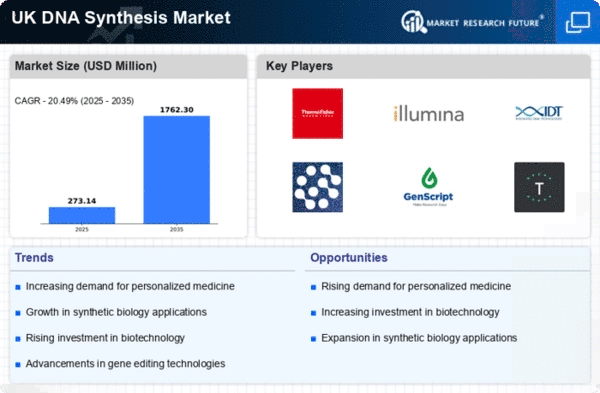
As per Market Research Future analysis, the UK DNA Synthesis Market Size was estimated at 226.69 USD Million in 2024. The UK DNA Synthesis Market is projected to grow from 273.14 USD Million in 2025 to 1762.3 USD Million by 2035, exhibiting a compound annual growth rate (CAGR) of 20.4% during the forecast period 2025 - 2035

Key Market Trends & Highlights

The UK DNA synthesis market is experiencing robust growth driven by technological advancements and increasing demand for custom solutions.

  • Technological advancements are enhancing the efficiency and accuracy of DNA synthesis processes.
  • The largest segment in the UK market is the biopharmaceutical sector, which is witnessing a surge in demand for synthetic DNA.
  • The fastest-growing segment is synthetic biology, fueled by innovative applications and research initiatives.
  • Rising biopharmaceutical investments and a growing focus on genomic research are key drivers propelling market expansion.

Market Size & Forecast

2024 Market Size 226.69 (USD Million)
2035 Market Size 1762.3 (USD Million)
CAGR (2025 - 2035) 20.49%

Major Players

Thermo Fisher Scientific (US), Illumina (US), Integrated DNA Technologies (US), Eurofins Genomics (DE), GenScript (CN), Twist Bioscience (US), Synthetic Genomics (US), DNA Script (FR), Bioneer (KR)

Our Impact
Enabled $4.3B Revenue Impact for Fortune 500 and Leading Multinationals
Partnering with 2000+ Global Organizations Each Year
30K+ Citations by Top-Tier Firms in the Industry

UK DNA Synthesis Market Trends

The DNA Synthesis Market is currently experiencing notable growth, driven by advancements in biotechnology and increasing demand for synthetic DNA in various applications. This market encompasses a range of services, including gene synthesis, oligonucleotide synthesis, and custom DNA products. The rise in personalized medicine and genetic research has further propelled the need for high-quality synthetic DNA, as researchers and healthcare professionals seek innovative solutions to complex biological challenges. Additionally, the integration of automation and artificial intelligence in synthesis processes is enhancing efficiency and accuracy, thereby attracting more stakeholders to this evolving field. Moreover, the regulatory landscape surrounding genetic materials is becoming more defined, which may influence the operational dynamics within the dna synthesis market. As ethical considerations gain prominence, companies are adapting their practices to align with regulatory requirements while ensuring compliance with safety standards. This shift could potentially reshape market strategies and foster collaboration among industry players, research institutions, and regulatory bodies. Overall, the dna synthesis market appears poised for continued expansion, with emerging technologies and a focus on ethical practices likely to play pivotal roles in its future development.

Technological Advancements

Recent innovations in synthesis technologies are transforming the dna synthesis market. Automation and high-throughput sequencing are streamlining production processes, leading to faster turnaround times and reduced costs. These advancements enable researchers to conduct experiments more efficiently, thereby accelerating the pace of scientific discovery.

Increased Demand for Custom Solutions

There is a growing trend towards personalized and custom DNA solutions within the dna synthesis market. Researchers and companies are increasingly seeking tailored products that meet specific project requirements. This demand is driven by the need for precision in genetic research and therapeutic applications.

Regulatory Developments

The evolving regulatory framework surrounding genetic materials is influencing the dna synthesis market. As governments and regulatory bodies establish clearer guidelines, companies are adapting their practices to ensure compliance. This trend may lead to enhanced collaboration between industry stakeholders and regulatory agencies.

UK DNA Synthesis Market Drivers

Collaborative Research Initiatives

Collaborative research initiatives between universities, research institutions, and industry players are emerging as a significant driver for the DNA Synthesis Market in the UK. These partnerships facilitate knowledge exchange and resource sharing, leading to accelerated advancements in dna synthesis technologies. In 2025, it is anticipated that collaborative projects will account for approximately 30% of all research funding in the life sciences sector. Such collaborations not only enhance the capabilities of the dna synthesis market but also ensure that the latest scientific discoveries are translated into practical applications, thereby fostering growth and innovation.

Increased Focus on Genomic Research

The DNA Synthesis Market is significantly influenced by the heightened focus on genomic research in the UK. With the completion of various genome projects, researchers are now more equipped to explore genetic variations and their implications in health and disease. The UK government has committed over £1 billion to genomic research initiatives, which is expected to drive demand for synthetic DNA. As researchers require custom DNA sequences for their studies, the dna synthesis market is poised for growth. This focus on genomics not only supports academic research but also paves the way for advancements in precision medicine and diagnostics.

Rising Biopharmaceutical Investments

The DNA Synthesis Market in the UK is experiencing a surge in investments from biopharmaceutical companies. This trend is driven by the increasing need for innovative therapies and personalized medicine. In 2025, the UK biopharmaceutical sector is projected to reach a valuation of £50 billion, with a significant portion allocated to research and development. As companies seek to enhance their product pipelines, the demand for high-quality synthetic DNA is likely to rise. This investment influx not only supports the growth of the dna synthesis market but also fosters collaborations between academic institutions and industry players, further propelling advancements in synthetic biology.

Emergence of Startups and Innovation Hubs

The DNA Synthesis Market is benefiting from the emergence of numerous startups and innovation hubs across the UK. These entities are often at the forefront of developing novel technologies and applications in dna synthesis. The UK government has established various funding programs to support biotech startups, which has led to an increase in entrepreneurial activities in the sector. In 2025, it is estimated that over 200 startups focused on synthetic biology and dna synthesis will be operational in the UK. This influx of innovation is likely to enhance competition and drive advancements in the dna synthesis market, ultimately benefiting end-users.

Growing Applications in Synthetic Biology

The applications of dna synthesis are expanding rapidly within the synthetic biology domain, which is a key driver for the DNA Synthesis Market. In the UK, sectors such as agriculture, environmental science, and biofuels are increasingly utilizing synthetic DNA to create genetically modified organisms that can withstand climate change and improve crop yields. The market for synthetic biology is expected to grow at a CAGR of 25% over the next five years, indicating a robust demand for dna synthesis services. This growth is likely to encourage more companies to invest in dna synthesis technologies, thereby enhancing the overall market landscape.


Market Segment Insights

By Application: Gene Therapy (Largest) vs. Vaccine Development (Fastest-Growing)

In the UK DNA Synthesis Market, the application segment exhibits a competitive landscape among Gene Therapy, Synthetic Biology, Molecular Diagnostics, and Vaccine Development. Gene Therapy holds a significant share due to its increasing adoption in clinical applications, while Vaccine Development is rapidly gaining traction, especially in light of recent global health challenges. The distribution of market share highlights the critical roles each application plays in advancing healthcare solutions. Growth trends in the application segment are largely driven by technological advancements and increased investment in research and development. The rapid emergence of synthetic biology and advances in molecular diagnostics are fueling innovation, leading to enhanced therapies and diagnostic capabilities. Moreover, the ongoing need for personalized medicine and efficient vaccines contributes to the robust growth of these segments, with Vaccine Development showing notable expansion opportunities.

Gene Therapy (Dominant) vs. Vaccine Development (Emerging)

Gene Therapy is well-established as a dominant force within the application segment of the UK dna synthesis market, characterized by its potential for curing genetic disorders and the increasing number of clinical trials. Its technologies enable precision targeting of genetic material, thus enhancing treatment efficacy. In contrast, Vaccine Development is seen as an emerging powerhouse, driven by recent global health events that emphasize the necessity for rapid vaccine technologies. The focus on mRNA vaccines and innovative delivery methods positions Vaccine Development as a critical area for future growth, responding to both pandemic and endemic health challenges with agility and speed.

By Product Type: Oligonucleotides (Largest) vs. Gene Libraries (Fastest-Growing)

In the UK DNA Synthesis Market, the product type segment is primarily dominated by oligonucleotides, which account for a significant share of the overall market. These synthetic strands of nucleotides are essential in various applications, including drug development, diagnostics, and research purposes. In contrast, gene fragments and gene libraries represent smaller proportions of the market, yet they contribute to the diverse landscape of the industry, catering to specific research and therapeutic needs. Growth trends indicate a robust expansion in the gene libraries segment, attributed to increasing investments in genomics research and personalized medicine. The rising demand for customized genetic solutions is expected to propel the market for gene fragments as well. Technological advancements in synthesis methods, alongside expanding applications in medical research, are also key drivers enhancing the overall market landscape for product types.

Oligonucleotides (Dominant) vs. Gene Libraries (Emerging)

Oligonucleotides play a dominant role in the UK dna synthesis market due to their versatility and essential utility in various applications, such as PCR amplification and gene synthesis. Their capacity to be tailored for specific sequences makes them crucial for researchers and industries alike. On the other hand, gene libraries are emerging as a noteworthy segment, driven by their application in functional genomics and high-throughput sequencing projects. While not as prevalent as oligonucleotides, gene libraries provide a repository of diverse genetic sequences that facilitate advanced research and innovation in genetic engineering and synthetic biology. Overall, both segments reflect the dynamic growth of the market, with specific applications impacting their respective distributions.

By End User: Pharmaceutical Companies (Largest) vs. Academic Research Institutions (Fastest-Growing)

The distribution of market share among the end user segments in the UK DNA Synthesis Market reveals a competitive landscape. Pharmaceutical companies hold the largest slice of the market due to their extensive R&D facilities and funding. Following closely are biotechnology companies and clinical laboratories, while academic research institutions are emerging with a growing share in the evolving landscape of genetic research. Growth trends indicate that academic research institutions are the fastest-growing segment, driven by increasing investments in genomics and synthetic biology. The demand for customized DNA products is surging, as researchers seek to innovate in areas like gene therapy and personalized medicine. This accelerating growth is also supported by collaborations between academic and industry players, enhancing the capabilities of research institutions in the market.

Pharmaceutical Companies: Dominant vs. Academic Research Institutions: Emerging

Pharmaceutical companies dominate the end user segment due to their robust capital investments, which enable advanced research and development of novel therapeutics. Their established infrastructure allows for large-scale synthesis of DNA, essential for drug development and testing. Conversely, academic research institutions are emerging as significant players in the UK dna synthesis market. They benefit from pivotal governmental grants and collaborations with biotech firms, providing them access to cutting-edge technologies and resources. While traditionally limited by budget constraints, many institutions are now focusing on translational research, thus increasing their market relevance and demand for bespoke DNA synthesizing solutions.

By Technology: Solid-Phase Synthesis (Largest) vs. PCR-Based Synthesis (Fastest-Growing)

In the UK DNA Synthesis Market, Solid-Phase Synthesis captures the largest market share due to its ability to produce high-quality oligonucleotides efficiently. This method dominates over Liquid-Phase Synthesis and PCR-Based Synthesis, which although significant, lag behind in terms of overall impact. Solid-Phase Synthesis is favored for its precision and adaptability across various applications, making it essential for both research and clinical uses. On the other hand, PCR-Based Synthesis is recognized as the fastest-growing segment within the UK dna synthesis market, propelled by increasing demand in genetic research, diagnostics, and synthetic biology. The segment's growth is fueled by advancements in PCR technology that enhance speed and accuracy, coupled with the expanding applications of synthetic DNA in fields such as pharmaceuticals and biotechnology. These trends are likely to continue as the market evolves, integrating newer technologies and methodologies.

Technology: Solid-Phase Synthesis (Dominant) vs. PCR-Based Synthesis (Emerging)

Solid-Phase Synthesis is the dominant technology in the UK dna synthesis market, known for its efficiency and high yield of desired products, which makes it highly sought after in research and medical applications. This method is characterized by its solid support and automated systems, allowing for precise synthesis of oligonucleotides essential for various applications, including gene therapy and diagnostics. Meanwhile, PCR-Based Synthesis is categorized as an emerging technology. This segment has gained momentum due to its incredible versatility and rapid results, particularly in genetic testing and molecular biology. The ongoing innovation in techniques, such as digital PCR, further enhances its appeal, positioning it as a vital component in the expanding landscape of genetic research.

Get more detailed insights about UK DNA Synthesis Market

Key Players and Competitive Insights

The dna synthesis market exhibits a dynamic competitive landscape characterized by rapid technological advancements and increasing demand for synthetic biology applications. Key players such as Thermo Fisher Scientific (US), Illumina (US), and Twist Bioscience (US) are strategically positioned to leverage innovation and expand their market presence. Thermo Fisher Scientific (US) focuses on enhancing its product portfolio through continuous research and development, while Illumina (US) emphasizes partnerships to bolster its sequencing capabilities. Twist Bioscience (US) is actively pursuing regional expansion, particularly in Europe, to tap into the growing demand for synthetic DNA. Collectively, these strategies contribute to a competitive environment that is increasingly driven by innovation and collaboration.In terms of business tactics, companies are localizing manufacturing and optimizing supply chains to enhance operational efficiency. The market structure appears moderately fragmented, with several key players exerting influence over various segments. This fragmentation allows for niche players to emerge, fostering a competitive atmosphere where innovation is paramount. The collective influence of these major companies shapes market dynamics, as they vie for leadership through differentiated offerings and strategic initiatives.

In October Thermo Fisher Scientific (US) announced a partnership with a leading European biotech firm to develop next-generation sequencing technologies. This collaboration is poised to enhance their capabilities in precision medicine, reflecting a strategic move to integrate advanced technologies into their product offerings. Such partnerships are likely to strengthen Thermo Fisher's position in the market, enabling them to address the evolving needs of researchers and clinicians.

In September Illumina (US) launched a new line of high-throughput sequencers aimed at reducing costs and increasing accessibility for academic institutions. This initiative underscores Illumina's commitment to democratizing genomic research, potentially expanding its customer base and reinforcing its market leadership. By focusing on affordability and accessibility, Illumina may effectively differentiate itself in a competitive landscape.

In August Twist Bioscience (US) expanded its manufacturing capabilities by opening a new facility in the UK, aimed at increasing production capacity for synthetic DNA. This strategic investment not only enhances their operational efficiency but also positions them to better serve the European market. The establishment of local manufacturing facilities may provide a competitive edge by reducing lead times and improving customer service.

As of November current trends in the dna synthesis market are increasingly defined by digitalization, sustainability, and the integration of artificial intelligence (AI) into research processes. Strategic alliances are becoming more prevalent, as companies recognize the value of collaboration in driving innovation. Looking ahead, competitive differentiation is likely to evolve from traditional price-based competition to a focus on technological advancements, supply chain reliability, and sustainable practices. This shift suggests that companies that prioritize innovation and adaptability will be better positioned to thrive in an increasingly complex market.

Key Companies in the UK DNA Synthesis Market include

Industry Developments

The UK DNA Synthesis Market has seen significant developments recently, with companies like Agilent Technologies, Eurofins Genomics, and Novogene playing key roles. The market is currently expanding due to increased demand for synthetic DNA in biotechnology and healthcare applications. In terms of mergers and acquisitions, no recent notable transactions have been reported among the specified companies as of October 2023. However, the market valuation for players like Thermo Fisher Scientific and Twist Bioscience is witnessing growth, driven by advancements in Research and Development activities and improved delivery of synthetic biology solutions. 

Over the past few years, the UK has also experienced notable investments in biotechnology, promoting advancements in gene editing technologies and personalized medicine, significantly impacting the DNA synthesis landscape. For instance, the UK government announced funding initiatives aimed at bolstering biotechnology innovation in June 2022, which positively influenced the overall market environment. As the market evolves, organizations such as Genscript and Synlogic continue to innovate, contributing to the competitive landscape and shaping future trends within the UK's DNA Synthesis Market.

Future Outlook

UK DNA Synthesis Market Future Outlook

The DNA synthesis Market is projected to grow at a 20.49% CAGR from 2025 to 2035, driven by advancements in biotechnology, increased demand for personalized medicine, and rising investments in genomics.

New opportunities lie in:

  • Development of custom DNA synthesis platforms for niche applications.
  • Expansion of partnerships with biotech firms for co-development projects.
  • Implementation of AI-driven analytics for optimizing synthesis processes.

By 2035, the DNA synthesis market is expected to achieve substantial growth, driven by innovation and strategic collaborations.

Market Segmentation

UK DNA Synthesis Market End User Outlook

  • Academic Research Institutions
  • Pharmaceutical Companies
  • Biotechnology Companies
  • Clinical Laboratories

UK DNA Synthesis Market Technology Outlook

  • Solid-Phase Synthesis
  • Liquid-Phase Synthesis
  • PCR-Based Synthesis

UK DNA Synthesis Market Application Outlook

  • Gene Therapy
  • Synthetic Biology
  • Molecular Diagnostics
  • Vaccine Development

UK DNA Synthesis Market Product Type Outlook

  • Oligonucleotides
  • Gene Fragments
  • Gene Libraries

Report Scope

MARKET SIZE 2024226.69(USD Million)
MARKET SIZE 2025273.14(USD Million)
MARKET SIZE 20351762.3(USD Million)
COMPOUND ANNUAL GROWTH RATE (CAGR)20.49% (2025 - 2035)
REPORT COVERAGERevenue Forecast, Competitive Landscape, Growth Factors, and Trends
BASE YEAR2024
Market Forecast Period2025 - 2035
Historical Data2019 - 2024
Market Forecast UnitsUSD Million
Key Companies ProfiledThermo Fisher Scientific (US), Illumina (US), Integrated DNA Technologies (US), Eurofins Genomics (DE), GenScript (CN), Twist Bioscience (US), Synthetic Genomics (US), DNA Script (FR), Bioneer (KR)
Segments CoveredApplication, Product Type, End User, Technology
Key Market OpportunitiesAdvancements in personalized medicine drive demand for tailored solutions in the dna synthesis market.
Key Market DynamicsTechnological advancements drive innovation in DNA synthesis, enhancing efficiency and reducing costs in the UK market.
Countries CoveredUK
Leave a Comment

FAQs

What is the expected market size of the UK DNA Synthesis Market in 2024?

The UK DNA Synthesis Market is expected to be valued at 250.02 USD Million in 2024.

What is the projected market value for the UK DNA Synthesis Market by 2035?

By 2035, the UK DNA Synthesis Market is projected to reach a value of 900.0 USD Million.

What is the expected CAGR for the UK DNA Synthesis Market from 2025 to 2035?

The expected CAGR for the UK DNA Synthesis Market from 2025 to 2035 is 12.349%.

Which application within the UK DNA Synthesis Market holds the highest value in 2024?

In 2024, the application of Molecular Diagnostics holds the highest value at 80.0 USD Million.

What is the estimated market value of Gene Therapy in the UK DNA Synthesis Market by 2035?

The estimated market value of Gene Therapy in the UK DNA Synthesis Market is projected to be 220.0 USD Million by 2035.

Who are some of the key players in the UK DNA Synthesis Market?

Key players in the UK DNA Synthesis Market include Agilent Technologies, Eurofins Genomics, and Thermo Fisher Scientific.

What is the market size for Vaccine Development in 2024 and 2035?

The market size for Vaccine Development is valued at 40.02 USD Million in 2024 and projected to reach 130.0 USD Million by 2035.

Which application is expected to grow the most in the UK DNA Synthesis Market between 2025 and 2035?

Synthetic Biology is expected to grow significantly, from 70.0 USD Million in 2024 to 250.0 USD Million by 2035.

What challenges does the UK DNA Synthesis Market face in its growth?

Key challenges include regulatory hurdles and the need for technological advancements in DNA synthesis.

How does the regional market compare in terms of growth rate?

The UK DNA Synthesis Market is expected to grow rapidly due to increasing demand in various applications throughout the region.

Download Free Sample

Kindly complete the form below to receive a free sample of this Report

Compare Licence

×
Features License Type
Single User Multiuser License Enterprise User
Price $4,950 $5,950 $7,250
Maximum User Access Limit 1 User Upto 10 Users Unrestricted Access Throughout the Organization
Free Customization
Direct Access to Analyst
Deliverable Format
Platform Access
Discount on Next Purchase 10% 15% 15%
Printable Versions