×
Request Free Sample ×

Kindly complete the form below to receive a free sample of this Report

* Please use a valid business email

Leading companies partner with us for data-driven Insights

clients tt-cursor
Hero Background

Spain Citizen Services AI Market

ID: MRFR/ICT/57493-HCR
200 Pages
Garvit Vyas
February 2026

Spain Citizen Services AI Market Research Report: By Technology (Natural Language Processing, Machine Learning, Computer Vision, Robotics, Deep Learning), By Application (Public Safety, Healthcare Services, Transportation Management, Citizen Engagement, Regulatory Compliance), By Deployment Mode (On-Premises, Cloud-Based, Hybrid) and By End Use (Government, Non-Profit Organizations, Private Sector) - Forecast to 2035.

Share:
Download PDF ×

We do not share your information with anyone. However, we may send you emails based on your report interest from time to time. You may contact us at any time to opt-out.

Spain Citizen Services AI Market Infographic
Purchase Options

Spain Citizen Services AI Market Summary

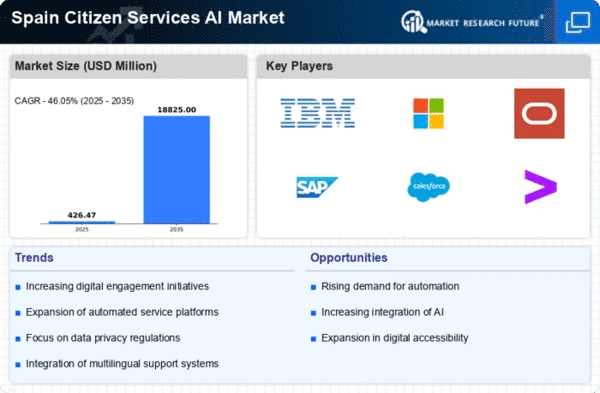
As per Market Research Future analysis, the Spain Citizen Services AI Market Size was estimated at 292.0 USD Million in 2024. The Spain citizen services-ai market is projected to grow from 426.47 USD Million in 2025 to 18825.0 USD Million by 2035, exhibiting a compound annual growth rate (CAGR) of 46.0% during the forecast period 2025 - 2035

Key Market Trends & Highlights

The Spain The citizen services AI market is undergoing a transformative shift towards automation and personalization.

  • The market is witnessing an increased automation of services, enhancing efficiency in public administration.
  • Enhanced personalization of interactions is becoming a focal point, aiming to improve citizen engagement.
  • There is a growing emphasis on data privacy and security, reflecting rising concerns among citizens.
  • Key market drivers include the growing demand for efficient public services and government initiatives supporting AI adoption.

Market Size & Forecast

2024 Market Size 292.0 (USD Million)
2035 Market Size 18825.0 (USD Million)
CAGR (2025 - 2035) 46.05%

Major Players

IBM (US), Microsoft (US), Oracle (US), SAP (DE), Salesforce (US), Accenture (IE), Cognizant (US), Capgemini (FR), Atos (FR)

Our Impact
Enabled $4.3B Revenue Impact for Fortune 500 and Leading Multinationals
Partnering with 2000+ Global Organizations Each Year
30K+ Citations by Top-Tier Firms in the Industry

Spain Citizen Services AI Market Trends

The citizen services AI market in Spain is undergoing a notable transformation, driven by advancements in artificial intelligence technologies. These innovations are enhancing the efficiency and accessibility of public services, allowing citizens to interact with government entities in more streamlined ways. The integration of AI into various platforms is facilitating quicker response times and personalized services, which appear to be increasingly valued by the populace. Moreover, the Spanish government is actively investing in digital infrastructure, which suggests a commitment to modernizing citizen engagement through technology. This shift not only improves service delivery but also fosters greater transparency and accountability within public institutions. In addition, the growing emphasis on data privacy and security is shaping the landscape of the citizen services-ai market. As AI systems handle sensitive information, there is a heightened awareness of the need for robust safeguards. This concern is prompting the development of regulations and frameworks aimed at protecting citizens' data while still leveraging AI capabilities. The interplay between innovation and regulation is likely to define the future trajectory of the market, as stakeholders seek to balance technological advancement with ethical considerations. Overall, the citizen services-ai market in Spain is poised for growth, driven by both technological progress and a focus on citizen-centric governance.

Increased Automation of Services

The citizen services AI market is trending towards the automation of various public services. This shift allows for more efficient processing of requests and inquiries, reducing wait times for citizens. Automation tools, powered by AI, are being implemented to handle routine tasks, enabling human resources to focus on more complex issues.

Enhanced Personalization of Interactions

There is a growing trend towards personalizing interactions between citizens and government services. AI technologies are being utilized to analyze user data, which helps tailor services to individual needs. This approach not only improves user satisfaction but also encourages greater engagement with public services.

Focus on Data Privacy and Security

As AI systems become more prevalent in public services, there is an increasing emphasis on data privacy and security. Stakeholders are prioritizing the development of frameworks that ensure the protection of citizens' information. This trend reflects a broader societal concern regarding data handling and the ethical implications of AI.

Spain Citizen Services AI Market Drivers

Growing Demand for Efficient Public Services

The citizen services-ai market in Spain is experiencing a notable surge in demand for efficient public services. Citizens increasingly expect streamlined interactions with government entities, leading to a push for AI-driven solutions that can automate routine tasks. This demand is reflected in the Spanish government's commitment to digital transformation, with investments projected to reach €1 billion by 2026. The integration of AI technologies in public services not only enhances operational efficiency but also improves citizen satisfaction. As a result, the citizen services-ai market is likely to expand, driven by the need for faster response times and reduced bureaucratic hurdles.

Government Initiatives Supporting AI Adoption

In Spain, various government initiatives are actively promoting the adoption of AI technologies within the citizen services-ai market. The Spanish government has launched programs aimed at fostering innovation and digitalization in public administration. For instance, the Digital Spain 2025 agenda outlines strategic objectives to enhance the use of AI in public services. This initiative is expected to allocate approximately €20 billion towards digital transformation efforts, thereby creating a conducive environment for AI solutions. Such government backing is likely to stimulate growth in the citizen services-ai market, encouraging public entities to invest in AI-driven tools and platforms.

Rising Citizen Expectations for Service Quality

As societal expectations evolve, citizens in Spain are increasingly demanding higher quality in public services. The citizen services AI market is leveraging AI technologies to enhance service delivery in response to this trend. Surveys indicate that over 70% of citizens express a desire for more personalized and responsive interactions with government services. This shift in expectations compels public institutions to adopt AI solutions that can analyze citizen data and tailor services accordingly. Consequently, the citizen services-ai market is poised for growth as public entities strive to meet these rising expectations and improve overall service quality.

Advancements in AI Technology and Infrastructure

The citizen services-ai market in Spain is benefiting from rapid advancements in AI technology and infrastructure. Innovations in machine learning, natural language processing, and data analytics are enabling public institutions to implement sophisticated AI solutions. The Spanish government has recognized the importance of investing in digital infrastructure, with plans to enhance broadband connectivity across the country. This investment is expected to facilitate the deployment of AI applications in public services, thereby driving growth in the citizen services-ai market. As technology continues to evolve, the potential for AI to transform public service delivery becomes increasingly apparent.

Increased Focus on Cost Efficiency in Public Administration

In the context of Spain's economic landscape, there is a growing emphasis on cost efficiency within public administration. The citizen services-ai market is likely to thrive as government entities seek to optimize resource allocation and reduce operational costs. AI technologies offer the potential to automate repetitive tasks, thereby freeing up human resources for more complex functions. Reports suggest that implementing AI solutions could lead to cost savings of up to 30% in certain public service areas. This focus on cost efficiency is expected to drive investment in the citizen services-ai market, as public institutions aim to enhance service delivery while managing budgets effectively.


Market Segment Insights

By Technology: Natural Language Processing (Largest) vs. Machine Learning (Fastest-Growing)

In the Spain citizen services-ai market, Natural Language Processing (NLP) holds the largest share as it effectively addresses the need for efficient communication and interaction between citizens and services. Its applications in chatbots, virtual assistants, and automated response systems have solidified its position as a crucial technological area. Following closely, Machine Learning (ML) is rapidly gaining ground, driven by its ability to analyze vast datasets and improve service personalization. The increasing adoption of predictive analytics enhances its significance in citizen services. The growth trends in this segment are primarily fueled by advancements in AI capabilities and the demand for enhanced citizen engagement through digital platforms. The ongoing integration of AI technologies in public services leads to efficiency and cost reduction, making services more accessible. As citizens expect quicker and more tailored interactions, technologies like Computer Vision, Robotics, and Deep Learning are also emerging as essential components of this evolving landscape, albeit at a slower pace compared to NLP and ML.

Technology: Natural Language Processing (Dominant) vs. Machine Learning (Emerging)

Natural Language Processing (NLP) is characterized by its focus on facilitating human-computer interaction through natural language understanding and generation. In the Spain citizen services-ai market, NLP enables public service providers to offer more intuitive and efficient communication channels. Applications include complaint resolution, information retrieval, and feedback mechanisms. Machine Learning, while currently designated as an emerging technology, is crucial for improving the accuracy and functionality of NLP solutions. ML's algorithms can learn from data patterns, driving enhancements in service delivery and personalizing citizen interactions. Both NLP and ML represent critical areas of technology that are shaping the future of citizen services, allowing for data-driven decision-making and streamlined operations.

By Application: Public Safety (Largest) vs. Healthcare Services (Fastest-Growing)

In the Spain citizen services-ai market, the segment values exhibit varying market share distributions. Public Safety holds the largest share, reflecting significant investments in technologies aimed at enhancing security and emergency response. This segment's dominance is driven by the increasing demand for real-time monitoring and surveillance solutions. Meanwhile, Healthcare Services, while smaller currently, shows remarkable potential due to the ongoing digital transformation in the health sector, highlighting a shift towards AI-driven patient care and management. Growth trends within these segments reveal powerful drivers influencing their trajectories. The Public Safety segment benefits from evolving security threats, prompting continuous upgrades and innovations. Conversely, the Healthcare Services segment is rapidly evolving, propelled by advances in AI applications for diagnostics, patient engagement, and operational efficiency, marking it as the fastest-growing area. This dual momentum suggests a balanced progression within the market, addressing critical areas for citizens.

Public Safety (Dominant) vs. Healthcare Services (Emerging)

The Public Safety segment is characterized by robust technological implementations designed to enhance surveillance, emergency response, and community safety. With governmental and municipal budgets allocated towards smart city initiatives, this segment plays a critical role in urban management and public welfare. As a dominant player, it focuses on integrating AI for predictive policing and crisis management. In contrast, the Healthcare Services segment is emerging rapidly, leveraging AI to streamline operations and improve patient outcomes. This segment is characterized by innovations in telemedicine, AI-driven diagnostics, and personalized health insights. While currently less dominant, Healthcare Services' expansive growth potential reflects healthcare's increasing reliance on technology, making it a vital area of focus for future investments.

By Deployment Mode: Cloud-Based (Largest) vs. Hybrid (Fastest-Growing)

In the Spain citizen services-ai market, the deployment mode segment has seen a dynamic distribution among its values. Cloud-Based solutions are currently the largest segment, capturing a significant share due to their scalability and accessibility. In contrast, Hybrid deployment is gaining traction, appealing to organizations that seek a balanced approach, leveraging both on-premises and cloud capabilities to enhance their service offerings. Growth trends within this segment are propelled by increasing demand for flexibility and cost efficiency. As agencies prioritize digital transformation, the Hybrid model is burgeoning, driven by the need for secure data management and integration of advanced technologies. The shift towards remote work solutions has also made Cloud-Based options more attractive, reinforcing their leading position while Hybrid solutions emerge as a competitive alternative.

Cloud-Based (Dominant) vs. Hybrid (Emerging)

The Cloud-Based deployment mode stands out in the Spain citizen services-ai market as the dominant choice among organizations. Its advantages, including ease of implementation, lower upfront costs, and automatic updates, make it highly appealing. Organizations benefit from robust infrastructure without the need for extensive on-site maintenance. On the other hand, Hybrid deployment presents itself as an emerging force, bridging the gap for businesses that wish to maintain some traditional infrastructure while adopting modern cloud solutions. This model allows for greater customization and control over sensitive data, attracting agencies that need to comply with stringent regulations while still enjoying the benefits of cloud innovations.

By End Use: Government (Largest) vs. Non-Profit Organizations (Fastest-Growing)

In the Spain citizen services-ai market, the distribution of market share shows that the Government segment holds the largest share, reflecting the significant investment in AI technologies for public administration and service delivery. Non-Profit Organizations, while smaller in comparison, are rapidly adopting AI solutions to enhance their operational efficiency, leading to a notable shift in market dynamics. Growth trends in this segment highlight an increasing reliance on AI to improve citizen engagement, streamline processes, and provide data-driven insights. The Government sector is leveraging AI for better resource allocation and policymaking, while Non-Profit Organizations are driven by the need for innovation and effectiveness in service provision. This trend indicates a robust future for AI applications across both segments, indicating potential for further investment and development.

Government: Dominant vs. Non-Profit Organizations: Emerging

The Government segment is characterized by significant deployment of AI technologies, focusing on enhancing public services, such as automated responses and streamlined bureaucratic processes. This segment benefits from substantial financial backing, allowing for wide-scale implementation of AI solutions. In contrast, Non-Profit Organizations represent an emerging segment that is increasingly adopting AI to optimize their outreach and service delivery capabilities. These organizations focus on harnessing technology to address social issues effectively, making their operations more efficient. As both segments grow, there will be greater collaboration opportunities, allowing for innovation in the Spain citizen services-ai market.

Get more detailed insights about Spain Citizen Services AI Market

Key Players and Competitive Insights

The citizen services-ai market in Spain is characterized by a dynamic competitive landscape, driven by the increasing demand for efficient public services and the integration of advanced technologies. Major players such as IBM (US), Microsoft (US), and Accenture (IE) are strategically positioned to leverage their technological expertise and innovative solutions. IBM (US) focuses on enhancing its AI capabilities through continuous investment in research and development, while Microsoft (US) emphasizes partnerships with local governments to tailor solutions that meet specific regional needs. Accenture (IE) adopts a comprehensive approach, integrating AI with consulting services to drive digital transformation in public sector organizations. Collectively, these strategies foster a competitive environment that prioritizes innovation and responsiveness to market demands.Key business tactics within this market include localized service offerings and strategic partnerships aimed at optimizing operational efficiency. The competitive structure appears moderately fragmented, with several key players vying for market share. This fragmentation allows for diverse service offerings, yet the influence of major companies remains substantial, as they set benchmarks for technology adoption and service delivery standards.

In October IBM (US) announced a collaboration with the Spanish government to implement AI-driven solutions for public health services. This initiative aims to enhance data analytics capabilities, thereby improving patient outcomes and streamlining healthcare processes. The strategic importance of this collaboration lies in its potential to position IBM (US) as a leader in the public health sector, showcasing the effectiveness of AI in addressing critical societal needs.

In September Microsoft (US) launched a new AI platform specifically designed for local governments in Spain, focusing on improving citizen engagement and service delivery. This platform integrates machine learning algorithms to analyze citizen feedback and optimize service responses. The launch signifies Microsoft's commitment to enhancing public sector efficiency and reflects a broader trend towards utilizing AI for citizen-centric services.

In August Accenture (IE) expanded its partnership with various municipalities in Spain to develop smart city initiatives that incorporate AI technologies. This expansion aims to create more sustainable urban environments through intelligent resource management and enhanced public safety measures. The strategic significance of this move lies in Accenture's ability to position itself as a key player in the smart city domain, aligning with global trends towards urban sustainability and technological integration.

As of November current competitive trends in the citizen services-ai market are heavily influenced by digitalization, sustainability, and the integration of AI technologies. Strategic alliances among key players are shaping the landscape, fostering innovation and collaborative solutions. Looking ahead, competitive differentiation is likely to evolve from traditional price-based competition to a focus on technological innovation, reliability in supply chains, and the ability to deliver tailored solutions that meet the unique needs of public sector clients.

Key Companies in the Spain Citizen Services AI Market include

Industry Developments

Recent developments in the Spain Citizen Services AI Market have been marked by significant advancements in the deployment of AI technologies across government services. Companies like Indra Sistemas and Accenture have expanded their capabilities, driving improvements in efficiency and citizen engagement. Current affairs indicate a rising focus on digital transformation with SAP and Microsoft leading initiatives aimed at enhancing citizen experiences through AI integration. Additionally, Amadeus IT Group and Atos are collaborating on projects that leverage AI to streamline administrative processes within public sector organizations.

In terms of mergers and acquisitions, no substantial activities have been reported recently involving these specific companies in the Spain Citizen Services AI Market, highlighting a period of strategic expansion rather than consolidation. Overall, the growth in market valuation for these companies is spurred by increased government investment in smart technologies, fostering an environment conducive to innovation.

Over the past two to three years, key initiatives, such as the Spanish Government’s commitment to digitize public services initiated in [Month, Year], have accelerated AI adoption, with an emphasis on improving service efficiency and citizen satisfaction. The focus remains heavily on utilizing AI for data analysis and enhancing the user experience in government interactions.

Future Outlook

Spain Citizen Services AI Market Future Outlook

The Citizen Services AI Market in Spain is projected to grow at a CAGR of 46.05% from 2025 to 2035, driven by technological advancements and increasing demand for efficient public services.

New opportunities lie in:

  • Development of AI-driven chatbots for real-time citizen engagement.
  • Implementation of predictive analytics for resource allocation in public services.
  • Integration of machine learning for personalized citizen service delivery.

By 2035, the market is expected to be robust, reflecting substantial growth and innovation.

Market Segmentation

Spain Citizen Services AI Market End Use Outlook

  • Government
  • Non-Profit Organizations
  • Private Sector

Spain Citizen Services AI Market Technology Outlook

  • Natural Language Processing
  • Machine Learning
  • Computer Vision
  • Robotics
  • Deep Learning

Spain Citizen Services AI Market Application Outlook

  • Public Safety
  • Healthcare Services
  • Transportation Management
  • Citizen Engagement
  • Regulatory Compliance

Spain Citizen Services AI Market Deployment Mode Outlook

  • On-Premises
  • Cloud-Based
  • Hybrid

Report Scope

MARKET SIZE 2024 292.0(USD Million)
MARKET SIZE 2025 426.47(USD Million)
MARKET SIZE 2035 18825.0(USD Million)
COMPOUND ANNUAL GROWTH RATE (CAGR) 46.05% (2025 - 2035)
REPORT COVERAGE Revenue Forecast, Competitive Landscape, Growth Factors, and Trends
BASE YEAR 2024
Market Forecast Period 2025 - 2035
Historical Data 2019 - 2024
Market Forecast Units USD Million
Key Companies Profiled IBM (US), Microsoft (US), Oracle (US), SAP (DE), Salesforce (US), Accenture (IE), Cognizant (US), Capgemini (FR), Atos (FR)
Segments Covered Technology, Application, Deployment Mode, End Use
Key Market Opportunities Integration of advanced artificial intelligence to enhance public service efficiency and citizen engagement.
Key Market Dynamics Growing demand for AI-driven citizen services enhances efficiency and responsiveness in public sector operations.
Countries Covered Spain
Leave a Comment

FAQs

What is the expected market size of the Spain Citizen Services AI Market in 2024?

The market is expected to be valued at 30.3 USD Million in 2024.

What will be the market size of the Spain Citizen Services AI Market in 2035?

The market is projected to reach 250.0 USD Million by 2035.

What is the expected CAGR for the Spain Citizen Services AI Market from 2025 to 2035?

The expected CAGR for the market during this period is 21.148%.

What are the key technologies driving the Spain Citizen Services AI Market?

Key technologies include Natural Language Processing, Machine Learning, Computer Vision, Robotics, and Deep Learning.

How much is the Natural Language Processing segment valued at in 2024?

The Natural Language Processing segment is valued at 8.1 USD Million in 2024.

What is the projected market size for Machine Learning in 2035?

The Machine Learning segment is expected to reach 56.0 USD Million by 2035.

Who are the major players in the Spain Citizen Services AI Market?

Major players include Indra Sistemas, SAP, Capgemini, Accenture, Atos, Google, Microsoft, and others.

What is the projected value of the Computer Vision segment in 2035?

The Computer Vision segment is expected to be valued at 49.0 USD Million in 2035.

What are the expected growth drivers for the Spain Citizen Services AI Market?

Growth drivers include advancements in AI technology and increasing demand for efficient citizen services.

How has the competitive landscape evolved within the Spain Citizen Services AI Market?

The competitive landscape has seen increased participation from tech giants and innovative startups alike.

Download Free Sample

Kindly complete the form below to receive a free sample of this Report

Compare Licence

×
Features License Type
Single User Multiuser License Enterprise User
Price $4,950 $5,950 $7,250
Maximum User Access Limit 1 User Upto 10 Users Unrestricted Access Throughout the Organization
Free Customization
Direct Access to Analyst
Deliverable Format
Platform Access
Discount on Next Purchase 10% 15% 15%
Printable Versions