×
Request Free Sample ×

Kindly complete the form below to receive a free sample of this Report

* Please use a valid business email

Leading companies partner with us for data-driven Insights

clients tt-cursor
Hero Background

Japan Citizen Services AI Market

ID: MRFR/ICT/57489-HCR
200 Pages
Garvit Vyas
February 2026

Japan Citizen Services AI Market Size, Share and Trends Analysis Report By Technology (Natural Language Processing, Machine Learning, Computer Vision, Robotics, Deep Learning), By Application (Public Safety, Healthcare Services, Transportation Management, Citizen Engagement, Regulatory Compliance), By Deployment Mode (On-Premises, Cloud-Based, Hybrid) andBy End Use (Government, Non-Profit Organizations, Private Sector)- Forecast to 2035

Share:
Download PDF ×

We do not share your information with anyone. However, we may send you emails based on your report interest from time to time. You may contact us at any time to opt-out.

Japan Citizen Services AI Market Infographic
Purchase Options

Japan Citizen Services AI Market Summary

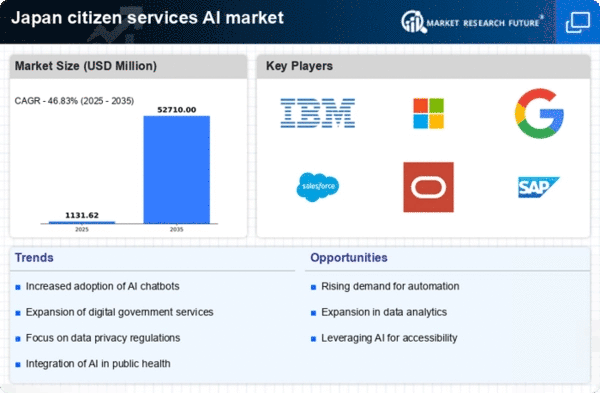
As per Market Research Future analysis, the Japan Citizen Services AI Market size was estimated at 770.7 USD Million in 2024. The Citizen Services-ai market is projected to grow from 1131.62 USD Million in 2025 to 52710.0 USD Million by 2035, exhibiting a compound annual growth rate (CAGR) of 46.8% during the forecast period 2025 - 2035

Key Market Trends & Highlights

The Japan citizen services-AI market is experiencing robust growth driven by technological advancements and increasing demand for enhanced citizen engagement.

  • The market is witnessing increased adoption of AI chatbots, enhancing communication between citizens and government services.
  • Data-driven decision making is becoming a cornerstone for improving service delivery and operational efficiency.
  • There is a heightened focus on cybersecurity measures to protect sensitive citizen data and maintain trust in digital services.
  • Technological advancements in AI and government initiatives are key drivers, alongside rising demand for enhanced citizen engagement.

Market Size & Forecast

2024 Market Size 770.7 (USD Million)
2035 Market Size 52710.0 (USD Million)
CAGR (2025 - 2035) 46.83%

Major Players

IBM (US), Microsoft (US), Google (US), Salesforce (US), Oracle (US), SAP (DE), Accenture (IE), Cognizant (US), TCS (IN)

Our Impact
Enabled $4.3B Revenue Impact for Fortune 500 and Leading Multinationals
Partnering with 2000+ Global Organizations Each Year
30K+ Citations by Top-Tier Firms in the Industry

Japan Citizen Services AI Market Trends

The Japan Citizen Services AI Market in Japan is currently experiencing a transformative phase, driven by advancements in artificial intelligence technologies and a growing demand for efficient public services. Government initiatives are increasingly focused on integrating AI solutions to enhance citizen engagement, streamline administrative processes, and improve service delivery. This shift appears to be motivated by the need for greater transparency and responsiveness in public administration, as well as the desire to reduce operational costs. As a result, various sectors, including healthcare, transportation, and public safety, are exploring AI applications to better serve the needs of citizens. Moreover, the emphasis on digital transformation within the public sector suggests a potential for significant growth in the citizen services-ai market. The Japanese government has been actively promoting smart city initiatives, which leverage AI to optimize urban living and enhance the quality of life for residents. This trend indicates a broader commitment to utilizing technology for societal benefit, potentially leading to increased investment in AI-driven solutions. As the landscape evolves, collaboration between public and private sectors may play a crucial role in shaping the future of citizen services, fostering innovation and ensuring that AI applications align with the needs of the populace.

Increased Adoption of AI Chatbots

The integration of AI chatbots in public services is becoming more prevalent. These tools facilitate real-time communication between citizens and government agencies, providing instant responses to inquiries. This trend indicates a shift towards more accessible and user-friendly services, enhancing citizen satisfaction.

Data-Driven Decision Making

There is a growing emphasis on utilizing data analytics to inform policy decisions. By harnessing AI technologies, government bodies can analyze vast amounts of data to identify trends and improve service delivery. This approach suggests a more informed and responsive public administration.

Focus on Cybersecurity Measures

As the citizen services-ai market expands, there is an increasing focus on cybersecurity. Protecting sensitive citizen data is paramount, leading to the implementation of advanced security protocols. This trend highlights the importance of maintaining trust in AI systems within public services.

Japan Citizen Services AI Market Drivers

Technological Advancements in AI

The rapid evolution of artificial intelligence technologies is a primary driver for the citizen services-ai market. In Japan, advancements in natural language processing and machine learning algorithms enhance the capabilities of AI systems, enabling them to provide more accurate and efficient services. This technological progress is reflected in the increasing investment in AI research and development, which reached approximately $1.5 billion in 2025. As a result, public sector organizations are more inclined to adopt AI solutions to improve service delivery and citizen engagement. The citizen services-ai market is likely to benefit from these innovations, as they facilitate the creation of more sophisticated applications that can address the diverse needs of the population.

Government Initiatives and Policies

The Japanese government actively promotes the integration of AI in public services, which significantly influences the citizen services-ai market. Initiatives such as the 'AI Strategy 2025' aim to enhance the efficiency and effectiveness of government operations through AI technologies. This strategic framework encourages collaboration between public and private sectors, fostering innovation and investment in AI solutions. As a result, funding for AI projects in public services is projected to increase by 20% annually, creating a conducive environment for the growth of the citizen services-ai market. These government policies not only support technological adoption but also aim to improve overall citizen satisfaction with public services.

Aging Population and Workforce Challenges

Japan's demographic trends, particularly its aging population, present unique challenges that impact the citizen services-ai market. With approximately 28% of the population aged 65 and older, there is an increasing need for efficient public services that cater to the elderly. AI technologies can play a crucial role in addressing these challenges by automating routine tasks and providing support for healthcare services. The government is expected to allocate an additional $500 million towards AI solutions aimed at improving services for the elderly by 2026. This focus on addressing demographic shifts is likely to drive growth in the citizen services-ai market as organizations seek innovative ways to support an aging society.

Increased Focus on Data Privacy and Ethics

As the citizen services-ai market expands, there is a heightened awareness of data privacy and ethical considerations surrounding AI technologies. In Japan, public trust in AI systems is paramount, and government agencies are implementing strict regulations to ensure data protection. The introduction of the Personal Information Protection Act has set a framework for how data is managed, influencing the development of AI solutions. Organizations are now prioritizing transparency and ethical AI practices, which could lead to a more responsible approach to technology deployment. This focus on data privacy is likely to shape the citizen services-ai market, as agencies strive to build trust and ensure compliance with evolving regulations.

Rising Demand for Enhanced Citizen Engagement

There is a growing expectation among citizens for more interactive and responsive public services, which drives the citizen services-ai market. In Japan, citizens increasingly seek personalized experiences and timely responses from government agencies. This demand is reflected in surveys indicating that over 70% of citizens prefer digital interactions for service inquiries. Consequently, public sector organizations are investing in AI-driven solutions, such as chatbots and virtual assistants, to meet these expectations. The citizen services-ai market is likely to expand as agencies strive to enhance engagement and streamline communication with the public, ultimately leading to improved service delivery.


Market Segment Insights

By Technology: Natural Language Processing (Largest) vs. Machine Learning (Fastest-Growing)

In the Japan citizen services-ai market, the technology segment is characterized by a significant presence of various advanced technologies. Natural Language Processing leads the market, capturing a substantial market share due to its extensive applications in customer service and automated communication. Machine Learning, while slightly behind, is rapidly gaining traction, driven by the increasing demand for predictive analytics and improved decision-making processes within government services. The growth trends in this segment are largely influenced by technological advancements and increased adoption of AI solutions across various sectors. Natural Language Processing continues to dominate as organizations focus on enhancing user experience, while Machine Learning is recognized as the fastest-growing area, fueled by innovations that allow for more intelligent data processing and real-time analysis. Robotics and Computer Vision are also prominent, but they currently play a secondary role in comparison to the leading technologies.

Technology: Natural Language Processing (Dominant) vs. Machine Learning (Emerging)

Natural Language Processing is positioned as the dominant technology within the Japan citizen services-ai market, driving efficiency in interactions between citizens and government services. Its capabilities allow for improved communication through chatbots and virtual assistants, significantly enhancing responsiveness and accessibility. Machine Learning, on the other hand, represents an emerging technology that is gaining momentum due to its ability to analyze vast datasets and provide insights that were previously unattainable. Both technologies are crucial; however, Natural Language Processing stands out for its immediate impact on user interaction, while Machine Learning is set to revolutionize data-driven decision-making in the coming years.

By Application: Public Safety (Largest) vs. Healthcare Services (Fastest-Growing)

In the Japan citizen services-ai market, the application segment displays diverse values such as Public Safety, Healthcare Services, Transportation Management, Citizen Engagement, and Regulatory Compliance. Among these, Public Safety holds the largest market share, demonstrating its critical importance in ensuring the safety and security of citizens. Conversely, Healthcare Services is emerging as the fastest-growing area, reflecting increasing investments in AI to enhance patient care and streamline operations throughout the healthcare system. Growth trends within the application segment are primarily driven by advancements in AI technologies and a growing need for efficient public services. The ongoing push for digital transformation in various sectors has led to significant adoption of AI solutions, especially in Healthcare Services and Public Safety. As cities in Japan become more interconnected, Transportation Management and Citizen Engagement also show promise, driven by the need to enhance urban mobility and improve communication between government entities and residents.

Public Safety (Dominant) vs. Healthcare Services (Emerging)

Public Safety serves as the dominant application in the Japan citizen services-ai market, leveraging AI to enhance crime prevention, emergency response, and disaster management. This segment benefits from significant government funding and public interest in safety initiatives. On the other hand, Healthcare Services is regarded as an emerging application, utilizing AI tools to improve diagnostics, patient monitoring, and operational efficiency. The rapid growth in this sector is fueled by the increasing demand for healthcare accessibility and the need to manage health data effectively. As AI technology evolves, both Public Safety and Healthcare Services will likely evolve, broadening their impact on citizen experiences and governance.

By Deployment Mode: Cloud-Based (Largest) vs. On-Premises (Fastest-Growing)

The Japan citizen services-ai market displays a diverse deployment mode landscape, with Cloud-Based solutions leading in market share due to their scalability and flexibility. This segment has gained substantial traction among government agencies looking for efficient and cost-effective service delivery mechanisms. Meanwhile, On-Premises solutions, while currently smaller in market share, are experiencing rapid uptake as organizations prioritize data security and control in their operations. Growth trends in this segment are driven by increasing digital transformation initiatives among public sector organizations, emphasizing the need for integrated and responsive services. The surge in remote work and digital engagement has also fueled demand for Cloud-Based systems, while enhancements in On-Premises technologies are making them more attractive as secure options. Hybrid models are emerging as a compelling alternative for organizations seeking to balance flexibility with data security, contributing to the overall growth in deployment modes.

Cloud-Based (Dominant) vs. On-Premises (Emerging)

Cloud-Based solutions dominate the Japan citizen services-ai market, offering unparalleled advantages in scalability and adaptability, which appeal to a wide array of public sector stakeholders. Their ability to streamline operations and facilitate real-time data accessibility makes them a preferred choice for many agencies. On the other hand, On-Premises solutions are gaining traction as they address specific needs for enhanced security and control over sensitive data. As organizations in the public sector become increasingly concerned about cybersecurity threats, the demand for On-Premises deployments is on the rise. This trend indicates a growing interest in tailored solutions that can cater to unique operational requirements, thus establishing On-Premises as an emerging option in a market notably characterized by Cloud-Based dominance.

By End Use: Government (Largest) vs. Non-Profit Organizations (Fastest-Growing)

In the Japan citizen services-ai market, the government sector dominates the landscape, taking a significant portion of market share due to its extensive reliance on AI solutions for efficiency and service delivery. Non-profit organizations, while smaller in share, are rapidly adopting AI technologies to enhance their operational capabilities and better serve their communities, marking a notable shift in their engagement with advanced technologies. As AI solutions continue to evolve, the growth trends in this segment are driven by increasing digital transformation initiatives across various sectors. Government entities are investing heavily in AI to improve public services and enhance administrative efficiency, while non-profit organizations are increasingly recognizing the value of AI in addressing critical societal issues. This dual focus highlights a vibrant and competitive landscape, setting the stage for sustained growth in both segments.

Government: Dominant vs. Non-Profit Organizations: Emerging

The government sector stands as the dominant force in the Japan citizen services-ai market, characterized by substantial investments in AI technologies aimed at improving public service delivery and operational efficiencies. This sector benefits from strong policy support and initiatives that foster the integration of AI solutions across governmental functions. In contrast, non-profit organizations represent an emerging segment, leveraging AI to optimize resource allocation and enhance service offerings. This segment is increasingly recognized for its agility in adopting new technologies, allowing it to address pressing social challenges more effectively. As both segments evolve, the interplay between government stability and non-profit agility will shape the future trajectory of AI implementation in citizen services.

Get more detailed insights about Japan Citizen Services AI Market

Key Players and Competitive Insights

The citizen services-ai market in Japan is characterized by a dynamic competitive landscape, driven by rapid technological advancements and increasing demand for efficient public services. Key players such as IBM (US), Microsoft (US), and Accenture (IE) are strategically positioning themselves through innovation and partnerships. IBM (US) focuses on integrating AI into public sector solutions, enhancing operational efficiency and citizen engagement. Microsoft (US) emphasizes cloud-based services, facilitating digital transformation for government agencies. Accenture (IE) leverages its consulting expertise to drive AI adoption in public services, thereby shaping a competitive environment that prioritizes technological integration and service optimization.The market structure appears moderately fragmented, with a mix of established players and emerging startups. Key business tactics include localizing solutions to meet specific regional needs and optimizing supply chains to enhance service delivery. The collective influence of these major companies fosters a competitive atmosphere where agility and responsiveness to market demands are crucial for success.

In October IBM (US) announced a partnership with the Japanese government to implement AI-driven analytics for urban planning. This strategic move is likely to enhance data-driven decision-making, allowing for more efficient resource allocation and improved public services. The collaboration underscores IBM's commitment to leveraging AI for societal benefits, positioning the company as a leader in the citizen services-ai sector.

In September Microsoft (US) launched a new initiative aimed at providing AI tools to local governments in Japan, focusing on enhancing citizen engagement through digital platforms. This initiative is significant as it aligns with the growing trend of digitalization in public services, enabling local authorities to better connect with citizens and respond to their needs. Microsoft's proactive approach may strengthen its market position by fostering long-term relationships with government entities.

In August Accenture (IE) expanded its AI capabilities by acquiring a local tech firm specializing in machine learning solutions. This acquisition is strategically important as it enhances Accenture's ability to deliver tailored AI solutions to Japanese public sector clients. By integrating local expertise, Accenture is likely to improve its service offerings, thereby increasing its competitive edge in the market.

As of November current trends in the citizen services-ai market include a strong emphasis on digitalization, sustainability, and the integration of AI technologies. Strategic alliances among key players are shaping the landscape, fostering innovation and collaboration. The competitive differentiation is expected to evolve, moving away from price-based competition towards a focus on technological innovation, reliability, and the ability to deliver customized solutions. This shift indicates a growing recognition that long-term success in the market will hinge on the ability to adapt to changing demands and leverage advanced technologies.

Key Companies in the Japan Citizen Services AI Market include

Industry Developments

Recent developments in the Japan Citizen Services AI Market indicate a significant growth trajectory, driven by increasing government initiatives to enhance public service delivery through technology. Google Japan has been actively collaborating with local governments to deploy AI solutions for improving citizen engagement and service efficiency. Nippon Telegraph and Telephone Corporation is also focusing on leveraging AI to optimize communication services and data management for public entities. Fujitsu Limited and Hitachi Ltd are enhancing their AI capabilities to support smart city projects, aiming at improving urban management and citizen quality of life.

Notably, in March 2023, Rakuten Group's acquisition of a local AI startup aimed at expanding its service offerings within the citizen services sector, showcasing a trend towards consolidation among key players. Additionally, SoftBank Group is investing heavily in AI to transform various public sector operations. Over the past couple of years, the market has witnessed heightened competition, with companies like Microsoft Japan and IBM Japan releasing new AI frameworks tailored for government applications, reflecting an ongoing commitment to digital transformation in public services across Japan.

Future Outlook

Japan Citizen Services AI Market Future Outlook

The Citizen Services AI Market in Japan is projected to grow at a remarkable 46.83% CAGR from 2025 to 2035, driven by technological advancements and increasing demand for efficient public services.

New opportunities lie in:

  • Development of AI-driven public health monitoring systems
  • Implementation of automated citizen feedback platforms
  • Creation of smart city solutions integrating AI for urban management

By 2035, the market is expected to be robust, reflecting substantial advancements and widespread adoption.

Market Segmentation

Japan Citizen Services AI Market End Use Outlook

  • Government
  • Non-Profit Organizations
  • Private Sector

Japan Citizen Services AI Market Technology Outlook

  • Natural Language Processing
  • Machine Learning
  • Computer Vision
  • Robotics
  • Deep Learning

Japan Citizen Services AI Market Application Outlook

  • Public Safety
  • Healthcare Services
  • Transportation Management
  • Citizen Engagement
  • Regulatory Compliance

Japan Citizen Services AI Market Deployment Mode Outlook

  • On-Premises
  • Cloud-Based
  • Hybrid

Report Scope

MARKET SIZE 2024 770.7(USD Million)
MARKET SIZE 2025 1131.62(USD Million)
MARKET SIZE 2035 52710.0(USD Million)
COMPOUND ANNUAL GROWTH RATE (CAGR) 46.83% (2025 - 2035)
REPORT COVERAGE Revenue Forecast, Competitive Landscape, Growth Factors, and Trends
BASE YEAR 2024
Market Forecast Period 2025 - 2035
Historical Data 2019 - 2024
Market Forecast Units USD Million
Key Companies Profiled IBM (US), Microsoft (US), Google (US), Salesforce (US), Oracle (US), SAP (DE), Accenture (IE), Cognizant (US), TCS (IN)
Segments Covered Technology, Application, Deployment Mode, End Use
Key Market Opportunities Integration of advanced artificial intelligence for enhanced public service delivery and citizen engagement.
Key Market Dynamics Rising demand for AI-driven citizen services in Japan, driven by technological advancements and regulatory support.
Countries Covered Japan
Leave a Comment

FAQs

What is the expected market size of the Japan Citizen Services AI Market in 2024?

The Japan Citizen Services AI Market is expected to be valued at 162.0 million USD in the year 2024.

What is the projected market size for the Japan Citizen Services AI Market by 2035?

By 2035, the Japan Citizen Services AI Market is projected to reach a value of 1325.0 million USD.

What is the expected compound annual growth rate (CAGR) for the Japan Citizen Services AI Market from 2025 to 2035?

The Japan Citizen Services AI Market is expected to grow at a CAGR of 21.052% from 2025 to 2035.

Who are the key players in the Japan Citizen Services AI Market?

Major players in the Japan Citizen Services AI Market include Google Japan, NTT Corporation, Fujitsu Limited, and IBM Japan among others.

What is the market value of Natural Language Processing in the Japan Citizen Services AI Market for the year 2024?

Natural Language Processing is valued at 40.0 million USD in the Japan Citizen Services AI Market for the year 2024.

How much is the Machine Learning segment expected to be valued in 2035?

The Machine Learning segment of the Japan Citizen Services AI Market is expected to reach 275.0 million USD by 2035.

What are some key applications driving growth in the Japan Citizen Services AI Market?

Key applications driving growth include automated customer service, predictive analytics, and data-driven decision making.

What is the expected value of the Computer Vision segment by 2035?

The Computer Vision segment is expected to be valued at 225.0 million USD in the Japan Citizen Services AI Market by 2035.

What are the anticipated growth drivers in the Japan Citizen Services AI Market?

Anticipated growth drivers include increased demand for efficiency, advancements in technology, and growing digitalization of services.

What impact do current global trends have on the Japan Citizen Services AI Market?

Current global trends positively impact the Japan Citizen Services AI Market by accelerating technology adoption and innovation in citizen services.

Download Free Sample

Kindly complete the form below to receive a free sample of this Report

Compare Licence

×
Features License Type
Single User Multiuser License Enterprise User
Price $4,950 $5,950 $7,250
Maximum User Access Limit 1 User Upto 10 Users Unrestricted Access Throughout the Organization
Free Customization
Direct Access to Analyst
Deliverable Format
Platform Access
Discount on Next Purchase 10% 15% 15%
Printable Versions