Focus on Multilingual Capabilities
Spain's diverse linguistic landscape necessitates the development of ai meeting-assistants that can operate in multiple languages. The ability to support various languages is crucial for businesses that operate in multilingual environments or have international clients. This demand for multilingual capabilities is likely to propel the ai meeting-assistants market, as companies seek solutions that can cater to their diverse workforce. Recent surveys indicate that around 60% of Spanish companies prioritize language support in their digital tools. Consequently, the development of ai meeting-assistants with robust language processing features may become a key differentiator in the market.
Rising Importance of User Experience
User experience (UX) is becoming a critical factor in the adoption of ai meeting-assistants in Spain. As organizations invest in technology, they are increasingly focused on ensuring that these tools are user-friendly and intuitive. A positive UX can lead to higher adoption rates among employees, which is essential for maximizing the benefits of these technologies. Data shows that tools with superior UX can improve user engagement by up to 40%. Therefore, the ai meeting-assistants market is likely to see a surge in demand for solutions that prioritize ease of use, customization, and seamless integration with existing workflows.
Integration with Business Process Automation
The integration of AI meeting-assistants with business process automation tools is becoming increasingly prevalent in Spain. Organizations are recognizing the potential of these assistants. Organizations are recognizing the potential of these assistants to not only schedule meetings but also to automate follow-up tasks, manage agendas, and track action items. This integration can lead to enhanced operational efficiency, as it reduces the manual workload on employees. Data suggests that companies utilizing automation in their workflows can see productivity increases of up to 30%. As the ai meeting-assistants market continues to evolve, the synergy between these technologies and automation tools is expected to drive further adoption and innovation.
Growing Demand for Remote Collaboration Tools
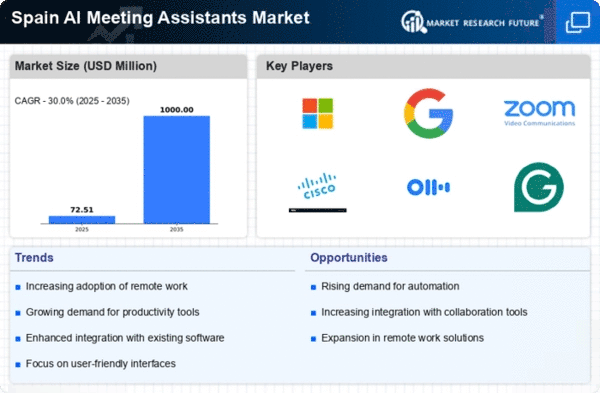
The rise in remote work culture in Spain has led to an increased demand for tools that facilitate effective collaboration. The ai meeting-assistants market is experiencing growth as organizations seek solutions that enhance virtual meetings. According to recent data, approximately 70% of companies in Spain have adopted remote work policies, which has driven the need for efficient communication tools. This trend indicates a shift towards digital solutions that can streamline meeting processes, improve productivity, and reduce time spent on administrative tasks. As businesses continue to adapt to this new normal, The AI meeting-assistants market is likely to expand significantly, catering to the evolving needs of remote teams.
Increased Investment in AI Research and Development
The Spanish government and private sector are significantly investing in AI research and development, which is likely to benefit the ai meeting-assistants market. This investment aims to foster innovation and enhance the capabilities of AI technologies. With funding initiatives and support for startups, the landscape for AI solutions is becoming more vibrant. Reports indicate that investment in AI in Spain has grown by over 50% in recent years. This influx of resources is expected to accelerate advancements in ai meeting-assistants, leading to more sophisticated features and improved performance, ultimately driving market growth.