×
Request Free Sample ×

Kindly complete the form below to receive a free sample of this Report

* Please use a valid business email

Leading companies partner with us for data-driven Insights

clients tt-cursor
Hero Background

South Korea Wheelchair Market

ID: MRFR/HC/48001-HCR
200 Pages
Rahul Gotadki
February 2026

South Korea Wheelchair Market Research Report By Product (Manual Wheelchair, Electric Wheelchair, Accessories), By Category (Adults, Pediatric) and By End-Use (Home Care Settings, Hospitals & Clinics) - Growth & Industry Forecast 2025 To 2035

Share:
Download PDF ×

We do not share your information with anyone. However, we may send you emails based on your report interest from time to time. You may contact us at any time to opt-out.

South Korea Wheelchair Market Infographic
Purchase Options

South Korea Wheelchair Market Summary

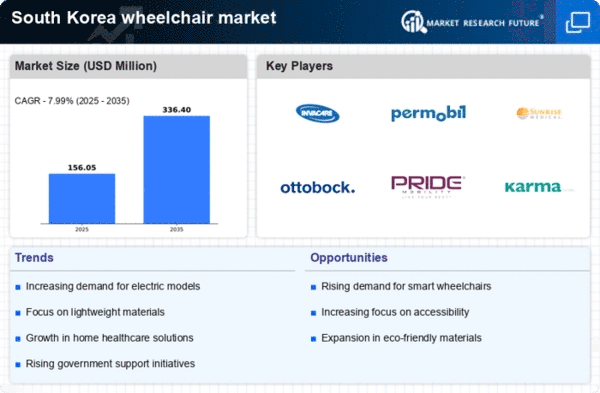
As per Market Research Future analysis, the South Korea wheelchair market Size was estimated at 144.5 USD Million in 2024. The South Korea wheelchair market is projected to grow from 156.05 USD Million in 2025 to 336.4 USD Million by 2035, exhibiting a compound annual growth rate (CAGR) of 7.9% during the forecast period 2025 - 2035

Key Market Trends & Highlights

The South Korea wheelchair market is experiencing growth driven by technological advancements and increasing government support.

  • Technological advancements are enhancing the functionality and user experience of wheelchairs.
  • The largest segment in the market is powered wheelchairs, while manual wheelchairs are the fastest-growing segment.
  • Government initiatives are promoting accessibility and inclusivity for individuals with disabilities.
  • Key market drivers include an aging population and rising awareness of disability rights.

Market Size & Forecast

2024 Market Size 144.5 (USD Million)
2035 Market Size 336.4 (USD Million)
CAGR (2025 - 2035) 7.99%

Major Players

Invacare Corporation (US), Permobil AB (SE), Sunrise Medical LLC (US), Ottobock SE & Co. KGaA (DE), Pride Mobility Products Corporation (US), Karma Medical Products Co. Ltd. (TW), Drive DeVilbiss Healthcare (UK), Medline Industries, Inc. (US)

Our Impact
Enabled $4.3B Revenue Impact for Fortune 500 and Leading Multinationals
Partnering with 2000+ Global Organizations Each Year
30K+ Citations by Top-Tier Firms in the Industry

South Korea Wheelchair Market Trends

The wheelchair market in South Korea is currently experiencing notable growth, driven by an increasing awareness of mobility solutions for individuals with disabilities and the elderly population. The government has been actively promoting policies aimed at enhancing accessibility and improving the quality of life for these groups. This has led to a rise in demand for various types of wheelchairs, including manual, powered, and specialized models designed for specific needs. Furthermore, advancements in technology are contributing to the development of innovative wheelchair designs that prioritize user comfort and functionality. In addition to technological advancements, the market is also influenced by changing societal attitudes towards disability and mobility. There is a growing recognition of the importance of inclusivity, which is reflected in urban planning and public transportation systems. As a result, manufacturers are increasingly focusing on producing lightweight, portable, and aesthetically pleasing wheelchairs that cater to the preferences of modern consumers. The combination of supportive government initiatives and evolving consumer expectations suggests a promising outlook for the wheelchair market in South Korea.

Technological Advancements

The wheelchair market is witnessing a surge in technological innovations, including smart wheelchairs equipped with sensors and connectivity features. These advancements enhance user experience and safety, making mobility more accessible.

Government Initiatives

Supportive policies from the South Korean government are fostering growth in the wheelchair market. Initiatives aimed at improving accessibility and funding for mobility aids are encouraging manufacturers to expand their offerings.

Changing Consumer Preferences

There is a noticeable shift in consumer preferences towards stylish and lightweight wheelchairs. This trend reflects a desire for products that not only serve functional purposes but also align with personal aesthetics.

South Korea Wheelchair Market Drivers

Aging Population

The aging population in South Korea is a crucial driver for the wheelchair market. As the demographic shifts, the number of elderly individuals requiring mobility assistance is increasing. By 2025, it is projected that over 20% of the population will be aged 65 and older. This demographic trend is likely to boost demand for wheelchairs, as older adults often face mobility challenges. The wheelchair market is expected to see a significant rise in sales, with estimates suggesting a growth rate of approximately 7% annually. This increase is driven by the need for both manual and powered wheelchairs, catering to the diverse needs of the elderly. The growing awareness of mobility solutions among this age group further propels the market, indicating a sustained demand for innovative wheelchair designs and features.

Rising Awareness of Disability Rights

The rising awareness of disability rights in South Korea is a significant driver for the wheelchair market. Advocacy for the rights of individuals with disabilities has gained momentum, leading to increased demand for mobility aids. The government has implemented various policies aimed at improving accessibility and inclusivity, which has resulted in a more supportive environment for individuals requiring wheelchairs. This shift in societal attitudes is likely to enhance the visibility of the wheelchair market, encouraging manufacturers to innovate and produce more user-friendly designs. As a result, the market may experience a growth rate of around 6% annually, reflecting the increasing recognition of the importance of mobility aids in promoting independence and quality of life for individuals with disabilities.

Healthcare Infrastructure Improvements

Improvements in healthcare infrastructure in South Korea are positively impacting the wheelchair market. Enhanced hospital facilities and rehabilitation centers are increasingly equipped with advanced mobility aids, including wheelchairs. The government has invested heavily in healthcare, with expenditures reaching approximately 8% of GDP. This investment is likely to facilitate better access to mobility solutions for patients, thereby increasing the demand for wheelchairs. Furthermore, the integration of wheelchairs into rehabilitation programs is becoming more common, as healthcare providers recognize the importance of mobility in recovery. This trend suggests that the wheelchair market will continue to expand, driven by the need for high-quality, durable, and comfortable wheelchairs that meet the standards of modern healthcare facilities.

Increased Government Support and Funding

Increased government support and funding for mobility aids is a vital driver for the wheelchair market. The South Korean government has recognized the importance of providing assistance to individuals with mobility challenges, leading to the allocation of substantial resources for wheelchair subsidies and programs. Recent initiatives have included financial support for low-income families to acquire wheelchairs, which has the potential to boost market penetration. With government funding expected to rise by approximately 15% over the next few years, the wheelchair market is likely to benefit from enhanced accessibility. This support not only encourages the purchase of wheelchairs but also fosters a more inclusive society, ultimately driving demand for a wider range of wheelchair options tailored to various user needs.

Technological Innovations in Mobility Devices

Technological innovations in mobility devices are transforming the wheelchair market in South Korea. The introduction of smart wheelchairs equipped with advanced features such as GPS navigation, automated controls, and health monitoring systems is reshaping consumer expectations. These innovations not only enhance user experience but also improve safety and convenience. The market for powered wheelchairs, in particular, is expected to grow significantly, with projections indicating a rise of approximately 10% in the next few years. As consumers become more tech-savvy, the demand for high-tech mobility solutions is likely to increase, prompting manufacturers to invest in research and development. This trend suggests that the wheelchair market will continue to evolve, driven by the need for cutting-edge technology that meets the diverse needs of users.


Market Segment Insights

By Product: Manual Wheelchairs (Largest) vs. Electric Wheelchairs (Fastest-Growing)

In the South Korea wheelchair market, Manual Wheelchairs comprise a significant portion of the overall product distribution, holding the largest market share. This segment benefits from a strong preference for traditional models among users who prioritize cost-effectiveness and maneuverability. Conversely, Electric Wheelchairs are emerging as the fastest-growing segment, driven by increasing demand for advanced mobility solutions that cater to a broader range of user needs such as comfort and ease of use. The growth trends in this segment are influenced by the aging population and rising awareness of mobility aids among consumers. Factors such as technological advancements, enhanced battery life, and the introduction of user-friendly features in electric wheelchairs contribute to their rapid adoption. Furthermore, the rising disposable income and health awareness are propelling the expansion of both the manual and electric wheelchair segments, as consumers seek more efficient mobility options.

Manual Wheelchairs: Dominant vs. Electric Wheelchairs: Emerging

The Manual Wheelchairs segment is characterized by their lightweight design and affordability, making them a preferred choice among many users, especially seniors who require basic mobility solutions. They offer simplicity in operation and maintenance, appealing to budget-conscious consumers. In contrast, Electric Wheelchairs represent an emerging trend with features that cater to enhanced user experience, including adjustable seating, advanced control systems, and longer battery lives. This segment is increasingly popular among younger users looking for comfort and technological innovation. The distinct users for both segments highlight the diverse needs within the South Korea wheelchair market, with manual options dominating the traditional market while electric options are capturing attention as a modern solution.

By Category: Adults (Largest) vs. Pediatrics (Fastest-Growing)

In the South Korea wheelchair market, the adult segment holds the largest share, significantly outpacing the pediatric segment. The demand for adult wheelchairs is primarily driven by an aging population and an increase in lifestyle-related disabilities. Adults represent a substantial portion of the user base, thereby establishing the segment as the dominant force in this market. In contrast, the pediatric segment is witnessing rapid growth, attributed to the rising awareness among parents and healthcare providers about pediatric mobility solutions. Innovative designs and customizable features that cater to the unique needs of children are further propelling this segment's expansion. The integration of technology and enhanced support systems in pediatric wheelchairs is also contributing to their increasing popularity among caregivers and healthcare facilities.

Adults: Dominant vs. Pediatrics: Emerging

The adults segment in the South Korea wheelchair market is characterized by its extensive variety, accommodating different mobility needs, from manual to electric options. This segment benefits from established demand and is widely recognized for its functional and durable design. On the other hand, the pediatric segment is emerging with innovative designs that prioritize safety, comfort, and usability for children. Market players are increasingly focusing on creating user-friendly wheelchairs that can be adjusted as children grow, ensuring long-term usability. With advances in materials and supportive technologies, the pediatric segment is gradually making a mark, appealing to a demographic that values both mobility and accessibility.

By End-User: Home Care Settings (Largest) vs. Hospitals & Clinics (Fastest-Growing)

In the South Korea wheelchair market, the distribution of market share among different end-user segments reveals that Home Care Settings hold a significant portion of the market, attributed to the increasing aging population and the growing preference for home-based care solutions. Hospitals & Clinics, while currently a smaller segment, are witnessing rapid growth due to advancements in healthcare technology and the rising demand for improved patient mobility solutions. The growth trends in the South Korea wheelchair market indicate a shift towards more sophisticated wheelchairs designed for specific user needs, particularly in hospital settings where personalized care is becoming a priority. Innovations such as smart wheelchairs and those equipped with enhanced features are driving this demand. Additionally, government initiatives to improve healthcare accessibility and infrastructure are further propelling the expansion of both segments, particularly for hospitals and clinics where the need for modern mobility aids is critically growing.

Home Care Settings: Dominant vs. Hospitals & Clinics: Emerging

Home Care Settings are characterized by the widespread adoption of wheelchairs tailored for individual use, focusing on comfort and usability within home environments. This segment is dominant due to the increasing trend of aging individuals choosing to receive care at home rather than in institutional settings. On the other hand, Hospitals & Clinics represent an emerging segment, where there is a notable inclination towards technologically advanced wheelchair solutions that cater to diverse patient requirements. The evolution of healthcare practices, coupled with an emphasis on patient mobility, is leading to a surge in demand for specialized wheelchairs in clinical settings. This emerging trend reflects a broader movement towards enhancing patient experiences through improved mobility solutions.

Get more detailed insights about South Korea Wheelchair Market

Key Players and Competitive Insights

The wheelchair market in South Korea is characterized by a competitive landscape that is increasingly shaped by innovation, strategic partnerships, and a focus on enhancing user experience. Key players such as Invacare Corporation (US), Permobil AB (SE), and Sunrise Medical LLC (US) are actively engaged in refining their product offerings and expanding their market presence. Invacare Corporation (US) emphasizes technological advancements in its wheelchair designs, aiming to improve mobility and comfort for users. Meanwhile, Permobil AB (SE) focuses on integrating smart technology into its products, enhancing functionality and user interaction. Sunrise Medical LLC (US) is also notable for its commitment to ergonomic design and customization, which caters to the diverse needs of consumers. Collectively, these strategies foster a dynamic competitive environment, where innovation and user-centric approaches are paramount.In terms of business tactics, companies are increasingly localizing manufacturing to reduce costs and improve supply chain efficiency. This trend is particularly evident in the South Korean market, which is moderately fragmented, with several players vying for market share. The collective influence of major companies shapes the market structure, as they leverage their operational strengths to optimize production and distribution channels. This localized approach not only enhances responsiveness to market demands but also aligns with the growing consumer preference for locally produced goods.

In October Invacare Corporation (US) announced a partnership with a leading South Korean technology firm to develop advanced mobility solutions that incorporate AI-driven features. This strategic move is significant as it positions Invacare at the forefront of technological innovation in the wheelchair sector, potentially enhancing user experience through personalized mobility solutions. The collaboration is expected to yield products that not only meet but exceed current market expectations, thereby strengthening Invacare's competitive edge.

In September Permobil AB (SE) launched a new line of smart wheelchairs equipped with IoT capabilities, allowing users to monitor their health metrics in real-time. This initiative reflects a growing trend towards digital health integration within mobility devices. By offering such advanced features, Permobil is likely to attract a tech-savvy demographic, further solidifying its market position and appealing to consumers who prioritize health and wellness.

In August Sunrise Medical LLC (US) expanded its distribution network in South Korea by partnering with local healthcare providers. This strategic expansion is crucial as it enhances accessibility to their products, ensuring that a wider audience can benefit from their innovative wheelchair designs. By aligning with local healthcare systems, Sunrise Medical not only increases its market penetration but also reinforces its commitment to improving the quality of life for individuals with mobility challenges.

As of November the competitive trends in the wheelchair market are increasingly defined by digitalization, sustainability, and the integration of AI technologies. Strategic alliances among key players are shaping the landscape, fostering innovation and enhancing product offerings. The shift from price-based competition to a focus on technological advancement and supply chain reliability is evident. Companies that prioritize innovation and user experience are likely to differentiate themselves in this evolving market, suggesting a future where competitive advantage hinges on the ability to adapt to changing consumer needs and technological advancements.

Key Companies in the South Korea Wheelchair Market include

Industry Developments

The South Korea wheelchair market has seen significant developments recently, particularly with increasing investments aimed at improving accessibility for the disabled. Companies such as Korea Rehabilitation Equipment Co and Samsung Medical Center are focusing on innovative designs and technology integration in wheelchairs, enhancing user experience and mobility. Sungwon Medical and Mediwheel are aligning with the government initiatives to boost local production and reduce dependency on imports, as per policies introduced in 2021, promoting domestic manufacturing capabilities.

Moreover, the introduction of the Mobility 2.0 initiative aims to further promote smart mobility solutions, benefiting companies like Karma Medical and HISOLAR, which are exploring electric and smart wheelchair technologies. In terms of market valuation, a notable growth trend has been observed, attributed to the rising demand for advanced wheelchair solutions and government support focused on enhancing the quality of life for individuals with disabilities.

In early July 2023, Daehan Healthcare was reported to be involved in a strategic partnership with Hanil Medical to develop a new line of advanced wheelchairs. This collaboration seeks to leverage combined expertise to innovate wheelchair functionality and affordability in the South Korean market.

Future Outlook

South Korea Wheelchair Market Future Outlook

The Wheelchair Market in South Korea is projected to grow at a 7.99% CAGR from 2025 to 2035, driven by technological advancements, increasing demand for mobility solutions, and an aging population.

New opportunities lie in:

  • Development of smart wheelchairs with IoT integration for enhanced user experience.
  • Expansion of e-commerce platforms for wheelchair sales and services.
  • Partnerships with healthcare providers for integrated mobility solutions.

By 2035, the wheelchair market is expected to achieve substantial growth, reflecting evolving consumer needs and technological innovations.

Market Segmentation

South Korea Wheelchair Market Product Outlook

  • Manual Wheelchairs
  • Electric Wheelchairs
  • Accessories

South Korea Wheelchair Market Category Outlook

  • Adults
  • Pediatrics

South Korea Wheelchair Market End-User Outlook

  • Home Care Settings
  • Hospitals & Clinics

Report Scope

MARKET SIZE 2024 144.5(USD Million)
MARKET SIZE 2025 156.05(USD Million)
MARKET SIZE 2035 336.4(USD Million)
COMPOUND ANNUAL GROWTH RATE (CAGR) 7.99% (2025 - 2035)
REPORT COVERAGE Revenue Forecast, Competitive Landscape, Growth Factors, and Trends
BASE YEAR 2024
Market Forecast Period 2025 - 2035
Historical Data 2019 - 2024
Market Forecast Units USD Million
Key Companies Profiled Invacare Corporation (US), Permobil AB (SE), Sunrise Medical LLC (US), Ottobock SE & Co. KGaA (DE), Pride Mobility Products Corporation (US), Karma Medical Products Co. Ltd. (TW), Drive DeVilbiss Healthcare (UK), Medline Industries, Inc. (US)
Segments Covered Product, Category, End-User
Key Market Opportunities Integration of smart technology in wheelchair designs enhances user experience and accessibility.
Key Market Dynamics Technological advancements and regulatory changes drive innovation and competition in the wheelchair market.
Countries Covered South Korea
Leave a Comment

FAQs

What is the projected market size of the South Korea Wheelchair Market in 2024?

The South Korea Wheelchair Market is expected to be valued at 145.0 million USD in 2024.

What is the expected market size of the South Korea Wheelchair Market by 2035?

The market is projected to reach a value of 360.0 million USD by the year 2035.

What is the expected CAGR for the South Korea Wheelchair Market from 2025 to 2035?

The expected compound annual growth rate (CAGR) for the market from 2025 to 2035 is 8.618%.

How is the market segmented by product type?

The market is divided into three sub-segments: Manual Wheelchair, Electric Wheelchair, and Accessories.

What will be the market value for Manual Wheelchairs in 2035?

By 2035, the market value for Manual Wheelchairs is expected to reach 150.0 million USD.

What is the projected market size for Electric Wheelchairs in 2024?

The market for Electric Wheelchairs is anticipated to be valued at 55.0 million USD in 2024.

What will be the market value of Accessories in the South Korea Wheelchair Market in 2035?

By 2035, Accessories are expected to have a market value of 80.0 million USD.

Who are the key players in the South Korea Wheelchair Market?

Major players in the market include Korea Rehabilitation Equipment Co, Samsung Medical Center, and Karma Medical.

What are the anticipated challenges for the South Korea Wheelchair Market in the upcoming years?

Challenges include competition from emerging technologies and the need for constant innovation to meet consumer demands.

What opportunities exist in the South Korea Wheelchair Market?

Opportunities include technological advancements in electric wheelchairs and the growing demand for mobility solutions.

Download Free Sample

Kindly complete the form below to receive a free sample of this Report

Compare Licence

×
Features License Type
Single User Multiuser License Enterprise User
Price $4,950 $5,950 $7,250
Maximum User Access Limit 1 User Upto 10 Users Unrestricted Access Throughout the Organization
Free Customization
Direct Access to Analyst
Deliverable Format
Platform Access
Discount on Next Purchase 10% 15% 15%
Printable Versions