×
Request Free Sample ×

Kindly complete the form below to receive a free sample of this Report

* Please use a valid business email

Leading companies partner with us for data-driven Insights

clients tt-cursor
Hero Background

South Korea Space Based Network Market

ID: MRFR/ICT/61348-HCR
200 Pages
Aarti Dhapte
February 2026

South Korea Space-Based Network Market Research Report By Application (Agriculture, Maritime, Aviation, Enterprise, Data and Telecommunication, Logistics and Transportation, Others), By End User (Defense and Government, Commercial, Individual Users), By Frequency (Ku, Ka, K Band, C Band, X Band, L Band, S Band), By Component (Satellite, Gateways, Antenna Dish, Modem), and By Orbit (Low Earth Orbit, Medium Earth Orbit, Geostationary Earth Orbit)- Forecast to 2035

Share:
Download PDF ×

We do not share your information with anyone. However, we may send you emails based on your report interest from time to time. You may contact us at any time to opt-out.

South Korea Space Based Network Market Infographic
Purchase Options

South Korea Space Based Network Market Summary

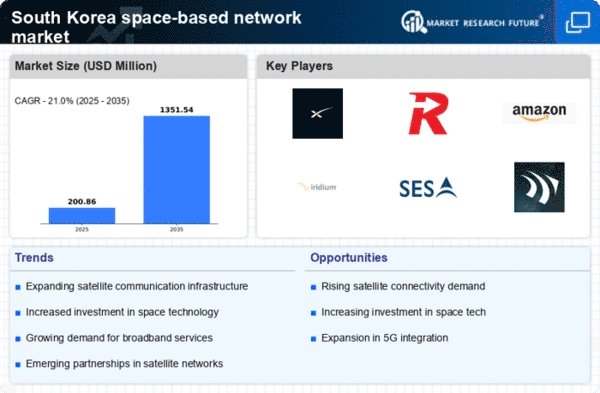
As per Market Research Future analysis, the South Korea space-based network market size was estimated at 166.0 USD Million in 2024. The South Korea space based-network market is projected to grow from 200.86 USD Million in 2025 to 1351.54 USD Million by 2035, exhibiting a compound annual growth rate (CAGR) of 21% during the forecast period 2025 - 2035

Key Market Trends & Highlights

The South Korea space based-network market is poised for substantial growth driven by technological advancements and increased government investment.

  • The market is witnessing increased government investment aimed at enhancing satellite infrastructure.
  • Satellite technology remains a focal point, with innovations driving efficiency and connectivity.
  • Sustainability initiatives are gaining traction, reflecting a commitment to environmentally responsible practices.
  • Rising demand for connectivity and technological advancements in satellite systems are key drivers of market expansion.

Market Size & Forecast

2024 Market Size 166.0 (USD Million)
2035 Market Size 1351.54 (USD Million)
CAGR (2025 - 2035) 21.0%

Major Players

SpaceX (US), OneWeb (GB), Amazon (US), Iridium Communications (US), SES S.A. (LU), Inmarsat (GB), Telesat (CA), Eutelsat (FR), Northrop Grumman (US)

Our Impact
Enabled $4.3B Revenue Impact for Fortune 500 and Leading Multinationals
Partnering with 2000+ Global Organizations Each Year
30K+ Citations by Top-Tier Firms in the Industry

South Korea Space Based Network Market Trends

The space-based network market in South Korea is experiencing notable advancements, driven by the nation's commitment to enhancing its satellite communication capabilities. The government has prioritized investments in space technology, aiming to bolster connectivity and support various sectors, including telecommunications, defense, and disaster management. This strategic focus appears to be fostering innovation and collaboration among private enterprises and research institutions, which may lead to the development of cutting-edge solutions tailored to meet domestic and international demands. Furthermore, the increasing reliance on satellite networks for data transmission and real-time communication is likely to propel growth in this sector, as businesses and government agencies seek to leverage these technologies for improved operational efficiency. In addition, South Korea's space based-network market is characterized by a growing emphasis on sustainability and environmental considerations. The integration of eco-friendly practices in satellite design and operation is becoming more prevalent, reflecting a broader global trend towards responsible space exploration. This shift may not only enhance the market's appeal but also align with international standards and expectations. As the nation continues to invest in research and development, the potential for innovative applications and services within the space based-network market appears promising, suggesting a dynamic future for stakeholders involved in this evolving landscape.

Increased Government Investment

The South Korean government is significantly increasing its investment in space based-network infrastructure. This commitment aims to enhance satellite communication capabilities, which could lead to improved connectivity across various sectors. Such investments may also stimulate private sector participation, fostering innovation and technological advancements.

Focus on Satellite Technology

There is a growing emphasis on the development of advanced satellite technologies within the space based-network market. South Korean companies are likely to explore new satellite designs and functionalities, which may enhance data transmission and communication efficiency. This trend suggests a shift towards more sophisticated and capable satellite systems.

Sustainability Initiatives

Sustainability is becoming a key consideration in the space based-network market. South Korean stakeholders are increasingly adopting eco-friendly practices in satellite design and operation. This focus on environmental responsibility may not only improve market competitiveness but also align with global sustainability goals.

South Korea Space Based Network Market Drivers

Rising Demand for Connectivity

The space based-network market in South Korea experiences a notable surge in demand for enhanced connectivity solutions. As urbanization accelerates, the need for reliable internet access in remote and rural areas becomes increasingly critical. The government has recognized this necessity, leading to initiatives aimed at expanding broadband coverage through satellite technology. Reports indicate that the market could grow at a CAGR of approximately 15% over the next five years, driven by the increasing reliance on digital services across various sectors. This rising demand for connectivity is likely to propel investments in satellite infrastructure, thereby fostering growth within the space based-network market.

Growing Interest in Space Exploration

The burgeoning interest in space exploration is significantly influencing the space based-network market in South Korea. As the nation aims to enhance its presence in the global space arena, investments in satellite technology and infrastructure are on the rise. This interest is not only limited to governmental initiatives but also includes private sector involvement, with several companies exploring opportunities in satellite manufacturing and launch services. The potential for commercial applications, such as Earth observation and data analytics, is driving innovation within the market. Analysts suggest that this trend could result in a market expansion of approximately 18% by 2028.

Regulatory Support and Policy Frameworks

The regulatory environment in South Korea is evolving to support the growth of the space based-network market. The government is implementing policies that encourage investment in satellite communications and streamline the licensing process for new technologies. This supportive framework is essential for fostering innovation and attracting foreign investment. Additionally, the establishment of clear guidelines for satellite operations enhances operational efficiency and safety. As a result, the space based-network market is likely to benefit from increased investor confidence, which could lead to a market growth rate of around 12% annually over the next five years.

Strategic Partnerships and Collaborations

Strategic partnerships between private companies and government entities are emerging as a key driver in the space based-network market. Collaborations with international space agencies and technology firms facilitate knowledge transfer and resource sharing, enhancing the overall capabilities of South Korea's satellite network. These alliances are instrumental in accelerating the deployment of innovative solutions and expanding service offerings. For instance, partnerships focused on developing satellite constellations can significantly improve coverage and service reliability. The impact of these collaborations is expected to be profound, potentially increasing market penetration by 20% within the next few years.

Technological Advancements in Satellite Systems

Technological innovations play a pivotal role in shaping the space based-network market in South Korea. The development of advanced satellite systems, including low Earth orbit (LEO) satellites, enhances data transmission speeds and reduces latency. These advancements are crucial for applications such as IoT, telemedicine, and smart city initiatives. The South Korean government has allocated substantial funding for research and development in satellite technologies, which is expected to yield significant improvements in network capabilities. As a result, the space based-network market is poised for expansion, with projections indicating a potential market value increase of over $1 billion by 2027.


Market Segment Insights

By Application: Data and Telecommunication (Largest) vs. Logistics and Transportation (Fastest-Growing)

The South Korea space based-network market showcases a diverse application landscape, with Data and Telecommunication holding the largest market share due to the rising demand for connectivity and communication services. Agricultural applications follow, driven by advancements in precision farming technologies. Other segments such as Maritime and Aviation are witnessing steady growth, reflecting their essential role in transportation and logistics chains. Growth trends in this market are primarily fueled by the digitization of industries and increasing reliance on satellite connectivity for real-time data and communication. The Logistics and Transportation segment is emerging rapidly, with innovations in supply chain and fleet management solutions propelling its expansion. The ongoing investment in satellite infrastructure and technology enhances operational efficiency across sectors, positioning them favorably for future growth.

Agriculture: Data and Telecommunication (Dominant) vs. Logistics and Transportation (Emerging)

In the South Korea space based-network market, Data and Telecommunication is the dominant application segment, characterized by its extensive usage in enhancing communication capabilities and connectivity across various sectors. This segment benefits from the continuous evolution of technology, enabling improved data transfer and communication reliability. On the other hand, Logistics and Transportation is an emerging segment that is gradually gaining traction. This growth is driven by advancements in logistics technologies and the push for optimized supply chain management. Companies are increasingly leveraging satellite connectivity to streamline operations, improve tracking, and enhance overall efficiency, making this segment a promising area for future investment.

By End User: Defense and Government (Largest) vs. Individual Users (Fastest-Growing)

In the South Korea space based-network market, the Defense and Government sector holds the largest market share, driven by ongoing technological advancements and strategic importance. This segment has leveraged significant investments in satellite communications and surveillance technologies, ensuring robust connectivity and operational efficiency. In contrast, Individual Users are emerging as the fastest-growing segment, fueled by a surge in demand for satellite internet services and increased accessibility to advanced communication tools that cater to personal and professional use. The growth trends within the Defense and Government segment are characterized by continuous government initiatives aimed at enhancing national security and defense communications. Additionally, the rapid expansion of commercial satellite services is enabling the Individual Users segment to flourish, as more households seek reliable internet access in remote areas. The convergence of technology and favorable policy frameworks is further propelling growth in both segments, indicating a dynamic future for the market.

Defense and Government (Dominant) vs. Individual Users (Emerging)

The Defense and Government segment is dominant within the South Korea space based-network market, characterized by extensive investment in secure and efficient communication infrastructure. This segment benefits from government contracts and a strategic focus on cybersecurity, ensuring reliable service for critical operations. In contrast, the Individual Users segment is emerging rapidly, supported by a growing consumer base that demands seamless connectivity for work and entertainment. This shift highlights the changing landscape of connectivity needs, where personal and commercial users alike seek advanced solutions to participate in a digitally connected environment. Both segments showcase diverse requirements, driving innovation and competition in the market.

By Frequency: Ku and Ka Bands (Largest) vs. C and X Bands (Fastest-Growing)

In the South Korea space based-network market, the Ku and Ka frequency bands dominate the overall market landscape, accounting for a significant share in terms of usage and demand. These bands are particularly favored for their ability to support high-throughput connectivity, making them essential for various applications, including broadcasting and broadband services. In contrast, the C and X bands, while historically important, are witnessing a resurgence in interest due to their robustness in adverse weather conditions, leading to a diversified market presence. Growth trends in this segment are driven by increasing demand for high-speed internet and satellite communication services, with Ku and Ka bands benefiting from advancements in satellite technology. The C and X bands are emerging as key players as industries focus more on resilient and reliable communication systems. As businesses and consumers become more mobile and reliant on connectivity, these frequency bands are set to expand their reach and capabilities, signaling a dynamic evolution in the segment.

Ku and Ka Bands (Dominant) vs. C and X Bands (Emerging)

The Ku and Ka frequency bands hold a dominant position in the South Korea space based-network market, primarily due to their high efficiency and ability to deliver enhanced data throughput. They are widely adopted across various sectors, including telecommunications and broadcasting, providing critical infrastructure for high-definition streaming and large-scale data transfers. In contrast, the C and X bands are emerging as viable alternatives, characterized by their resilience and ability to operate effectively even in severe weather conditions. This makes them particularly attractive for military and disaster recovery applications where reliability is paramount. As the market evolves, the synergy between these bands promises to foster innovation and meet the growing demands of diverse end-users.

By Component: Antenna Dish and Modem (Largest) vs. Gateway (Fastest-Growing)

In the South Korea space based-network market, the market share distribution among the component segments reveals a clear dominance of Antenna Dish and Modem, which constitutes a significant portion of the overall market. This segment is characterized by its established presence and reliable performance in facilitating connectivity. Gateway, while capturing a smaller share, represents an innovative and rapidly advancing area, showing strong potential for growth as newer technologies and applications arise. The growth trends for these segments indicate a robust demand for Antenna Dish and Modem, driven by the increasing need for reliable satellite communication and data transmission. Conversely, Gateway is recognized as the fastest-growing segment, largely fueled by advancements in satellite technology and the rising adoption of integrated communication systems. This trend is also supported by investments in infrastructure and efforts to enhance network capabilities, positioning the Gateway as a critical player in the evolving landscape of satellite communications.

Antenna Dish and Modem (Dominant) vs. Gateway (Emerging)

The Antenna Dish and Modem segment stands out as the dominant force in the South Korea space based-network market, known for its robustness and reliability in providing high-quality communication services. This segment benefits from longstanding industry experience and a solid customer base. On the other hand, the Gateway segment is emerging rapidly, representing a shift towards more adaptive and modern communication solutions. Although it currently holds a smaller market share, the Gateway's innovative features and capacity to facilitate advanced connectivity solutions position it well for future growth. The contrast between the robustness of Antenna Dish and Modem and the agility of Gateway illustrates the dynamic interplay in this sector, highlighting the ongoing evolution of satellite-based communications.

By Orbit: Low Earth Orbit (Largest) vs. Medium Earth Orbit (Fastest-Growing)

In the South Korea space based-network market, the distribution of market share among different orbit types reveals a clear dominance of Low Earth Orbit (LEO), which holds the largest share of the market. This segment benefits from its ability to support a variety of applications, including satellite communications and Earth observation, leading to significant investments and developments. Meanwhile, Medium Earth Orbit (MEO) is gaining traction, primarily due to advancements in technology and increasing demand for navigation and timing services, carving out a notable presence in the market. Growth trends for the South Korea space based-network market indicate a robust expansion for both LEO and MEO segments. The LEO segment continues to thrive, driven by a surge in satellite launches and a focus on reducing latency for communication services. Conversely, MEO is rapidly becoming the fastest-growing segment, fueled by innovations in satellite technology and the rising need for precise location-based services. The dynamic interplay between these segments highlights a vibrant and competitive market landscape.

Low Earth Orbit (Dominant) vs. Medium Earth Orbit (Emerging)

Low Earth Orbit (LEO) remains the dominant force within the South Korea space based-network market, characterized by its low latency and ability to serve a variety of high-demand applications, such as real-time communications and imaging services. Its strategic advantages facilitate a rapid rollout of broadband services, making it appealing for both commercial and governmental users. On the other hand, Medium Earth Orbit (MEO) is emerging as a noteworthy segment, leveraging advancements in satellite technology that enhance navigation and communication services. MEO's unique positioning enables it to establish a suitable balance between coverage area and service quality, positioning it well to capitalize on the growing demand for reliable global navigational systems.

Get more detailed insights about South Korea Space Based Network Market

Key Players and Competitive Insights

The space based-network market in South Korea is characterized by a dynamic competitive landscape, driven by technological advancements and increasing demand for connectivity. Major players such as SpaceX (US), OneWeb (GB), and Amazon (US) are actively shaping the market through innovative strategies and regional expansions. SpaceX (US) continues to leverage its Starlink constellation to enhance broadband access, particularly in underserved areas, while OneWeb (GB) focuses on partnerships with local telecommunications providers to bolster its service offerings. Amazon (US), through its Project Kuiper, aims to establish a robust satellite network that complements its existing cloud services, indicating a strategic positioning towards integrated solutions that combine satellite and terrestrial networks.Key business tactics within this market include localizing manufacturing and optimizing supply chains to enhance operational efficiency. The competitive structure appears moderately fragmented, with several key players vying for market share. This fragmentation is influenced by the diverse strategies employed by these companies, which collectively enhance competition and drive innovation. The presence of multiple players fosters an environment where technological advancements and service differentiation are paramount, allowing companies to cater to specific regional needs and preferences.

In October SpaceX (US) announced a partnership with a South Korean telecommunications firm to expand its Starlink services, aiming to provide high-speed internet to rural communities. This strategic move underscores SpaceX's commitment to enhancing connectivity in regions that have historically faced challenges in accessing reliable internet services. By collaborating with local entities, SpaceX not only strengthens its market presence but also aligns its offerings with the specific needs of South Korean consumers.

In September OneWeb (GB) secured a significant contract with the South Korean government to provide satellite-based communication services for emergency response systems. This development highlights OneWeb's strategic focus on government partnerships, which may enhance its credibility and market penetration. By positioning itself as a critical player in national security and emergency management, OneWeb is likely to bolster its competitive edge in the region.

In November Amazon (US) revealed plans to launch its first batch of Project Kuiper satellites, marking a pivotal step in its strategy to establish a comprehensive satellite network. This initiative is expected to enhance Amazon's service offerings, particularly in the realm of cloud computing and IoT applications. The integration of satellite technology with existing services could provide Amazon with a unique competitive advantage, allowing it to offer seamless connectivity solutions to its customers.

As of November current trends in the space based-network market indicate a strong emphasis on digitalization, sustainability, and AI integration. Strategic alliances among key players are increasingly shaping the competitive landscape, fostering innovation and collaboration. The shift from price-based competition to a focus on technological differentiation and supply chain reliability is evident, suggesting that future competitive dynamics will hinge on the ability to innovate and adapt to evolving market demands.

Key Companies in the South Korea Space Based Network Market include

Industry Developments

In order to lessen dependency on foreign satellite services, the South Korean Ministry of Science and ICT announced a domestic LEO satellite network strategy in September 2023, investing about US$360 million in R&D, frequency distribution, and infrastructure development.In order to provide low-latency "Space Internet" to South Korea, with an emphasis on distant, marine, and emergency use cases, Hanwha Systems signed a distribution agreement with Eutelsat OneWeb in November 2023. Rollout is anticipated by the end of 2024.

Both SpaceX's Starlink and Eutelsat OneWeb were approved by regulatory bodies to provide satellite broadband services in South Korea by June 2025. Commercial operations will begin the following month, after equipment certification.The Korea Aerospace Administration (KASA) of South Korea awarded Arianespace a significant contract in February 2025 to launch the multifunctional GEO-KOMPSAT-3 "Chollian-3" satellite in 2027.

This satellite will help disaster response, aviation, communications, and maritime safety.Lastly, to strengthen South Korea's domestic satellite manufacturing capabilities and increase its involvement in both government and commercial space endeavors, Korea Aerospace Industries (KAI) and Airbus teamed up in May 2024 to co-develop small LEO satellites.

Future Outlook

South Korea Space Based Network Market Future Outlook

The space based-network market in South Korea is projected to grow at a 21.0% CAGR from 2025 to 2035, driven by technological advancements and increasing demand for connectivity.

New opportunities lie in:

  • Development of satellite-based IoT solutions for smart agriculture.
  • Expansion of low-latency communication services for remote areas.
  • Investment in space-based data analytics for urban planning.

By 2035, the market is expected to achieve substantial growth and innovation.

Market Segmentation

South Korea Space Based Network Market Orbit Outlook

  • Low Earth Orbit
  • Medium Earth Orbit
  • Geostationary Earth Orbit

South Korea Space Based Network Market End User Outlook

  • Defense and Government
  • Commercial
  • Individual Users

South Korea Space Based Network Market Component Outlook

  • Satellite
  • Gateway
  • Antenna Dish and Modem

South Korea Space Based Network Market Frequency Outlook

  • Ku, Ka, and K Band
  • C and X Band
  • L and S Band

South Korea Space Based Network Market Application Outlook

  • Agriculture
  • Maritime
  • Aviation
  • Enterprise
  • Data and Telecommunication
  • Logistics and Transportation
  • Others

Report Scope

MARKET SIZE 2024 166.0(USD Million)
MARKET SIZE 2025 200.86(USD Million)
MARKET SIZE 2035 1351.54(USD Million)
COMPOUND ANNUAL GROWTH RATE (CAGR) 21.0% (2025 - 2035)
REPORT COVERAGE Revenue Forecast, Competitive Landscape, Growth Factors, and Trends
BASE YEAR 2024
Market Forecast Period 2025 - 2035
Historical Data 2019 - 2024
Market Forecast Units USD Million
Key Companies Profiled SpaceX (US), OneWeb (GB), Amazon (US), Iridium Communications (US), SES S.A. (LU), Inmarsat (GB), Telesat (CA), Eutelsat (FR), Northrop Grumman (US)
Segments Covered Application, End User, Frequency, Component, Orbit
Key Market Opportunities Expansion of satellite communication infrastructure to enhance connectivity in remote areas.
Key Market Dynamics Intensifying competition drives innovation and regulatory adaptation in the evolving space based-network market.
Countries Covered South Korea
Leave a Comment

FAQs

What is the expected market size of the South Korea Space-Based Network Market in 2024?

The South Korea Space-Based Network Market is expected to be valued at 298.8 million USD in 2024.

What is the projected market size for the South Korea Space-Based Network Market by 2035?

By 2035, the South Korea Space-Based Network Market is projected to reach a value of 1143.0 million USD.

What is the expected CAGR for the South Korea Space-Based Network Market from 2025 to 2035?

The expected CAGR for the South Korea Space-Based Network Market from 2025 to 2035 is 12.972%.

Which application has the largest projected market size in 2035 within the South Korea Space-Based Network Market?

The Enterprise application segment is projected to have the largest market size of 320.0 million USD in 2035.

What is the market value for the Agriculture application in the South Korea Space-Based Network Market in 2024?

The Agriculture application segment is valued at 45.0 million USD in 2024.

Who are the key players in the South Korea Space-Based Network Market?

Major players in the South Korea Space-Based Network Market include Samsung Electronics, SK Telecom, and SpaceX among others.

What is the expected market value for the Maritime application in 2035?

The Maritime application segment is expected to reach a value of 120.0 million USD by 2035.

What is the projected market value for the Data and Telecommunication application in 2024?

The Data and Telecommunication application segment is projected to be valued at 83.8 million USD in 2024.

What growth opportunities exist in the South Korea Space-Based Network Market until 2035?

The South Korea Space-Based Network Market presents growth opportunities in applications such as aviation and telecommunication due to evolving technology.

How does the growth rate of the Enterprise application segment compare to others from 2025 to 2035?

The Enterprise application segment shows significant growth potential, with its value expected to increase from 90.0 million USD in 2024 to 320.0 million USD by 2035.

Download Free Sample

Kindly complete the form below to receive a free sample of this Report

Compare Licence

×
Features License Type
Single User Multiuser License Enterprise User
Price $4,950 $5,950 $7,250
Maximum User Access Limit 1 User Upto 10 Users Unrestricted Access Throughout the Organization
Free Customization
Direct Access to Analyst
Deliverable Format
Platform Access
Discount on Next Purchase 10% 15% 15%
Printable Versions