×
Request Free Sample ×

Kindly complete the form below to receive a free sample of this Report

* Please use a valid business email

Leading companies partner with us for data-driven Insights

clients tt-cursor
Hero Background

Germany Space Based Network Market

ID: MRFR/ICT/61349-HCR
200 Pages
Aarti Dhapte
February 2026

Germany Space-Based Network Market Size, Share and Trends Analysis Report By Application (Agriculture, Maritime, Aviation, Enterprise, Data and Telecommunication, Logistics and Transportation, Others), By End User (Defense and Government, Commercial, Individual Users), By Frequency (Ku, Ka, K Band, C Band, X Band, L Band, S Band), By Component (Satellite, Gateways, Antenna Dish, Modem), and By Orbit (Low Earth Orbit, Medium Earth Orbit, Geostationary Earth Orbit)- Forecast to 2035

Share:
Download PDF ×

We do not share your information with anyone. However, we may send you emails based on your report interest from time to time. You may contact us at any time to opt-out.

Germany Space Based Network Market Infographic
Purchase Options

Germany Space Based Network Market Summary

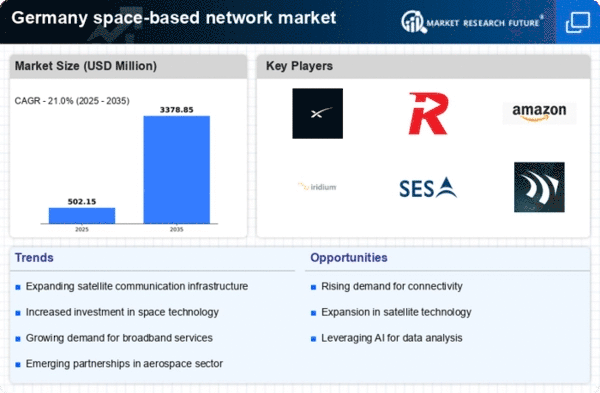
As per Market Research Future analysis, the Space-based Network market size was estimated at 415.0 USD Million in 2024. The space based-network market is projected to grow from 502.15 USD Million in 2025 to 3378.85 USD Million by 2035, exhibiting a compound annual growth rate (CAGR) of 21% during the forecast period 2025 - 2035

Key Market Trends & Highlights

The Germany space based-network market is experiencing robust growth driven by technological advancements and increasing demand for connectivity.

  • The market is witnessing increased investment in satellite infrastructure, indicating a strong commitment to enhancing capabilities.
  • Integration of satellite and terrestrial networks is becoming a prominent trend, facilitating seamless connectivity across platforms.
  • Sustainability and earth observation are gaining traction, reflecting a growing awareness of environmental impacts and data utilization.
  • Key market drivers include the growing demand for high-speed connectivity and government initiatives and funding supporting infrastructure development.

Market Size & Forecast

2024 Market Size 415.0 (USD Million)
2035 Market Size 3378.85 (USD Million)
CAGR (2025 - 2035) 21.0%

Major Players

SpaceX (US), OneWeb (GB), Amazon (US), Iridium Communications (US), SES S.A. (LU), Inmarsat (GB), Telesat (CA), Eutelsat (FR), Northrop Grumman (US)

Our Impact
Enabled $4.3B Revenue Impact for Fortune 500 and Leading Multinationals
Partnering with 2000+ Global Organizations Each Year
30K+ Citations by Top-Tier Firms in the Industry

Germany Space Based Network Market Trends

The space based-network market in Germany is currently experiencing a transformative phase, driven by advancements in satellite technology and increasing demand for high-speed connectivity. The integration of satellite systems with terrestrial networks is becoming more prevalent, enabling seamless communication across various sectors, including telecommunications, defense, and transportation. This convergence is likely to enhance operational efficiency and expand service offerings, catering to both urban and rural areas. Furthermore, the German government is actively investing in space initiatives, which may bolster the development of innovative solutions and foster collaboration between public and private entities. In addition, the growing emphasis on sustainability and environmental monitoring is shaping the landscape of the space based-network market. Germany's commitment to climate action and the European Space Agency's initiatives are encouraging the deployment of satellite systems for Earth observation and data collection. This trend suggests a potential shift towards utilizing space-based technologies for addressing global challenges, such as climate change and disaster management. As the market evolves, stakeholders are likely to explore new business models and partnerships, positioning themselves to capitalize on emerging opportunities in this dynamic sector.

Increased Investment in Satellite Infrastructure

There is a noticeable rise in funding directed towards the enhancement of satellite infrastructure. This trend is driven by both governmental initiatives and private sector investments, aiming to improve connectivity and expand service capabilities. The focus on developing advanced satellite systems is expected to facilitate better communication services across various industries.

Integration of Satellite and Terrestrial Networks

The convergence of satellite and terrestrial networks is becoming increasingly prominent. This integration allows for more reliable and efficient communication solutions, particularly in remote areas where traditional infrastructure may be lacking. The synergy between these networks is likely to enhance overall service delivery.

Focus on Sustainability and Earth Observation

The space based-network market is witnessing a growing emphasis on sustainability, particularly in the context of Earth observation. The deployment of satellite systems for environmental monitoring aligns with Germany's climate goals, suggesting a shift towards utilizing space technologies for addressing pressing global issues.

Germany Space Based Network Market Drivers

Emergence of New Market Players

The space based-network market in Germany is witnessing the emergence of new players, including startups and established tech companies venturing into satellite communications. This influx of competition is likely to drive innovation and reduce costs, making satellite services more accessible to a broader audience. In 2025, it is estimated that the number of active satellite operators in Germany will increase by 20%, fostering a dynamic ecosystem within the space based-network market. These new entrants are expected to introduce novel solutions, enhancing service offerings and contributing to the overall growth of the market.

Government Initiatives and Funding

The German government is actively promoting the development of the space based-network market through various initiatives and funding programs. With a focus on enhancing national security and technological independence, the government has allocated substantial resources to support satellite technology research and development. In 2025, public funding for space projects is expected to exceed €1 billion, reflecting the government's commitment to fostering innovation in the space sector. This financial backing not only stimulates growth within the space based-network market but also encourages private sector investment, creating a synergistic environment for technological advancements and infrastructure development.

Advancements in Satellite Technology

Technological advancements are significantly shaping the space based-network market in Germany. Innovations in satellite design, propulsion systems, and miniaturization are enabling the deployment of more efficient and cost-effective satellite networks. In 2025, the market is expected to benefit from the introduction of next-generation satellites that offer improved bandwidth and lower latency. These advancements are likely to enhance the overall performance of the space based-network market, making satellite communications a viable alternative to traditional terrestrial networks, particularly in remote and underserved areas.

Growing Demand for High-Speed Connectivity

The space based-network market in Germany is experiencing a notable surge in demand for high-speed connectivity solutions. As businesses and consumers increasingly rely on digital services, the need for robust and reliable internet access has become paramount. This trend is reflected in the rising number of satellite launches aimed at enhancing broadband coverage across urban and rural areas. In 2025, the market is projected to grow by approximately 15%, driven by advancements in satellite technology and the expansion of low Earth orbit (LEO) constellations. The space based-network market is thus positioned to play a crucial role in bridging the digital divide, ensuring that all regions of Germany have access to high-speed internet services.

Increased Focus on Security and Resilience

As cyber threats continue to evolve, the space based-network market in Germany is placing a heightened emphasis on security and resilience. The integration of advanced encryption technologies and secure communication protocols is becoming essential for satellite networks. In 2025, it is anticipated that investments in cybersecurity measures for satellite systems will rise by 30%, reflecting the industry's commitment to safeguarding data integrity and user privacy. This focus on security not only enhances consumer confidence but also positions the space based-network market as a reliable solution for critical communications.


Market Segment Insights

By Application: Data and Telecommunication (Largest) vs. Logistics and Transportation (Fastest-Growing)

In the Germany space based-network market, the Data and Telecommunication segment holds the largest market share. It plays a crucial role in ensuring connectivity and communication across various sectors, significantly influencing the market landscape. Following closely, the Logistics and Transportation segment is emerging as a key player, driven by advancements in technology and increasing reliance on efficient transport networks. Growth trends in the segment indicate a robust demand for seamless communication solutions. The rapid digital transformation across industries is propelling the adoption of space-based networks, particularly in Logistics and Transportation, where the integration of data-driven processes enhances operational efficiency. Additionally, the agriculture and aviation sectors are also witnessing notable advancements, but the Logistics segment is currently attracting more investment and innovation, marking it as the fastest-growing area of interest.

Data and Telecommunication (Dominant) vs. Logistics and Transportation (Emerging)

The Data and Telecommunication segment stands as the dominant force in the Germany space based-network market, primarily due to its foundational role in enabling communication infrastructure. This segment benefits from the growing demand for high-speed internet and reliable connectivity, which are crucial for various applications. Conversely, the Logistics and Transportation segment is emerging, characterized by its focus on leveraging space-based networks to optimize supply chains and enhance tracking capabilities. The increasing complexity of logistics operations necessitates advanced communication solutions, driving innovation in this area. As businesses strive for efficiency and sustainability, these segments are positioned to shape the future landscape of the market significantly, catering to the evolving needs of various industries.

By End User: Defense and Government (Largest) vs. Commercial (Fastest-Growing)

In the Germany space based-network market, the distribution of market share among different end-user segments showcases a clear leader in the Defense and Government category. This segment accounts for a significant portion of the market, driven by the ongoing need for secure and robust communication infrastructures. Conversely, the Commercial segment is rapidly gaining traction, reflecting the increasing demand for innovative connectivity solutions across various industries. These dynamics indicate a competitive landscape where established players in Defense and Government are challenged by the evolving preferences of commercial entities. Growth trends in the Germany space based-network market are being shaped by advancing technologies and shifting user requirements. Particularly, the Commercial segment is witnessing accelerated growth due to digital transformation initiatives among enterprises seeking to enhance operational efficiency and connectivity. Additionally, the Defense and Government segment continues to thrive as national security concerns drive investment in advanced communication systems. The anticipation of future innovations and increased public sector spending suggests a promising outlook for both segments in the coming years.

Defense and Government (Dominant) vs. Commercial (Emerging)

The Defense and Government segment is characterized by its substantial investment in secure, reliable, and advanced communication systems. This segment serves critical functions such as defense operations, emergency response, and government communications, where systems must adhere to strict security protocols. As such, firms in this space prioritize high performance and resilience. On the other hand, the Commercial segment is emerging rapidly, driven by the digital shift and an insatiable demand for enhanced connectivity. Businesses are increasingly adopting innovative solutions tailored to specific needs, fueling growth. While the Defense and Government segment stands as a dominant force, the Commercial sector's potential for growth positions it as a key player in the future landscape of the Germany space based-network market.

By Frequency: Ka Band (Largest) vs. Ku Band (Fastest-Growing)

In the Germany space based-network market, frequency segments exhibit varied market shares, with the Ka Band leading due to its high throughput capabilities and increasing demand for broadband services. Meanwhile, the Ku Band, while slightly trailing, shows a robust growth potential, particularly in applications like broadcast and data services. The C and X Band frequencies follow, primarily serving government and military applications, thus holding a smaller share in commercial uses. The growth trends in the frequency segment are significantly driven by advancements in satellite technology and an increasing reliance on satellite communication for various applications. The rising demand for high-speed internet connectivity and the proliferation of IoT devices are propelling the Ka Band's expansion. Conversely, the Ku Band is benefitting from its adaptability for new technologies, making it the fastest-growing segment as companies invest in upgrading infrastructure for enhanced service offerings.

Ka Band (Dominant) vs. Ku Band (Emerging)

The Ka Band, recognized for its dominant position in the market, is characterized by its capacity to support high data rates and deliver enhanced performance for broadband applications. It is increasingly favored for its ability to cater to high-demand sectors, including video broadcasting and internet services. In contrast, the Ku Band stands out as an emerging segment, benefiting from its versatility and established technology. While it has traditionally served broadcasting needs, its adaptability and integration with newer technologies allow it to capture a wider audience, thereby driving growth in the overall Germany space based-network market.

By Component: Satellite (Largest) vs. Gateway (Fastest-Growing)

In the Germany space based-network market, the 'Component' segment showcases a diversified distribution among key values: Satellite, Gateway, and Antenna Dish and Modem. Satellite has a significant market share, solidifying its position as the largest component due to widespread applications in communications and broadcasting. In contrast, the Gateway component is gaining traction, capturing an increasing share of the market as connectivity demands rise and enterprises move towards more integrated solutions. The growth trends within this segment reveal a dynamic landscape. The Satellite component is primarily driven by advancements in technology, facilitating better performance and coverage. On the other hand, Gateway is identified as the fastest-growing value, attributed to the surge in demand for high-speed internet and the proliferation of IoT devices. As organizations embrace digital transformation, the significance of robust Gateway solutions becomes paramount, leading to rapid growth and innovation in this area.

Satellite (Dominant) vs. Gateway (Emerging)

The Satellite component holds a dominant position in the Germany space based-network market, characterized by its established infrastructure and robust usage across various sectors. Its reliability and extensive reach cater to a wide array of applications, from telecommunications to remote area communications. In contrast, the Gateway component emerges as a compelling alternative, focusing on enabling seamless connectivity and integration within the network. This shift towards Gateway solutions is driven by the increasing demand for faster connections and the expanding ecosystem of devices in both consumer and enterprise settings. Together, these components highlight the evolving nature of the market, showcasing both stable dominance and rapid emergence based on contemporary technological requirements.

By Orbit: Low Earth Orbit (Largest) vs. Medium Earth Orbit (Fastest-Growing)

The Germany space based-network market exhibits a diverse distribution of market share among the different orbit types, with Low Earth Orbit (LEO) holding the largest share due to its favorable characteristics such as low latency and proximity to Earth. In comparison, Medium Earth Orbit (MEO) is gaining traction, driven by its balanced performance metrics, while Geostationary Earth Orbit (GEO) continues to play a significant role but experiences slower growth rates due to higher latency and increased operational costs. Growth trends within the orbit segment show a clear shift towards Low Earth Orbit solutions, fueled by advancements in technology and increasing demand for high-speed internet services. The emergence of satellite constellations facilitates rapid deployment in LEO, capturing market interest. MEO's quick growth is supported by its applications in navigation and communication services, positioning it as a viable alternative to LEO for specific use cases. GEO, while still essential, is facing challenges balancing cost-effectiveness with performance, indicating a need for innovation in its deployment strategies.

Low Earth Orbit (Dominant) vs. Medium Earth Orbit (Emerging)

Low Earth Orbit (LEO) serves as the dominant force in the Germany space based-network market, characterized by its ability to deliver broadband connectivity with minimal latency due to its proximity to Earth. The rapid advancement in satellite technology has led to numerous LEO constellations being launched, catering to the increasing demand for reliable internet services across diverse sectors. This position is bolstered by strategic partnerships and investments aimed at expanding coverage and enhancing service offerings. Meanwhile, Medium Earth Orbit (MEO) is emerging as a competitive alternative, particularly valued for its role in GPS and advanced communication systems. MEO satellites offer a balanced approach, providing greater coverage than LEO while maintaining lower latency than traditional GEO systems, making it an attractive option for specific applications.

Get more detailed insights about Germany Space Based Network Market

Key Players and Competitive Insights

The space based-network market in Germany is characterized by a dynamic competitive landscape, driven by technological advancements and increasing demand for connectivity solutions. Key players such as SpaceX (US), OneWeb (GB), and SES S.A. (LU) are at the forefront, each adopting distinct strategies to enhance their market presence. SpaceX (US) focuses on innovation through its Starlink project, which aims to provide high-speed internet globally, while OneWeb (GB) emphasizes partnerships with local telecommunications firms to expand its reach. SES S.A. (LU) leverages its established satellite infrastructure to offer tailored solutions for various sectors, including government and enterprise, thereby shaping a competitive environment that prioritizes technological differentiation and strategic collaborations.The market structure appears moderately fragmented, with several players vying for market share. Key business tactics include localizing manufacturing to reduce costs and enhance supply chain efficiency. Companies are increasingly optimizing their operations to respond to regional demands, which may lead to a more integrated supply chain. This collective influence of major players fosters a competitive atmosphere where innovation and operational excellence are paramount.

In October SpaceX (US) announced the successful launch of its latest batch of Starlink satellites, significantly enhancing its global coverage. This strategic move is crucial as it not only expands its service capabilities but also positions SpaceX (US) as a leader in the race for global broadband connectivity. The implications of this launch are profound, as it may attract new customers and solidify existing contracts with governments and enterprises seeking reliable internet solutions.

In September OneWeb (GB) secured a partnership with a major German telecommunications provider to enhance its service offerings in the region. This collaboration is strategically important as it allows OneWeb (GB) to leverage local expertise and infrastructure, potentially accelerating its market penetration in Germany. Such partnerships are indicative of a broader trend where companies seek to localize their operations to better serve regional markets.

In August SES S.A. (LU) unveiled a new satellite service aimed at the maritime sector, which is expected to enhance connectivity for shipping companies operating in German waters. This initiative reflects SES S.A.'s (LU) commitment to diversifying its service portfolio and addressing specific industry needs. By focusing on niche markets, SES S.A. (LU) may gain a competitive edge in a landscape where tailored solutions are increasingly valued.

As of November current trends in the space based-network market include a strong emphasis on digitalization, sustainability, and the integration of AI technologies. Strategic alliances are becoming more prevalent, as companies recognize the need for collaboration to enhance their service offerings and operational capabilities. Looking ahead, competitive differentiation is likely to evolve, shifting from price-based competition to a focus on innovation, technological advancements, and supply chain reliability. This transition suggests that companies that prioritize these aspects may emerge as leaders in the increasingly competitive landscape.

Key Companies in the Germany Space Based Network Market include

Industry Developments

An important operational milestone in national space infrastructure was reached in March 2023 when OHB SE and the German Space Agency successfully launched a group of reconnaissance satellites intended for secure Earth observation and communications.In order to improve bandwidth and lower latency for enterprise and marine connectivity throughout Germany, Deutsche Telekom announced in August 2023 a multi-year agreement with SES to incorporate O3b mPOWER MEO capacity into its network.

Airbus Defence and Space advanced secure satellite-to-satellite and satellite-to-ground networks secured by quantum key distribution by delivering Germany's first experimental quantum communications payload aboard a satellite in December 2023.In an effort to efficiently and economically overcome connectivity gaps in underserved rural regions, Telesat teamed up with a regional broadband program in Germany in April 2024 to test lightweight LEO-based ground stations.

By opening a specialized satellite production facility close to Munich in February 2025, Rocket Lab most recently increased its launch footprint in Europe. This allowed for more control over launch cycles and more effective deployment of small satellite constellations within Germany.

Future Outlook

Germany Space Based Network Market Future Outlook

The space based-network market in Germany is projected to grow at a 21.0% CAGR from 2025 to 2035, driven by technological advancements and increasing demand for connectivity.

New opportunities lie in:

  • Development of satellite-based IoT solutions for smart agriculture.
  • Expansion of low-latency communication services for autonomous vehicles.
  • Investment in space-based data analytics for climate monitoring and disaster response.

By 2035, the market is expected to achieve substantial growth, positioning itself as a leader in innovative connectivity solutions.

Market Segmentation

Germany Space Based Network Market Orbit Outlook

  • Low Earth Orbit
  • Medium Earth Orbit
  • Geostationary Earth Orbit

Germany Space Based Network Market End User Outlook

  • Defense and Government
  • Commercial
  • Individual Users

Germany Space Based Network Market Component Outlook

  • Satellite
  • Gateway
  • Antenna Dish and Modem

Germany Space Based Network Market Frequency Outlook

  • Ku, Ka, and K Band
  • C and X Band
  • L and S Band

Germany Space Based Network Market Application Outlook

  • Agriculture
  • Maritime
  • Aviation
  • Enterprise
  • Data and Telecommunication
  • Logistics and Transportation
  • Others

Report Scope

MARKET SIZE 2024 415.0(USD Million)
MARKET SIZE 2025 502.15(USD Million)
MARKET SIZE 2035 3378.85(USD Million)
COMPOUND ANNUAL GROWTH RATE (CAGR) 21.0% (2025 - 2035)
REPORT COVERAGE Revenue Forecast, Competitive Landscape, Growth Factors, and Trends
BASE YEAR 2024
Market Forecast Period 2025 - 2035
Historical Data 2019 - 2024
Market Forecast Units USD Million
Key Companies Profiled SpaceX (US), OneWeb (GB), Amazon (US), Iridium Communications (US), SES S.A. (LU), Inmarsat (GB), Telesat (CA), Eutelsat (FR), Northrop Grumman (US)
Segments Covered Application, End User, Frequency, Component, Orbit
Key Market Opportunities Expansion of low Earth orbit satellite constellations enhances global connectivity in the space based-network market.
Key Market Dynamics Growing demand for satellite-based communication solutions drives innovation and competition in the space based-network market.
Countries Covered Germany
Leave a Comment

FAQs

What is the expected market size of the Germany Space-Based Network Market in 2024?

The Germany Space-Based Network Market is anticipated to be valued at 350.0 USD Million in 2024.

What is the projected market size for the Germany Space-Based Network Market by 2035?

By 2035, the Germany Space-Based Network Market is expected to reach a value of 2150.0 USD Million.

What is the expected compound annual growth rate (CAGR) for the Germany Space-Based Network Market from 2025 to 2035?

The CAGR for the Germany Space-Based Network Market is projected to be 17.942% from 2025 to 2035.

Which application segment is expected to show significant growth in the Germany Space-Based Network Market?

Among various applications, the Maritime segment is anticipated to grow to 410.0 USD Million by 2035.

What will the value of the Agriculture application in the Germany Space-Based Network Market be in 2035?

The Agriculture application is projected to reach a value of 290.0 USD Million by 2035.

Who are the key players in the Germany Space-Based Network Market?

Major players in the market include OHB SE, SES S.A., Rocket Lab, Northrop Grumman, and Deutsche Telekom.

What is the expected market size for the Data and Telecommunications application in 2024?

The Data and Telecommunications application is expected to be valued at 90.0 USD Million in 2024.

How will the Aviation application in the Germany Space-Based Network Market grow by 2035?

The Aviation application is expected to grow significantly, reaching 485.0 USD Million by 2035.

What is the growth potential for the Enterprise application segment in the Germany Space-Based Network Market?

The Enterprise application is forecasted to increase to 505.0 USD Million by 2035 from 80.0 USD Million in 2024.

What impact might global conflicts have on the Germany Space-Based Network Market?

The ongoing global conflicts could create challenges and opportunities, potentially influencing market dynamics and growth.

Download Free Sample

Kindly complete the form below to receive a free sample of this Report

Compare Licence

×
Features License Type
Single User Multiuser License Enterprise User
Price $4,950 $5,950 $7,250
Maximum User Access Limit 1 User Upto 10 Users Unrestricted Access Throughout the Organization
Free Customization
Direct Access to Analyst
Deliverable Format
Platform Access
Discount on Next Purchase 10% 15% 15%
Printable Versions