×
Request Free Sample ×

Kindly complete the form below to receive a free sample of this Report

* Please use a valid business email

Leading companies partner with us for data-driven Insights

clients tt-cursor
Hero Background

South Korea Outsourced Software Testing Market

ID: MRFR/ICT/59667-HCR
200 Pages
Aarti Dhapte
February 2026

South Korea Outsourced Software Testing Market Size, Share and Trends Analysis Report By Type (Hardware, Software) and By Application (BFSI, IT & Telecommunication, Retail, Others)-Forecast to 2035

Share:
Download PDF ×

We do not share your information with anyone. However, we may send you emails based on your report interest from time to time. You may contact us at any time to opt-out.

South Korea Outsourced Software Testing Market Infographic
Purchase Options

South Korea Outsourced Software Testing Market Summary

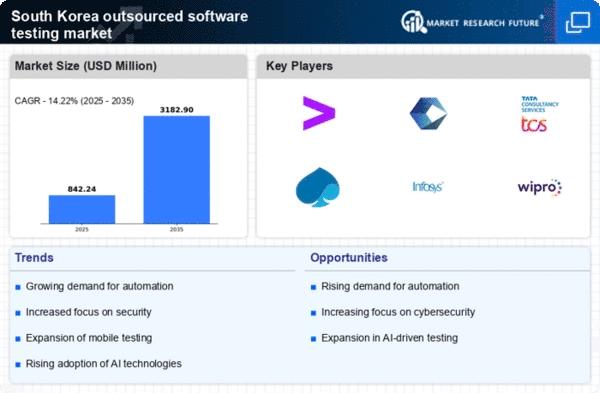
As per Market Research Future analysis, the South Korea outsourced software-testing market Size was estimated at 737.38 USD Million in 2024. The South Korea outsourced software-testing market is projected to grow from 842.24 USD Million in 2025 to 3182.9 USD Million by 2035, exhibiting a compound annual growth rate (CAGR) of 14.2% during the forecast period 2025 - 2035

Key Market Trends & Highlights

The South Korea outsourced software-testing market is experiencing robust growth driven by technological advancements and evolving industry needs.

  • The market is witnessing a rising demand for automation, which enhances testing efficiency and accuracy.
  • Integration of AI technologies is becoming prevalent, enabling smarter testing processes and predictive analytics.
  • Cybersecurity testing is gaining prominence as organizations prioritize data protection and compliance.
  • Key market drivers include the growing adoption of agile methodologies and the escalating complexity of software systems.

Market Size & Forecast

2024 Market Size 737.38 (USD Million)
2035 Market Size 3182.9 (USD Million)
CAGR (2025 - 2035) 14.22%

Major Players

Accenture (IE), Cognizant (US), TCS (IN), Capgemini (FR), Infosys (IN), Wipro (IN), HCL Technologies (IN), Qualitest (IL), TestFort (UA)

Our Impact
Enabled $4.3B Revenue Impact for Fortune 500 and Leading Multinationals
Partnering with 2000+ Global Organizations Each Year
30K+ Citations by Top-Tier Firms in the Industry

South Korea Outsourced Software Testing Market Trends

The outsourced software-testing market in South Korea is currently experiencing notable growth, driven by the increasing demand for high-quality software products. As businesses continue to prioritize digital transformation, the need for rigorous testing processes has become paramount. Companies are increasingly recognizing the value of outsourcing these services to specialized firms, which can provide expertise and efficiency. This trend is further supported by the rise of agile methodologies and DevOps practices, which emphasize rapid development cycles and continuous integration. Consequently, organizations are seeking partners that can deliver reliable testing solutions that align with their fast-paced environments. Moreover, the competitive landscape in South Korea is evolving, with both domestic and international players vying for market share. The emphasis on quality assurance is leading to innovations in testing technologies, including automation and artificial intelligence. These advancements not only enhance the accuracy of testing but also reduce time-to-market for software products. As a result, businesses are likely to invest more in outsourced testing services, viewing them as a strategic advantage in a crowded marketplace. The future of this market appears promising, with ongoing developments in technology and an increasing focus on quality driving demand for outsourced software-testing services.

Rising Demand for Automation

The trend towards automation in the outsourced software-testing market is becoming increasingly pronounced. Companies are adopting automated testing tools to enhance efficiency and accuracy. This shift allows for faster testing cycles and reduces the likelihood of human error, which is crucial in maintaining software quality.

Integration of AI Technologies

Artificial intelligence is making significant inroads into the outsourced software-testing market. AI-driven testing solutions are being utilized to predict potential issues and optimize testing processes. This integration not only streamlines operations but also enhances the overall quality of software products.

Focus on Cybersecurity Testing

As cyber threats continue to evolve, there is a growing emphasis on cybersecurity testing within the outsourced software-testing market. Organizations are increasingly prioritizing security assessments to safeguard their applications and data. This trend reflects a broader awareness of the importance of robust security measures in software development.

South Korea Outsourced Software Testing Market Drivers

Growing Adoption of Agile Methodologies

The increasing adoption of Agile methodologies within the software development lifecycle is a notable driver for the outsourced software-testing market. Agile practices emphasize iterative development and rapid feedback, which necessitate robust testing processes. In South Korea, organizations are increasingly outsourcing testing functions to enhance flexibility and speed. This shift allows companies to focus on core competencies while leveraging specialized testing services. As Agile practices become more prevalent, the demand for outsourced testing services is projected to rise, potentially increasing the market size by approximately 15% annually. The outsourced software-testing market is thus positioned to benefit from this trend, as companies seek to align their testing strategies with Agile principles.

Cost Efficiency and Resource Optimization

Cost efficiency remains a pivotal driver for the outsourced software-testing market. South Korean companies are increasingly seeking ways to optimize their operational expenditures, and outsourcing testing functions presents a viable solution. By leveraging external testing services, organizations can reduce overhead costs associated with maintaining in-house testing teams. This approach not only lowers expenses but also allows for better allocation of resources towards core business activities. The outsourced software-testing market is likely to see a surge in demand as companies aim to achieve cost savings of up to 30% through outsourcing. This financial incentive is a compelling factor for many businesses considering their testing strategies.

Escalating Complexity of Software Systems

The escalating complexity of software systems is a significant driver impacting the outsourced software-testing market. As applications become more intricate, the need for comprehensive testing solutions intensifies. In South Korea, businesses are increasingly recognizing that in-house testing may not suffice to address the multifaceted nature of modern software. Consequently, many organizations are turning to specialized testing firms that can provide the necessary expertise and resources. This trend is likely to propel the outsourced software-testing market forward, with an expected growth rate of around 12% over the next few years. The ability to manage complex testing scenarios effectively is crucial for maintaining software quality and performance.

Emergence of Cloud-Based Testing Solutions

The emergence of cloud-based testing solutions is reshaping the landscape of the outsourced software-testing market. South Korean companies are increasingly adopting cloud technologies to enhance their testing capabilities. Cloud-based testing offers scalability, flexibility, and cost-effectiveness, allowing organizations to conduct extensive testing without the need for significant infrastructure investments. This trend is particularly appealing to startups and SMEs, which may lack the resources for extensive in-house testing. The outsourced software-testing market is likely to benefit from this shift, with cloud-based solutions projected to account for a substantial portion of the market share, potentially reaching 40% by 2027. This transformation indicates a growing reliance on innovative testing methodologies.

Regulatory Compliance and Quality Assurance

Regulatory compliance is becoming increasingly stringent across various industries, driving demand for reliable testing services. In South Korea, companies are under pressure to meet specific quality assurance standards, particularly in sectors such as finance and healthcare. This regulatory landscape compels organizations to ensure that their software products are thoroughly tested and compliant with relevant regulations. As a result, the outsourced software-testing market is experiencing heightened demand for specialized testing services that can navigate these complex compliance requirements. The need for rigorous testing to meet regulatory standards is expected to contribute to a market growth rate of approximately 10% in the coming years.


Market Segment Insights

By Type: Software (Largest) vs. Hardware (Fastest-Growing)

In the South Korea outsourced software-testing market, the two primary segment values, Software and Hardware, show a stark contrast in market presence. Software dominates the landscape, benefiting from a robust demand driven by increasing digital transformation across industries. The market share distribution reveals that Software accounts for a significant portion, reflecting its established position and widespread adoption among businesses seeking comprehensive testing solutions. Conversely, the Hardware segment is emerging as the fastest-growing area within the market. This growth is fueled by advancements in technology and the increasing need for integration of hardware testing alongside software services. Many organizations recognize the importance of hardware compatibility, leading to a surge in investments and interest in specialized hardware testing services, ultimately contributing to its rapid expansion.

Software (Dominant) vs. Hardware (Emerging)

Software serves as the dominant segment in the South Korea outsourced software-testing market, characterized by its extensive range of testing frameworks, methodologies, and tools that address various software applications. This segment is inherently linked to the growing reliance on software solutions across sectors such as finance, healthcare, and retail. In contrast, the Hardware segment is emerging, driven by the need for compatibility assessments and performance evaluations in an increasingly integrated technological environment. Organizations are more aware of the necessity of thorough hardware testing to complement their software offerings, resulting in an evolving landscape where hardware testing is steadily gaining traction and significance in overall quality assurance strategies.

By End User: BFSI (Largest) vs. IT & Telecommunications (Fastest-Growing)

The market share distribution among the key segments reveals that the BFSI sector holds the largest share in the South Korea outsourced software-testing market. This sector's prominence is influenced by the increasing need for secure and compliant software solutions, further driving service demand. Meanwhile, the IT & Telecommunications segment is witnessing rapid growth, fueled by the ongoing digital transformation and the demand for innovative software testing solutions that can keep pace with evolving technologies. Growth trends indicate that the BFSI sector will continue to thrive as regulatory requirements and financial technologies advance. In contrast, the IT & Telecommunications sector is expected to emerge stronger, largely due to the rising cloud computing and mobile application testing needs. By focusing on automation and agility, companies are responding to the regulatory and technology changes, enhancing their competitive edge within the South Korea outsourced software-testing market.

BFSI: Dominant vs. IT & Telecommunications: Emerging

In the South Korea outsourced software-testing market, the BFSI sector stands out with its dominant position due to stringent regulatory requirements and the pressing need for secure financial applications. This segment utilizes advanced testing solutions to ensure compliance and mitigate risks associated with software failures. On the other hand, the IT & Telecommunications sector is emerging rapidly, characterized by its focus on innovation and speed. Companies in this segment are adopting cutting-edge testing tools that facilitate faster deployments and better quality assurance. As digital transformation continues to shape the landscape, the strategic priorities of these segments reflect their unique challenges and market dynamics, influencing their overall performance in the industry.

Get more detailed insights about South Korea Outsourced Software Testing Market

Key Players and Competitive Insights

The outsourced software-testing market is currently characterized by a dynamic competitive landscape, driven by rapid technological advancements and increasing demand for quality assurance in software development. Major players such as Accenture (IE), Cognizant (US), and TCS (IN) are strategically positioning themselves through innovation and regional expansion. Accenture (IE) has been focusing on enhancing its digital transformation capabilities, which appears to be a critical factor in maintaining its competitive edge. Cognizant (US), on the other hand, emphasizes partnerships with emerging tech firms to bolster its service offerings, while TCS (IN) is leveraging its extensive global delivery model to optimize operational efficiency and client satisfaction. Collectively, these strategies contribute to a competitive environment that is increasingly reliant on technological prowess and strategic collaborations.In terms of business tactics, companies are increasingly localizing their operations to better serve regional markets, which is particularly evident in South Korea. The market structure is moderately fragmented, with a mix of large multinational corporations and smaller specialized firms. This fragmentation allows for diverse service offerings, yet the influence of key players remains substantial, as they set industry standards and drive innovation.

In October Accenture (IE) announced a partnership with a leading AI firm to integrate advanced machine learning algorithms into its testing processes. This strategic move is likely to enhance the efficiency and accuracy of software testing, positioning Accenture (IE) as a frontrunner in adopting cutting-edge technologies. Such initiatives not only improve service delivery but also align with the growing trend of AI integration in software development.Similarly, in September 2025, Cognizant (US) expanded its operations in South Korea by acquiring a local software-testing company. This acquisition is expected to enhance Cognizant's (US) market presence and provide access to a skilled workforce familiar with regional client needs. The strategic importance of this move lies in its potential to accelerate growth and improve service localization, which is increasingly vital in a competitive landscape.

In August TCS (IN) launched a new suite of automated testing tools aimed at reducing time-to-market for software products. This initiative reflects TCS's (IN) commitment to innovation and efficiency, which are crucial in meeting the demands of a fast-paced market. By investing in automation, TCS (IN) not only enhances its service offerings but also positions itself as a leader in the ongoing digital transformation of the software-testing sector.

As of November the competitive trends in the outsourced software-testing market are heavily influenced by digitalization, sustainability, and the integration of AI technologies. Strategic alliances are becoming increasingly important, as they enable companies to pool resources and expertise to tackle complex challenges. Looking ahead, it appears that competitive differentiation will evolve from traditional price-based competition to a focus on innovation, technological advancement, and supply chain reliability. This shift suggests that companies that prioritize these elements will likely emerge as leaders in the market.

Key Companies in the South Korea Outsourced Software Testing Market include

Industry Developments

The South Korea Outsourced Software Testing Market has witnessed several notable developments recently. In September 2023, Cognizant Technology Solutions announced a strategic partnership with Samsung SDS to enhance software quality assurance services tailored for the local market. Additionally, in August 2023, Accenture expanded its capabilities in the region by acquiring a local software testing company, further strengthening its service offerings and presence in South Korea.

Concurrently, the rising demand for software quality assurance due to the increasing number of digital transformation projects across various industries is significantly impacting market growth. Companies like Wipro and Infosys are also enhancing their service delivery models by integrating advanced automation and AI into their testing methodologies.

Over the past two to three years, a remarkable influx of investments has been noted in South Korea's technology sector, with the Outsourced Software Testing Market growing at an estimated CAGR of 15%, reflecting the country’s robust digital economy. The strategic initiatives by key players like TCS and HCL Technologies underline the competitive landscape while highlighting South Korea's prominence as a hub for innovative software testing solutions.

Future Outlook

South Korea Outsourced Software Testing Market Future Outlook

The Outsourced Software Testing Market is projected to grow at a 14.22% CAGR from 2025 to 2035, driven by increasing demand for quality assurance and automation technologies.

New opportunities lie in:

  • Development of AI-driven testing tools for enhanced efficiency.
  • Expansion of mobile application testing services to meet rising demand.
  • Integration of cloud-based testing solutions for scalability and flexibility.

By 2035, the market is expected to achieve substantial growth, positioning itself as a leader in software quality assurance.

Market Segmentation

South Korea Outsourced Software Testing Market Type Outlook

  • Hardware
  • Software

South Korea Outsourced Software Testing Market End User Outlook

  • BFSI
  • IT & Telecommunications
  • Retail
  • Others

Report Scope

MARKET SIZE 2024 737.38(USD Million)
MARKET SIZE 2025 842.24(USD Million)
MARKET SIZE 2035 3182.9(USD Million)
COMPOUND ANNUAL GROWTH RATE (CAGR) 14.22% (2025 - 2035)
REPORT COVERAGE Revenue Forecast, Competitive Landscape, Growth Factors, and Trends
BASE YEAR 2024
Market Forecast Period 2025 - 2035
Historical Data 2019 - 2024
Market Forecast Units USD Million
Key Companies Profiled Accenture (IE), Cognizant (US), TCS (IN), Capgemini (FR), Infosys (IN), Wipro (IN), HCL Technologies (IN), Qualitest (IL), TestFort (UA)
Segments Covered Type, End User
Key Market Opportunities Integration of artificial intelligence in the outsourced software-testing market enhances efficiency and accuracy.
Key Market Dynamics Rising demand for automation in software testing drives competitive innovation and efficiency in the outsourced software-testing market.
Countries Covered South Korea
Leave a Comment

FAQs

What is the current projected market size of the South Korea Outsourced Software Testing Market for 2024?

The South Korea Outsourced Software Testing Market is expected to be valued at 700.0 million USD in 2024.

What is the expected market size of the South Korea Outsourced Software Testing Market by 2035?

By 2035, the market is anticipated to grow to 3,100.0 million USD.

What is the expected compound annual growth rate (CAGR) for the South Korea Outsourced Software Testing Market from 2025 to 2035?

The market is projected to grow at a CAGR of 14.486% during the period from 2025 to 2035.

Which segments dominate the South Korea Outsourced Software Testing Market?

The market is segmented into Hardware and Software, with significant valuations expected in both segments by 2035.

What will be the market value for Hardware testing services in 2035?

The value for Hardware testing services in the market is expected to reach 925.0 million USD by 2035.

What will be the market value for Software testing services in 2035?

The value for Software testing services in the market is anticipated to be 2,175.0 million USD by 2035.

Who are the major players in the South Korea Outsourced Software Testing Market?

Key players in the market include Capgemini, Accenture, Infosys, Wipro, and TCS among others.

What is the impact of the current global scenario on the South Korea Outsourced Software Testing Market?

The ongoing global scenario is expected to influence the demand for software testing services, with increased emphasis on quality assurance.

What are the emerging trends in the South Korea Outsourced Software Testing Market?

Emerging trends include automation in testing processes and the growing adoption of AI-driven testing solutions.

What are the growth drivers for the South Korea Outsourced Software Testing Market?

Key growth drivers include the increasing complexity of software applications and a rising need for efficient testing solutions.

Download Free Sample

Kindly complete the form below to receive a free sample of this Report

Compare Licence

×
Features License Type
Single User Multiuser License Enterprise User
Price $4,950 $5,950 $7,250
Maximum User Access Limit 1 User Upto 10 Users Unrestricted Access Throughout the Organization
Free Customization
Direct Access to Analyst
Deliverable Format
Platform Access
Discount on Next Purchase 10% 15% 15%
Printable Versions