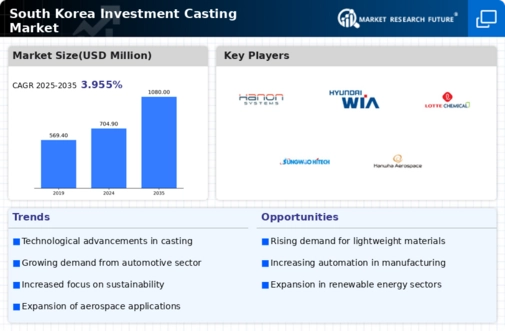
The investment casting market in South Korea is characterized by a competitive landscape that is increasingly shaped by innovation, technological advancements, and strategic partnerships. Key players such as Precision Castparts Corp (US), Alcoa Corporation (US), and Thyssenkrupp AG (DE) are actively pursuing strategies that emphasize operational efficiency and market expansion. Precision Castparts Corp (US) focuses on enhancing its product offerings through advanced manufacturing techniques, while Alcoa Corporation (US) is investing in sustainable practices to reduce its carbon footprint. Thyssenkrupp AG (DE) appears to be leveraging digital transformation initiatives to optimize its supply chain and improve customer engagement, collectively fostering a dynamic competitive environment.The market structure is moderately fragmented, with several players vying for market share through localized manufacturing and supply chain optimization. This fragmentation allows for a diverse range of products and services, catering to various industries such as aerospace, automotive, and industrial machinery. The collective influence of these key players is significant, as they not only drive innovation but also set industry standards that competitors must adhere to in order to remain relevant.
In October Alcoa Corporation (US) announced a partnership with a leading South Korean technology firm to develop advanced aluminum alloys specifically for the automotive sector. This strategic move is likely to enhance Alcoa's competitive edge by enabling the production of lighter, more fuel-efficient vehicles, aligning with global trends towards sustainability and efficiency. Such collaborations may also facilitate knowledge transfer and technological advancements within the local market.
In September Thyssenkrupp AG (DE) launched a new digital platform aimed at streamlining its investment casting processes. This initiative is expected to significantly reduce lead times and improve product quality, thereby enhancing customer satisfaction. The integration of digital tools into traditional manufacturing processes indicates a shift towards Industry 4.0, which could redefine operational standards across the sector.
In August Precision Castparts Corp (US) expanded its manufacturing capabilities in South Korea by investing in a state-of-the-art facility designed to produce high-precision components for the aerospace industry. This expansion not only signifies a commitment to meeting increasing demand but also positions the company as a leader in high-value markets, potentially increasing its market share in the region.
As of November the investment casting market is witnessing trends that emphasize digitalization, sustainability, and the integration of artificial intelligence. Strategic alliances are becoming increasingly important, as companies seek to enhance their technological capabilities and market reach. The competitive differentiation is likely to evolve from traditional price-based competition to a focus on innovation, technology, and supply chain reliability, suggesting that companies that invest in these areas will be better positioned for future success.