×
Request Free Sample ×

Kindly complete the form below to receive a free sample of this Report

* Please use a valid business email

Leading companies partner with us for data-driven Insights

clients tt-cursor
Hero Background

South Korea Industrial Services Market

ID: MRFR/ICT/58684-HCR
200 Pages
Aarti Dhapte
February 2026

South Korea Industrial Services Market Size, Share and Research Report: By Type (Installation & Commissioning, Engineering & Consulting), By Application (Human Machine Interface, Distributed Control System, Valves & Actuators) and By End User (Automotive, Metal & Mining, Food & Beverages, Paper, Oil & Gas)-Forecast to 2035

Share:
Download PDF ×

We do not share your information with anyone. However, we may send you emails based on your report interest from time to time. You may contact us at any time to opt-out.

South Korea Industrial Services Market Infographic
Purchase Options

South Korea Industrial Services Market Summary

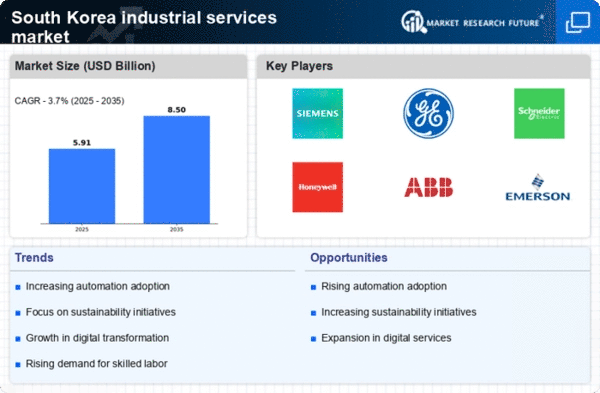
As per Market Research Future analysis, the South Korea industrial services market size was estimated at 5.7 USD Billion in 2024. The South Korea industrial services market is projected to grow from 5.91 USD Billion in 2025 to 8.5 USD Billion by 2035, exhibiting a compound annual growth rate (CAGR) of 3% during the forecast period 2025 - 2035

Key Market Trends & Highlights

The South Korea industrial services market is experiencing a transformative shift driven by technological advancements and sustainability efforts.

  • Technological integration is reshaping service delivery across various sectors, enhancing efficiency and productivity.
  • Sustainability initiatives are becoming increasingly vital, with companies prioritizing eco-friendly practices and solutions.
  • Outsourcing trends are on the rise, as businesses seek to optimize operations and reduce costs through external partnerships.
  • The market is primarily driven by rising demand for automation and a focus on workforce skill development.

Market Size & Forecast

2024 Market Size 5.7 (USD Billion)
2035 Market Size 8.5 (USD Billion)
CAGR (2025 - 2035) 3.7%

Major Players

Siemens (DE), General Electric (US), Schneider Electric (FR), Honeywell (US), ABB (CH), Emerson Electric (US), Rockwell Automation (US), Konecranes (FI), Mitsubishi Electric (JP)

Our Impact
Enabled $4.3B Revenue Impact for Fortune 500 and Leading Multinationals
Partnering with 2000+ Global Organizations Each Year
30K+ Citations by Top-Tier Firms in the Industry

South Korea Industrial Services Market Trends

The industrial services market in South Korea is currently experiencing a dynamic transformation, driven by advancements in technology and increasing demand for efficiency across various sectors. The integration of automation and digital solutions is reshaping traditional service offerings, enabling companies to optimize operations and reduce costs. This shift is particularly evident in manufacturing, logistics, and maintenance services, where smart technologies are being adopted to enhance productivity and reliability. Furthermore, the emphasis on sustainability is prompting service providers to innovate and develop eco-friendly solutions, aligning with national policies aimed at reducing carbon emissions and promoting green practices. In addition, the industrial services market is witnessing a growing trend towards outsourcing, as businesses seek to focus on core competencies while leveraging specialized service providers for non-core activities. This trend is likely to foster collaboration between companies and service providers, leading to enhanced service delivery and customer satisfaction. As South Korea continues to invest in infrastructure and technology, the industrial services market appears poised for sustained growth, with opportunities for both domestic and international players to capitalize on emerging trends and demands.

Technological Integration

The industrial services market is increasingly incorporating advanced technologies such as IoT, AI, and big data analytics. These innovations facilitate real-time monitoring and predictive maintenance, enhancing operational efficiency and reducing downtime.

Sustainability Initiatives

There is a notable shift towards sustainable practices within the industrial services market. Companies are adopting eco-friendly solutions and services that align with government regulations aimed at reducing environmental impact.

Outsourcing Trends

The trend of outsourcing non-core services is gaining traction. Businesses are increasingly partnering with specialized service providers to enhance efficiency and focus on their primary operations.

South Korea Industrial Services Market Drivers

Rising Demand for Automation

The industrial services market in South Korea is experiencing a notable increase in demand for automation solutions. This trend is driven by the need for enhanced efficiency and productivity across various sectors, including manufacturing and logistics. As companies seek to reduce operational costs and improve output quality, the adoption of automated systems is becoming more prevalent. According to recent data, the automation market in South Korea is projected to grow at a CAGR of approximately 8% from 2025 to 2030. This growth is likely to stimulate the industrial services market, as service providers adapt to offer specialized support for automation technologies, including installation, maintenance, and training.

Increased Regulatory Compliance

The industrial services market in South Korea is influenced by the rising complexity of regulatory compliance requirements. As industries face stricter environmental and safety regulations, companies are compelled to invest in services that ensure adherence to these standards. This trend is particularly evident in sectors such as manufacturing and construction, where compliance with safety protocols is paramount. The market for compliance-related services is expected to expand, with estimates suggesting a growth rate of around 6% annually. Service providers that specialize in regulatory compliance are likely to see increased demand, as businesses seek to mitigate risks and avoid potential penalties associated with non-compliance.

Focus on Workforce Skill Development

In the context of the industrial services market, there is a growing emphasis on workforce skill development in South Korea. As industries evolve with technological advancements, the need for skilled labor becomes increasingly critical. Companies are investing in training programs to equip their workforce with the necessary skills to operate advanced machinery and systems. This trend is reflected in the government's initiatives to promote vocational training and education in technical fields. The industrial services market is likely to benefit from this focus, as service providers may offer training and certification programs to help businesses upskill their employees, thereby enhancing overall productivity and competitiveness.

Expansion of Renewable Energy Projects

The industrial services market is witnessing a surge in activities related to renewable energy projects in South Korea. The government's commitment to reducing carbon emissions and promoting sustainable energy sources is driving investments in solar, wind, and other renewable technologies. This shift is creating opportunities for industrial service providers to engage in project management, installation, and maintenance of renewable energy systems. Recent reports indicate that the renewable energy sector is expected to grow by approximately 10% annually, which could significantly impact the industrial services market as companies seek specialized services to support their transition to greener energy solutions.

Growth of Smart Manufacturing Initiatives

Smart manufacturing initiatives are reshaping the industrial services market in South Korea. The integration of IoT, AI, and big data analytics into manufacturing processes is enhancing operational efficiency and product quality. As companies adopt smart technologies, there is a corresponding need for specialized services that facilitate the implementation and maintenance of these systems. The industrial services market is likely to expand as service providers offer solutions tailored to smart manufacturing, including system integration, data analysis, and ongoing support. Projections suggest that the smart manufacturing sector could grow at a CAGR of 9% over the next five years, further driving demand for industrial services.


Market Segment Insights

By Service Type: Maintenance Services (Largest) vs. Repair Services (Fastest-Growing)

In the South Korea industrial services market, Maintenance Services hold the largest market share, primarily due to the increasing need for regular upkeep and servicing of machinery across various industries. Following closely, Repair Services represent a significant portion, driven by the essential requirements of industries to promptly address equipment failures to minimize downtime. The growth trends indicate a rising demand for Operational and Installation Services, propelled by technological advancements and the push for enhanced operational efficiency. The ongoing industrial automation and maintenance of complex systems are creating opportunities for these services. Moreover, the emphasis on sustainability and energy efficiency is shaping how service providers operate, positioning Repair Services as a critical focus area for growth as they adapt to evolving market needs.

Maintenance Services: Dominant vs. Repair Services: Emerging

Maintenance Services are recognized as the dominant force within the South Korea industrial services market, reflecting their crucial role in ensuring operational continuity and machinery longevity. They encompass various preventative and scheduled services tailored to a wide range of industrial sectors, which enhances reliability and reduces unexpected failures. On the other hand, Repair Services are rapidly emerging, characterized by their flexibility to respond to immediate industrial needs and equipment malfunctions. As industries transition toward more complex technologies, the adaptability of Repair Services is becoming a key differentiator, allowing providers to integrate advanced diagnostic tools and techniques to improve service execution and turnaround times.

By End Use Industry: Manufacturing (Largest) vs. Oil and Gas (Fastest-Growing)

The South Korea industrial services market displays a diverse distribution of market share among various end use industries. Manufacturing holds a significant portion of the market, driven by a robust production environment and technological advancements. Oil and Gas, while smaller in market share, demonstrates dynamic growth fueled by increasing energy demands and innovations in extraction techniques. In terms of growth trends, the Oil and Gas segment is emerging as the fastest-growing area, reflecting a broader shift towards sustainable energy practices and enhanced operational efficiencies. Meanwhile, Manufacturing continues to dominate as it benefits from consistent investments in automation and smart technologies. This interplay of stability in Manufacturing and rapid growth in Oil and Gas highlights evolving industrial priorities within the market.

Manufacturing: Dominant vs. Oil and Gas: Emerging

Manufacturing in the South Korea industrial services market is characterized by its established presence and steady demand stemming from various industries, including electronics, automotive, and machinery. This segment's dominance is aided by ongoing investments in infrastructure and advancements in manufacturing processes, positioning it as a backbone of the industrial landscape. On the other hand, the Oil and Gas segment, while currently less dominant, is recognized for its potential as an emerging player in the market. This dynamism is supported by a surge in exploration activities and a shift towards cleaner energy sources, prompting increased investment and innovation. Together, these segments reflect the broad range of the industrial services market's capabilities and the changing needs of the economy.

By Service Delivery Model: On-site Services (Largest) vs. Remote Services (Fastest-Growing)

The South Korea industrial services market is characterized by significant contributions from various service delivery models. On-site Services currently hold the largest market share, predominantly due to the increasing preference for personalized and direct service interactions. However, Remote Services are emerging rapidly, leveraging technological advancements to provide flexible and cost-effective solutions. Growth trends indicate a robust demand for both On-site and Remote Services, driven by the need for operational efficiency and reduced downtime. The pandemic has accelerated the adoption of Remote Services, as businesses seek to minimize physical interactions. Meanwhile, On-site Services continue to thrive in sectors where hands-on support is critical, indicating a balanced growth trajectory across service delivery models.

On-site Services (Dominant) vs. Remote Services (Emerging)

On-site Services play a dominant role in the South Korea industrial services market, characterized by their focus on direct customer engagement and personalized service delivery. Industries relying on complex machinery and equipment maintain a significant demand for On-site Services, ensuring minimal downtime and immediate problem resolution. In contrast, Remote Services represent an emerging trend, gaining popularity due to advancements in technology and the growing need for flexible service models that can be tailored to the client's schedule. The ability to troubleshoot and manage services remotely has made these services attractive for many businesses, providing a balance between efficiency and cost savings, making them an essential element of the service delivery landscape.

By Technology Used: Automation (Largest) vs. Artificial Intelligence (Fastest-Growing)

In the South Korea industrial services market, the technology used segment showcases a diverse distribution among Automation, Artificial Intelligence, IoT, and Cloud Computing. Automation stands as the most substantial segment, commanding a significant market share due to its established presence in the industry. Meanwhile, Artificial Intelligence is rapidly gaining traction, increasingly appealing to firms seeking innovation and efficiency improvements. On the other hand, IoT and Cloud Computing are also integral to the market, contributing to the overall technological landscape. The growth trends within this segment indicate a robust shift towards integrating advanced technologies such as Artificial Intelligence and IoT. Companies are leveraging Automation to enhance operational efficiency, while the growing adoption of AI is evidenced by its increasing investment rates. Factors driving this trend include the demand for streamlined processes, enhanced data analytics, and the rising importance of digital transformation, solidifying the position of these technologies as essential components in the South Korea industrial services market.

Technology: Automation (Dominant) vs. Artificial Intelligence (Emerging)

Automation is recognized as the dominant technology in the South Korea industrial services market, characterized by its widespread implementation in manufacturing and logistics. This technology enhances productivity and reduces operational costs, making it an indispensable component for many businesses. In contrast, Artificial Intelligence is emerging rapidly, offering unprecedented capabilities in data processing and decision-making. As firms increasingly adopt AI solutions for predictive analytics and automation of complex tasks, its potential to revolutionize industries becomes evident. The synergy between Automation and AI is poised to create powerful efficiencies, paving the way for innovative solutions and transforming operational frameworks within the market.

Get more detailed insights about South Korea Industrial Services Market

Key Players and Competitive Insights

The industrial services market in South Korea is characterized by a dynamic competitive landscape, driven by technological advancements and increasing demand for automation and efficiency. Major players such as Siemens (DE), General Electric (US), and Schneider Electric (FR) are actively shaping the market through strategic initiatives focused on innovation and digital transformation. Siemens (DE) emphasizes its commitment to sustainability and smart infrastructure, while General Electric (US) leverages its extensive portfolio in energy and healthcare to enhance operational efficiencies. Schneider Electric (FR) positions itself as a leader in energy management and automation, indicating a collective shift towards integrated solutions that enhance productivity and reduce environmental impact.
Key business tactics within this market include localizing manufacturing and optimizing supply chains to meet the specific needs of South Korean industries. The competitive structure appears moderately fragmented, with several key players exerting influence across various sectors. This fragmentation allows for a diverse range of services and solutions, fostering innovation and competition among established firms and emerging players alike.
In October 2025, Siemens (DE) announced a strategic partnership with a leading South Korean technology firm to develop advanced automation solutions tailored for the manufacturing sector. This collaboration is expected to enhance Siemens' market presence and accelerate the adoption of Industry 4.0 technologies in the region. The strategic importance of this partnership lies in its potential to leverage local expertise and drive innovation in automation, thereby positioning Siemens as a frontrunner in the industrial services market.
In September 2025, General Electric (US) unveiled a new digital platform aimed at optimizing energy management for industrial clients in South Korea. This platform integrates AI and machine learning capabilities to provide real-time insights and predictive analytics. The introduction of this platform signifies General Electric's commitment to digital transformation and its strategic focus on enhancing operational efficiencies for its clients, which could lead to increased market share in the competitive landscape.
In August 2025, Schneider Electric (FR) launched a comprehensive sustainability initiative aimed at reducing carbon emissions across its operations in South Korea. This initiative includes investments in renewable energy sources and the development of energy-efficient solutions for industrial clients. The strategic importance of this initiative is underscored by the growing emphasis on sustainability within the industrial sector, positioning Schneider Electric as a leader in environmentally responsible practices.
As of November 2025, current competitive trends in the industrial services market are heavily influenced by digitalization, sustainability, and the integration of AI technologies. Strategic alliances among key players are shaping the landscape, fostering innovation and enhancing service offerings. Looking ahead, competitive differentiation is likely to evolve from traditional price-based competition to a focus on innovation, technological advancements, and supply chain reliability, reflecting the changing demands of the market.

Key Companies in the South Korea Industrial Services Market include

Industry Developments

The South Korea Industrial Services Market is experiencing significant developments with key players such as Hanjin Heavy Industries, LG Chem, and Hyundai Heavy Industries focusing on technological innovations and expansion strategies. Recently, Hyundai Heavy Industries announced plans to enhance its service capabilities in offshore wind projects, aligning with its commitment to green energy solutions. Additionally, in August 2023, Daelim Industrial revealed a major partnership for infrastructure projects within South Korea, aiming to capitalize on the growing demand for sustainable construction methods.

The market has seen notable growth, with LG Chem reporting a significant increase in its projections due to rising chemical demand in industrial applications. Meanwhile, mergers and acquisitions have shaped the landscape; for instance, in June 2023, Hanwha Engineering and Construction announced an acquisition of a key competitor to strengthen its engineering portfolio.

Reports indicate that SK Engineering and Construction are also exploring strategic collaborations to enhance their service offerings. Overall, the South Korea Industrial Services Market is positioned for growth amid ongoing advancements and strategic initiatives by major companies, reflecting a dynamic shift towards sustainable practices and technological integration across various sectors.

Future Outlook

South Korea Industrial Services Market Future Outlook

The industrial services market in South Korea is projected to grow at a 3.7% CAGR from 2025 to 2035, driven by technological advancements and increasing demand for efficiency.

New opportunities lie in:

  • Development of predictive maintenance solutions for industrial equipment.
  • Expansion of remote monitoring services to enhance operational efficiency.
  • Implementation of energy management systems to reduce operational costs.

By 2035, the industrial services market is expected to achieve robust growth and increased competitiveness.

Market Segmentation

South Korea Industrial Services Market Service Type Outlook

  • Maintenance Services
  • Repair Services
  • Operational Services
  • Installation Services

South Korea Industrial Services Market Technology Used Outlook

  • Automation
  • Artificial Intelligence
  • IoT
  • Cloud Computing

South Korea Industrial Services Market End Use Industry Outlook

  • Manufacturing
  • Oil and Gas
  • Construction
  • Mining
  • Energy

South Korea Industrial Services Market Service Delivery Model Outlook

  • On-site Services
  • Remote Services
  • Managed Services

Report Scope

MARKET SIZE 2024 5.7(USD Billion)
MARKET SIZE 2025 5.91(USD Billion)
MARKET SIZE 2035 8.5(USD Billion)
COMPOUND ANNUAL GROWTH RATE (CAGR) 3.7% (2025 - 2035)
REPORT COVERAGE Revenue Forecast, Competitive Landscape, Growth Factors, and Trends
BASE YEAR 2024
Market Forecast Period 2025 - 2035
Historical Data 2019 - 2024
Market Forecast Units USD Billion
Key Companies Profiled Siemens (DE), General Electric (US), Schneider Electric (FR), Honeywell (US), ABB (CH), Emerson Electric (US), Rockwell Automation (US), Konecranes (FI), Mitsubishi Electric (JP)
Segments Covered Service Type, End Use Industry, Service Delivery Model, Technology Used
Key Market Opportunities Integration of advanced automation technologies enhances efficiency in the industrial services market.
Key Market Dynamics Technological advancements drive efficiency in industrial services, reshaping competitive dynamics and service delivery in South Korea.
Countries Covered South Korea
Leave a Comment

FAQs

What is the projected market size of the South Korea Industrial Services Market by 2024?

The South Korea Industrial Services Market is expected to be valued at 1.1 billion USD in 2024.

What is the expected market valuation for the South Korea Industrial Services Market in 2035?

The market is projected to reach a valuation of 2.2 billion USD by the year 2035.

What is the expected CAGR for the South Korea Industrial Services Market from 2025 to 2035?

The expected CAGR for the market is 6.504% during the period from 2025 to 2035.

Which segment of the South Korea Industrial Services Market holds the larger market value in 2024?

In 2024, the Engineering & Consulting segment is valued at 0.65 billion USD, making it the larger segment compared to Installation & Commissioning.

What will be the market value of the Installation & Commissioning segment in 2035?

The Installation & Commissioning segment is projected to reach a market value of 0.9 billion USD by 2035.

Who are the key players in the South Korea Industrial Services Market?

Major players in the market include Hanjin Heavy Industries, LG Chem, Hyundai Heavy Industries, and several others.

What is the expected market growth rate for the Engineering & Consulting segment from 2025 to 2035?

The Engineering & Consulting segment is anticipated to grow to 1.3 billion USD by 2035, marking significant growth.

What opportunities are driving growth in the South Korea Industrial Services Market?

Rising demand for advanced engineering solutions and modernization of industrial facilities are key growth drivers.

How will global conflicts impact the South Korea Industrial Services Market?

Current global scenarios may lead to fluctuations in market dynamics, affecting investment and operational strategies.

What challenges does the South Korea Industrial Services Market face?

Challenges include regulatory changes and the need for innovation in technology and processes within the industry.

Download Free Sample

Kindly complete the form below to receive a free sample of this Report

Compare Licence

×
Features License Type
Single User Multiuser License Enterprise User
Price $4,950 $5,950 $7,250
Maximum User Access Limit 1 User Upto 10 Users Unrestricted Access Throughout the Organization
Free Customization
Direct Access to Analyst
Deliverable Format
Platform Access
Discount on Next Purchase 10% 15% 15%
Printable Versions