×
Request Free Sample ×

Kindly complete the form below to receive a free sample of this Report

* Please use a valid business email

Leading companies partner with us for data-driven Insights

clients tt-cursor
Hero Background

South Korea Generative Ai In Data Analytics Market

ID: MRFR/ICT/58538-HCR
200 Pages
Aarti Dhapte
February 2026

South Korea Generative AI in Data Analytics Market Research Report By Deployment (Cloud-Based, On-premise), By Technology (Machine learning, Natural Language Processing, Deep learning, Computer vision, Robotic Process Automation) and By Application (Data Augmentation, Anomaly Detection, Text Generation, Simulation and Forecasting)-Forecast to 2035

Share:
Download PDF ×

We do not share your information with anyone. However, we may send you emails based on your report interest from time to time. You may contact us at any time to opt-out.

South Korea Generative Ai In Data Analytics Market Infographic
Purchase Options

South Korea Generative Ai In Data Analytics Market Summary

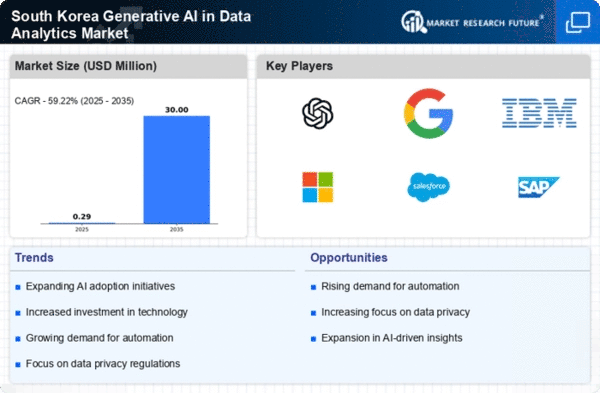
As per Market Research Future analysis, the South Korea generative ai-in-data-analytics market Size was estimated at 0.18 USD Million in 2024. The South Korea generative ai-in-data-analytics market is projected to grow from 0.287 USD Million in 2025 to 30.0 USD Million by 2035, exhibiting a compound annual growth rate (CAGR) of 59.2% during the forecast period 2025 - 2035

Key Market Trends & Highlights

The South Korea generative AI-in-data-analytics market is poised for substantial growth driven by technological advancements and increasing demand for data-driven insights.

  • The market is witnessing increased adoption of AI tools across various industries, indicating a shift towards automation and efficiency.
  • Government support and initiatives are fostering a conducive environment for AI development, enhancing market potential.
  • Focus on data privacy and security is becoming paramount as organizations seek to protect sensitive information while leveraging AI capabilities.
  • Rising demand for data-driven insights and technological advancements in AI are key drivers propelling the market forward.

Market Size & Forecast

2024 Market Size 0.18 (USD Million)
2035 Market Size 30.0 (USD Million)
CAGR (2025 - 2035) 59.22%

Major Players

OpenAI (US), Google (US), IBM (US), Microsoft (US), Salesforce (US), SAP (DE), NVIDIA (US), Palantir Technologies (US)

Our Impact
Enabled $4.3B Revenue Impact for Fortune 500 and Leading Multinationals
Partnering with 2000+ Global Organizations Each Year
30K+ Citations by Top-Tier Firms in the Industry

South Korea Generative Ai In Data Analytics Market Trends

The generative AI in Data Analytics market is experiencing notable growth in South Korea., driven by advancements in artificial intelligence technologies and increasing demand for data-driven decision-making. Organizations across various sectors are recognizing the potential of generative AI to enhance their analytical capabilities, streamline operations, and improve customer experiences. This trend is further supported by government initiatives aimed at fostering innovation and digital transformation within the economy. As businesses seek to leverage vast amounts of data, the integration of generative AI tools is becoming essential for maintaining competitive advantage. In addition, the South Korean government is actively promoting the development of AI technologies through funding and support programs. This has led to a surge in startups and established companies investing in generative AI solutions tailored for data analytics. The focus on enhancing data privacy and security is also shaping the market landscape, as organizations strive to comply with regulations while harnessing the power of AI. Overall, The generative AI in Data Analytics market is poised for continued expansion., with a strong emphasis on innovation and strategic partnerships among key stakeholders.

Increased Adoption of AI Tools

Organizations in South Korea are increasingly adopting generative AI tools to enhance their data analytics capabilities. This trend is driven by the need for more efficient data processing and the ability to generate insights from complex datasets. Companies are recognizing that these tools can significantly reduce the time required for analysis, allowing for quicker decision-making.

Government Support and Initiatives

The South Korean government is actively supporting the development of AI technologies, including generative AI for data analytics. Various initiatives and funding programs are being implemented to encourage innovation and research in this field. This support is likely to accelerate the growth of the market and foster collaboration between public and private sectors.

Focus on Data Privacy and Security

As the generative ai-in-data-analytics market expands, there is a growing emphasis on data privacy and security. Organizations are increasingly aware of the importance of protecting sensitive information while utilizing AI technologies. Compliance with regulations and the implementation of robust security measures are becoming critical factors in the adoption of generative AI solutions.

South Korea Generative Ai In Data Analytics Market Drivers

Technological Advancements in AI

Technological advancements in artificial intelligence are significantly influencing the generative ai-in-data-analytics market. Innovations in machine learning algorithms and natural language processing are enabling more sophisticated data analysis techniques. In South Korea, companies are increasingly investing in AI research and development, with expenditures reaching around $1 billion in 2025. These advancements allow for the automation of complex data analysis tasks, thereby reducing the time and resources required for data processing. As a result, organizations can harness the power of generative AI to generate predictive models and enhance their analytical capabilities, ultimately leading to more informed business strategies.

Increased Focus on Personalization

An increased focus on personalization is driving the generative ai-in-data-analytics market in South Korea. Businesses are recognizing the importance of tailoring their products and services to meet individual customer preferences. Generative AI technologies enable organizations to analyze customer data and generate personalized recommendations, enhancing customer engagement and satisfaction. This trend is particularly prevalent in the e-commerce and entertainment sectors, where personalized experiences can significantly impact consumer behavior. As companies strive to differentiate themselves in a competitive market, the demand for generative AI solutions that facilitate personalization is expected to grow, potentially leading to a market valuation of $1.5 billion by 2025.

Rising Demand for Data-Driven Insights

The generative ai-in-data-analytics market is experiencing a notable surge in demand for data-driven insights across various sectors in South Korea. Organizations are increasingly recognizing the value of leveraging data analytics to enhance decision-making processes. This trend is particularly evident in industries such as finance, healthcare, and retail, where data analytics can lead to improved operational efficiency and customer satisfaction. According to recent estimates, the market for data analytics in South Korea is projected to grow at a CAGR of approximately 15% over the next five years. This growth is likely to drive the adoption of generative AI technologies, as businesses seek innovative solutions to analyze vast amounts of data and extract actionable insights.

Growing Importance of Real-Time Analytics

The growing importance of real-time analytics is shaping the generative ai-in-data-analytics market landscape. In South Korea, businesses are increasingly seeking the ability to analyze data as it is generated, allowing for timely decision-making and responsiveness to market changes. This demand is particularly evident in sectors such as finance and telecommunications, where real-time insights can provide a competitive edge. The integration of generative AI into real-time analytics platforms is expected to enhance data processing capabilities, enabling organizations to react swiftly to emerging trends. As a result, the market for real-time analytics solutions is projected to expand, with estimates suggesting a growth rate of approximately 20% annually over the next few years.

Integration of AI with Big Data Technologies

The integration of generative AI with big data technologies is emerging as a crucial driver for the generative ai-in-data-analytics market. In South Korea, the proliferation of big data has created a fertile ground for AI applications, as organizations seek to manage and analyze vast datasets. The combination of generative AI and big data analytics enables businesses to uncover hidden patterns and trends, facilitating more accurate forecasting and strategic planning. As the volume of data generated continues to grow, the demand for AI-driven analytics solutions is expected to rise, with the market projected to reach $2 billion by 2026. This integration is likely to enhance the overall effectiveness of data analytics initiatives.


Market Segment Insights

By Deployment: Cloud-Based (Largest) vs. On-premise (Fastest-Growing)

In the South Korea generative ai-in-data-analytics market, the distribution of deployment preferences shows a strong inclination towards cloud-based solutions, which capture the largest market share due to their scalability and ease of integration with existing technologies. On-premise solutions, while currently holding a smaller share, are gaining traction as organizations increasingly prioritize data security and compliance, showing a significant uptick in adoption rates which highlights an evolving market landscape. Looking ahead, the growth trends for these deployment models indicate a dichotomy where cloud-based solutions continue to dominate, propelled by factors such as the rapid digitization of industries and the growing need for real-time analytics. Conversely, on-premise solutions are emerging as a robust alternative for those with stringent data governance requirements, making them the fastest-growing segment. This growth is driven by the need for enhanced control over sensitive data and the ability to customize analytics solutions tailored to specific organizational needs.

Deployment: Cloud-Based (Dominant) vs. On-premise (Emerging)

Cloud-based deployment models in the South Korea generative ai-in-data-analytics market are characterized by their flexibility, cost-effectiveness, and high scalability, appealing to a wide range of businesses eager to leverage advanced analytics without heavy upfront investment. These models allow for seamless updates and integrations, making them the preferred choice for many organizations. On the other hand, on-premise solutions are increasingly seen as an emerging option for enterprises that require heightened data security and compliance control. These setups offer fixed infrastructure and customizable environments that can cater to specific organizational needs, making them appealing to sectors that mandate strict adherence to data protection standards. As such, both deployment models play pivotal roles in shaping the analytics landscape in South Korea.

By Technology: Natural Language Processing (Largest) vs. Machine Learning (Fastest-Growing)

In the South Korea generative ai-in-data-analytics market, Natural Language Processing holds the largest market share, substantially contributing to the overall growth of AI-enabled analytics. It leverages sophisticated algorithms to process and analyze vast amounts of unstructured data, making it a cornerstone technology in this sector. Machine Learning follows closely, reflecting robust adoption rates across various industries, providing substantial insights and predictive capabilities that propel its growth trajectory. The growth trends indicate an increasing investment in AI technologies, particularly due to the demand for automation and data-driven decision-making. Drivers include advancements in deep learning techniques and the need for enhanced data analytics capabilities, which spur innovation in machine learning applications. The race towards the adoption of AI across sectors not only fosters competition but also emphasizes the need for developing sophisticated models tailored to specific industry requirements.

Technology: Natural Language Processing (Dominant) vs. Deep Learning (Emerging)

Natural Language Processing (NLP) stands out as the dominant technology in the South Korea generative ai-in-data-analytics market, characterized by its ability to understand and manipulate human language. This technology enhances user engagement through chatbots and virtual assistants, driving significant demand in sectors like customer service and marketing. On the other hand, Deep Learning is emerging as an influential segment, renowned for its capacity to analyze data patterns and improve accuracy through layered neural networks. While NLP focuses on language processing, Deep Learning empowers various applications, including image recognition and predictive analytics, showcasing their complementary roles in advancing the capabilities of data analytics.

By Application: Text Generation (Largest) vs. Anomaly Detection (Fastest-Growing)

In the South Korea generative ai-in-data-analytics market, Text Generation leads the application segment with a significant market share, demonstrating its versatility in automating content creation and enhancing communication. Following closely, Data Augmentation plays a crucial role in enriching datasets for machine learning, while Anomaly Detection emerges as a critical application for identifying irregularities in data streams, showcasing its rising importance in various sectors. The growth trends within this segment indicate a strong shift towards automation and improved data-driven decision-making. Text Generation is driven by increasing demand for personalized content, whereas Anomaly Detection is witnessing rapid adoption due to the growing focus on security and operational efficiency. Simulation and Forecasting, while currently less dominant, are recognized for their potential in predictive analytics, contributing to strategic planning across industries.

Text Generation (Dominant) vs. Anomaly Detection (Emerging)

Text Generation serves as the dominant application within the market, known for its ability to generate coherent, contextually relevant text utilizing advanced language models. This application aids businesses in marketing, customer service, and more, enhancing operational efficiency through content automation. Conversely, Anomaly Detection represents an emerging segment, leveraging AI to identify deviations in data patterns. As businesses prioritize data security and operational integrity, Anomaly Detection's relevance grows, particularly in industries like finance and healthcare. Together, these applications signify a robust landscape driven by innovation and the need for intelligent data solutions.

Get more detailed insights about South Korea Generative Ai In Data Analytics Market

Key Players and Competitive Insights

The generative ai-in-data-analytics market is currently characterized by a dynamic competitive landscape, driven by rapid technological advancements and increasing demand for data-driven insights. Major players such as OpenAI (US), Google (US), and IBM (US) are strategically positioning themselves through innovation and partnerships. OpenAI (US) focuses on enhancing its AI models to provide more accurate data analytics solutions, while Google (US) leverages its cloud infrastructure to integrate generative AI capabilities into its analytics offerings. IBM (US) emphasizes its hybrid cloud strategy, aiming to provide businesses with flexible and scalable data analytics solutions. Collectively, these strategies contribute to a competitive environment that is increasingly centered around technological innovation and collaborative partnerships.
Key business tactics within this market include localizing services and optimizing supply chains to better meet regional demands. The competitive structure appears moderately fragmented, with several key players vying for market share. This fragmentation allows for diverse offerings, yet the influence of major companies remains substantial, as they set industry standards and drive technological advancements.
In September 2025, OpenAI (US) announced a partnership with a leading South Korean telecommunications company to enhance data analytics capabilities for smart city initiatives. This collaboration is strategically significant as it not only expands OpenAI's footprint in the region but also aligns with the growing trend of integrating AI into urban infrastructure, potentially leading to smarter, more efficient city management.
In October 2025, Google (US) launched a new generative AI tool specifically designed for financial analytics, targeting the South Korean market. This move is indicative of Google's commitment to tailoring its offerings to meet local industry needs, thereby enhancing its competitive edge. The tool's ability to provide real-time insights could significantly transform how financial institutions operate, suggesting a shift towards more agile decision-making processes.
In August 2025, IBM (US) unveiled its latest AI-driven analytics platform, which incorporates advanced machine learning algorithms to improve predictive analytics capabilities. This development is crucial as it positions IBM as a leader in providing sophisticated analytics solutions, catering to businesses seeking to leverage data for strategic advantage. The platform's emphasis on security and compliance also addresses growing concerns regarding data privacy in the region.
As of November 2025, current trends in the generative ai-in-data-analytics market include a strong focus on digitalization, sustainability, and the integration of AI technologies. Strategic alliances are increasingly shaping the competitive landscape, as companies recognize the value of collaboration in driving innovation. Looking ahead, competitive differentiation is likely to evolve, with a shift from price-based competition towards a focus on technological innovation and supply chain reliability. This transition underscores the importance of agility and adaptability in a rapidly changing market.

Key Companies in the South Korea Generative Ai In Data Analytics Market include

Industry Developments

Recent developments in the South Korea Generative AI in Data Analytics Market have seen significant advancements, particularly with key players such as Samsung SDS and SK Telecom launching innovative AI-driven platforms that enhance data processing capabilities.

The market has been further energized by the rise of AhnLab and Naver, both of which are integrating Generation AI technologies within their cybersecurity and analytics frameworks. Current affairs indicate a notable growth trajectory, with substantial investments in AI research, particularly from Hana Financial Group, which is focusing on utilizing AI to optimize financial analytics.

March 26, 2025 — Samsung SDS said at its Cello Square Conference that generative AI-powered market reports are now integrated into its logistics analytics platform. These reports give consumers the ability to create analytical summaries on demand through the ChatGPT Store by giving them real-time information about unloading delays, ETA/ETD forecasts, and global logistics concerns. This is a definite step forward in using generative AI to make enterprise-level logistical decisions. January 13, 2025 — GPU-as-a-Service (GPUaaS) was introduced by SK Telecom at the Gasan AI Data Center in Seoul.

This on-demand generative AI infrastructure, which is based on NVIDIA H100 GPUs with the H200 scheduled for release in early 2025, allows businesses to safely and efficiently train and implement LLMs and analytics models. "AI Cloud Manager" is a feature of the platform that makes GPU resource orchestration easier.

Future Outlook

South Korea Generative Ai In Data Analytics Market Future Outlook

The generative AI in Data Analytics market was projected to grow at a 59.22% CAGR from 2025 to 2035., driven by advancements in machine learning, data processing capabilities, and increasing demand for automation.

New opportunities lie in:

  • Development of AI-driven predictive analytics tools for real-time decision-making.
  • Integration of generative AI in customer relationship management systems.
  • Creation of tailored data visualization platforms leveraging generative AI capabilities.

By 2035, the market is expected to be a leader in innovative data solutions, significantly enhancing business intelligence.

Market Segmentation

South Korea Generative Ai In Data Analytics Market Deployment Outlook

  • Cloud-Based
  • On-premise

South Korea Generative Ai In Data Analytics Market Technology Outlook

  • Natural Language Processing
  • Machine learning
  • Computer vision
  • Deep learning
  • Robotic Process Automation

South Korea Generative Ai In Data Analytics Market Application Outlook

  • Data Augmentation
  • Text Generation
  • Anomaly Detection
  • Simulation and Forecasting

Report Scope

MARKET SIZE 2024 0.18(USD Million)
MARKET SIZE 2025 0.287(USD Million)
MARKET SIZE 2035 30.0(USD Million)
COMPOUND ANNUAL GROWTH RATE (CAGR) 59.22% (2025 - 2035)
REPORT COVERAGE Revenue Forecast, Competitive Landscape, Growth Factors, and Trends
BASE YEAR 2024
Market Forecast Period 2025 - 2035
Historical Data 2019 - 2024
Market Forecast Units USD Million
Key Companies Profiled OpenAI (US), Google (US), IBM (US), Microsoft (US), Salesforce (US), SAP (DE), NVIDIA (US), Palantir Technologies (US)
Segments Covered Deployment, Technology, Application
Key Market Opportunities Integration of generative AI enhances predictive analytics capabilities, driving data-driven decision-making.
Key Market Dynamics Rising demand for advanced analytics drives innovation in generative AI solutions within South Korea's data analytics sector.
Countries Covered South Korea
Leave a Comment

FAQs

What is the expected market size of the South Korea Generative AI in Data Analytics Market in 2024?

The South Korea Generative AI in Data Analytics Market is expected to be valued at 0.18 million USD in 2024.

What will be the projected market size by 2035 for the South Korea Generative AI in Data Analytics Market?

By 2035, the market is projected to reach a value of 63.19 million USD.

What is the anticipated compound annual growth rate (CAGR) for the South Korea Generative AI in Data Analytics Market from 2025 to 2035?

The expected CAGR for the market during this period is 70.379%.

Which deployment segment is expected to dominate the market, cloud-based or on-premise?

The cloud-based segment is anticipated to dominate the market, with a value of 44.5 million USD by 2035.

What is the value of the on-premise segment in 2024 for the South Korea Generative AI in Data Analytics Market?

The on-premise segment is valued at 0.08 million USD in the year 2024.

Who are the major players in the South Korea Generative AI in Data Analytics Market?

Key players in the market include Samsung SDS, SK Telecom, Naver, and LG CNS, among others.

What are the key applications driving growth in the South Korea Generative AI in Data Analytics Market?

Key applications include data management, predictive analytics, and real-time decision-making.

What potential opportunities exist in the South Korea Generative AI in Data Analytics Market?

Opportunities include the expansion of AI technologies and increased demand for data-driven insights across industries.

What challenges may affect the growth of the South Korea Generative AI in Data Analytics Market?

Challenges may include regulatory hurdles and the need for skilled professionals in AI technology.

How is the current global economic scenario impacting the South Korea Generative AI in Data Analytics Market?

The global economic scenario is influencing investment trends and innovation within the South Korea Generative AI in Data Analytics Market.

Download Free Sample

Kindly complete the form below to receive a free sample of this Report

Compare Licence

×
Features License Type
Single User Multiuser License Enterprise User
Price $4,950 $5,950 $7,250
Maximum User Access Limit 1 User Upto 10 Users Unrestricted Access Throughout the Organization
Free Customization
Direct Access to Analyst
Deliverable Format
Platform Access
Discount on Next Purchase 10% 15% 15%
Printable Versions