×
Request Free Sample ×

Kindly complete the form below to receive a free sample of this Report

* Please use a valid business email

Leading companies partner with us for data-driven Insights

clients tt-cursor
Hero Background

South Korea Fermentation Ingredients Market

ID: MRFR/FnB/56563-HCR
128 Pages
Snehal Singh
February 2026

South Korea Fermentation Ingredients Market Size, Share, Industry Trend & Analysis Research Report By Application (Food Beverages, Pharmaceuticals, Animal Feed, Biofuels), By Type (Yeast, Bacterial Cultures, Enzymes, Acids), By Source (Natural, Synthetic) and By Form (Liquid, Powder, Granular) - Forecast to 2035

Share:
Download PDF ×

We do not share your information with anyone. However, we may send you emails based on your report interest from time to time. You may contact us at any time to opt-out.

South Korea Fermentation Ingredients Market Infographic
Purchase Options

South Korea Fermentation Ingredients Market Summary

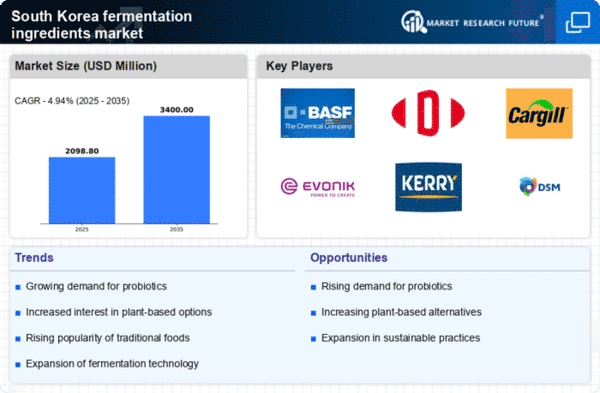
As per Market Research Future analysis, the South Korea fermentation ingredients market size was estimated at 2000.0 USD Million in 2024. The South Korea fermentation ingredients market is projected to grow from 2098.8 USD Million in 2025 to 3400.0 USD Million by 2035, exhibiting a compound annual growth rate (CAGR) of 4.9% during the forecast period 2025 - 2035

Key Market Trends & Highlights

The South Korea fermentation ingredients market is experiencing robust growth driven by evolving consumer preferences and technological advancements.

  • The market is witnessing a rising demand for natural ingredients, reflecting a shift towards healthier consumption patterns.
  • Innovation in fermentation technologies is enhancing product quality and expanding application areas across various sectors.
  • Cultural influences continue to shape the popularity of fermented products, particularly in traditional and modern culinary practices.
  • Health consciousness among consumers and the rising popularity of plant-based diets are key drivers propelling market growth.

Market Size & Forecast

2024 Market Size 2000.0 (USD Million)
2035 Market Size 3400.0 (USD Million)
CAGR (2025 - 2035) 4.94%

Major Players

BASF SE (DE), DuPont de Nemours Inc (US), Cargill Inc (US), Evonik Industries AG (DE), Kerry Group plc (IE), DSM Nutritional Products (CH), Archer Daniels Midland Company (US), Novozymes A/S (DK)

Our Impact
Enabled $4.3B Revenue Impact for Fortune 500 and Leading Multinationals
Partnering with 2000+ Global Organizations Each Year
30K+ Citations by Top-Tier Firms in the Industry

South Korea Fermentation Ingredients Market Trends

The fermentation ingredients market in South Korea is currently experiencing notable growth, driven by increasing consumer interest in health and wellness. This trend is reflected in the rising demand for natural and organic products, which are perceived as healthier alternatives to synthetic options. The South Korean population is becoming more health-conscious, leading to a shift in dietary preferences. As a result, manufacturers are focusing on developing innovative fermentation ingredients that cater to these evolving consumer needs. Additionally, the government is supporting the industry through various initiatives aimed at promoting sustainable practices and enhancing food safety standards. This supportive environment is likely to foster further advancements in fermentation technologies. Moreover, the fermentation ingredients market is witnessing a surge in applications across various sectors, including food and beverages, pharmaceuticals, and cosmetics. The versatility of fermentation processes allows for the creation of diverse products, from probiotics to bioactive compounds. South Korea's rich culinary heritage, which includes traditional fermented foods, is also contributing to the market's expansion. As consumers seek authentic flavors and functional benefits, the demand for traditional fermentation methods is likely to persist. Overall, the fermentation ingredients market appears poised for continued growth, driven by innovation, consumer preferences, and supportive government policies.

Rising Demand for Natural Ingredients

There is a growing preference among consumers for natural fermentation ingredients, as they are perceived to offer health benefits. This trend is particularly evident in the food and beverage sector, where products made with natural ingredients are increasingly favored over synthetic alternatives.

Innovation in Fermentation Technologies

Advancements in fermentation technologies are enabling the development of new and improved ingredients. These innovations are likely to enhance product quality and functionality, catering to the diverse needs of consumers and industries alike.

Cultural Influence on Fermented Products

South Korea's rich tradition of fermentation is influencing modern product offerings. The popularity of traditional fermented foods is driving interest in authentic flavors and health benefits, which may lead to a resurgence of traditional fermentation practices in contemporary products.

South Korea Fermentation Ingredients Market Drivers

Culinary Traditions and Innovations

Culinary traditions in South Korea, combined with modern innovations, are driving the fermentation ingredients market. Traditional fermented foods, such as kimchi and doenjang, are integral to South Korean cuisine, fostering a strong cultural connection to fermentation. However, there is also a growing trend towards fusion cuisine, where traditional fermentation techniques are applied to new ingredients and recipes. This blending of old and new is likely to create demand for diverse fermentation ingredients, as chefs and food manufacturers experiment with flavors and textures. The fermentation ingredients market is thus positioned to benefit from this culinary evolution, as it encourages the exploration of unique fermented products that appeal to both local and international consumers.

Health Consciousness Among Consumers

The increasing health consciousness among consumers in South Korea appears to be a pivotal driver for the fermentation ingredients market. As individuals become more aware of the benefits associated with fermented foods, such as improved gut health and enhanced immunity, the demand for natural fermentation ingredients is likely to rise. Reports indicate that the market for probiotics, a key segment within fermentation ingredients, is projected to grow at a CAGR of approximately 8% over the next five years. This trend suggests that consumers are actively seeking products that incorporate fermentation ingredients, thereby influencing manufacturers to innovate and expand their offerings. The fermentation ingredients market is thus positioned to benefit from this shift towards healthier dietary choices, as consumers increasingly prioritize functional foods that contribute to overall well-being.

Rising Popularity of Plant-Based Diets

The rising popularity of plant-based diets in South Korea is emerging as a significant driver for the fermentation ingredients market. As more consumers adopt vegetarian and vegan lifestyles, the demand for plant-based fermentation ingredients is likely to increase. This shift is reflected in the growing interest in fermented plant-based products, such as tempeh and kimchi, which are rich in probiotics and nutrients. Market analysis suggests that the plant-based food sector is expected to grow by approximately 10% annually, indicating a robust opportunity for fermentation ingredient suppliers. The fermentation ingredients market stands to gain from this trend, as manufacturers seek to develop innovative plant-based products that cater to the evolving dietary preferences of consumers.

Technological Advancements in Production

Technological advancements in the production of fermentation ingredients are significantly impacting the market dynamics in South Korea. Innovations in fermentation processes, such as the use of precision fermentation and bioreactor technologies, are enhancing the efficiency and scalability of ingredient production. These advancements not only improve yield but also reduce production costs, making fermentation ingredients more accessible to manufacturers. The fermentation ingredients market is expected to witness a surge in demand as companies adopt these technologies to meet the growing consumer preference for high-quality, sustainable products. Furthermore, the integration of automation and data analytics in fermentation processes may lead to improved product consistency and quality, further driving market growth.

Regulatory Support for Fermented Products

Regulatory support for fermented products in South Korea is playing a crucial role in shaping the fermentation ingredients market. The government has implemented policies that promote the production and consumption of fermented foods, recognizing their health benefits and cultural significance. Initiatives aimed at enhancing food safety and quality standards for fermentation ingredients are likely to bolster consumer confidence and stimulate market growth. Additionally, the establishment of guidelines for labeling and marketing fermented products may further encourage manufacturers to innovate and expand their product lines. As regulatory frameworks evolve, the fermentation ingredients market is expected to thrive, benefiting from increased consumer trust and a favorable business environment.


Market Segment Insights

By Application: Food Beverages (Largest) vs. Pharmaceuticals (Fastest-Growing)

In the South Korea fermentation ingredients market, the Food Beverages application holds the largest market share, reflecting consumer preferences for fermented products in culinary applications. Following closely, Pharmaceuticals are witnessing an upsurge, primarily due to the increasing demand for probiotics and other health-related products that rely on fermentation technologies. Growth in the Food Beverages sector is driven by the rising popularity of fermented drinks and health-conscious choices among consumers. Conversely, the Pharmaceutical segment is expanding swiftly as innovation in drug formulations and the prevalence of lifestyle diseases escalate the need for effective fermentation-derived ingredients. These trends underscore the varying dynamics within the applications, highlighting the robust potential and direction of each sector.

Food Beverages (Dominant) vs. Pharmaceuticals (Emerging)

The Food Beverages application stands dominant in the South Korea fermentation ingredients market, attributed to its established consumer base and diverse product range, including traditional beverages like kimchi and modern health drinks. This segment capitalizes on nutritional benefits and flavor enhancement, making it a staple in diets. On the other hand, the Pharmaceuticals application is an emerging segment fueled by advancements in bioengineering and an increased focus on preventive healthcare. The integration of fermented ingredients in pharmaceutical formulations enhances efficacy, catering to a growing demographic seeking natural health solutions. This competitive landscape illustrates the robust interaction between consumer demand and innovation.

By Type: Yeast (Largest) vs. Bacterial Cultures (Fastest-Growing)

In the South Korea fermentation ingredients market, the distribution of market share among the different types reveals yeast as the largest segment, holding a significant portion of the overall market. Bacterial cultures follow, representing a growing share as more consumers and manufacturers adopt specific strains for various fermentation processes, particularly in food and beverage production. Enzymes and acids, while essential, occupy smaller niches within this competitive landscape, highlighting the dominance of yeast and the increasing popularity of bacterial cultures. The growth trends in this segment are largely driven by the rising demand for probiotics and health-oriented products, which have enhanced the appeal of bacterial cultures significantly. Additionally, innovations in yeast applications for various fermentative processes, including alcoholic beverages and baked goods, contribute to its dominance. Enzymes and acids also play vital roles, although they are experiencing slower growth due to market saturation and the need for niche applications in specialized industries.

Yeast (Dominant) vs. Bacterial Cultures (Emerging)

Yeast serves as the dominant player in the South Korea fermentation ingredients market, primarily due to its extensive applications in baking, brewing, and distillation. It is characterized by a strong emphasis on quality and strain specificity to meet consumer demands for flavor, texture, and fermentation efficiency. On the other hand, bacterial cultures have emerged as a crucial component of health-focused products, appealing to the growing probiotics trend. They are utilized in yogurt production and fermented foods, gaining attention for their health benefits. Both segments are poised for growth, with yeast maintaining its lead due to established market presence while bacterial cultures are rapidly catching up, driven by novel applications and increased consumer interest.

By Source: Natural (Largest) vs. Synthetic (Fastest-Growing)

In the South Korea fermentation ingredients market, the distribution of market share between natural and synthetic sources demonstrates a clear preference for natural ingredients, which currently hold the largest portion. This favor for natural ingredients aligns with consumer trends leaning towards healthier and more organic choices, fostering a robust demand that solidifies their dominant position in the market. Meanwhile, synthetic fermentation ingredients, while holding a smaller share, are gaining traction, especially in specialized applications due to their cost-effectiveness and scalability. The growth trends for these segments reveal a dynamic shift in consumer preferences and technological advancements. Natural sources are projected to remain dominant; however, synthetic ingredients are rapidly evolving, driven by increasing adoption in various industries, including food and beverages. Innovations and improvements in synthetic fermentation processes are expected to enhance product quality and performance, making them the fastest-growing segment as businesses seek more efficient production methods.

Source: Natural (Dominant) vs. Synthetic (Emerging)

Natural fermentation ingredients are characterized by their organic sourcing and minimal processing, resonating strongly with consumer demand for clean label products. This segment not only dominates the market share but also benefits from a growing trend towards health-conscious consumption. On the other hand, synthetic fermentation ingredients represent an emerging segment, leveraging advancements in biochemistry and technology. These ingredients are often favored for their stability, consistency, and cost-effectiveness in large-scale applications, making them increasingly popular among manufacturers looking to optimize production while meeting regulatory requirements. As the South Korea fermentation ingredients market evolves, both segments are expected to coexist, catering to diverse consumer needs and market demands.

By Form: Liquid (Largest) vs. Powder (Fastest-Growing)

In the South Korea fermentation ingredients market, the 'Form' segment is characterized by a diverse distribution among liquid, powder, and granular forms. The liquid form dominates the landscape, holding the largest market share due to its extensive application in beverages and food products. This segment benefits from established supply chains and customer preferences that lean toward liquid formulations for their versatility and ease of use. On the other hand, the powder form is emerging as the fastest-growing segment, driven by increasing demand for convenience and clean-label products. The health and wellness trend is pushing manufacturers to develop powder formulations that are easy to transport, store, and use, appealing to both industrial and home users. This shift indicates a significant change in consumer preferences, leading to robust growth in this area.

Liquid (Dominant) vs. Powder (Emerging)

The liquid segment in the South Korea fermentation ingredients market remains dominant due to its widespread use in various applications, including sauces, beverages, and dairy products. Its position is bolstered by the preference for ready-to-use solutions that require minimal processing. In contrast, the powder segment is gaining momentum as an emerging trend, appealing to consumers seeking convenience and users looking for cost-effective storage options. Powders are often perceived as cleaner and more versatile, allowing for easy incorporation into recipes and formulations. As manufacturers innovate to meet health-conscious demands, the growth of powder fermentation ingredients signifies a fundamental shift in consumer behavior, leading to its rapid expansion in the market.

Get more detailed insights about South Korea Fermentation Ingredients Market

Key Players and Competitive Insights

The fermentation ingredients market in South Korea is characterized by a dynamic competitive landscape, driven by increasing consumer demand for natural and sustainable products. Key players are actively engaging in innovation and strategic partnerships to enhance their market presence. Companies such as BASF SE (DE), DuPont de Nemours Inc (US), and Novozymes A/S (DK) are at the forefront, focusing on product development and sustainability initiatives. Their collective strategies not only foster competition but also push the market towards more eco-friendly solutions, reflecting a broader trend towards sustainability in the food and beverage sector.In terms of business tactics, companies are increasingly localizing manufacturing to reduce costs and improve supply chain efficiency. This approach appears to be particularly effective in a moderately fragmented market, where the influence of major players is significant but not overwhelming. The competitive structure allows for both established firms and emerging players to coexist, fostering innovation and responsiveness to market demands.

In October DuPont de Nemours Inc (US) announced a partnership with a local South Korean biotech firm to develop advanced fermentation technologies aimed at enhancing the production of plant-based proteins. This strategic move is likely to bolster DuPont's position in the market by leveraging local expertise and addressing the growing demand for alternative protein sources. Such collaborations may enhance product offerings and accelerate time-to-market for innovative solutions.

In September Novozymes A/S (DK) launched a new line of enzymes specifically designed for the fermentation of dairy products, targeting the health-conscious consumer segment. This initiative underscores Novozymes' commitment to innovation and its ability to adapt to changing consumer preferences. By focusing on health-oriented products, Novozymes is positioning itself to capture a larger share of the market, which is increasingly leaning towards functional foods.

In August BASF SE (DE) expanded its fermentation ingredient portfolio by acquiring a small local company specializing in organic fermentation processes. This acquisition not only enhances BASF's product range but also aligns with its sustainability goals, as organic products are gaining traction among consumers. The strategic importance of this move lies in BASF's ability to integrate new technologies and processes that could lead to more sustainable production methods.

As of November the competitive trends in the fermentation ingredients market are increasingly defined by digitalization, sustainability, and the integration of artificial intelligence in production processes. Strategic alliances are becoming more prevalent, as companies seek to leverage each other's strengths to enhance innovation and operational efficiency. Looking ahead, the competitive differentiation is likely to evolve from traditional price-based competition to a focus on technological advancements, sustainability, and supply chain reliability, reflecting the changing priorities of consumers and regulatory environments.

Key Companies in the South Korea Fermentation Ingredients Market include

Industry Developments

Recent developments in the South Korea Fermentation Ingredients Market have been notable, particularly with companies like CJ CheilJedang and Sempio Foods Company focusing on expanding their product lines to enhance the flavor profiles and health benefits of their offerings. In October 2023, Hanil Fermentation announced a new partnership with Sookmyung Women's University aimed at developing innovative fermentation technologies, potentially positioning the company as a leader in sustainable food innovation. Additionally, in September 2023, Daesang Corporation made headlines by acquiring a smaller player in the Biotechnology sector to strengthen its fermentation capabilities, thus boosting its market share. 

The growth in market valuation for these companies is significant, with major players experiencing increased revenue driven by consumer demand for fermented foods and enzymes, which are seen as health-promoting. Companies like Nongshim and Samyang Foods are exploring opportunities in plant-based fermentation as they adapt to changing consumer preferences. Over the last few years, the South Korean fermentation market has successfully tapped into the global health and wellness trend, and ongoing investments in Research and Development are expected to trigger further market growth and innovation, firmly placing South Korea at the forefront of the fermentation industry in Asia.

Future Outlook

South Korea Fermentation Ingredients Market Future Outlook

The Fermentation Ingredients Market is projected to grow at a 4.94% CAGR from 2025 to 2035, driven by rising demand for natural food additives and sustainable production methods.

New opportunities lie in:

  • Development of customized fermentation solutions for niche markets.
  • Expansion into plant-based fermentation products to meet consumer trends.
  • Investment in advanced fermentation technologies to enhance production efficiency.

By 2035, the market is expected to achieve robust growth, driven by innovation and evolving consumer preferences.

Market Segmentation

South Korea Fermentation Ingredients Market Form Outlook

  • Liquid
  • Powder
  • Granular

South Korea Fermentation Ingredients Market Type Outlook

  • Yeast
  • Bacterial Cultures
  • Enzymes
  • Acids

South Korea Fermentation Ingredients Market Source Outlook

  • Natural
  • Synthetic

South Korea Fermentation Ingredients Market Application Outlook

  • Food Beverages
  • Pharmaceuticals
  • Animal Feed
  • Biofuels

Report Scope

MARKET SIZE 2024 2000.0(USD Million)
MARKET SIZE 2025 2098.8(USD Million)
MARKET SIZE 2035 3400.0(USD Million)
COMPOUND ANNUAL GROWTH RATE (CAGR) 4.94% (2025 - 2035)
REPORT COVERAGE Revenue Forecast, Competitive Landscape, Growth Factors, and Trends
BASE YEAR 2024
Market Forecast Period 2025 - 2035
Historical Data 2019 - 2024
Market Forecast Units USD Million
Key Companies Profiled BASF SE (DE), DuPont de Nemours Inc (US), Cargill Inc (US), Evonik Industries AG (DE), Kerry Group plc (IE), DSM Nutritional Products (CH), Archer Daniels Midland Company (US), Novozymes A/S (DK)
Segments Covered Application, Type, Source, Form
Key Market Opportunities Growing demand for plant-based fermentation ingredients driven by health-conscious consumer preferences.
Key Market Dynamics Rising demand for plant-based fermentation ingredients drives innovation and competition in South Korea's food industry.
Countries Covered South Korea
Leave a Comment

FAQs

What is the projected market size of the South Korea Fermentation Ingredients Market in 2024?

The South Korea Fermentation Ingredients Market is projected to be valued at 872.64 million USD in 2024.

What will be the market value of the South Korea Fermentation Ingredients Market by 2035?

The market is expected to reach a value of 1560.0 million USD by 2035.

What is the expected CAGR for the South Korea Fermentation Ingredients Market from 2025 to 2035?

The market is anticipated to grow at a CAGR of 5.423% during the forecast period from 2025 to 2035.

Which segment of the South Korea Fermentation Ingredients Market is expected to have the highest value in 2035?

The Food Beverages segment is expected to be valued at 730.0 million USD by 2035.

What is the estimated market size for the Pharmaceuticals segment in 2024?

The Pharmaceuticals segment in the South Korea Fermentation Ingredients Market is expected to be valued at 250.0 million USD in 2024.

Who are the major players in the South Korea Fermentation Ingredients Market?

Major players in the market include Hanon Systems, Sempio Foods Company, and CJ CheilJedang among others.

What will the market size for Animal Feed be in 2035?

The market size for Animal Feed in the South Korea Fermentation Ingredients Market is projected to reach 250.0 million USD by 2035.

What size is the Biofuels application expected to be in 2024?

The Biofuels application within the market is expected to be valued at 72.64 million USD in 2024.

How does the South Korea Fermentation Ingredients Market reflect growth opportunities?

The market is showing significant growth opportunities driven by increasing demand for fermentation applications across various sectors.

What impact do current global trends have on the South Korea Fermentation Ingredients Market?

Current global trends can influence market dynamics, affecting growth rates and demand patterns within the fermentation ingredients sector.

Download Free Sample

Kindly complete the form below to receive a free sample of this Report

Compare Licence

×
Features License Type
Single User Multiuser License Enterprise User
Price $4,950 $5,950 $7,250
Maximum User Access Limit 1 User Upto 10 Users Unrestricted Access Throughout the Organization
Free Customization
Direct Access to Analyst
Deliverable Format
Platform Access
Discount on Next Purchase 10% 15% 15%
Printable Versions