×
Request Free Sample ×

Kindly complete the form below to receive a free sample of this Report

* Please use a valid business email

Leading companies partner with us for data-driven Insights

clients tt-cursor
Hero Background

South Korea Empty Capsule Market

ID: MRFR/Pharma/47491-HCR
200 Pages
Rahul Gotadki
February 2026

South Korea Empty Capsule Market Research Report By Type (Gelatin Capsules, Vegetarian Capsules), By Functionality (Fast-release Capsules, Slow-release Capsules), By Physical Characteristics (Halal, Non-Halal), By Form (Hard Capsules, Soft Capsules), By Appearance (Transparent, Opaque) and By Application (Pharmaceutical, Nutraceutical) - Growth & Industry Forecast 2025 To 2035

Share:
Download PDF ×

We do not share your information with anyone. However, we may send you emails based on your report interest from time to time. You may contact us at any time to opt-out.

South Korea Empty Capsule Market Infographic
Purchase Options

South Korea Empty Capsule Market Summary

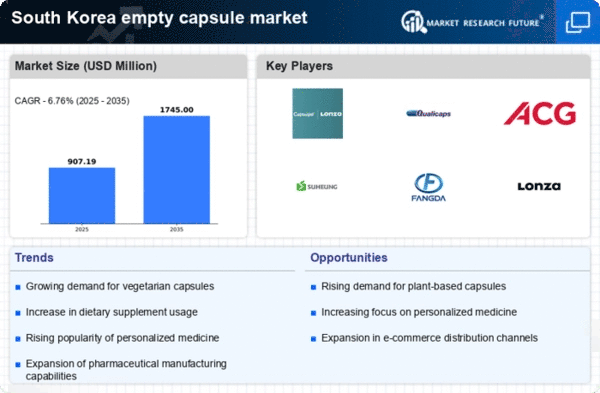
As per Market Research Future analysis, the South Korea empty capsule market Size was estimated at 849.75 USD Million in 2024. The South Korea empty capsule market is projected to grow from 907.19 USD Million in 2025 to 1745.0 USD Million by 2035, exhibiting a compound annual growth rate (CAGR) of 6.7% during the forecast period 2025 - 2035

Key Market Trends & Highlights

The South Korea empty capsule market is experiencing robust growth driven by innovation and changing consumer preferences.

  • The largest segment in the South Korea empty capsule market is the pharmaceutical sector, while the fastest-growing segment is the nutraceutical sector.
  • There is a notable rise in demand for plant-based capsules, reflecting a shift towards more health-conscious consumer choices.
  • Technological advancements in capsule production are enhancing efficiency and product quality, thereby attracting more manufacturers.
  • Key market drivers include growing health consciousness and the expansion of the pharmaceutical sector, which are likely to propel market growth.

Market Size & Forecast

2024 Market Size 849.75 (USD Million)
2035 Market Size 1745.0 (USD Million)
CAGR (2025 - 2035) 6.76%

Major Players

Capsugel (BE), Qualicaps (JP), ACG (IN), Suheung (KR), Fangda (CN), Lonza (CH), Roxlor (US), MediCaps (IN)

Our Impact
Enabled $4.3B Revenue Impact for Fortune 500 and Leading Multinationals
Partnering with 2000+ Global Organizations Each Year
30K+ Citations by Top-Tier Firms in the Industry

South Korea Empty Capsule Market Trends

The empty capsule market in South Korea is experiencing notable growth, driven by increasing demand for dietary supplements and pharmaceuticals. The rise in health consciousness among consumers has led to a surge in the use of capsules as a preferred delivery method for various formulations. This trend is further supported by the expansion of the specialty pharmaceutical industry, which is focusing on innovative drug delivery systems. Additionally, the growing popularity of vegetarian and vegan capsules is reshaping consumer preferences, as more individuals seek plant-based alternatives. As a result, manufacturers are adapting their production processes to meet these evolving demands, which may enhance their competitive edge in the market. Moreover, regulatory frameworks in South Korea are becoming more favorable for the empty capsule market. The government is implementing policies that encourage research and development in the pharmaceutical sector, which could lead to advancements in capsule technology. This supportive environment may attract investments and foster collaborations between industry players and research institutions. Consequently, the empty capsule market is poised for further expansion, with potential opportunities for innovation and diversification in product offerings. The interplay of consumer preferences, regulatory support, and industry advancements suggests a dynamic landscape for stakeholders in this sector.

Rising Demand for Plant-Based Capsules

There is a growing preference for vegetarian and vegan capsules among consumers in South Korea. This shift is largely influenced by increased health awareness and dietary choices that favor plant-based products. Manufacturers are responding by developing more options that cater to this trend, which may enhance their market position.

Technological Advancements in Capsule Production

Innovations in capsule manufacturing technology are emerging, allowing for improved quality and efficiency. These advancements may lead to the production of capsules with enhanced bioavailability and stability, which could attract pharmaceutical companies looking for effective delivery systems.

Regulatory Support for Pharmaceutical Innovations

The South Korean government is actively promoting research and development within the pharmaceutical sector. This regulatory support may facilitate the introduction of new products and technologies in the empty capsule market, potentially driving growth and attracting investment.

South Korea Empty Capsule Market Drivers

Growing Health Consciousness

The increasing awareness of health and wellness among consumers in South Korea is driving the empty capsule market. As individuals become more health-conscious, there is a notable shift towards dietary supplements and nutraceuticals. This trend is reflected in the rising demand for vegetarian and gelatin capsules, which are perceived as healthier alternatives. The empty capsule market is likely to benefit from this shift, as manufacturers adapt their offerings to meet consumer preferences. In 2023, the market for dietary supplements in South Korea was valued at approximately $2 billion, indicating a robust growth trajectory. This growing health consciousness is expected to continue influencing the empty capsule market, as consumers seek convenient and effective ways to enhance their health.

Expansion of the Pharmaceutical Sector

The pharmaceutical sector in South Korea is experiencing significant growth, which is positively impacting the empty capsule market. With an increasing number of pharmaceutical companies focusing on research and development, the demand for empty capsules is likely to rise. The empty capsule market is poised to benefit from this expansion, as capsules are a preferred dosage form for many medications. In 2024, the pharmaceutical market in South Korea was projected to reach $30 billion, highlighting the potential for growth in related sectors. This expansion is expected to create opportunities for manufacturers of empty capsules, as they cater to the evolving needs of the pharmaceutical industry.

Rising Popularity of Personalized Medicine

The trend towards personalized medicine is gaining traction in South Korea, which is influencing the empty capsule market. As healthcare becomes more tailored to individual needs, the demand for customized dosage forms is increasing. Empty capsules offer flexibility in formulation, allowing for the creation of personalized supplements and medications. The empty capsule market is likely to see growth as healthcare providers and patients seek more individualized treatment options. In 2025, the personalized medicine market in South Korea is anticipated to grow at a CAGR of 10%, further driving the demand for empty capsules as a versatile delivery system.

Regulatory Developments Favoring Capsule Use

Regulatory frameworks in South Korea are increasingly supportive of the use of empty capsules in various applications, including pharmaceuticals and dietary supplements. Recent policy changes have streamlined the approval processes for new products, encouraging innovation within the empty capsule market. This regulatory support is likely to foster a more favorable environment for manufacturers, enabling them to bring new products to market more efficiently. In 2024, the regulatory landscape is expected to further evolve, potentially increasing the market size of empty capsules by 15%. This trend indicates a growing recognition of the importance of capsules in delivering effective health solutions.

Technological Innovations in Capsule Manufacturing

Technological advancements in capsule manufacturing are playing a crucial role in shaping the empty capsule market. Innovations such as improved encapsulation techniques and the development of new materials are enhancing the quality and efficiency of capsule production. The empty capsule market is benefiting from these advancements, as manufacturers can produce capsules that meet stringent quality standards. In 2023, the market for advanced capsule technologies was valued at $500 million in South Korea, indicating a strong interest in innovation. As technology continues to evolve, it is expected that the empty capsule market will see increased competition and product differentiation.


Market Segment Insights

By Type: Gelatin Capsules (Largest) vs. Vegetarian Capsules (Fastest-Growing)

In the South Korea empty capsule market, Gelatin Capsules dominate the landscape, capturing a significant share due to their traditional usage in the pharmaceutical and dietary supplement sectors. Their popularity stems from established consumer preferences for gelatin, which is often perceived as a high-quality and effective option. On the other hand, Vegetarian Capsules, while currently smaller in market share, are gaining traction, particularly among health-conscious consumers who favor plant-based products over animal-derived alternatives. This shift is influenced by the increasing number of individuals adopting vegetarian and vegan lifestyles, as well as concerns regarding sustainability and animal welfare. Growth trends in this segment indicate a strong upward trajectory for Vegetarian Capsules, driven by changing dietary habits and an expanding population segment that prioritizes nutritional products without animal origins. Manufacturers are responding to this demand by innovatively formulating vegetarian options that meet consumer needs for efficacy and digestibility. Furthermore, the growing trend of transparency in ingredient sourcing is influencing consumers to favor brands that highlight their vegetarian or vegan certifications. As a result, the Vegetarian Capsule segment is expected to experience accelerated growth, positioning it as a competitive alternative to Gelatin Capsules.

Gelatin Capsules: Dominant vs. Vegetarian Capsules: Emerging

Gelatin Capsules are characterized by their traditional manufacturing process, widely accepted fulfillment of medical and nutritional purposes, and established reputation among pharmacists and consumers alike. They offer benefits such as improved bioavailability and taste masking, making them a preferred choice for many formulations. Conversely, Vegetarian Capsules represent a burgeoning segment gaining recognition among consumers who are increasingly motivated by health and ethical considerations. These capsules are derived from plant-based materials like hydroxypropyl methylcellulose (HPMC) or pullulan, appealing to a diverse array of dietary preferences. With substantial innovations and investments in raw materials and technology, the Vegetarian Capsules are poised for remarkable growth, catering to the rising demand for clean-label and sustainable product alternatives.

By Functionality: Fast-release Capsules (Largest) vs. Slow-release Capsules (Fastest-Growing)

In the South Korea empty capsule market, Fast-release Capsules hold the largest market share, driven by the increasing demand for rapid-action medications. Meanwhile, Slow-release Capsules, although currently smaller in market share, are recognized as the fastest-growing segment due to the rising popularity of prolonged drug release profiles for chronic conditions. The growth of Fast-release Capsules can be attributed to their ability to deliver active pharmaceutical ingredients (APIs) quickly, catering to the preferences of patients and healthcare providers. In contrast, Slow-release Capsules are gaining traction as they provide a more efficient delivery method of medications over extended periods, leading to enhanced patient compliance and therapeutic effectiveness. The expanding pharmaceutical landscape in South Korea favors both segments, with technological advancements supporting their production.

Functionality: Fast-release Capsules (Dominant) vs. Slow-release Capsules (Emerging)

Fast-release Capsules are characterized by their ability to deliver medications rapidly, making them a dominant choice among consumers and healthcare providers alike. This segment has benefitted from the growing demand for immediate therapeutic effects, particularly in acute treatments. On the other hand, Slow-release Capsules, although currently an emerging option, are increasingly being adopted for their enhanced stability and extended dosage intervals. This shift is driven by the need for medications that provide sustained efficacy and improved patient adherence. As the South Korea empty capsule market evolves, both segment values are likely to play pivotal roles, with Fast-release Capsules leading the way, while Slow-release Capsules gain momentum through innovation and changing patient needs.

By Physical Characteristics: Halal (Largest) vs. Non-Halal (Fastest-Growing)

In the South Korea empty capsule market, the distribution of market share between Halal and Non-Halal segments demonstrates a significant preference for Halal options among consumers. This trend is influenced by cultural dietary laws and an increasing demand for Halal-certified products that cater to a diverse population. Non-Halal capsules are gaining traction due to growing health awareness, yet they still represent a smaller portion of the market. Growth trends indicate that the Halal segment is steadily expanding as more manufacturers are obtaining certification to meet demand. Meanwhile, the Non-Halal segment is experiencing faster growth as health-conscious consumers are seeking alternative options. Overall, both segments are evolving, with Halal leading in market share and Non-Halal showing potential for increased acceptance.

Halal: Dominant vs. Non-Halal: Emerging

The Halal segment in the South Korea empty capsule market is characterized by its robust demand, driven by cultural preferences and the strict compliance with Halal regulations. This segment serves a significant portion of the population that adheres to Halal dietary laws, thus establishing its dominant position. On the other hand, the Non-Halal segment is emerging as a notable alternative, appealing to health-focused consumers striving for more variety in dietary supplements. The growth in the Non-Halal segment is fueled by an increase in health awareness and a diversified consumer base that seeks innovative, functional, and bioavailable capsules. As trends evolve, both segments are expected to coexist, catering to the unique needs and preferences of consumers.

By Form: Hard Capsules (Largest) vs. Soft Capsules (Fastest-Growing)

In the South Korea empty capsule market, hard capsules currently hold a significant share, dominating the landscape due to their favorable characteristics such as stability and versatility in formulations. Their robust structure and capability to encapsulate a variety of substances make them the preferred choice among manufacturers and consumers alike. On the other hand, soft capsules, while smaller in market share, have been gaining traction rapidly as they offer advantages like a smoother swallow and enhanced bioavailability, appealing to a larger consumer base. The growth trend for soft capsules is particularly notable as consumers are increasingly seeking more convenient dosage forms that are easy to ingest. The rising awareness about health and wellness, coupled with advancements in capsule technology that improve the overall effectiveness of soft capsules, is contributing to their rapid expansion. Factors such as changes in consumer preferences and an uptick in dietary supplements are driving this transformation, signaling a shifting focus within the empty capsule sector of the market.

Capsules: Hard Capsules (Dominant) vs. Soft Capsules (Emerging)

Hard capsules are recognized as the dominant form in the South Korea empty capsule market, primarily used for nutritional supplements and pharmaceuticals due to their solid structure that allows for a secure and effective delivery of ingredients. They are especially favored in the production of powder-filled applications. In contrast, soft capsules, which represent an emerging segment, are increasingly appreciated for their flexibility and the ability to encapsulate oils and other liquid formulations. This emerging form also benefits from innovation in production techniques that enhance their visual appeal and performance. The market is witnessing a shift as consumer preferences lean toward the convenience and efficacy associated with soft capsules, indicating a dynamic and evolving landscape driven by both established and novel product forms.

By Appearance: Transparent (Largest) vs. Opaque (Fastest-Growing)

In the South Korea empty capsule market, the distribution between transparent and opaque capsules reveals a strong preference for transparent options, which hold a significant market share. Transparent capsules are favored for their aesthetic appeal and consumer preference for visible contents, making them the dominant choice among manufacturers. In contrast, opaque capsules are gradually gaining traction, leveraging their ability to protect light-sensitive ingredients and enhance product stability. Growth trends in the segment demonstrate a shift towards containing more sensitive formulations in opaque capsules, catering to the emerging demand for nutraceuticals and personalized medicine. This trend is fueled by an increasing awareness of product integrity and the effectiveness of opaque capsules in preserving potency, positioning them as the fastest-growing choice in the market. Industry innovations also play a role in enhancing the functionality and appeal of both segment types.

Transparent (Dominant) vs. Opaque (Emerging)

Transparent capsules are characterized by their clarity, allowing consumers to view the contents, which is essential for products with distinctive formulations. They dominate the market due to their versatility and aesthetics, appealing to various sectors, including pharmaceuticals and dietary supplements. In contrast, opaque capsules serve as an emerging alternative, attracting attention for their capability to shield light-sensitive ingredients and improve product shelf life. This segment is developing rapidly as manufacturers strive to create innovative formulations and respond to the increased demand for health products that require enhanced protection. Both segment values cater to diverse consumer needs, making them vital components of the South Korea empty capsule market.

By Application: Pharmaceutical (Largest) vs. Nutraceutical (Fastest-Growing)

The South Korea empty capsule market consists of significant contributions from the pharmaceutical and nutraceutical segments. The pharmaceutical segment currently holds the largest share, driven by the increasing demand for capsules as a drug delivery system. Concurrently, the nutraceutical sector is witnessing rapid growth as health-conscious consumers seek dietary supplements in convenient forms, thus boosting its market presence. Growth trends in this segment are influenced by the rising awareness regarding health and wellness. The pharmaceutical segment is expected to benefit from advancements in drug formulation, while the nutraceutical segment is propelled by trends towards preventive healthcare and natural products. Consumer preferences for plant-based and organic options further drive nutraceutical innovation, making it the fastest-growing segment in the South Korea empty capsule market.

Pharmaceutical: Dominant vs. Nutraceutical: Emerging

The pharmaceutical segment is characterized by a well-established market presence and robust demand for various drug formulations, relying on empty capsules for effective delivery. This dominance is supported by a strong pipeline of new drug approvals and an aging population requiring more medications. In contrast, the nutraceutical segment, while emerging, is growing rapidly due to the rising trend of preventive health care and the popularity of dietary supplements. Consumers are increasingly seeking products that support health and overall well-being, leading to innovation in capsule formulations. This dynamic creates a competitive landscape where both segments are crucial to the market, with the pharmaceutical segment leading in size and the nutraceutical segment gaining momentum.

Get more detailed insights about South Korea Empty Capsule Market

Key Players and Competitive Insights

The empty capsule market in South Korea is characterized by a competitive landscape that is both dynamic and multifaceted. Key growth drivers include the increasing demand for dietary supplements and pharmaceuticals, alongside a growing preference for vegetarian and gelatin capsules. Major players such as Capsugel (Belgium), Qualicaps (Japan), and Suheung (South Korea) are strategically positioned to leverage these trends. Capsugel (Belgium) focuses on innovation in capsule technology, particularly in developing plant-based options, while Qualicaps (Japan) emphasizes regional expansion and partnerships to enhance its market presence. Suheung (South Korea) is actively investing in digital transformation to optimize its manufacturing processes, which collectively shapes a competitive environment that is increasingly reliant on technological advancements and consumer preferences.Key business tactics within this market include localizing manufacturing and optimizing supply chains to enhance efficiency and responsiveness to market demands. The competitive structure appears moderately fragmented, with several key players exerting influence over market dynamics. This fragmentation allows for niche players to thrive, while larger companies consolidate their market share through strategic initiatives and collaborations.

In October Capsugel (Belgium) announced the launch of a new line of sustainable capsules made from plant-based materials, which is expected to cater to the rising consumer demand for environmentally friendly products. This strategic move not only aligns with global sustainability trends but also positions Capsugel as a leader in innovation within the empty capsule sector. The introduction of these capsules may significantly enhance their competitive edge, particularly among health-conscious consumers.

In September Qualicaps (Japan) entered into a strategic partnership with a local South Korean pharmaceutical company to co-develop customized capsule solutions. This collaboration is likely to enhance Qualicaps' ability to meet specific regional needs, thereby strengthening its foothold in the South Korean market. Such partnerships may facilitate knowledge sharing and innovation, ultimately benefiting both companies in terms of product offerings and market reach.

In August Suheung (South Korea) implemented advanced AI-driven analytics in its production facilities to streamline operations and reduce waste. This initiative reflects a broader trend towards digitalization in the industry, which is crucial for maintaining competitiveness. By adopting AI technologies, Suheung is likely to improve its operational efficiency and responsiveness to market changes, thereby solidifying its position in the market.

As of November current competitive trends are increasingly defined by digitalization, sustainability, and the integration of AI technologies. Strategic alliances are shaping the landscape, enabling companies to pool resources and expertise to drive innovation. The shift from price-based competition to a focus on technological advancement and supply chain reliability is evident. Moving forward, competitive differentiation will likely hinge on the ability to innovate and adapt to evolving consumer preferences, with a strong emphasis on sustainable practices and advanced manufacturing techniques.

Key Companies in the South Korea Empty Capsule Market include

Industry Developments

The South Korea Empty Capsule Market has seen several developments recently, notably the increasing demand for vegetarian capsules driven by health-conscious consumers. Companies like Qualicaps and Gelita are ramping up their production capacities to meet this rising demand. In October 2023, Eligo announced a partnership with Lonza to enhance the quality and availability of their empty capsules, marking a significant advancement in the market.

Additionally, Sahm Biotechnology has reported a 25% growth in product sales over the past year, indicative of heightened interest in their offerings. Moreover, in September 2023, ACG Worldwide expanded its operations in South Korea, significantly contributing to the local economy and employment. Regarding mergers and acquisitions, there have been no major publicized deals involving the key players like Weigao or Medcaps in recent months, maintaining a stable market landscape.

The South Korean government is also supporting the pharmaceutical industry through various incentives, which is positively influencing the Empty Capsule Market. Overall, the trajectory of the South Korea Empty Capsule Market appears strong with ongoing developments shaping its future.

Future Outlook

South Korea Empty Capsule Market Future Outlook

The Empty Capsule Market in South Korea is projected to grow at a 6.76% CAGR from 2025 to 2035, driven by increasing demand for dietary supplements and pharmaceutical innovations.

New opportunities lie in:

  • Expansion of plant-based capsule production lines
  • Development of customized capsule formulations for niche markets
  • Investment in advanced manufacturing technologies for efficiency

By 2035, the empty capsule market is expected to achieve robust growth and enhanced competitive positioning.

Market Segmentation

South Korea Empty Capsule Market Form Outlook

  • Hard Capsules
  • Soft Capsules

South Korea Empty Capsule Market Type Outlook

  • Gelatin Capsules
  • Vegetarian Capsules

South Korea Empty Capsule Market Appearance Outlook

  • Transparent
  • Opaque

South Korea Empty Capsule Market Application Outlook

  • Pharmaceutical
  • Nutraceutical

South Korea Empty Capsule Market Functionality Outlook

  • Fast-release Capsules
  • Slow-release Capsules

South Korea Empty Capsule Market Physical Characteristics Outlook

  • Halal
  • Non-Halal

Report Scope

MARKET SIZE 2024849.75(USD Million)
MARKET SIZE 2025907.19(USD Million)
MARKET SIZE 20351745.0(USD Million)
COMPOUND ANNUAL GROWTH RATE (CAGR)6.76% (2025 - 2035)
REPORT COVERAGERevenue Forecast, Competitive Landscape, Growth Factors, and Trends
BASE YEAR2024
Market Forecast Period2025 - 2035
Historical Data2019 - 2024
Market Forecast UnitsUSD Million
Key Companies ProfiledCapsugel (BE), Qualicaps (JP), ACG (IN), Suheung (KR), Fangda (CN), Lonza (CH), Roxlor (US), MediCaps (IN)
Segments CoveredType, Functionality, Physical Characteristics, Form, Appearance, Application
Key Market OpportunitiesGrowing demand for plant-based empty capsules driven by health-conscious consumer preferences and regulatory support.
Key Market DynamicsRising demand for plant-based empty capsules driven by consumer preference for natural and sustainable products.
Countries CoveredSouth Korea
Leave a Comment

FAQs

What is the expected market size of the South Korea Empty Capsule Market in 2024?

The South Korea Empty Capsule Market is expected to be valued at 850.0 USD Million in 2024.

What is the projected market size for the South Korea Empty Capsule Market in 2035?

By 2035, the South Korea Empty Capsule Market is projected to reach a valuation of 1950.0 USD Million.

What is the expected CAGR for the South Korea Empty Capsule Market from 2025 to 2035?

The expected CAGR for the South Korea Empty Capsule Market from 2025 to 2035 is 7.841%.

Which segment of the South Korea Empty Capsule Market holds the largest market share?

In 2024, the Gelatin Capsules segment is estimated to dominate the market with a valuation of 500.0 USD Million.

What will be the market valuation for Gelatin Capsules in 2035?

The market valuation for Gelatin Capsules is expected to reach 1150.0 USD Million by 2035.

How much is the Vegetarian Capsules segment valued at in 2024?

The Vegetarian Capsules segment is valued at 350.0 USD Million in the year 2024.

What is the forecasted market size for Vegetarian Capsules in 2035?

By 2035, the Vegetarian Capsules segment is projected to grow to 800.0 USD Million.

Who are the key players in the South Korea Empty Capsule Market?

Some major players include Eligo, Lonza, and Qualicaps, among others.

What opportunities exist in the South Korea Empty Capsule Market?

There are opportunities driven by an increasing demand for vegetarian and gelatin capsules across various applications.

What impact does the regional growth rate of the South Korean market suggest?

The South Korea Empty Capsule Market is witnessing a promising growth trajectory, reflecting strong demand for health and dietary supplements.

Download Free Sample

Kindly complete the form below to receive a free sample of this Report

Compare Licence

×
Features License Type
Single User Multiuser License Enterprise User
Price $4,950 $5,950 $7,250
Maximum User Access Limit 1 User Upto 10 Users Unrestricted Access Throughout the Organization
Free Customization
Direct Access to Analyst
Deliverable Format
Platform Access
Discount on Next Purchase 10% 15% 15%
Printable Versions