×
Request Free Sample ×

Kindly complete the form below to receive a free sample of this Report

* Please use a valid business email

Leading companies partner with us for data-driven Insights

clients tt-cursor
Hero Background

South Korea Electrical Computer Aided Design Market

ID: MRFR/ICT/56717-HCR
200 Pages
Garvit Vyas
February 2026

South Korea Electrical Computer-Aided Design Market Size, Share and Trends Analysis Report By Component (Software, Services, Support, Training, Maintenance) - Forecast to 2035

Share:
Download PDF ×

We do not share your information with anyone. However, we may send you emails based on your report interest from time to time. You may contact us at any time to opt-out.

South Korea Electrical Computer Aided Design Market Infographic
Purchase Options

South Korea Electrical Computer Aided Design Market Summary

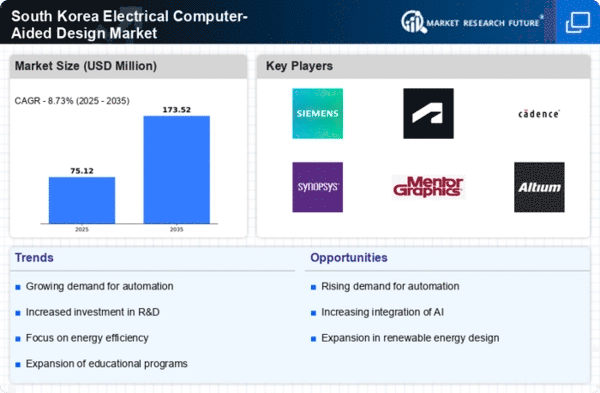
As per Market Research Future analysis, the South Korea electrical computer-aided-design market size was estimated at 69.09 USD Million in 2024.. The South Korea electrical computer-aided-design market is projected to grow from 75.12 USD Million in 2025 to 173.52 USD Million by 2035, exhibiting a compound annual growth rate (CAGR) of 8.7% during the forecast period 2025 - 2035

Key Market Trends & Highlights

The South Korea electrical computer-aided-design market is experiencing robust growth driven by technological advancements and increasing demand for automation.

  • The integration of AI in design processes is transforming traditional CAD methodologies.
  • Sustainable design solutions are gaining traction as industries prioritize eco-friendly practices.
  • Smart technologies are on the rise, enhancing the capabilities of CAD applications.
  • Technological advancements in CAD software and government initiatives are key drivers of market growth.

Market Size & Forecast

2024 Market Size 69.09 (USD Million)
2035 Market Size 173.52 (USD Million)
CAGR (2025 - 2035) 8.73%

Major Players

Siemens (DE), Autodesk (US), Cadence Design Systems (US), Synopsys (US), Mentor Graphics (US), Altium (AU), Zuken (JP), Keysight Technologies (US), ANSYS (US)

Our Impact
Enabled $4.3B Revenue Impact for Fortune 500 and Leading Multinationals
Partnering with 2000+ Global Organizations Each Year
30K+ Citations by Top-Tier Firms in the Industry

South Korea Electrical Computer Aided Design Market Trends

the electrical computer-aided-design market in South Korea is currently experiencing significant growth, driven by advancements in technology and increasing demand for efficient design solutions. The integration of artificial intelligence and machine learning into design processes appears to enhance productivity and accuracy, allowing engineers and designers to create complex systems with greater ease. Furthermore, the growing emphasis on sustainable practices within the engineering sector suggests a shift towards tools that facilitate eco-friendly designs, potentially influencing the types of software and services offered in this market. In addition, the rise of smart technologies and the Internet of Things (IoT) is likely to shape the future landscape of the electrical computer-aided-design market. As industries increasingly adopt smart devices, the need for sophisticated design tools that can accommodate these innovations becomes paramount. This trend may lead to a greater focus on interoperability and collaboration among various design platforms, ensuring that engineers can work seamlessly across different systems. Overall, the electrical computer-aided-design market in South Korea is poised for growth, driven by technological advancements and evolving industry needs.

Integration of AI in Design Processes

The incorporation of artificial intelligence into the electrical computer-aided-design market is transforming traditional design methodologies. AI tools are enhancing efficiency by automating repetitive tasks, allowing designers to focus on more complex aspects of their projects. This trend indicates a shift towards smarter design solutions that can adapt to user needs.

Focus on Sustainable Design Solutions

There is a growing emphasis on sustainability within the electrical computer-aided-design market. Designers are increasingly seeking tools that support eco-friendly practices, reflecting a broader industry trend towards reducing environmental impact. This focus may lead to the development of software that prioritizes energy efficiency and sustainable materials.

Rise of Smart Technologies

The proliferation of smart technologies and IoT devices is influencing the electrical computer-aided-design market. As industries integrate these innovations, the demand for advanced design tools that can accommodate complex systems is likely to increase. This trend suggests a need for enhanced interoperability among design platforms.

South Korea Electrical Computer Aided Design Market Drivers

Government Initiatives and Support

Government initiatives in South Korea are playing a pivotal role in the growth of the electrical computer-aided-design market. Various programs aimed at promoting technological innovation and digital transformation are being implemented. For instance, the South Korean government has allocated substantial funding to support research and development in engineering technologies. This support is expected to enhance the capabilities of local firms, thereby increasing their competitiveness in the electrical computer-aided-design market. Furthermore, the government's focus on fostering a robust digital economy is likely to create a conducive environment for the adoption of advanced CAD tools, potentially leading to a market growth rate of around 7% in the coming years.

Rising Demand for Automation in Design

The increasing demand for automation in design processes is significantly influencing the electrical computer-aided-design market. Industries are seeking to streamline operations and reduce human error, which has led to a greater emphasis on automated design solutions. In South Korea, sectors such as manufacturing and construction are particularly focused on integrating automation into their workflows. This trend is expected to drive the electrical computer-aided-design market, as companies invest in software that facilitates automated design tasks. The market could see an increase of approximately 6% in revenue as businesses recognize the benefits of automation in enhancing productivity and efficiency.

Technological Advancements in CAD Software

There is a surge in technological advancements in the electrical computer-aided-design market, particularly in software capabilities. Enhanced functionalities such as 3D modeling, simulation, and real-time collaboration are becoming increasingly prevalent. In South Korea, the demand for sophisticated CAD tools is driven by the need for precision and efficiency in design processes. The market is projected to grow at a CAGR of approximately 8% over the next five years, reflecting the increasing reliance on advanced software solutions. As industries such as automotive and electronics continue to evolve, the electrical computer-aided-design market is likely to benefit from these innovations, enabling designers to create intricate and highly efficient designs.

Growing Emphasis on Training and Skill Development

As the electrical computer-aided-design market evolves, there is a growing emphasis on training and skill development among professionals. Educational institutions in South Korea are increasingly incorporating CAD training into their curricula, ensuring that the workforce is equipped with the necessary skills to utilize advanced design tools effectively. This focus on education is likely to enhance the overall competency of designers and engineers, thereby driving demand for sophisticated CAD software. The market may experience a growth trajectory of around 5% as a result of this increased emphasis on skill development, which is essential for keeping pace with technological advancements.

Expansion of the Electronics and Automotive Sectors

The expansion of the electronics and automotive sectors in South Korea is a key driver of the electrical computer-aided-design market. As these industries continue to innovate and grow, the demand for advanced design tools is expected to rise correspondingly. The automotive sector, in particular, is undergoing a transformation with the advent of electric vehicles and smart technologies, necessitating the use of cutting-edge CAD solutions. This trend is projected to contribute to a market growth rate of approximately 9% over the next few years, as companies seek to enhance their design capabilities to meet the evolving demands of consumers and regulatory standards.


Market Segment Insights

By Component: Software (Largest) vs. Services (Fastest-Growing)

In the South Korea electrical computer-aided-design market, the component segment is prominently dominated by software, capturing a significant share of the overall market. Services play a crucial role, supporting software solutions and enhancing user experience, although they hold a smaller share comparatively. The distribution reflects a steady demand for sophisticated software tools that cater to the growing needs of design accuracy and efficiency. Growth trends indicate an increasing reliance on innovative software solutions driven by advancements in technology and integration of artificial intelligence. The services segment is showing rapid growth, fueled by the need for customization and specialized support. As industries evolve, the interplay between software and services is crucial for sustaining competitive advantages and meeting customer expectations in the market.

Software (Dominant) vs. Services (Emerging)

Software stands out as the dominant force in the component segment, characterized by its wide application in various design processes and continual enhancements to functionalities. This dominance is attributed to the expanding requirement for sophisticated design tools that enable precision and efficiency. On the other hand, the services segment is emerging as a vital complement to software, focusing on customized solutions and ongoing support for users. This growing demand for services is influenced by the complexity of modern design projects and the necessity for expert guidance and troubleshooting. Together, these segments illustrate a dynamic relationship where software leads the market, while services rapidly evolve to meet emerging needs.

By Industry Type: Discrete Industry (Largest) vs. Process Industry (Fastest-Growing)

In the South Korea electrical computer-aided-design market, the discrete industry represents the largest segment, capturing a significant portion of the market share due to its extensive application in manufacturing sectors such as automotive and electronics. It has established a strong foothold, driven by continuous advancements in technology that enhance design efficiency and accuracy. On the other hand, the process industry is emerging rapidly, experiencing substantial growth as manufacturers increasingly adopt electrical computer-aided-design solutions to streamline operations and improve productivity. The transition towards automation and smart manufacturing is contributing to the robust expansion of this segment. The growth trends in the South Korea electrical computer-aided-design market reveal a clear shift towards automation and digitalization. The discrete industry is bolstered by innovations in design software and tools that enable faster prototyping and reduced time-to-market for products. Conversely, the process industry, characterized by sectors such as chemicals and pharmaceuticals, benefits from an increased focus on process optimization and operational efficiency. The upward trend in demand for integrated solutions that facilitate real-time data analysis and improved project management capabilities further drives the growth of both segments, ensuring their relevance in an evolving landscape.

Discrete Industry (Dominant) vs. Process Industry (Emerging)

The discrete industry is marked by its dominance in the South Korea electrical computer-aided-design market, primarily due to its extensive integration in various manufacturing processes. Industries such as automotive, aerospace, and consumer electronics are leveraging these solutions to enhance design precision and reduce production costs. Its established presence is backed by continuous R&D efforts, leading to improved software capabilities and user accessibility. Conversely, the process industry is emerging significantly, driven by the growing need for automation in sectors like pharmaceuticals and chemical manufacturing. As companies in this segment strive for greater efficiency, they are increasingly adopting advanced electrical computer-aided-design solutions to optimize their workflows. The convergence of IoT and smart technology is shaping the future of the process industry, making it a key player in the market.

By Application: Industrial Machine Control (Largest) vs. Plant Design (Fastest-Growing)

The South Korea electrical computer-aided-design market displays a diverse application landscape, with Industrial Machine Control commanding the largest market share. Following closely are segments such as Plant Design and Mining Equipment Control. This proportionate distribution illustrates the varied demands from different sectors including manufacturing, infrastructure, and mining, each contributing to the overall dynamics of the market. The competition among these application segments underscores the technological advancements and specialized needs within the growth trajectory of South Korea's industrial infrastructure. Amidst the competitive dynamics, Plant Design has emerged as the fastest-growing segment, driven by increasing investments in energy efficiency and sustainable architecture. Additionally, technological innovations, such as integration with IoT and AI, enhance the capabilities of Electrical Computer-Aided Design (ECAD) tools in this sector. As industries prioritize digital transformation and precision in design methodologies, the expected increase in demand for Plant Design solutions reflects broader trends in automation and smart technologies, indicating a robust growth outlook in the coming years.

Industrial Machine Control (Dominant) vs. Plant Design (Emerging)

Industrial Machine Control serves as a dominant force in the application landscape, characterized by its critical role in optimizing production processes and enhancing operational efficiency. This segment is driven by the rising need for automated solutions and precision in industrial environments. In contrast, Plant Design, while emerging, is gaining traction due to evolving regulatory standards and the increasing need for sustainable resource management. The unique characteristics of these segments highlight their respective positions: Industrial Machine Control thrives on established industrial practices and technologies, whereas Plant Design capitalizes on innovative design solutions aimed at future-ready infrastructure, showcasing a significant shift towards environmentally-conscious engineering.

By Industry Vertical: Automotive (Largest) vs. Aerospace & Defense (Fastest-Growing)

In the South Korea electrical computer-aided-design market, the industry vertical segment is primarily dominated by the automotive sector, which holds the largest share and significantly influences growth trends across various applications. Followed closely by aerospace & defense, this segment exhibits a robust distribution of market share among other value categories including railway, construction, and energy-related industries. Growth trends in this segment are highly driven by advancements in technology, increasing demand for efficient design tools, and the rising complexity of modern products. The automotive industry, leveraging cutting-edge EDA tools, is paving the way for innovation in vehicle design and manufacturing processes. Meanwhile, the aerospace & defense sector is becoming the fastest-growing segment, fueled by heightened investments in research and development, alongside an increasing focus on sustainability and regulatory compliance.

Automotive (Dominant) vs. Aerospace & Defense (Emerging)

The automotive segment in the South Korea electrical computer-aided-design market represents a dominant force, characterized by extensive use of EDA tools for streamlining design processes, enhancing vehicle functionality, and ensuring compliance with stringent regulations. This sector is heavily influenced by the demand for innovation and efficiency, leading firms to invest in advanced software solutions. In contrast, the aerospace & defense segment is emerging rapidly, driven by technological advancements and the need for enhanced design precision. This segment is witnessing increased investments in EDA technologies, which support the development of safer and more efficient aircraft and defense systems. Overall, both segments highlight contrasting dynamics that shape the marketplace, offering opportunities for growth and innovation.

Get more detailed insights about South Korea Electrical Computer Aided Design Market

Key Players and Competitive Insights

The electrical computer-aided-design market in South Korea is characterized by a dynamic competitive landscape, driven by rapid technological advancements and increasing demand for efficient design solutions. Major players such as Siemens (DE), Autodesk (US), and Cadence Design Systems (US) are at the forefront, each adopting distinct strategies to enhance their market presence. Siemens (DE) focuses on integrating digital twin technology into its offerings, thereby enhancing product lifecycle management. Autodesk (US) emphasizes cloud-based solutions, facilitating collaboration and accessibility for users. Cadence Design Systems (US) is heavily investing in AI-driven design tools, which are expected to streamline workflows and improve design accuracy. Collectively, these strategies indicate a shift towards more integrated and intelligent design solutions, shaping a competitive environment that prioritizes innovation and user-centric approaches.
Key business tactics within this market include localizing manufacturing and optimizing supply chains to enhance responsiveness to customer needs. The competitive structure appears moderately fragmented, with several key players vying for market share while also collaborating on various initiatives. This fragmentation allows for a diverse range of solutions, catering to different segments of the market, while the influence of major players ensures a level of stability and innovation.
In September 2025, Siemens (DE) announced a strategic partnership with a leading South Korean university to develop advanced training programs in digital design technologies. This initiative not only aims to bolster local talent but also positions Siemens as a thought leader in the region, fostering innovation through education. Such partnerships are likely to enhance Siemens' brand reputation and create a pipeline of skilled professionals adept in their technologies.
In October 2025, Autodesk (US) launched a new suite of cloud-based design tools tailored specifically for the South Korean market. This launch is significant as it reflects Autodesk's commitment to addressing local needs and preferences, potentially increasing its market share. By leveraging cloud technology, Autodesk enhances collaboration among design teams, which is crucial in a fast-paced development environment.
In August 2025, Cadence Design Systems (US) unveiled a new AI-driven tool aimed at automating complex design tasks. This tool is expected to reduce design time by up to 30%, a substantial improvement that could redefine efficiency standards in the industry. The introduction of such innovative solutions indicates Cadence's focus on leveraging AI to maintain a competitive edge and meet the evolving demands of the market.
As of November 2025, current competitive trends in the electrical computer-aided-design market are heavily influenced by digitalization, sustainability, and the integration of AI technologies. Strategic alliances are increasingly shaping the landscape, as companies recognize the value of collaboration in driving innovation. Looking ahead, competitive differentiation is likely to evolve from traditional price-based competition to a focus on technological innovation, reliability in supply chains, and the ability to deliver tailored solutions. This shift underscores the importance of adaptability and forward-thinking strategies in maintaining a competitive advantage.

Key Companies in the South Korea Electrical Computer Aided Design Market include

Industry Developments

Recent developments in the South Korea Electrical Computer-Aided Design Market continue to reflect advancements in technology and integration among key players. Companies such as Samsung Electronics and LG Electronics are increasingly leveraging Electrical Computer-Aided Design tools to enhance their product design processes, particularly in semiconductor design and electronics. The market has witnessed significant growth over the past few years, attributed to the rising demand for advanced solutions in the automotive and electronics sectors. Notably, in July 2023, Altium announced the acquisition of a local firm to strengthen its presence in South Korea, enhancing its design capabilities in the region.

Furthermore, Synopsys released updates to its Electronic Design Automation software in August 2023, providing more robust solutions for design verification. Additionally, Siemens Digital Industries Software has been actively collaborating with educational institutions in South Korea to foster innovation and a skilled workforce in electrical design. The focus on Research and Development is key, as market players aim to cater to the increasing complexity of integrated systems. Overall, the South Korea Electrical Computer-Aided Design Market is on a trajectory of growth, driven by technological innovations and strategic partnerships among major companies.

Future Outlook

South Korea Electrical Computer Aided Design Market Future Outlook

The electrical computer-aided-design market is projected to grow at 8.73% CAGR from 2025 to 2035, driven by technological advancements and increasing demand for automation.

New opportunities lie in:

  • Development of AI-driven design tools for enhanced efficiency.
  • Expansion of cloud-based CAD solutions for remote collaboration.
  • Integration of IoT capabilities in CAD software for real-time data analysis.

By 2035, the market is expected to achieve substantial growth and innovation.

Market Segmentation

South Korea Electrical Computer Aided Design Market Component Outlook

  • Software
  • Services

South Korea Electrical Computer Aided Design Market Application Outlook

  • Industrial Machine Control
  • Plant Design
  • Mining Equipment Control
  • Rail Signaling
  • Switchgear Design
  • Water Treatment & Distribution System Control
  • Others

South Korea Electrical Computer Aided Design Market Industry Type Outlook

  • Discrete Industry
  • Process Industry

South Korea Electrical Computer Aided Design Market Industry Vertical Outlook

  • Automotive
  • Aerospace & Defense
  • Railway
  • Equipment and Machinery
  • Construction
  • Power Generation & Energy
  • Oil & Gas
  • Food & Beverages
  • Others

Report Scope

MARKET SIZE 2024 69.09(USD Million)
MARKET SIZE 2025 75.12(USD Million)
MARKET SIZE 2035 173.52(USD Million)
COMPOUND ANNUAL GROWTH RATE (CAGR) 8.73% (2025 - 2035)
REPORT COVERAGE Revenue Forecast, Competitive Landscape, Growth Factors, and Trends
BASE YEAR 2024
Market Forecast Period 2025 - 2035
Historical Data 2019 - 2024
Market Forecast Units USD Million
Key Companies Profiled Siemens (DE), Autodesk (US), Cadence Design Systems (US), Synopsys (US), Mentor Graphics (US), Altium (AU), Zuken (JP), Keysight Technologies (US), ANSYS (US)
Segments Covered Component, Industry Type, Application, Industry Vertical
Key Market Opportunities Integration of artificial intelligence in electrical computer-aided-design market enhances design efficiency and innovation.
Key Market Dynamics Rising demand for advanced electrical computer-aided-design tools driven by technological innovation and regulatory compliance in South Korea.
Countries Covered South Korea
Leave a Comment

FAQs

What is the expected market size of the South Korea Electrical Computer-Aided Design Market in 2024?

The market is expected to be valued at 69.0 USD Million in 2024.

What is the projected market size for the South Korea Electrical Computer-Aided Design Market by 2035?

By 2035, the market is anticipated to reach a value of 176.0 USD Million.

What is the expected CAGR for the South Korea Electrical Computer-Aided Design Market from 2025 to 2035?

The expected compound annual growth rate is 8.885 percent for the period from 2025 to 2035.

Which component category holds the largest market share in 2024?

In 2024, the software segment is expected to hold the largest market share at 28.0 USD Million.

What will be the market share of the services component by 2035?

The services component is projected to grow to 37.0 USD Million by 2035.

Who are the key players in the South Korea Electrical Computer-Aided Design Market?

Major players in the market include EDRMedeso, Altium, Altair Engineering, and Cadence Design Systems.

What is the expected market growth rate for the maintenance component from 2024 to 2035?

The maintenance component is expected to grow from 8.0 USD Million in 2024 to 27.0 USD Million by 2035.

What are the growth drivers for the South Korea Electrical Computer-Aided Design Market?

Key growth drivers include advancements in technology and increasing demand for efficient design solutions.

How does the South Korea Electrical Computer-Aided Design Market compare regionally to other countries?

The South Korea market is poised for significant growth, positioning itself as a key player in the APAC region by 2035.

What impact do current global trends have on the South Korea Electrical Computer-Aided Design Market?

Current global trends in technology and automation are creating opportunities and challenges for market growth.

Download Free Sample

Kindly complete the form below to receive a free sample of this Report

Compare Licence

×
Features License Type
Single User Multiuser License Enterprise User
Price $4,950 $5,950 $7,250
Maximum User Access Limit 1 User Upto 10 Users Unrestricted Access Throughout the Organization
Free Customization
Direct Access to Analyst
Deliverable Format
Platform Access
Discount on Next Purchase 10% 15% 15%
Printable Versions