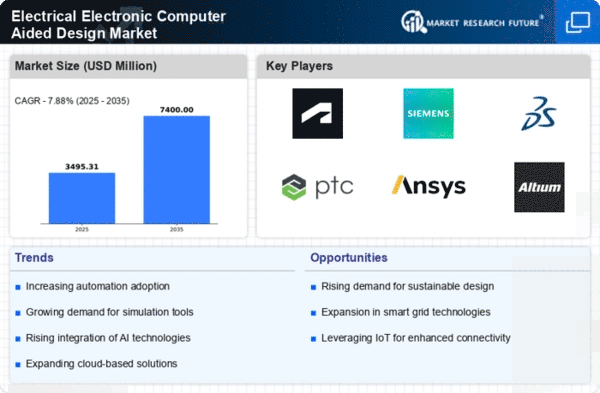
The Electrical Electronic Computer Aided Design Market is currently characterized by a dynamic competitive landscape, driven by rapid technological advancements and increasing demand for efficient design solutions. Key players such as Autodesk (US), Siemens (DE), and Dassault Systemes (FR) are strategically positioned to leverage innovation and digital transformation. Autodesk (US) focuses on enhancing its cloud-based offerings, which allows for greater collaboration and efficiency in design processes. Siemens (DE) emphasizes its commitment to integrating AI and IoT into its design tools, thereby enhancing functionality and user experience. Meanwhile, Dassault Systemes (FR) is concentrating on expanding its simulation capabilities, which is crucial for industries requiring high-fidelity modeling and analysis. Collectively, these strategies not only enhance their competitive edge but also shape the market dynamics by pushing the boundaries of what is possible in design technology.
In terms of business tactics, companies are increasingly localizing manufacturing and optimizing supply chains to respond swiftly to market demands. The market structure appears moderately fragmented, with a mix of established players and emerging startups. This fragmentation allows for diverse offerings and innovation, yet the collective influence of key players like PTC (US) and ANSYS (US) remains significant, as they continue to set industry standards and drive technological advancements.
In January 2026, Autodesk (US) announced a strategic partnership with a leading cloud service provider to enhance its software capabilities. This collaboration is expected to bolster Autodesk's cloud infrastructure, enabling users to access advanced design tools seamlessly. The strategic importance of this partnership lies in its potential to improve user experience and expand market reach, particularly among small to medium-sized enterprises that require scalable solutions.
In December 2025, Siemens (DE) launched a new AI-driven design tool aimed at automating routine tasks in the design process. This tool is anticipated to significantly reduce design time and improve accuracy, thereby enhancing productivity for engineers. The introduction of this tool reflects Siemens' commitment to innovation and positions the company as a leader in integrating AI into design workflows, which could reshape industry standards.
In November 2025, Dassault Systemes (FR) unveiled a new simulation platform that integrates real-time data analytics. This platform is designed to provide engineers with immediate feedback on design performance, facilitating quicker iterations and more informed decision-making. The strategic importance of this development lies in its ability to enhance the design process, making it more responsive to real-world conditions and user needs.
As of February 2026, current trends in the Electrical Electronic Computer Aided Design Market indicate a strong focus on digitalization, sustainability, and AI integration. Strategic alliances are increasingly shaping the competitive landscape, as companies recognize the value of collaboration in driving innovation. Looking ahead, competitive differentiation is likely to evolve from traditional price-based competition to a focus on technological innovation, reliability in supply chains, and the ability to deliver sustainable solutions. This shift underscores the importance of adaptability and forward-thinking strategies in maintaining a competitive edge.